The Autism Potty Training Playbook
Your autistic kid can get out of pull-ups.
It hasn't worked yet because every plan you tried was built for a different kid. This one is built for yours. It reads your kid's sensory profile, communication mode, and exact triggers, then hands you one clear move a day instead of a method that backfires by Day 3. Most kids sit on the toilet successfully in the first week or two. Five clinicians reviewed every step.
Free to begin, one day at a time.
Already started or bought? Sign back in
From Spectrum Unlocked. Reviewed by Brandi Thomas (credentialed special-education advocate) plus a developmental-behavioral pediatrician, an LCSW, a BCBA, and an SLP.
What starts to change
- Your kid sits on the toilet on purpose. Most families get that first real sit in the first week or two.
- You stop guessing. Each morning the plan names the one thing to do that day, shaped around your kid instead of a generic script.
- The 11pm panic finally has an answer. The Companion is awake when you are, in the same calm voice as the plan.
Sound familiar?
It's been 18 months in pull-ups and you don't know if you're still in the process or if you've stopped.
Daycare keeps asking when your kid will be trained. You don't have an answer.
Your kid hides to poop in a corner. Won't go on the toilet, but knows when they need to go.
Every plan online assumes a neurotypical kid. The advice they give backfires within a week.
Your pediatrician shrugged. Your OT shrugged. No one specializes in this.
You've read the books. They didn't write the chapter you actually need.
It's not you. The plans aren't built for your kid.
Autistic kids don't fail neurotypical potty plans because something is wrong with them. They fail because the plans are calibrated for a kid with a different sensory profile, a different communication mode, and a different relationship to predictability. A plan that works for your kid has to know all three before Day 1.
Wherever you're starting from
Not everyone lands here stuck after 18 months. If your kid is already ready, the Plan skips the pre-readiness week and starts at the first sit. Older kids get age-band inserts that adjust for 8 to 14 and 15+, not toddler scripts. And when there's a medical knot, the Day 0 check catches it and routes you to clear it first. The Plan reads where you actually are and starts there.
Meet your Companion
The Companion is the part of the Plan that knows your kid. You answer 6 questions on Day 0 (sensory profile, communication, age, where you are in the process, what your hardest moment is) and the Companion shapes the 30 days around that. When the plan goes sideways at 11pm (it will), you ask it. It answers in the same voice as the plan, not a generic chatbot voice.
Personalized plan generation
Day 1 calls out the single thing that matters most for your kid. Day 30 looks completely different from another family's Day 30.
Scripts on demand
Type the situation, get the script. Same calm tone as the 15 base scripts in the library.
Regression diagnostic
When things slip, describe what changed. The Companion finds the sub-plan that fits and tells you what to try first.
Ask anything
3am questions. Tap a scenario or speak it. You get an answer card: what to try, why, and what to do if it doesn't work.
A look inside
Here's what shows up on your phone and your bathroom door. Real screens, not mockups.
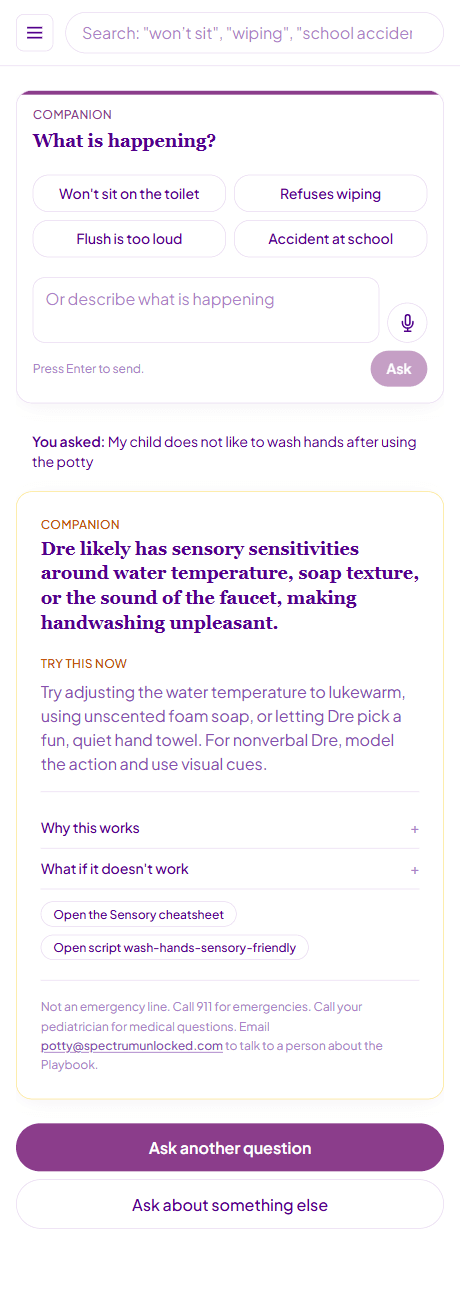
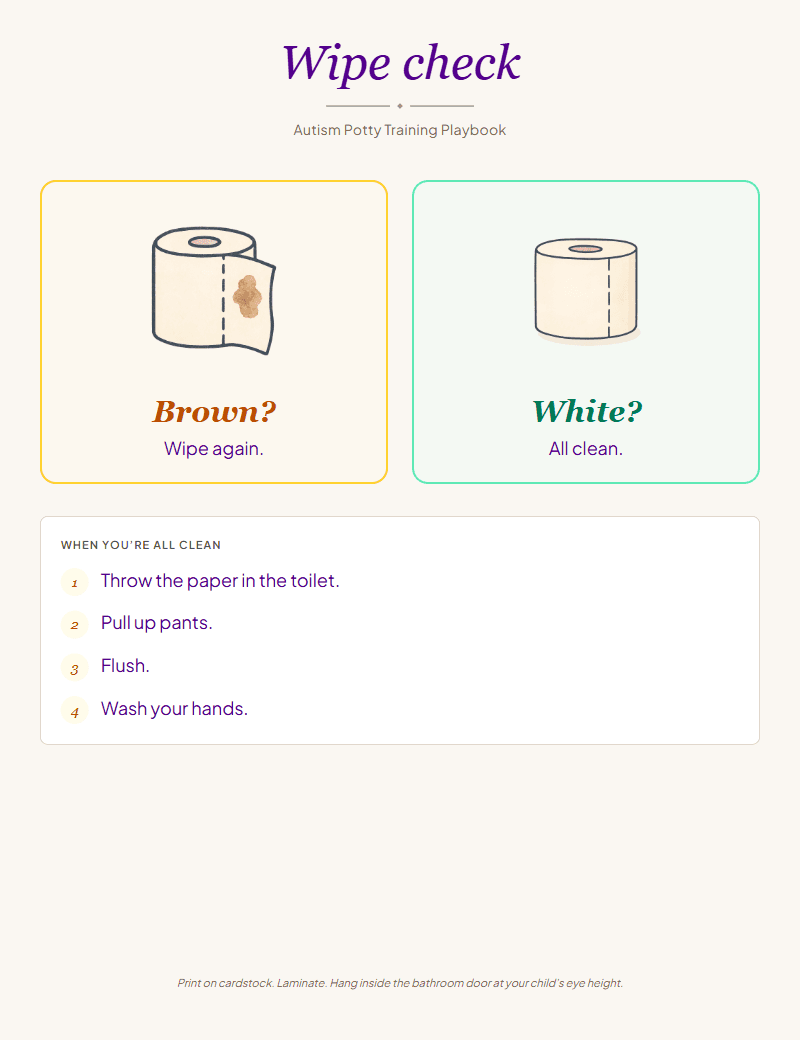
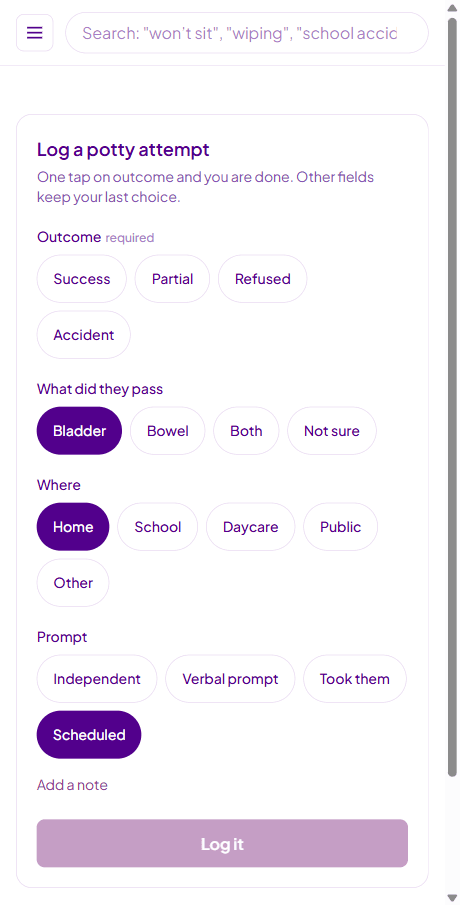
Inside the Playbook
What you get, from day one
- Your full 30-day plan, shaped to your kid from the Day 0 quiz (4 phase backbones personalized by 12 tag inserts).
- All 12 printables, to print whenever you need them: four reward charts (stickers, token board, picture chart, blank weekly), the bathroom visuals (wipe-check card, AAC toileting cards with 13 cards, bathroom routine strip, First-Then cards), all six visual schedules in one bundle, the school handoff and caregiver coordination sheets, and a doctor screening pack to hand your pediatrician if the medical flag triggers.
- The 15-script library, so you stop scripting every transition in your head.
- 6 sub-plans for the moments that derail other families: bowel withholding, nighttime training, public bathrooms, travel, self-injury safety, and the Week 1 setup of pull-ups, underwear, or naked.
- The Companion, ready to answer from the first day.
What changes as you go
- The Companion calibrates to your kid the more you use it together.
- You stop guessing. Each day the plan names the next move, and you start to see real movement in the early weeks.
- A pattern you can name: what your kid's body wants, when, and with what cue.
- A plan for what comes after Day 30, calibrated to where you actually got to.
- The Companion still answering at 11pm, for as long as you need it.
Every day: ask the Companion anything. Tap a scenario or speak it.
Free to begin, one day at a time.
Reviewed by 5 clinicians and a special-ed advocate
Brandi Thomas, credentialed special-education advocate
Reviewed every phase backbone for parent voice, plus all IDEA, 504, OSEP, and state special-education law claims throughout the Playbook.
Developmental-behavioral pediatrician
Reviewed the medical-flag flow, the Doctor First Week alternate Phase 1, and the doctor screening pack.
Licensed Clinical Social Worker (LCSW)
Reviewed the Companion safeguarding patterns and the crisis-response handoff scripts.
Board Certified Behavior Analyst (BCBA)
Reviewed the regression diagnostic, the 8-trigger taxonomy, and the already-trained-regressed entry layer.
Speech-Language Pathologist with AAC clinical experience
Reviewed the four AAC-communication adaptations (verbal, AAC iPad, PECS, nonverbal) and the parent-facing AAC routing logic in the Companion.
Several secondary reviewers asked to be listed by credential rather than by name. The editorial-board page lists each by credential and links to LinkedIn where applicable.
What parents say
“My 8-year-old son had never successfully potty trained despite years of OT, pelvic floor therapy, reward charts, timers, and every method we could find. The playbook helped me understand that his struggle wasn't a lack of effort. Once we started focusing on body awareness and readiness skills, we began seeing progress for the first time. Today, he's recognizing when he needs to go and having successful trips to the toilet. I finally feel hopeful about his future independence.”
“My daughter was 6 and would completely refuse to sit on the toilet. Every attempt ended in tears and frustration for both of us. What made this playbook different was that it addressed her sensory challenges instead of ignoring them. The strategies were simple to implement and actually worked with her needs rather than against them. She now sits on the toilet willingly and has started using it consistently. It has completely changed the atmosphere in our home.”
“My 9-year-old struggled with accidents every day and could not tell when he needed to use the bathroom. Most potty training resources made me feel like I was failing because they weren't designed for autistic children. This playbook helped me understand interoception, sensory processing, and how to support my child in a way that made sense. He is now staying dry for longer periods, communicating his needs, and building confidence every week. The difference has been incredible.”
“After trying to potty train my autistic son for more than three years, I felt defeated. We had spent so much money on programs, specialist appointments, and supplies with very little progress. This playbook gave us a clear roadmap and helped us stop guessing. The step-by-step approach made everything feel manageable. Within a few weeks, we were seeing small wins that turned into real progress. I only wish I had found it sooner.”
Shared by parents we've worked with in autism support groups, used with their permission.
What 30 days actually gets you
In 30 days you get a plan shaped to your kid, a clear move to make each day, and real change you can see. What you don't get is a magic finish line, and we won't pretend otherwise. Most autistic kids take many months, sometimes years, to fully potty train. The 30 days compress the hardest part, the structured-effort phase, so you always know the next step instead of guessing. You see steady movement in the first month, and the plan stays with you for the rest of the road.
Frequently asked questions
- Will my child be fully potty trained in 30 days?
- Most autistic kids take 18 months to several years for full training. The 30 days are 30 days of structured progress, not a finish line. You will see meaningful change in 30 days. Full training takes the time it takes.
- Is this ABA?
- No. The Plan uses a few behaviorist principles (clear cues, immediate acknowledgment, structured sub-plans for regression) but it is not an ABA program. It is a parent-led, sensory-first, communication-adapted plan with clinical review.
- My child has medical concerns. Should I still buy this?
- If the Companion's Day 0 quiz flags medical signals (stool retention, blood, pain, withholding posture), it routes you to Doctor First Week and gives you the doctor screening pack to hand to your pediatrician. Buy the Plan, but get the medical thing checked first.
- Do I need to be a behavior analyst to use this?
- No. The Plan is written for parents and reviewed by Brandi for clarity. The Companion personalizes day to day so you are never guessing.
- What if I bought it and my child's situation changed?
- Retake the assessment anytime from the portal. The Companion regenerates the remaining days based on the new answers. Your earlier days stay in history.
- How is this different from the free content on Spectrum Unlocked?
- The free content tells you what IEPs, sensory profiles, and routines are. The Playbook is a specific 30-day plan for one specific thing (potty training), personalized to your kid, with a Companion that stays with you for the full month.
- What is the Companion?
- The Companion is the part of the Plan that knows your kid. It personalizes the 30 days from your quiz answers, writes scripts for specific moments, and helps you read patterns when things change. If you say something that signals a crisis, it stops trying to be a coach and gives you real resources.
Start tonight
You can start the plan tonight, with the Companion guiding you the whole way.
Free to begin, one day at a time.