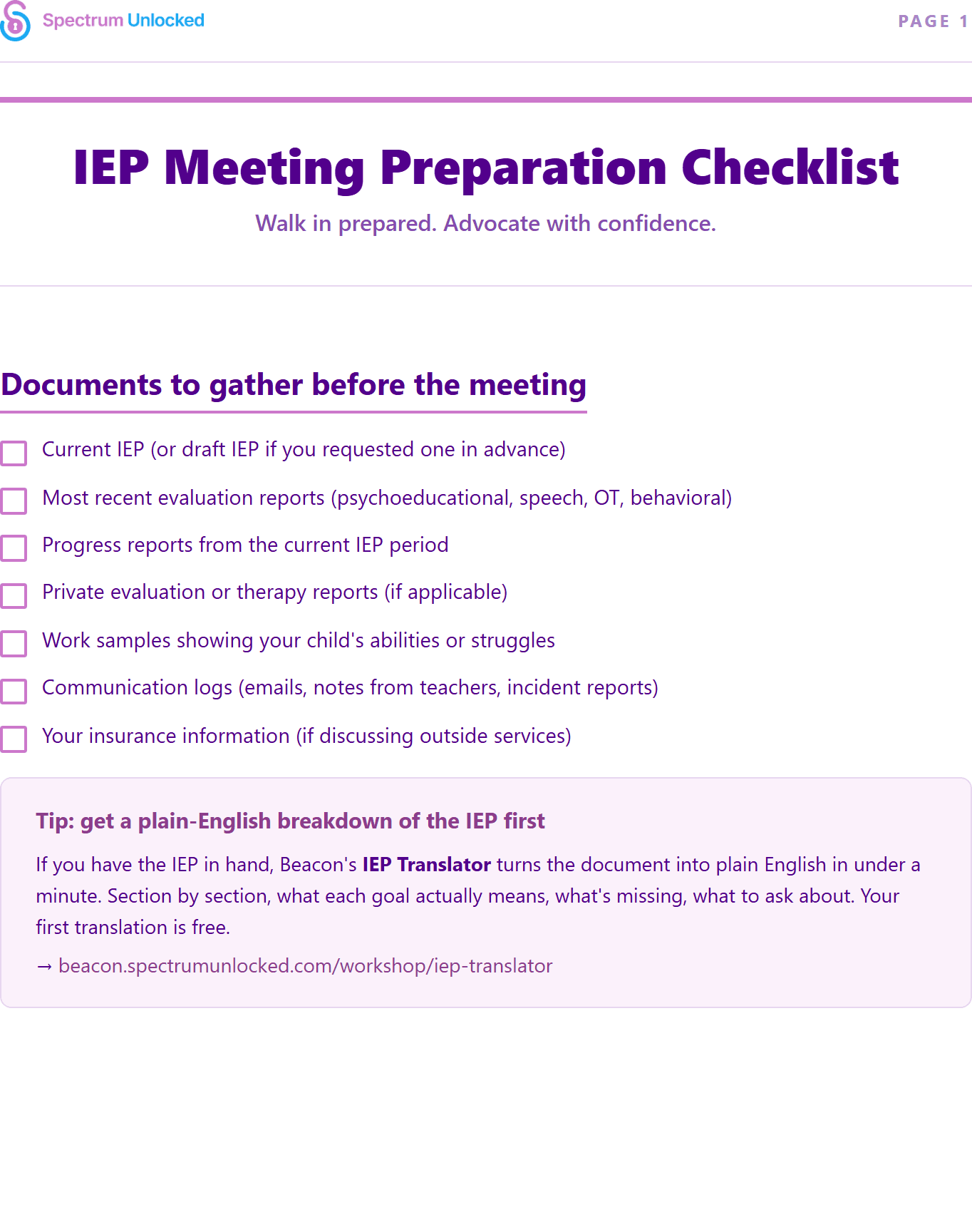
Free IEP Meeting Prep Checklist for Parents (Printable)
Walking into an IEP meeting unprepared? This free printable checklist covers what to bring, what to ask, the warning signs in goals and accommodations, and the questions schools hope parents don't ask.
Download ResourceAn IEP (Individualized Education Program) meeting is the annual conference where parents, teachers, and school specialists agree on legally binding goals, services, and accommodations for a child receiving special education. Walking into one prepared makes all the difference. You are the only person at that table who knows your child across every environment and every year of their life. Your voice matters, and preparation is what turns anxiety into advocacy.
Below is a two-week prep checklist, the 20 questions worth asking, and the red flags worth catching before you sign.
Try our free IEP Meeting Prep Builder to generate a personalized game plan with agenda items, questions, talking points, and rights reminders tailored to your specific situation. Answer a few questions about your child and your goals, and we'll build a custom preparation plan you can bring to the meeting.
2 Weeks Before
- Request the draft IEP in advance. You are legally entitled to receive it before the meeting so you can review it, not just react to it at the table. Ask in writing if needed.
- Pull together your child's records. Gather last year's IEP, current progress reports, any private evaluations, therapy reports, medical documentation, and school communications from the past year.
- Review last year's goals. Were they met? Partially met? Not addressed? Come ready with specifics.
- Write down your parent concerns. Parents have a right to include a Parent Concerns section in the IEP. Write it out in advance: what is working, what is not working, what your priorities are for this year.
- Contact your child's outside providers. Ask your child's private therapists (OT, SLP, ABA, etc.) if they have updated reports or input to share. Ask if they will provide a written statement or be available by phone during the meeting.
- Identify your top 3-5 priorities. IEP meetings can get overwhelming. Know what matters most to you going in so you don't leave without addressing it.
- Research any new services or placements you want to request. If you are going to ask for something new, understand what it is and why it is appropriate for your child before the meeting.
1 Week Before
- Read the draft IEP carefully. Read every section: present levels, goals, services, accommodations, placement. Mark anything you have questions about or disagree with.
- Bring a support person. You are allowed to bring anyone you choose: a spouse or partner, a trusted friend, a parent advocate, or a special education attorney. Having a second set of ears is invaluable.
- Notify the school in writing of who you are bringing. Particularly if you are bringing an advocate or attorney, giving advance notice prevents surprises.
- Prepare your questions. Use the list in this guide as a starting point. Write them down; you will not remember everything in the moment.
- Review your procedural rights. The school is required to give you a copy of your Procedural Safeguards at least once per year. Read it. Know that you can consent to some parts of the IEP and reject others, request an independent evaluation, and request mediation if you disagree.
- Request data on current goals. Ask the school to have objective progress data ready to present at the meeting for every current goal.
The Night Before
- Organize your documents into a folder. Draft IEP, last year's IEP, evaluation reports, your written parent concerns, and your question list.
- Charge your phone or bring a pen and paper. Take notes, whether written or recorded (check your state's laws on recording school meetings; many states are one-party consent).
- Prepare emotionally. IEP meetings can bring up a lot of feelings. That is normal. Remind yourself: you are not there to be liked, you are there to advocate. Disagreement is allowed. You do not have to sign the IEP the day of the meeting.
- Plan your logistics. Childcare arranged? Travel time accounted for? You want to arrive calm, not rushed.
Day Of
- Arrive a few minutes early. Collect yourself before walking in.
- Introduce everyone. Ask each person at the table to introduce themselves and explain their role. You should know who is in the room.
- Ask that all pagers/phones be silenced. You deserve everyone's full attention.
- Take notes throughout. Write down who said what, especially any promises or commitments made verbally.
- Slow things down if needed. It is okay to say "Can we go back to that? I have a question." IEP meetings are not a race.
- Remember you do not have to sign today. You can take the IEP home to review. Signing begins services, so if you have unresolved concerns, it is okay to say "I need a few days to review this before I sign."
20 Essential Questions to Ask
About Present Levels and Progress
- How is my child's current performance being measured? What data is that based on?
- For each goal from last year: was it met, partially met, or not met? Why?
- What has been my child's biggest area of growth this year?
- Where is my child still struggling most, and what does the data show?
About Goals
- How was each proposed goal developed, and why was it prioritized?
- How will progress on each goal be measured, and how often will I receive a progress report?
- Is there a goal addressing [communication / sensory regulation / social skills / reading / math, whatever your priority is]? If not, why not?
- Are these goals ambitious enough? Are they meaningful for my child's daily life and long-term independence?
About Services
- What specific services is my child being recommended for, how many minutes per week, and in what setting (pull-out, push-in, separate classroom)?
- Who exactly will be providing each service? What are their qualifications?
- How will services be coordinated so my child's team is communicating with each other?
- What happens if a service session is missed? How will it be made up?
About Placement and Least Restrictive Environment (LRE)
- Why is this placement being recommended? What is the data supporting it?
- How much time will my child spend with general education peers? If that time is limited, what is the justification?
- Has a full continuum of placement options been considered? What other placements were discussed?
About Accommodations and Supports
- What accommodations will be in place in the general education classroom?
- What supports will be provided during transitions, unstructured time (lunch, recess), and specials (art, PE, music)?
- Is there a behavior support plan? If so, is it based on a Functional Behavior Assessment (FBA)?
About Communication and Parent Involvement
- How will the team communicate with me throughout the year? How quickly can I expect responses?
- What can I do at home to reinforce what my child is working on at school?
Red Flags to Watch For
These situations do not automatically mean something illegal is happening, but they are signs to slow down, ask more questions, and possibly consult a parent advocate or special education attorney.
- The IEP is presented as already final. Every section should be open for discussion. If you are told "this is what we're doing," that is a problem.
- You are rushed through the meeting. An IEP meeting should take as long as it takes. Staff needing to leave for another meeting is not your concern.
- Goals are vague or unmeasurable. Goals must be specific and measurable ("will read 90 words per minute with 80% accuracy" not "will improve reading skills").
- Services are determined by what's available, not what your child needs. Placement and services must be driven by your child's needs, not the school's budget or scheduling convenience.
- Your concerns are minimized or dismissed. "All kids do that" or "he seems fine here" without data to back it up is not a professional response.
- You are told you must sign today. You never have to sign an IEP the day it is presented.
- You are the only parent at a table of 6-8 professionals. This is legal, but it can be intimidating. This is exactly why bringing a support person matters.
- The team speaks in jargon you don't understand. Ask them to stop and explain. This is your legal right. You cannot give informed consent to something you do not understand.
After the Meeting
- Review the final IEP before signing. Make sure the document reflects what was discussed and agreed to, not what was proposed before the meeting.
- Keep a signed copy. You are entitled to a copy of the signed IEP. Keep it with your records.
- Send a follow-up email. Within 24-48 hours, send a brief email summarizing what was agreed to, any action items the school committed to, and any unresolved concerns you noted. This creates a paper trail.
- Calendar the next review date. IEPs must be reviewed at least annually, but you can request a meeting at any time if concerns arise.
- Watch for implementation. Services should begin within a reasonable timeframe after signing (often within 2 weeks). If services are not starting, follow up in writing.
- Track progress reports. You should receive progress reports on IEP goals at the same frequency as general report cards. If you are not receiving them, ask.
- Request data at the 3-month mark if you have concerns. Do not wait until the annual review.
Know Your Rights
IDEA (Individuals with Disabilities Education Act)
IDEA is the federal law that governs special education in the United States. Under IDEA, children with qualifying disabilities (including autism) are entitled to a free, appropriate public education (FAPE) in the least restrictive environment (LRE). IDEA also gives parents the right to participate in every decision about their child's education, review all educational records, and request an independent educational evaluation (IEE) at school expense if you disagree with the school's evaluation.
FAPE (Free Appropriate Public Education)
FAPE means your child is entitled to special education and related services at no cost to your family, designed to meet their unique needs. "Appropriate" does not mean the best possible education, but it does mean one reasonably calculated to enable your child to make meaningful progress. If you believe your child is not receiving FAPE, you can file a state complaint or request a due process hearing.
Least Restrictive Environment (LRE)
The LRE requirement means children with disabilities should be educated alongside their non-disabled peers to the maximum extent appropriate. Removing a child from general education requires justification. More restrictive placements are appropriate for some children, but the team must demonstrate that the less restrictive option was considered and found inadequate, not simply that it would be inconvenient.
Section 504 (Rehabilitation Act)
Section 504 is a civil rights law that covers a broader group of students than IDEA. A child does not need to qualify for special education services to get a 504 plan. If your child has a disability that substantially limits a major life activity (including learning), they may be entitled to accommodations under 504, such as extended time, preferential seating, reduced assignments, or modified testing conditions. 504 plans are less intensive than IEPs but can be valuable for students who need accommodations but not specialized instruction.
Your Right to Disagree
You can disagree with any part of the IEP. You can consent to some services and reject others. You can request mediation (a neutral third party) or file a due process complaint if you believe the school is not meeting its obligations. Many parent-school disputes are resolved without formal proceedings, but knowing your rights changes the dynamic at the table.
If you need support, PACER Center (pacer.org) and your state's Parent Training and Information Center (PTI) offer free resources and in some cases free advocates. Find your PTI at parentcenterhub.org.
Want the powered-up version?
Want a checklist built specifically for YOUR child's next meeting? Beacon creates personalized IEP prep based on your child's goals, current challenges, and last year's progress.
Talk to Beacon →