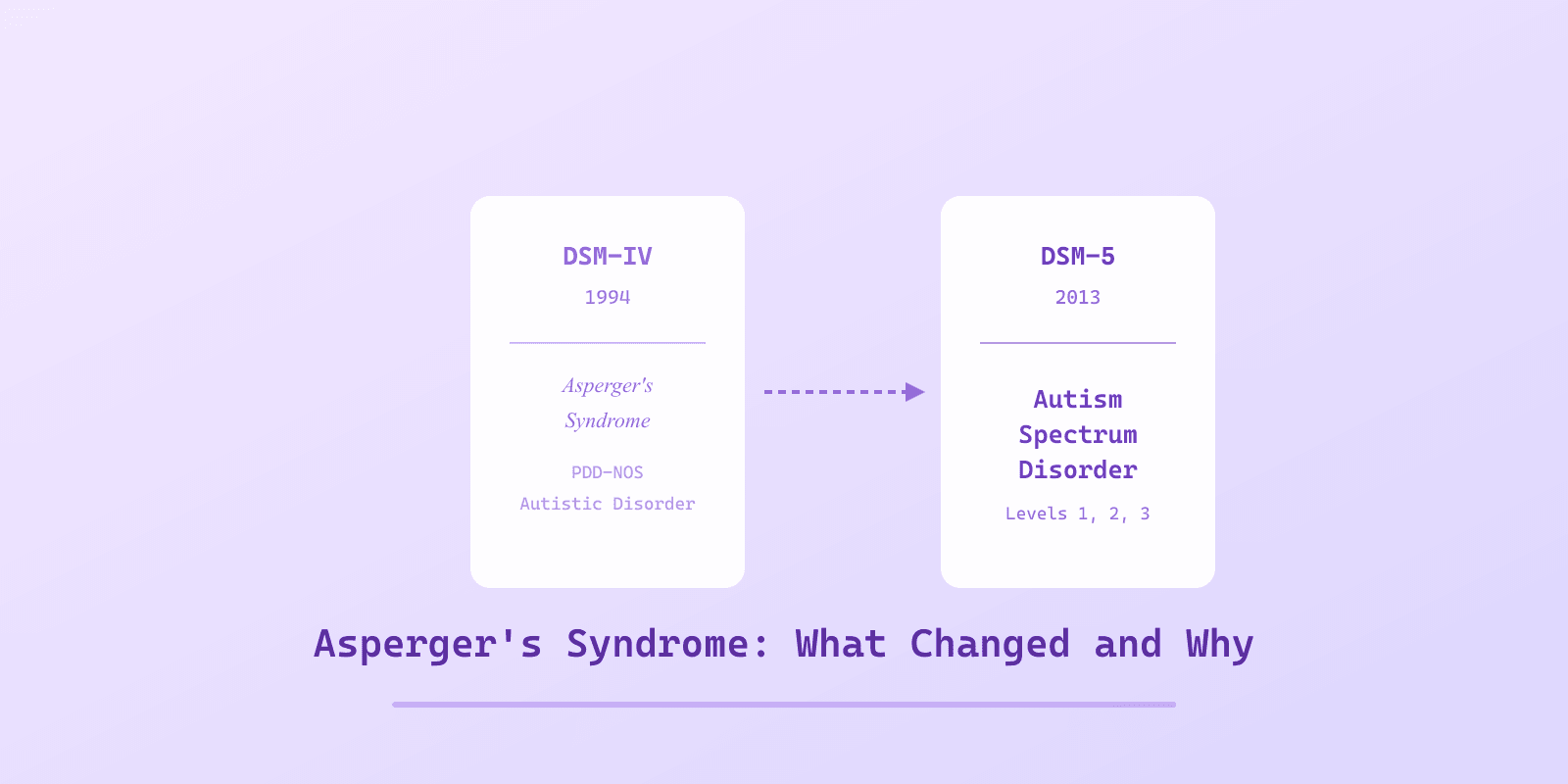
What Is Asperger's Syndrome and Why Was It Removed from the DSM?
Asperger's syndrome was a real diagnosis until 2013, when the DSM-5 folded it into Autism Spectrum Disorder. Here's what it was, why it was dropped, and what it means today.
Key Takeaways
- Asperger's syndrome was a separate autism diagnosis in the DSM-IV (1994 to 2013) for individuals with social communication differences and restricted interests but typical language development. The DSM-5 (2013) folded it into a single Autism Spectrum Disorder diagnosis.
- The DSM-5 dropped the Asperger's label because clinicians applied it inconsistently across patients with similar profiles, and research showed no clinically meaningful boundary between Asperger's and 'high-functioning' autism. The change was about diagnostic accuracy, not about removing recognition of the people.
- Hans Asperger, the Austrian pediatrician the syndrome was named for, was later shown by historians (Edith Sheffer's 2018 book and Herwig Czech's research) to have collaborated with Nazi-era child euthanasia programs. This wasn't the formal reason the DSM-5 made the change, but it reinforced the case afterward.
- If your child has an old Asperger's diagnosis from before 2013, it's still valid. They simply meet criteria for what is now called Autism Spectrum Disorder, most commonly at Level 1 (requires support). Services and accommodations don't change.
- Many autistic adults still self-identify as 'Aspies,' especially those who were diagnosed pre-2013, and that identity belongs to them. Clinical terminology and personal identity don't have to match.
If you've spent any time on autism forums, parenting subreddits, or older memoirs, you've come across the word Asperger's used as if it's a current diagnosis. It isn't, hasn't been for over a decade, and the reasons it was removed turn out to be more interesting than they sound. This post walks through what Asperger's syndrome was, why the DSM-5 dropped the name, and what it means today if you, your child, or someone you know carries an old Asperger's diagnosis.
If you're newer to this and looking for the broader picture, Spectrum Unlocked's autism levels explained post covers the current diagnostic framework, and the signs of autism in toddlers post covers what to watch for in early childhood.
What Asperger's Syndrome Was
Asperger's syndrome was a clinical diagnosis in the DSM-IV (the diagnostic manual used by US clinicians from 1994 to 2013). The criteria required:
- Qualitative impairment in social interaction (difficulty with eye gaze, body language, peer relationships, social or emotional reciprocity)
- Restricted, repetitive, and stereotyped patterns of behavior, interests, and activities (intense focus on specific topics, inflexible adherence to routines, repetitive motor mannerisms)
- Clinically significant impairment in social, occupational, or other important areas of functioning
- No clinically significant general delay in language (single words by age 2, communicative phrases by age 3)
- No clinically significant delay in cognitive development, self-help skills, adaptive behavior (other than social), or curiosity about the environment in childhood
- The criteria are not met for another specific Pervasive Developmental Disorder or Schizophrenia
That third bullet from the bottom is the key distinguishing feature. What separated Asperger's from autistic disorder in the DSM-IV was the absence of a language delay and the absence of a cognitive delay. A child with social communication differences, restricted interests, and rigid behaviors who started talking on time and tested in the typical IQ range was diagnosed with Asperger's. The same child with an early language delay was diagnosed with autistic disorder.
The diagnosis was named after Austrian pediatrician Hans Asperger, who described the pattern in a 1944 paper called Die Autistischen Psychopathen im Kindesalter (Autistic Psychopathy in Childhood). His work was largely unknown to the English-speaking world for decades until British psychiatrist Lorna Wing translated and popularized it in a 1981 paper. She proposed the term Asperger's syndrome as a way to honor his early observations, and the DSM-IV picked it up in 1994.
Why the DSM-5 Dropped It (the Clinical Case)
The DSM-5, published by the American Psychiatric Association in May 2013, made one of the largest revisions in autism diagnostic history. Five separate Pervasive Developmental Disorder diagnoses were collapsed into one Autism Spectrum Disorder (ASD) category:
- Autistic Disorder
- Asperger's Syndrome
- Childhood Disintegrative Disorder
- Pervasive Developmental Disorder Not Otherwise Specified (PDD-NOS)
- Rett's Disorder (later removed entirely from the autism category)
ASD added a severity rating system (Level 1, 2, or 3, based on the support needs in two domains) so the loss of named subtypes was paired with new ways to describe how autism presents in any individual. Subtype thinking didn't disappear, though; recent biological and genetic research is starting to surface what may be a new generation of subtypes, and the autism subtypes 2025 research post covers what is and isn't supported by current evidence.
The official rationale for collapsing Asperger's into ASD came down to four arguments documented in DSM-5 working group papers and the field-trial research that preceded the publication.
1. Clinicians applied the Asperger's label inconsistently
Field studies from the late 2000s repeatedly showed that the same patient could be diagnosed with Asperger's syndrome at one clinic and autistic disorder at another, depending on how the clinician interpreted the language-delay criterion. Some clinicians used Asperger's as an informal "softer" label for higher-functioning patients regardless of their early language history. Others applied it strictly. The variability was high enough that the diagnostic distinction was not reliable across settings.
2. The boundary with high-functioning autism wasn't clinically meaningful
Multiple research groups examined whether children diagnosed with Asperger's syndrome and children diagnosed with "high-functioning autism" (autistic disorder without intellectual disability, in patients with adequate language) actually differed in any clinically meaningful way at the time of evaluation. The answer was: not really. Once the early language history was set aside, the two groups looked similar in current functioning, intervention response, long-term outcomes, and underlying neurology. The argument for keeping them as separate diagnoses weakened.
3. The spectrum framework matched the actual presentation better
By the late 2000s, the prevailing model of autism in research and clinical communities was a spectrum: traits varying continuously from minimal to substantial, in multiple dimensions, rather than discrete subtypes. The DSM-IV's five categorical PDD diagnoses imposed boundaries that didn't reflect this. Replacing them with a single ASD diagnosis paired with severity ratings was an attempt to make the manual catch up with how researchers and clinicians had been thinking for years.
4. Diagnostic stability across the lifespan
A categorical diagnosis like Asperger's syndrome implicitly suggested a stable category throughout life. In practice, individuals' support needs change as they develop, learn coping strategies, and encounter different environments. The level-based system in the DSM-5 was designed to be re-rated at different life stages, which fits the lived experience of autistic individuals and their families better than a fixed subtype name.
These four arguments, combined, drove the change. The decision was made by a working group of researchers and clinicians and was not without controversy. Several prominent autism advocates and clinicians publicly opposed the change, arguing that the Asperger's label had become important to many individuals' identities and that subsuming it into a broader category risked erasing recognition. The APA proceeded anyway, and the DSM-5 went live in 2013.
The Historical Concerns About Hans Asperger
The case for dropping the Asperger's label gained a different kind of weight after 2018, though this was not part of the formal DSM-5 reasoning. A series of historical investigations, most prominently Edith Sheffer's 2018 book Asperger's Children: The Origins of Autism in Nazi Vienna and concurrent archival research by historian Herwig Czech, revealed that Hans Asperger had collaborated with the Nazi regime in ways the autism community had not previously known.
The findings, drawn from German-language Vienna archives:
- Hans Asperger ran the children's clinic at the University of Vienna during the period of Austrian annexation by Nazi Germany (1938 to 1945).
- He was not a member of the Nazi Party but maintained working relationships with senior figures in the regime.
- He participated in the assessment of children for the Aktion T4 child euthanasia program, in which children deemed disabled or unfit were transferred to facilities like Am Spiegelgrund and murdered. Czech's research documents specific case files in which Asperger referred children to Spiegelgrund after his own evaluation, with full knowledge that this was, in practice, a death sentence for many of them.
- Asperger himself wrote in his 1944 paper that children with severe autistic features had "no place" in the Volk (the German term for the racialized national community), language consistent with the regime's framing of disability.
- His own published descriptions of the milder pattern that became "Asperger's syndrome" emphasized children with intellectual gifts and special talents who could potentially serve the regime, in contrast to the children he referred to Spiegelgrund.
This history was not widely known to English-language clinicians or the autism community before 2018. After publication, it produced an ongoing conversation about whether his name should continue to be used, regardless of the clinical reasons for the DSM-5 change.
A few important caveats:
- The DSM-5's removal of Asperger's syndrome happened in 2013, five years before this history was widely publicized. The two events are connected only in retrospect.
- The historical findings have been peer-reviewed and are now widely accepted, though the precise extent of his complicity continues to be debated by historians.
- Asperger himself was never prosecuted, lost his position briefly after the war, was reinstated, and continued his career until his death in 1980.
For families dealing with an old Asperger's diagnosis, this history is context, not a verdict. Your child's diagnosis is not a moral question, and the term they were given does not implicate them in anything. But the history is part of why many autism organizations, clinicians, and self-advocates have been reluctant to keep using the eponym even informally.
What This Means If Your Child Has an Old Asperger's Diagnosis
If your child was diagnosed with Asperger's syndrome before 2013, that diagnosis is still a valid clinical record. The terminology has changed, not the underlying observation. Practical implications:
School services and IEPs
A pre-2013 Asperger's diagnosis qualifies your child for special education services under the IDEA category of Autism just as a current ASD diagnosis would. School districts are required to honor existing diagnostic documentation; you do not need a new evaluation simply because the diagnostic label changed.
If your child's IEP team needs current language for paperwork, you can request that the team use "Autism Spectrum Disorder, Level 1 (formerly Asperger's syndrome)" so historical continuity is preserved while the current label is accurate.
Insurance coverage
Insurance plans that cover autism-related services (ABA, speech therapy, occupational therapy) will accept either label as long as your child meets criteria. A re-evaluation is typically not required. If a plan denies a service citing "Asperger's is no longer a covered diagnosis," that is incorrect and you can appeal with the DSM-5 conversion guidance from the APA.
State and federal disability programs
SSI, Medicaid waivers, and other state-administered disability programs handle the diagnostic transition the same way. The clinical record stands; the label updates as needed.
When a new evaluation makes sense
You may want a current ASD evaluation if:
- Your child is transitioning to adult services and needs current documentation
- You are pursuing services that specifically require a recent (within 3 to 5 years) evaluation
- The original Asperger's diagnosis was minimal, and you want a more detailed current profile
- Your child's needs have changed substantially since the original diagnosis
A new evaluation will assess against current DSM-5 criteria and produce an ASD diagnosis with a level designation. The clinical work doesn't restart from zero; current evaluators draw on the existing record.
Why Some People Still Identify as Aspies
Walk into any online autism community or attend any autistic adult event and you'll find people who self-identify as Aspies. They were diagnosed in the 1994-to-2013 window, the term became part of how they understood themselves, and the diagnostic manual changing didn't change that.
Self-identification belongs to the individual. A clinician doesn't get to update someone's personal identity by revising a manual. Many adults specifically prefer "Asperger's" or "Aspie" because it captures something about their experience (typical language development paired with social communication differences) that the broader "ASD Level 1" label flattens.
Some other adults have chosen to retire the term, citing the historical concerns about Hans Asperger or the desire to align with current clinical language. Both choices are legitimate. The autism community is broadly accepting of both, and using one term in personal life while clinicians use another in your file is entirely normal.
For parents, the practical implication is: don't correct an autistic adult who self-identifies as an Aspie. Don't push them to use the new label. Their relationship to the term predates and outlasts the diagnostic manual.
What's the Diagnosis Now?
If a child today shows the pattern that would have been diagnosed as Asperger's syndrome in 1994, what diagnosis do they get? Almost always:
Autism Spectrum Disorder, Level 1 (Requires Support)
The DSM-5 captures the same underlying observation (social communication differences, restricted interests, no significant language or cognitive delay) under the ASD umbrella with a Level 1 designation. The level rating is based on current support needs, not severity of autism, and a child can be Level 1 in one domain (social communication) and Level 2 in another (restricted/repetitive behaviors). The dual rating is how the DSM-5 actually specifies it, though in practice many reports collapse it to a single overall level.
The autism levels explained post goes deep on what each level actually means, what it does and doesn't predict, and how to read your child's evaluation report.
If you're earlier in the process and trying to figure out whether to seek an evaluation at all, the signs of autism in toddlers post covers what to watch for, and the autism screening action plan tool generates a personalized 30-day plan based on your child's age, M-CHAT result if you have one, and what you're seeing at home.
The Bottom Line
Asperger's syndrome was a real diagnosis that helped a generation of clinicians and families recognize a pattern that the autistic disorder label hadn't captured cleanly. It served its purpose. The DSM-5 absorbed it into Autism Spectrum Disorder for sound clinical reasons in 2013, and the historical concerns about Hans Asperger that came to wider attention in 2018 reinforced the case in retrospect.
If your child has an old Asperger's diagnosis, it is still valid, your services are unaffected, and the practical day-to-day work of supporting your child is exactly the same. If an autistic adult in your life identifies as an Aspie, that's their term and their story.
The diagnostic manual is a tool, and it gets revised when the field learns more. The label changed in 2013. The people it described, and their needs, did not.
This guide covers the basics. But every child is different.
Beacon learns about YOUR child and gives guidance specific to them.
What would Beacon say?
"What should I focus on first with my child?"
If you asked Beacon "My child was just diagnosed, what do I do first?" it would look at your child's age, communication style, and biggest challenges, and give you a specific starting point. Not a generic list.

Spectrum Unlocked Editorial Team
Editorial Team
The Spectrum Unlocked editorial team combines lived experience as autism parents with research-backed guidance to create resources families can trust.
Frequently asked questions
- What is Asperger's syndrome?
- Asperger's syndrome was a developmental diagnosis in the DSM-IV (1994 to 2013) defined by social communication differences, restricted or unusual interests, and repetitive behavior patterns, in individuals with no clinically significant general delay in language or cognitive development. It was named after Austrian pediatrician Hans Asperger, who described the pattern in 1944. In the DSM-5 (published 2013), Asperger's was folded into Autism Spectrum Disorder along with the other previously-separate diagnoses (autistic disorder, PDD-NOS, childhood disintegrative disorder).
- Why was Asperger's removed from the DSM-5?
- The American Psychiatric Association made the change for clinical reasons: research showed clinicians were applying the Asperger's label inconsistently, the boundary between Asperger's and 'high-functioning' autism was not clinically meaningful, and the spectrum framework better captured how autism actually presents. Patients who would have been diagnosed with Asperger's now meet criteria for Autism Spectrum Disorder, typically at Level 1 (requires support). The historical concerns about Hans Asperger's wartime conduct, which became more widely publicized after 2018, reinforced the decision but were not the formal trigger.
- Is Asperger's the same as autism?
- Today, yes. Anyone who would have been diagnosed with Asperger's syndrome under the DSM-IV now meets criteria for Autism Spectrum Disorder under the DSM-5, most commonly at Level 1 (requires support). Before 2013, Asperger's was technically a separate diagnosis with its own criteria, but in practice many of those individuals were indistinguishable from people diagnosed with 'high-functioning autism,' which is one of the reasons the boundary was dropped.
- Is high-functioning autism the same as Asperger's?
- Closely related but not identical. 'High-functioning autism' was an informal label used in the DSM-IV era for autistic individuals with average or above-average IQ and functional language. The Asperger's diagnosis required no clinically significant language delay, while 'high-functioning autism' was sometimes used for people who had a language delay early on but had since developed strong language. In the DSM-5, both groups are now grouped under Autism Spectrum Disorder, typically Level 1. Most autistic adults and clinicians have moved away from the high- and low-functioning labels because they imply that less-visible autism is also less impactful, which isn't true.
- If my child was diagnosed with Asperger's before 2013, is the diagnosis still valid?
- Yes. An Asperger's diagnosis from before 2013 is still a valid clinical record. Under the DSM-5, your child's profile would now be described as Autism Spectrum Disorder, most commonly at Level 1. Services, accommodations, IEP eligibility, and insurance coverage are unaffected by the terminology change. If your child needs a current evaluation for any reason (school services, insurance reauthorization, transition to adult services), the new evaluation will use ASD terminology.
- Why do some people still call themselves Aspies?
- The term predates the DSM-5 change. Many autistic adults were diagnosed with Asperger's between 1994 and 2013, and that label became part of how they identified themselves and built community with others. Self-identification is personal. The clinical reasons for changing the diagnostic label do not require individuals to abandon a term that has genuine identity and community meaning to them. The autism community is broadly accepting of both terminologies in personal use, while clinicians and current diagnostic reports use the DSM-5 framework.
- Was Hans Asperger a Nazi?
- Hans Asperger (1906 to 1980) was an Austrian pediatrician who worked at the University of Vienna's Children's Hospital during World War II. Historical research published from 2018 onward, particularly Edith Sheffer's book Asperger's Children and Herwig Czech's archival research, documented that Asperger collaborated with the Nazi regime's child euthanasia program at the Am Spiegelgrund clinic. He referred children he deemed unable to integrate to facilities where many were murdered as part of Aktion T4. He was not a member of the Nazi Party, but his collaboration with the regime is now well-documented. This history became more widely publicized after the DSM-5 change but was not the formal reason for it.