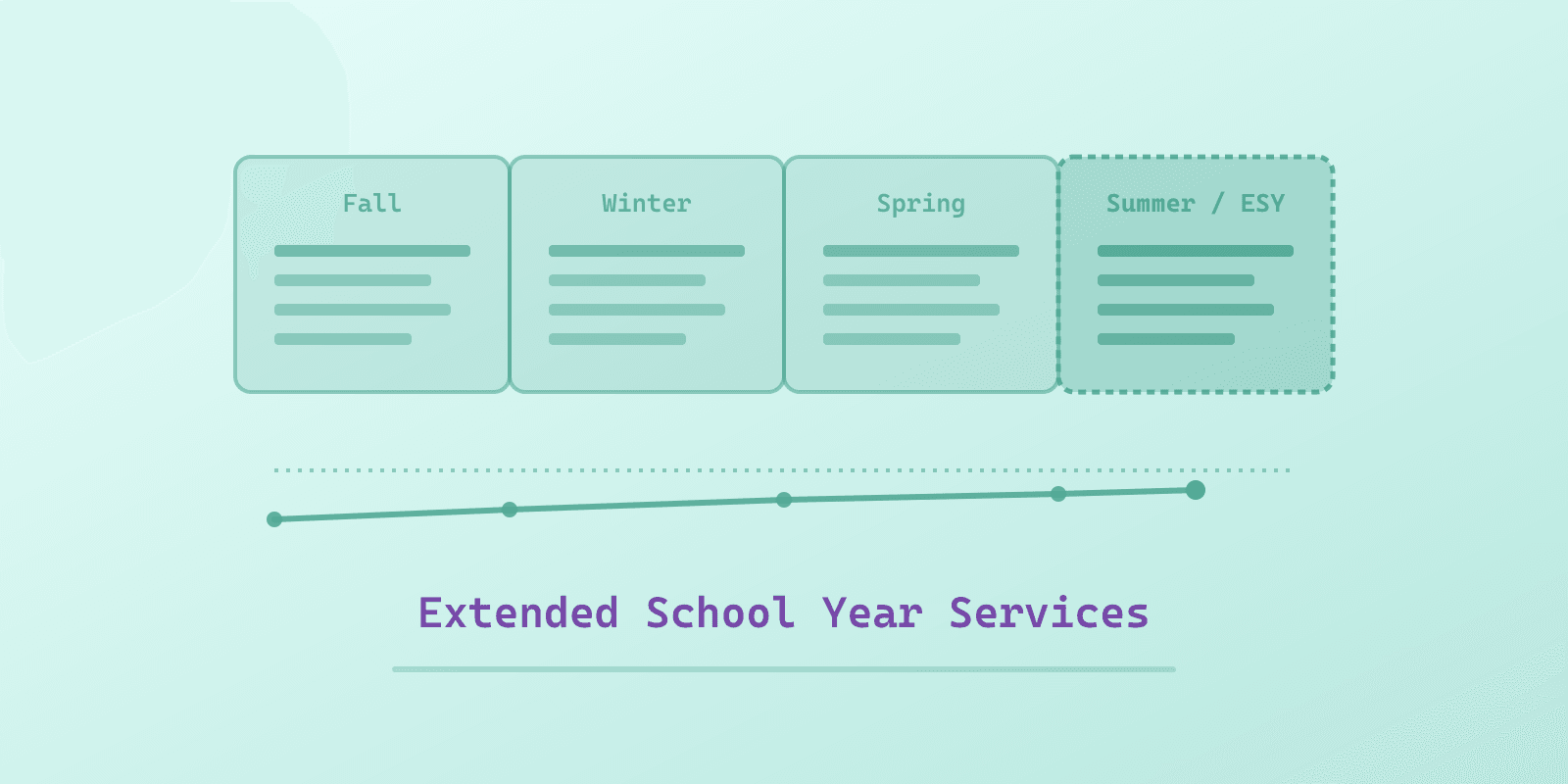
ESY (Extended School Year) in Special Education: Eligibility, Criteria, and How to Request It
ESY is the continuation of IEP services across school breaks when data shows your child regresses without them. Here is who qualifies for Extended School Year, the 4 eligibility tests states use, and how to request it.
Key Takeaways
- ESY (Extended School Year) is the continuation of IEP services across school breaks for children whose data shows they regress on critical skills without continuous services (34 CFR §300.106).
- ESY is provided only if the IEP team determines services are necessary for the child to receive FAPE (34 CFR §300.106(a)(2)); ESY is not summer school, and it is not automatic.
- States apply 4 eligibility tests in different combinations: regression-recoupment (most common, used in CA / TX / FL / NY), self-sufficiency (daily-living-skills emphasis), emerging skill (preserves breakthroughs), and multi-factor (PA combines tests). The federal floor at 34 CFR §300.106(a)(3) prohibits states from limiting ESY by disability category, type, location, or hours.
- When the IEP team has not addressed ESY and the data shows your child regresses across breaks, the IEP Advocacy Letter Builder generates a written ESY request letter (additional-services type) that names the data, cites 34 CFR §300.106, and asks the team to consider ESY at the next meeting.
ESY isn't summer school. It's a continuation of the IEP services your child gets during the school year, provided over the break, when the data shows your child loses critical skills without it. The federal regulation that anchors it is 34 CFR §300.106, and it ties ESY directly to the school's obligation to provide a free appropriate public education (FAPE) under 20 USC §1412(a)(1) and 34 CFR §300.101.
In plain terms: ESY is for children whose IEP teams determine, on the basis of data, that without continuous services across the school break the child will regress on critical skills and not recover within a reasonable recoupment window. The extended school year services are individualized, named in the IEP, and provided at no cost. The acronym ESY is what most schools, advocacy groups, and federal documents use; "extended school year" is the same thing.
4 Things to Know About ESY
A quick orientation before the deep dive:
- What it is. The continuation of IEP services across school breaks for children whose IEP teams determine ESY is necessary for the child to receive FAPE (34 CFR §300.106(a)(1)).
- Eligibility criteria. A data-driven IEP team determination, applying one or more of the 4 state-defined eligibility tests (regression-recoupment, self-sufficiency, emerging skill, multi-factor) anchored to 34 CFR §300.106(a)(2).
- What it isn't. Not summer school. Not automatic. Not limited by disability category, type, location, or hours; the state may not impose any such limit (34 CFR §300.106(a)(3)).
- How to request it. A written request to the IEP team, ideally 2 to 3 months before the break, naming the data and asking the team to consider ESY at the next meeting.
This guide walks through each of these, names the 4 eligibility tests states use, shows an autism-specific regression-recoupment scenario, covers how to request ESY, and what to do if the school denies it.
What ESY Is (And What It Isn't)
ESY services are special education and related services provided to a child with a disability beyond the normal school year, in accordance with the child's IEP, at no cost to the parent (34 CFR §300.106(b)). Two structural points that surprise parents the first time they encounter ESY:
First, ESY is provided only if the IEP team determines services are necessary for the child to receive FAPE (34 CFR §300.106(a)(2)). ESY is one of the ways a district meets its FAPE obligation under 20 USC §1412(a)(1) and 34 CFR §300.101; the bar is not "the child might benefit," but "without continuous services across the break, the child will not receive FAPE." For a walkthrough of the FAPE standard itself, see FAPE under IDEA.
Second, the federal regulation explicitly prohibits states from limiting ESY by disability category, type, location, or hours (34 CFR §300.106(a)(3)). A district cannot say "we only offer ESY for students with intellectual disabilities," and a state cannot impose a uniform hours cap.
ESY is not summer school. Summer school is open to any student and follows a general-education curriculum; ESY is individualized, named in the IEP, and tied to the goals and services the child's data supports. ESY is also not a replacement for related services like speech, OT, or behavioral support; it is the continuation of those services when the data shows the child needs continuous delivery. For a deeper look at how IEP services are structured, see what an IEP is.
Who Qualifies for ESY: The 4 Eligibility Tests
The federal regulation at 34 CFR §300.106 does not prescribe a single eligibility test. States define and apply 4 standard tests in different combinations. Knowing which test (or combination) your state uses determines what data the IEP team should collect and what the team's analysis should look like at the meeting.
1. Regression-recoupment. The most common test, and the primary test in California, Texas, Florida, and New York. The IEP team gathers two kinds of data: how much a critical skill regresses during the break (regression), and how long the child takes to return to the pre-break level once school resumes (recoupment). When the regression is significant and the recoupment time is longer than a reasonable window (often 2 to 4 weeks, though states vary), the child qualifies for ESY under regression-recoupment.
2. Self-sufficiency. Some states emphasize daily-living and self-sufficiency skills critical to the child's eventual independence. The test asks whether the lack of services across the break would interrupt the child's progress on those skills. It is more forward-looking than regression-recoupment and can apply even when the child has not yet shown summer regression, if the IEP team judges that an interruption would set back independence in a way that cannot be recovered.
3. Emerging skill. A newer test, sometimes called "breakthrough skill," that applies when the child's IEP includes a critical skill that is just emerging. The concern is that without continuous services across the break, the child will lose the emerging skill before it consolidates. This test is especially relevant for speech, language, communication, or behavioral skills mid-acquisition.
4. Multi-factor. Some states combine the above into a multi-factor test the IEP team must apply in full. Pennsylvania uses this approach under 22 Pa. Code §14.132; the team considers regression-recoupment, self-sufficiency, emerging skill, special circumstances, and parental support as a 5-factor analysis. A child can qualify under the multi-factor test even if no single factor would carry the determination on its own.
The state callout below names which test each of California, Texas, Florida, New York, and Pennsylvania applies. If your state is not listed, check your state DOE special-education page; every state has a published ESY eligibility framework that names which of the 4 tests it uses.
An Autism-Specific ESY Example: Regression on AAC Communication Skills
Consider a 7-year-old autistic learner who uses an AAC (augmentative and alternative communication) device for most school and home communication. During the regular school year the child works with a speech-language pathologist twice a week, and the IEP team has documented steady growth in independent AAC use: from 4-symbol independent communication at the start of the year to 12-symbol independent communication by spring.
Over the prior summer's 10-week break, the child received no ESY services. The IEP team gathered post-break data in September and observed that the child had regressed from 12-symbol independent use to 4-symbol independent use, and took 6 weeks of regular-school-year services to return to the pre-break level. That 6-week recoupment window is well beyond the typical 2-to-4-week threshold most states use.
For the upcoming break, the IEP team gathers baseline data in May on a baseline data sheet that fixes each skill's pre-break level, names the prior summer's regression and 6-week recoupment in the child's PLAAFP statement, and applies the regression-recoupment test. Tracking those same skills on an IEP progress monitoring sheet through the fall is what later shows how long recoupment actually took. The team determines that the child requires ESY services (weekly speech-AAC sessions across the 10-week break) under 34 CFR §300.106(a)(2) because without those services the data predicts another significant regression and an unreasonable recoupment window.
A few practical points about how this scenario plays out:
- The data carries the determination. The child does not need to demonstrate regression in the current school year; the prior summer's regression-and-recoupment data is the evidence base.
- ESY services are anchored to the same IEP goals. The distinction between accommodations versus modifications matters because ESY services that keep the child on goal-level work preserve the standard educational pathway.
- ESY should be provided in the least restrictive environment consistent with the school-year placement, not automatically moved into a self-contained summer classroom.
- ESY is an IDEA-IEP construct, not a Section 504 construct. The IEP vs 504 Plan walkthrough covers the framework distinction, and the 504 Accommodations for Autism guide covers the parallel civil-rights framework.
How to Request ESY
ESY is best raised 2 to 3 months before the break, which gives the IEP team time to gather pre-break baseline data, review prior-break regression data, plan staffing, and write the services into the IEP. A late request leaves the team scrambling and increases the chance of a procedural shortcut.
The workflow most parent advocates walk parents through:
- Write a dated letter or email to the IEP case manager and district special education director. Use the words "I am requesting that the IEP team consider Extended School Year (ESY) services for my child under 34 CFR §300.106."
- Name the data you have on regression and recoupment from prior breaks: which skill, what level pre-break, what level post-break, how long until the child returned to baseline. If you have no prior-break data, name the emerging skill or self-sufficiency basis and ask the team to gather baseline data now.
- Ask the team to schedule an IEP meeting (or add ESY to the agenda of an already-scheduled meeting) where the team can apply your state's eligibility test and document the determination.
- Ask for prior written notice if the team decides not to address ESY at the meeting; 34 CFR §300.503 requires written notice of any refusal to initiate or change services.
The IEP Advocacy Letter Builder generates this letter using the additional-services template; it prefills the 34 CFR §300.106 citation, prompts you for the skill and data points, and produces a written request the IEP team can respond to.
The team cannot decline to consider ESY on the grounds that "we do not have the data"; the school is required to gather the data needed to apply the eligibility test (34 CFR §300.106 read together with 34 CFR §300.324(a)(1)(iv) requiring the IEP team to consider the academic, developmental, and functional needs of the child).
What If the School Denies ESY
If the IEP team determines that ESY is not necessary, the school is required to issue a Prior Written Notice (PWN) under 34 CFR §300.503. The PWN must describe the proposed refusal, explain the basis, list the data the team relied on, and document the alternatives considered. A denial without a PWN is procedurally defective on its face; the parent's first response is to request the PWN in writing.
When the PWN arrives and the parent disagrees, several procedural options are available. The parent can request additional data collection, can request an Independent Educational Evaluation (IEE) at public expense under 34 CFR §300.502, can send a services dispute letter documenting the ESY refusal, or can pursue procedural-safeguard routes (mediation, state complaint, due process hearing) under 34 CFR §300.151 and 34 CFR §300.507. The technical rules and short timelines make a consultation with a special-education attorney a sensible first step before formal dispute resolution.
The IEP Advocacy Letter Builder drafts a written follow-up that names the data the team did not adequately weigh, cites the regulation, and asks the team to reconvene. Free legal help is available in every state through Parent Training and Information centers; you can find yours at the Center for Parent Information and Resources.
A parent in California whose child has both IDEA-IEP services and Regional Center services through the Lanterman Act has a second avenue worth considering: the California autism benefits guide covers how Regional Center summer programming can supplement (not replace) federal IDEA ESY for many autistic children.
How ESY Timing and Eligibility Vary by State
Federal ESY rules at 34 CFR §300.106 are the floor; states add procedural detail. The state callout below names the statute or regulation for California, Texas, Florida, New York, and Pennsylvania, and which of the 4 eligibility tests each state applies.
California, Texas, Florida, and New York all use regression-recoupment as the primary or dominant test. The most common reason a parent in these states sees an ESY denial is that the team has not collected enough recoupment data; asking the team to gather more data is often the productive next step. Pennsylvania uses a multi-factor test combining regression-recoupment, self-sufficiency, emerging skill, and special circumstances; if the meeting notes show the team only considered one factor, that is a procedural gap the parent can name in writing.
If your state is not listed, the federal rule still governs, and your state DOE will have an ESY policy document published on its special-education page.
A Quick Recap for Parents
Before any IEP meeting where ESY might be on the table, keep these 5 anchors in mind:
- ESY is a federal IDEA construct at 34 CFR §300.106, not optional and not a state-level invention.
- ESY is the continuation of IEP services across school breaks for children whose IEP teams determine, on the basis of data, that ESY is necessary for FAPE under 34 CFR §300.106(a)(2).
- States apply 4 tests (regression-recoupment, self-sufficiency, emerging skill, multi-factor) in different combinations; the state callout below names which test each state uses.
- States may not limit ESY by disability category, type, location, or hours under 34 CFR §300.106(a)(3).
- When the team has not addressed ESY and the data shows your child regresses across breaks, the IEP Advocacy Letter Builder drafts a written request that names the data, cites the regulation, and gives the team a clean document.
For more on navigating the IEP process, see the IEP vs 504 Plan walkthrough, the least restrictive environment guide, the present levels (PLAAFP) explainer, the accommodations vs modifications walkthrough, and the prior written notice explainer, or use the IEP Advocacy Letter Builder to draft a written ESY request.
Need help preparing for YOUR next IEP meeting?
Beacon learns about YOUR child and gives guidance specific to them.
What would Beacon say?
"Help me prep for my IEP meeting"
Beacon pulls your child's goals, challenges, and history, then gives you the exact questions to ask, the red flags to watch for, and what to push back on.

Spectrum Unlocked Editorial Team
Editorial Team
The Spectrum Unlocked editorial team combines lived experience as autism parents with research-backed guidance to create resources families can trust.
Frequently asked questions
- What is ESY in special education?
- ESY (Extended School Year) is the continuation of IEP services across school breaks (typically summer) for children who, without those continuous services, would regress on critical skills and not recoup them in a reasonable time after returning to school (34 CFR §300.106). ESY services are determined individually by the IEP team based on data, not by disability category, and not as a one-size-fits-all summer program.
- How does the IEP team decide if my child qualifies for ESY?
- The IEP team uses data to determine whether ESY services are necessary for the child to receive FAPE (34 CFR §300.106(a)(2)). States apply 4 main eligibility tests in different combinations: regression-recoupment (does the child lose critical skills over breaks and take an unreasonable time to recover them?), self-sufficiency (will the lack of services interrupt progress on critical daily-living skills?), emerging skill (will the child lose a newly emerging breakthrough skill without continuous services?), and multi-factor (a combination of the above). California, Florida, Texas, and New York emphasize regression-recoupment; Pennsylvania combines all 4 as multi-factor.
- Is ESY the same as summer school?
- No. ESY is the continuation of the child's IEP services across breaks based on the child's individual data; summer school is a general academic program open to any student. ESY is provided only if the IEP team determines services are necessary for FAPE (34 CFR §300.106(a)(2)). The federal regulation explicitly prohibits states from limiting ESY by disability category, type, location, or hours (34 CFR §300.106(a)(3)).
- How do I request ESY for my child?
- Submit a written request to the IEP team naming the specific skill regression you have observed across past breaks, the data sources (progress reports, observation notes, related-service logs, work samples), and a request for the team to consider ESY at the next IEP meeting. The IEP Advocacy Letter Builder (additional-services type) drafts this request with 34 CFR §300.106 cited inline. ESY is best raised 2 to 3 months before the break so the team has time to gather baseline and recoupment data and plan staffing.
- What if the school denies ESY?
- If the IEP team determines ESY is not necessary, the district must issue a Prior Written Notice (PWN) explaining the basis for the denial, the data considered, and the alternatives considered (34 CFR §300.503). Parents who disagree can request additional data collection, request an Independent Educational Evaluation (IEE), or pursue procedural-safeguard routes (state complaint, mediation, due process hearing). Talk to a special-education attorney before pursuing formal dispute resolution.
- Does my child have to lose a skill before qualifying for ESY?
- Not always. Regression-recoupment is the most common eligibility test, but it is not the only one. States that use the emerging skill test (the child's IEP includes a critical breakthrough skill that would be lost without continuous services) and the self-sufficiency test (daily-living skills critical to the child's eventual independence) do not require past skill loss; predicted future loss based on data and IEP team judgment is sufficient. The 4-test framework lets the IEP team consider ESY for children whose data does not yet show summer regression but whose programming includes critical emerging skills.