Financial Literacy Worksheets for Teens: Saving for a Goal Money Workbook
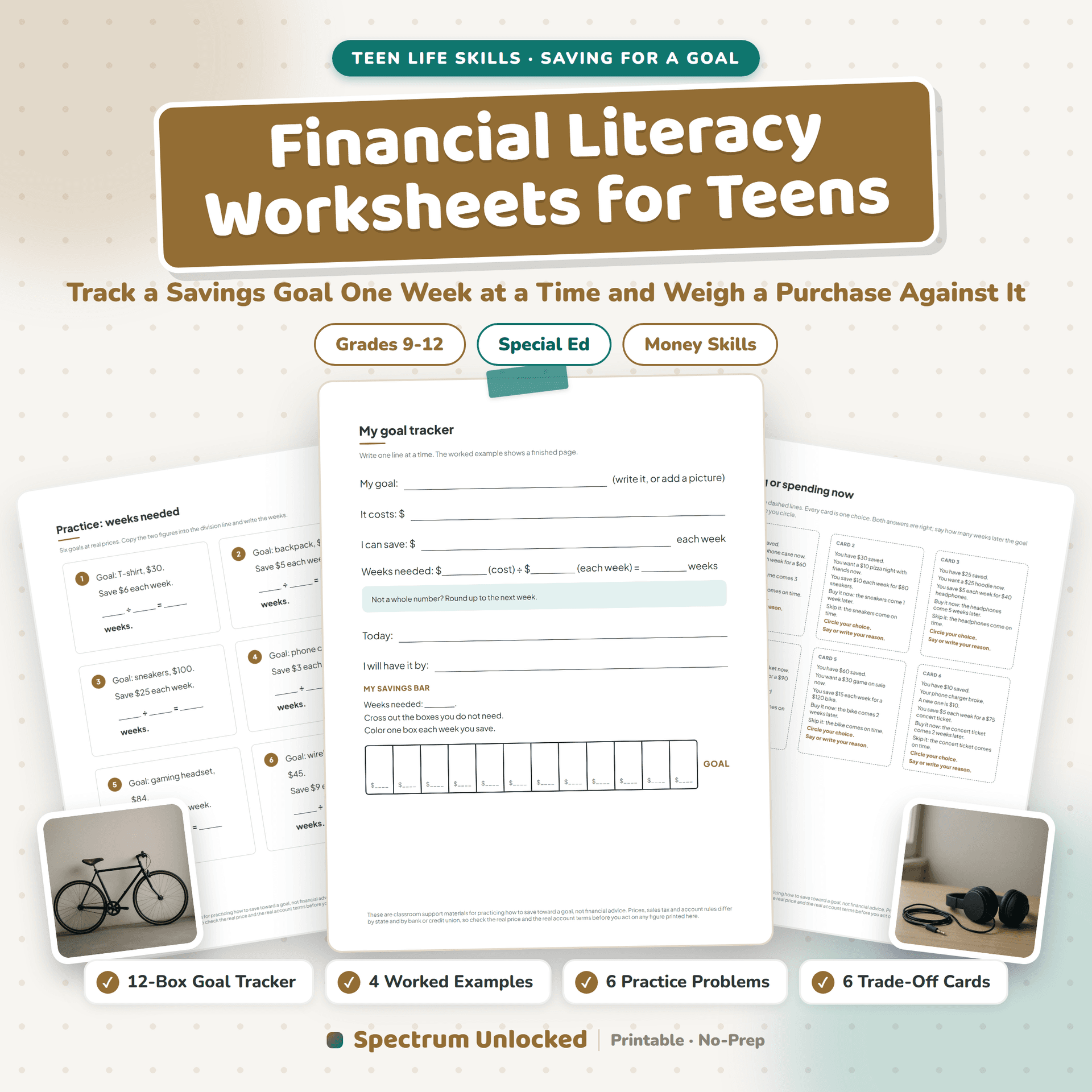
Saving for a goal for teens and young adults in special education: a fill-in goal tracker with a bar of twelve boxes, one box per week saved, four worked examples, six named practice problems, six two-choice trade-off cards and a where-money-goes card. The worked examples print in the tracker's own layout and are shown at week three; the practice problems name real goals at 2026 prices with the answers on the key only; on every trade-off card both choices are correct and the student states the delay in weeks before choosing; the where-money-goes card lists three options and prescribes none. Plus three levels, a teacher key, a data sheet, a portfolio sheet and two copy-paste IEP goals.
$4
Instant download after checkout. No account needed.
Financial literacy worksheets teach the money moves adult life asks for on paper, and this workbook takes one of them and teaches it end to end: saving toward something with a price on it. A student writes the goal, the price and the amount they can put aside each week, works the one division the book teaches, and colors a bar of twelve boxes one box per week saved, so progress is something they color rather than estimate. Four worked examples (headphones, video game, concert ticket, bike) print in the same layout and are shown at week three, so the student sees the finished page before making one. Six practice problems name real goals at 2026 prices, with the answers on the key only. Six trade-off cards put a small purchase against the goal, and both choices are correct: the data point is the delay in weeks the student states before choosing. A last card lists where people keep saved money without telling anyone which to pick.
What is included
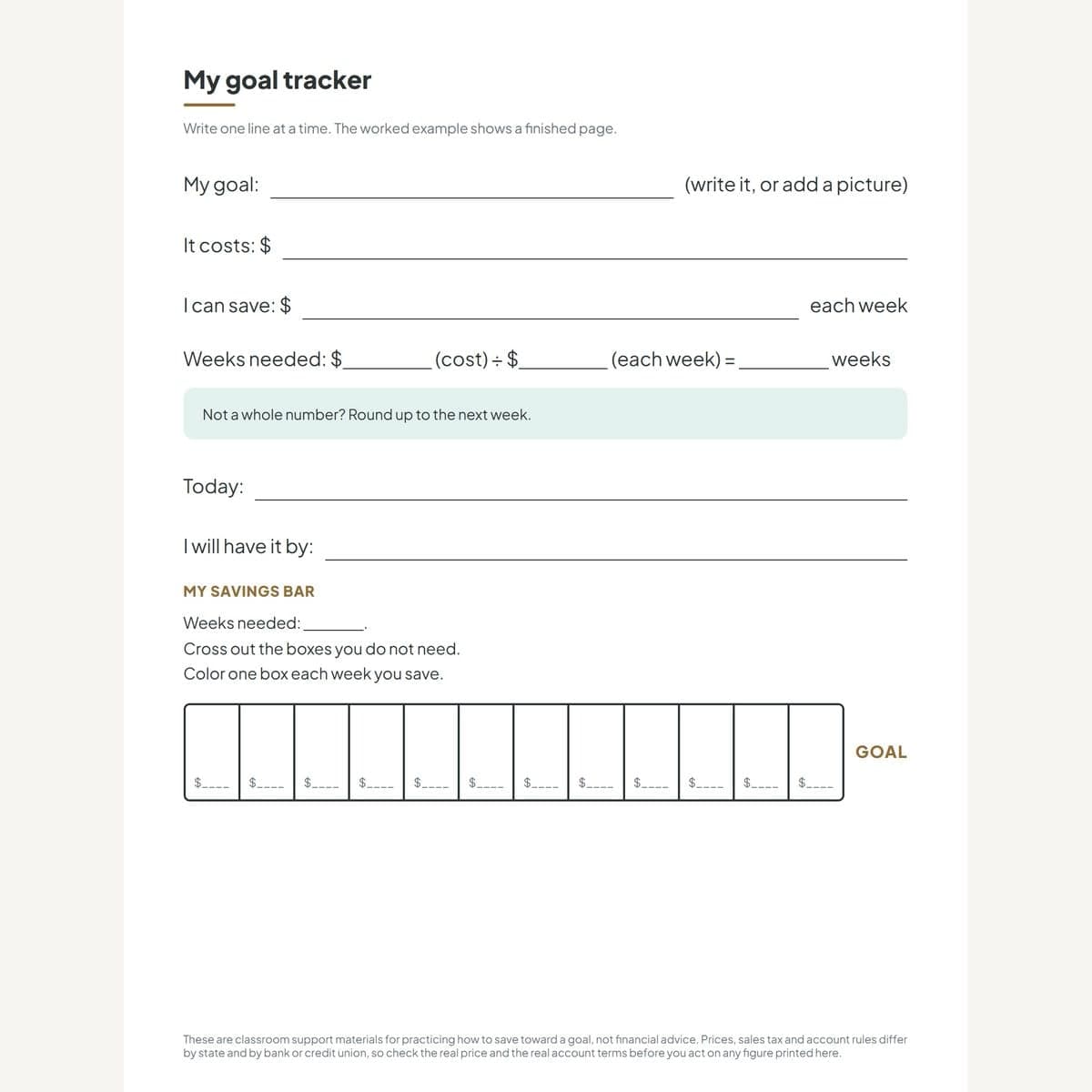
- A fill-in goal tracker with five scored lines (goal, cost, weekly amount, weeks needed, target date), a Today line, the round-up rule and a bar of twelve boxes, one box per week saved, with a running-total blank on every box
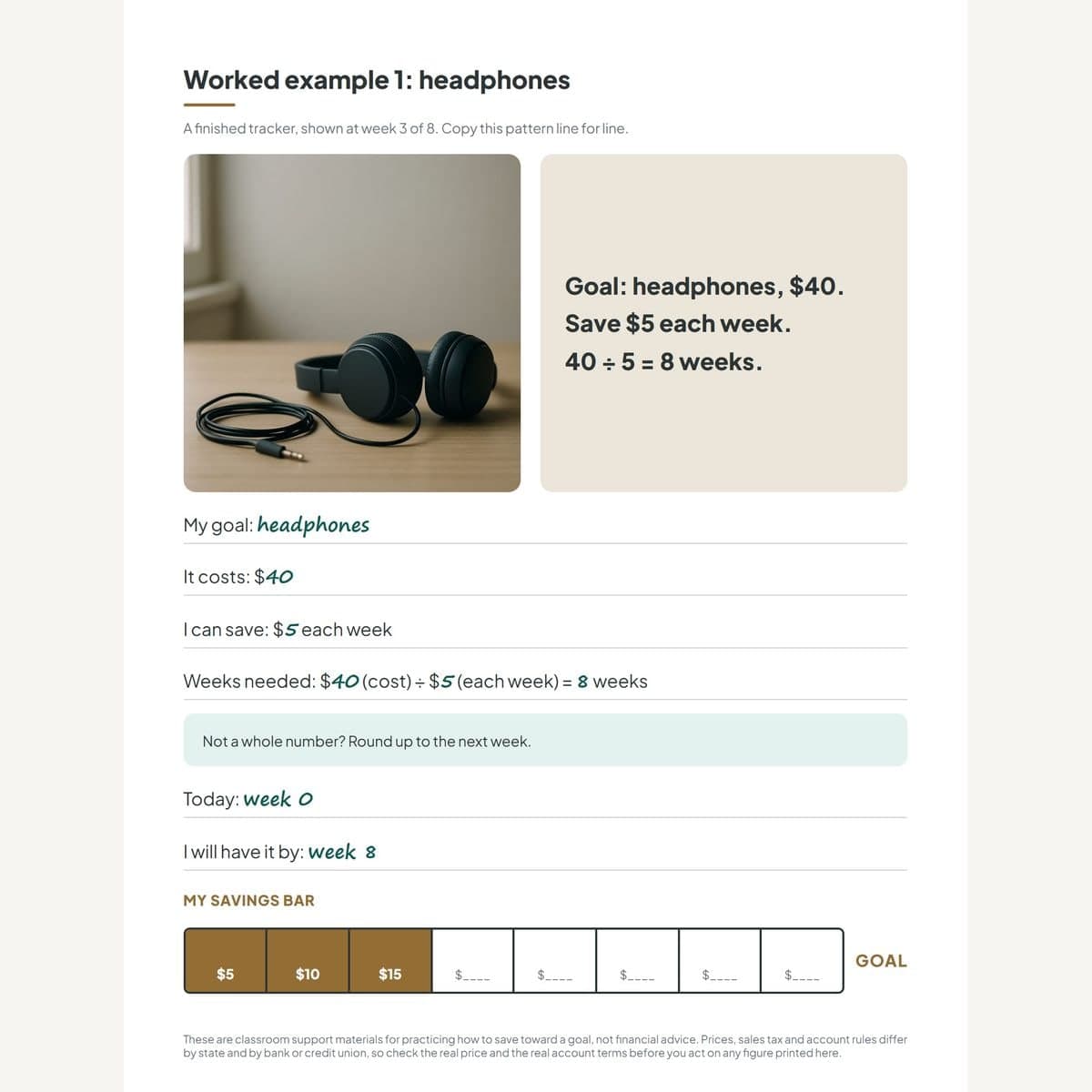
- Four worked examples (headphones, video game, concert ticket, bike) printed in the exact tracker layout and shown at week three, each with its own photo
- Six named practice problems at 2026 prices (t-shirt, backpack, sneakers, phone case, gaming headset, wireless earbuds) in the tracker's own division line, with the answers on the teacher key only
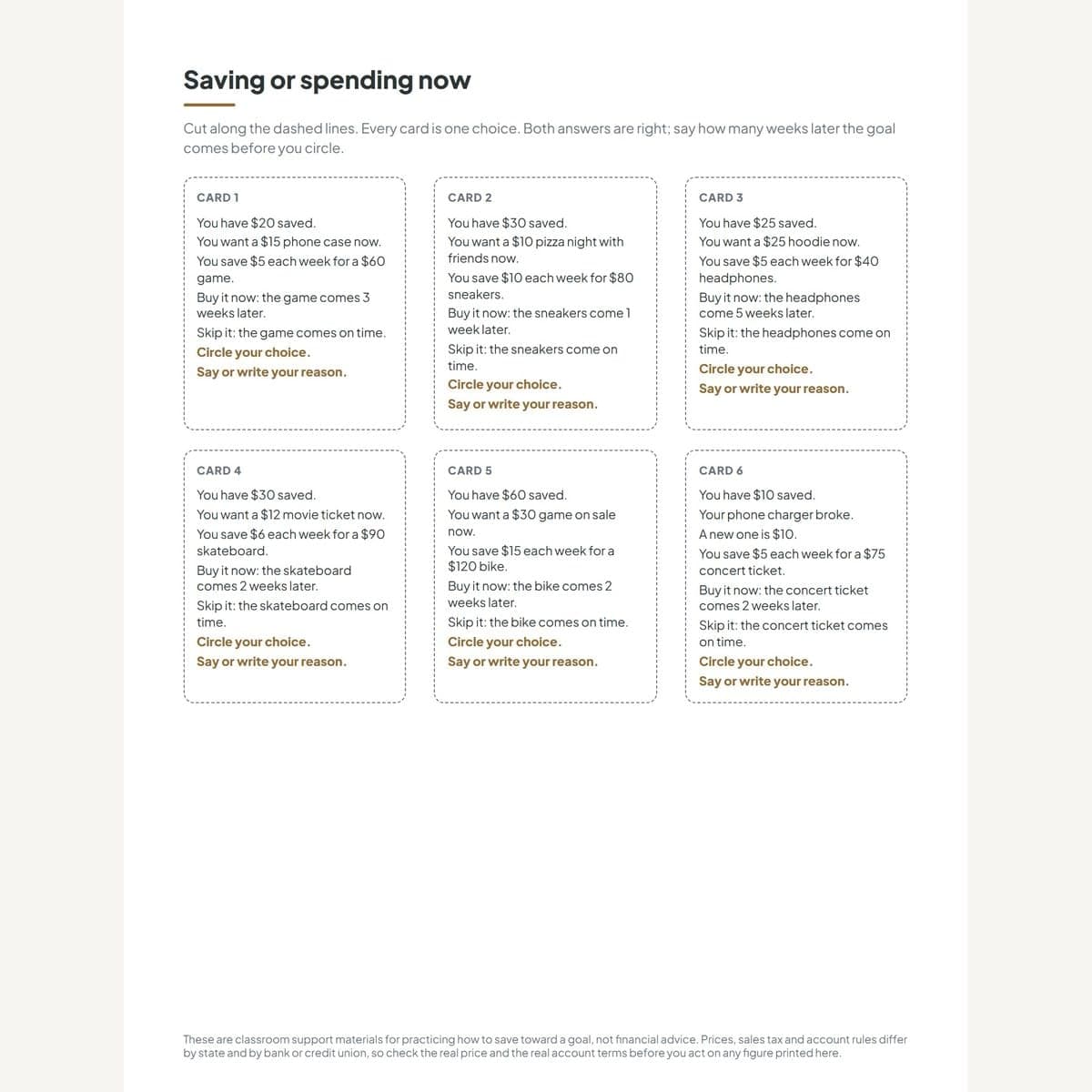
- Six two-choice trade-off cards where both choices are correct and the stated delay in weeks is the data point, one of them a need (a broken phone charger)
- A where-money-goes card with three options and no prescription, and a teacher key that carries the sales-tax, calendar, price-context, under-18 account, SSI and scoring lines
- Three levels, a data sheet, a portfolio sheet and two copy-paste IEP goals
- US Letter and A4 print files, everything single-sided
Formats, license and delivery
- Formats
- Print-ready PDF, US Letter and A4, everything single-sided. Color prints best; every page still reads in black and white.
- License
- Licensed for personal and single-classroom use by the purchaser. For another classroom or teacher, please add a license for each.
- Delivery
- The download unlocks the moment Stripe checkout completes and the link is emailed to you. The pack also stays in your My Resources library, reachable anytime through a magic link sent to your email.
- Refunds
- Because this is an instant digital download, all sales are final. If a file will not open or you bought the wrong pack, email info@spectrumunlocked.com and Spectrum Unlocked will make it right.
Questions from teachers
- What are financial literacy worksheets, and who is this workbook for?
- Financial literacy worksheets are printable practice for handling money on paper: reading a price, working out what it takes to reach it, and deciding what to do when something else comes up first. This workbook is the saving strand of that. It is written for teens and young adults from about 13 to 21 in special education, life skills and transition programs, and for the job coaches and SLPs who run them, at a plain reading level and without childish framing. It does not teach budgeting, banking or credit, and the page does not claim to.
- How does the savings bar work?
- One box per week saved. The blank tracker prints twelve boxes; the student writes the weeks needed, crosses out the boxes they do not need, and colors one box each week they save, writing the running total on it. A ten-percent bar was tried first and rejected, because a $40 goal at $5 a week fills a quarter of a box every week and a literal reader cannot color a quarter of a box. Each worked example prints exactly as many boxes as it needs and is shown at week three, so the student sees the coloring rule by example.
- Are the goals and prices real?
- Yes, at 2026 prices, and the reviewer checked each one against a live source before the build: headphones, video game, concert ticket, bike, priced $40, $70, $75, $120. A new video game is $70, not the $60 an older worksheet would print. Weekly amounts run $3 to $25, inside what teens are reported to have. Every division in the book comes out whole on purpose, and the tracker carries a round-up rule for the student's own goal, which usually will not.
- What if a student has no income?
- The weekly amount may be $0 and the arithmetic still teaches. Where a student's money comes from, an allowance, a job, gifts, or nothing yet, is not the workbook's business, and the teacher key says so. The worked examples and the practice problems work for a student who is saving nothing this term, and the tracker is ready for the first week they can.
- Does it tell students where to keep their money?
- No. The last card lists three options, one per line, and ends with "talk with someone you trust about what works for you", the same non-prescriptive shape the CFPB and the FDIC use with teens. It never says "a trusted adult" or "your family", because a student in this workbook may be 21 and living alone. The teacher key carries the lines a card should not: most banks and credit unions need an adult on an account under 18, a student of 18 or older can open one alone, and a student on SSI has a resource limit the goals in this book sit far below.
- What formats do I get, and how is it delivered?
- Print-ready PDFs in US Letter and A4, everything single-sided so no page has to be flipped. Delivery is instant: the download unlocks the moment Stripe checkout completes, a copy of the link is emailed to you, and the files stay in your My Resources library behind a magic link, so a lost download is never a problem. The workbook is licensed for personal and single-classroom use by the purchaser.
Want to try it first?
Grab the free Savings Goal Tracker Printable: Saving for a Goal sample. It is a real, print-ready slice of this pack, yours to download at no cost. You can browse all free samples too.
Get the Free Savings Goal Tracker Printable: Saving for a Goal SamplePacks that go together
Functional Math Worksheets for Teens: Tipping and Splitting the Bill
Tipping and splitting the bill for teens and young adults in special education: the tipping lesson the restaurant pack ships, ten practice bills at 10, 15, 20 percent, six even splits, four pay-your-own scenarios and a receipt card in real slip order. The lesson is the ten-percent trick, who gets a tip, how to leave one and the line that a calculator is OK; every practice bill carries the easy number to leave; in a pay-your-own scenario each person adds a tip on their own food; and the receipt card fits a real or practice bill. Plus three levels, a teacher key with every answer, a 12-row data sheet, a portfolio sheet and two copy-paste IEP goals.
Independent Living Skills Worksheets: Rent and Bills for Teens
Rent and bills for teens and young adults in special education: four mock bills built with the eight fields a real bill carries, a labeled bill to read them against, a six-step paying sequence, and a two-month calendar that shows why the bills due at the start of the month are paid with last month's money. Its three cannot-pay cards route a student to chat, app, text, email or in person as well as a call, with a script card so asking for a payment plan never depends on a phone call. Plus a rent page, an FTC scam page, an autopay page, a my-real-bill sheet, a teacher page, an answer key, a 20-row data sheet with a prompt-level column, a portfolio sheet and three copy-paste IEP goals.
Paycheck & Banking Skills for Teens
Grocery Math Vol. 2: the money skills a first paycheck needs. Students read a rendered Valley Market paystub (gross, taxes, net, and which number is yours to spend), learn three plain-language debit card rules, run six real checkouts priced with the exact Grocery Math pack prices, walk a photographed six-step safe ATM sequence, then sort 24 needs-versus-wants cards and build a budget on the paystub's own net pay, savings first. Two levels on every page, a computed answer key, a data sheet, and three copy-paste IEP goals.
Looking for more? Browse all classroom packs.
Reviews
Be the first to review this pack.