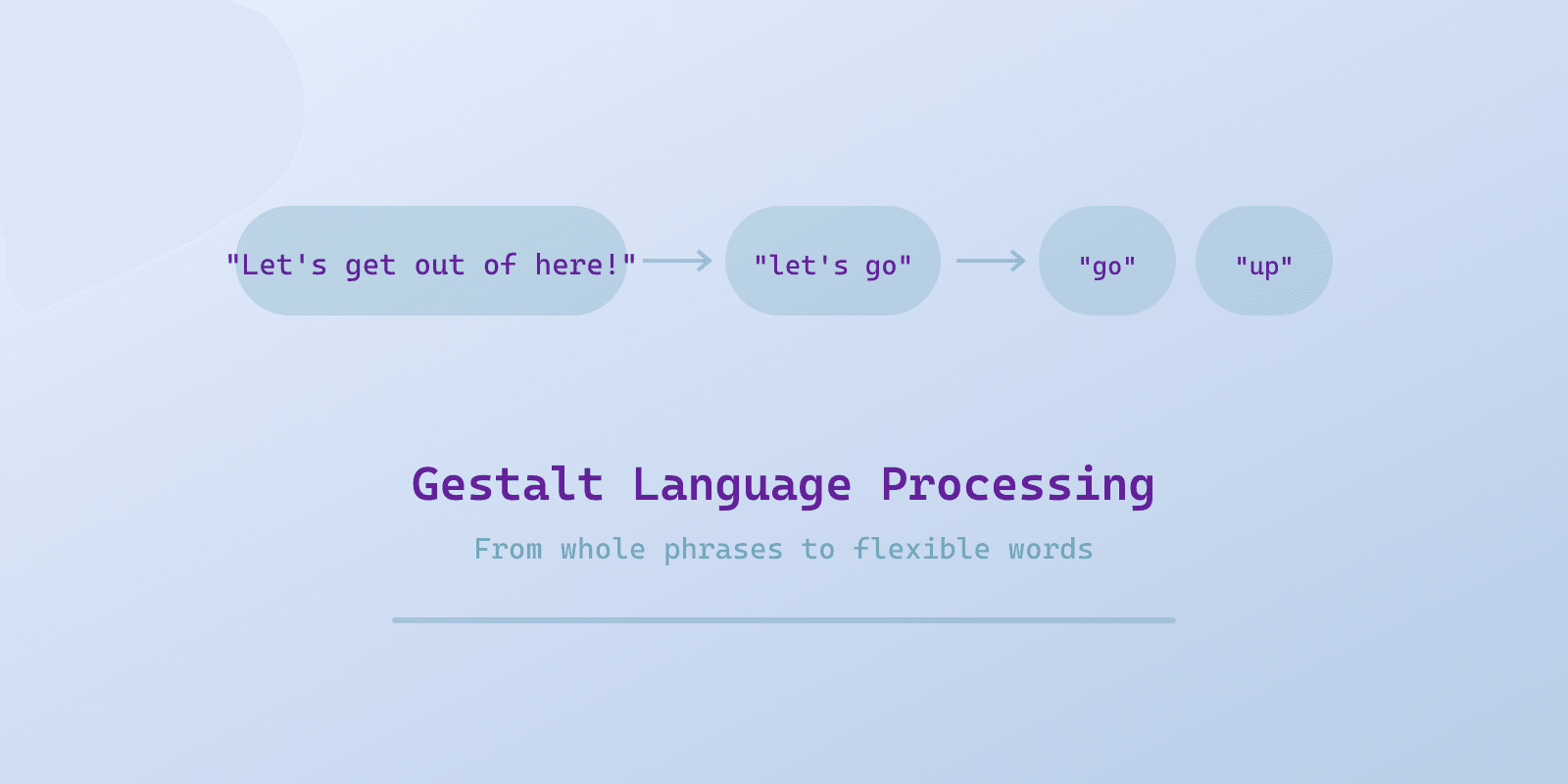
What Is a Gestalt Language Processor? And Why It Changed Everything for My Son
Your child scripts full sentences from Bluey but can't say 'milk.' What gestalt language processing means, the 6 stages, and how to support your child.
Key Takeaways
- Gestalt language processors learn language in whole chunks (scripts, phrases, song lyrics) before breaking it down into single words.
- Echolalia is not meaningless repetition. It is the first stage of language development for gestalt processors.
- There are 6 stages of Natural Language Acquisition (NLA) that map how gestalt processors move from full scripts to original sentences.
- Traditional speech therapy techniques designed for analytic processors can actually slow a gestalt processor's progress.
- Parents can support GLP development at home by acknowledging the meaning behind the script, not correcting the form.
When FJ was 2, he could recite entire scenes from Bluey, full sentences with perfect intonation, every word in the right place. People were impressed, and "He talks so well!" was something we heard often.
But he could not tell me he was hungry, he could not say "I want milk," and he could not answer "What is your name?" with anything other than a line from a show.
He had hundreds of phrases, but almost none of them were his.
A gestalt language processor is a person who learns language by acquiring whole phrases, sentences, or scripts before breaking them down into individual words. That's FJ, and it's what I wish someone had told me the day he was born.
After the autism diagnosis, his speech therapist told us something that changed the way I understood everything about how FJ communicates: "He is a gestalt language processor."
I had never heard the term, so I went home and searched for hours. What I found was clinical research papers and scattered Instagram posts, but very little that explained it in plain language for a parent who just needed to understand their kid.
This is the post I wish I had found that day.
What Is Gestalt Language Processing?
There are two ways humans learn language.
Analytic processors start with single words ("Mama," "Ball," "More") and build up from individual words to two-word phrases to full sentences. This is what most developmental milestone charts track, and it is what most speech therapy is designed around.
Gestalt processors do the opposite: they start with whole chunks. Full phrases, sentences, song lyrics, lines from TV shows, things they heard an adult say once three weeks ago. They acquire language in big pieces and then, over time, break those pieces apart and recombine the individual words into original sentences.
Neither approach is wrong; they are two valid paths to the same destination: flexible, self-generated language.
The problem is that almost everything in early childhood development (the milestone checklists, the pediatrician screenings, the early intervention assessments) is built around the analytic path. So when a gestalt processor shows up reciting full sentences from Bluey but cannot answer a simple question, the system does not know what to make of them.
A Quick Note on the Term
You'll see this called both "gestalt language processor" and "gestalt learning processor" in parent groups, social posts, and even some clinical write-ups. The technically correct term is gestalt language processor, because the framework specifically describes how a child acquires language. "Learning processor" is a common misremembering ("learning" feels more intuitive than "language" when you first encounter the concept), but in practice both phrases refer to the exact same thing. If you searched "gestalt learning processor" and landed here, you're in the right place.
Why This Matters for Your Child
If your child is a gestalt processor and nobody identifies it, several things can go wrong.
Echolalia gets treated as a problem. A well-meaning therapist might try to extinguish the scripting, the repeating, the borrowed phrases. But for a gestalt processor, echolalia is not a defect; it is Stage 1 of their language development, and trying to eliminate it is like trying to stop an analytic processor from saying single words.
Therapy targets the wrong skills. Traditional speech therapy often focuses on labeling (point to the cup, say "cup"), answering WH-questions, and building vocabulary one word at a time. For a gestalt processor, this approach can feel confusing and unnatural because it skips the way their brain actually acquires language.
Parents get the wrong read on their child's abilities. When FJ recited a full sentence from a show, people assumed he had flexible language, and when he could not answer "How was your day?" they assumed he was being defiant or not paying attention. Neither was true. He was a gestalt processor in the early stages, using the tools he had.
The 6 Stages of Natural Language Acquisition
Dr. Marge Blanc, a speech-language pathologist and researcher, developed the Natural Language Acquisition (NLA) framework that maps how gestalt processors develop language. Her book, "Natural Language Acquisition on the Autism Spectrum," is the foundational text on this topic.
Here are the 6 stages:
Stage 1: Whole Gestalts. The child uses complete scripts, phrases, or "chunks" picked up from the environment. These are borrowed language units used with communicative intent. Example: FJ says "Are you okay, Bingo?" (from Bluey) when he sees someone who looks sad. The words are borrowed, but the meaning is real.
Stage 2: Partial Gestalts (Mix and Match). The child begins breaking chunks apart and combining pieces from different scripts. This often sounds like odd or "jumbled" language. Example: "Are you okay + want some water" becomes "Are you okay want water?" It sounds grammatically wrong, but it represents enormous cognitive progress.
Stage 3: Single Words and Two-Word Combinations. The child has broken the chunks down far enough to isolate individual words and starts combining them in new ways. This is where gestalt processors arrive at the same place analytic processors started, but from the opposite direction. A universal core-word board gives them a stable set of single words to point to and combine.
Stage 4: Early Sentences. The child begins generating original sentences using the single words and short phrases from Stage 3. Grammar may still be developing.
Stage 5: Complex Sentences. The child combines ideas into longer, more complex sentences with emerging grammar.
Stage 6: Mature Grammar. The child uses flexible, self-generated language with conventional grammar.
Most gestalt processors I have read about (and FJ) spend the longest time in Stages 1 and 2, because the jump from borrowed chunks to original word combinations is the hardest part, and it cannot be rushed.
Signs Your Child Is a Gestalt Language Processor
You might be reading this and recognizing your own child. Here are common signs:
Your child repeats full phrases or sentences from shows, songs, books, or conversations, and these are not random. If you pay attention, you will notice they use specific scripts in specific situations.
Your child has "advanced" speech that does not match their ability to answer questions or have a back-and-forth conversation; they can recite complex sentences but cannot tell you what they want for lunch.
Your child sings constantly, or uses song lyrics in everyday situations, because music is a common source of gestalts since melody helps gestalt processors retain longer chunks.
Your child echoes what you just said, either immediately or hours and days later (delayed echolalia). This is not defiance or "just repeating," they are filing it away for future use.
Your child's speech sounds "scripted" or has unusual intonation, like they are performing a line rather than speaking spontaneously.
If this sounds familiar, bring it up with your child's speech therapist and ask them directly: "Are you familiar with gestalt language processing and Natural Language Acquisition?" Their answer will tell you a lot about whether they are the right fit. (Gestalt processors are often mislabeled as having a "speech delay," so Spectrum Unlocked's autism vs speech delay walkthrough covers how to tell the patterns apart and ask the right questions at the eval.)
How to Find a Speech Therapist for Gestalt Language Processing
Not all SLPs are trained in gestalt language processing, and while this is changing, it's changing slowly. When evaluating a speech therapist for a gestalt processor, ask these questions:
"Are you familiar with Dr. Marge Blanc's Natural Language Acquisition framework?" If the answer is no, that does not make them a bad therapist, but it means they may not be equipped to support your child's specific language development path.
"How do you view echolalia?" The answer you want: echolalia is meaningful communication and a stage of language development; the answer that should concern you is echolalia framed as a behavior to reduce or redirect.
"What does a typical session look like for a child who scripts?" You want to hear about play-based, child-led sessions where the therapist follows the child's lead and models language at or slightly above their current NLA stage. What you do not want to hear about is flashcard drills, forced labeling, or "say this" prompts.
If you are struggling to find the right therapist, our guide to autism therapy types includes questions to ask any provider and red flags to watch for.
How to Support Your Gestalt Processor at Home
You do not need to be a speech therapist to support your child's language development, and here is what has worked for us.
Acknowledge the meaning behind the script, not the form. When FJ says "Are you okay, Bingo?" and he is looking at me because I seem upset, I respond to the intent: "You noticed I look sad. Thank you for checking on me." I do not correct the script or ask him to "use his own words," because the meaning was already there.
Model short, meaningful phrases tied to real experiences. Instead of drilling "say milk" or "say more," narrate what is happening in the moment: "Pouring the milk," "Shoes on, time to go," "That was loud!" These short, emotionally relevant phrases become the raw material your child will eventually break apart and recombine.
Lean into music and rhythm. If your child learns through songs (and most gestalt processors do), use that. Make up short songs for routines, sing transitions, and remember that music is not a distraction from language development for these kids; it is a vehicle for it.
Do not force WH-questions. "What did you do at school today?" is one of the hardest question types for a gestalt processor in the early stages. Instead, try offering a choice ("Did you play outside or play inside?") or make a statement they can confirm or expand ("I bet you played with the trains"). Printable request cards give a child who is not yet speaking a way to make those choices and requests without words.
Track what scripts your child uses and when. You will start to see patterns, because certain scripts map to certain emotions or needs. Once you crack the code, you can respond to the real message and model a more flexible version of it. Our free behavior tracking log can help you spot these patterns. When someone else has your child for a while, it helps to tell sitters how your child communicates, so they know which scripts mean "I am hungry" or "something is wrong" instead of hearing only a line from a show.
Build a visual schedule to support transitions. Gestalt processors often struggle with transitions because they are processing language and context simultaneously, so visual schedules reduce the language demand of transitions and give your child a concrete reference point.
What I Wish I Had Known From the Start
I spent months worried that FJ's scripting meant something was wrong beyond the autism diagnosis. I thought the echolalia was a wall between us, but I did not realize it was a bridge.
Every script he uses means something. "Let's go to the creek, Dad!" (from Bluey) means he wants to go outside, while "Oh no, the power is out!" (from a Daniel Tiger episode he watched once, six months ago) means something unexpected happened and he is unsettled.
Once I started listening for the meaning behind the scripts instead of wishing he would "just talk normally," our communication improved overnight, not because his language changed, but because my understanding of his language changed.
That is what gestalt language processing reframed for me: FJ is not failing to learn language the "right" way, he is learning language his way, and his way has a well-documented, research-backed developmental path. He is right on track, just on a different track than the one the milestone chart assumes.
Resources for Learning More
Dr. Marge Blanc is the leading researcher on this topic, and her book "Natural Language Acquisition on the Autism Spectrum" is the most comprehensive resource available. Her website (communication-development.com) also has articles and training information for SLPs and parents.
Meaningful Speech (meaningfulspeech.com) was co-founded by two SLPs trained in NLA and has become one of the most accessible parent-facing resources on gestalt language processing; their Instagram account is an excellent starting point.
Alexandria Zachos (SLP) creates widely shared educational content on GLP and NLA across social media, so search her name on Instagram or TikTok for short, practical explanations.
If your child was recently diagnosed and you are still finding your footing, the First 48 Hours printable guide covers the immediate next steps, and the resource library has free printable tools for daily life.
For a focused look at echolalia specifically (immediate vs delayed, how to decode the meaning, when to seek extra support), see the echolalia in autism post.
You are not behind. You are learning a new language, and not a foreign one: your child's.
Communication support depends entirely on where your child is right now.
Beacon learns about YOUR child and gives guidance specific to them.
What would Beacon say?
"How do I help my child communicate?"
Beacon knows whether your child is pre-verbal, uses AAC, or is a gestalt language processor, and adjusts every suggestion to fit where they actually are.

Spectrum Unlocked Editorial Team
Editorial Team
The Spectrum Unlocked editorial team combines lived experience as autism parents with research-backed guidance to create resources families can trust.
Frequently asked questions
- What is a gestalt language processor?
- A gestalt language processor is someone who learns language by acquiring whole chunks of speech (phrases, sentences, song lyrics, scripts from shows) before gradually breaking those chunks into smaller pieces and recombining them into original sentences. This is the opposite of analytic language processing, where children start with single words and build up.
- Is echolalia a sign of gestalt language processing?
- Yes. Echolalia (repeating words, phrases, or scripts heard from other people, shows, or songs) is the hallmark first stage of gestalt language processing. It is not meaningless repetition. The child is using those borrowed chunks to communicate meaning, even if the connection is not immediately obvious.
- How common is gestalt language processing in autistic children?
- Research suggests that up to 75-85% of autistic children who develop speech are gestalt language processors, making it the dominant language acquisition style in autism. It also occurs in non-autistic children, but it is especially common in kids who use scripting, echolalia, and song lyrics to communicate before they produce original single-word speech.
- What kind of speech therapy works best for gestalt language processors?
- Natural Language Acquisition (NLA) therapy, developed by Dr. Marge Blanc, is specifically designed for gestalt processors. It follows the child through 6 stages of language development, starting with acknowledging their scripts and gradually supporting them in breaking chunks apart and recombining words into original sentences.
- How can I support my gestalt language processor at home?
- Recognize that scripts and echolalia carry meaning, and respond to the intent behind them instead of correcting the form. Model short, meaningful phrases tied to real moments rather than drilling single words. Narrate what is happening as it happens. And find an SLP trained in Natural Language Acquisition.