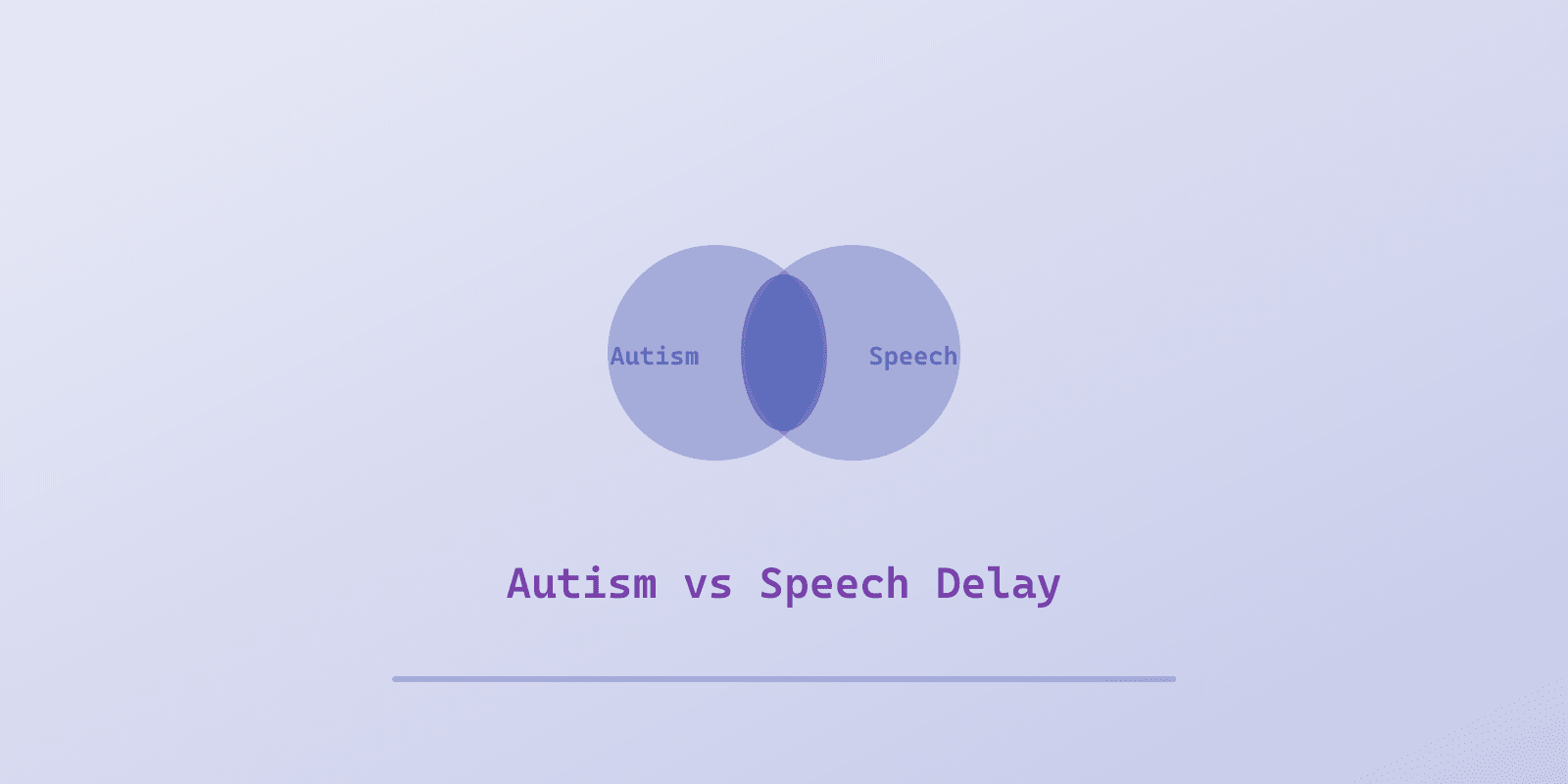
Autism vs Speech Delay: How to Tell the Difference at Each Age
Many speech delays aren't autism, and many autistic kids have far more than just speech delay. The diagnostic differences at each age, and how to know which evaluation to pursue.
Key Takeaways
- Speech delay alone (without other autism markers) is more often a speech-only delay; autism shows differences across multiple areas (social communication, verbal/nonverbal communication, restricted/repetitive behaviors)
- The clearest disambiguating signs are nonverbal: pointing to share interest, joint attention, social engagement, eye contact, and pretend play; these are typically intact in speech-only delays and impacted in autism
- Both conditions need early intervention regardless of which one is present, and EI services are often similar at the start; pursuing evaluation when in doubt costs little and resolves uncertainty
- Many late-talking kids who turn out not to be autistic catch up significantly between 18 and 36 months; the autism-shaped pattern doesn't typically catch up the same way
- If both speech delay and other autism signs are present, autism is the more likely explanation; if only speech is delayed and everything else is on track, speech-only is more likely, but evaluation is still warranted
Your kid is two and a half and isn't talking the way other kids that age talk. They have a few words but you're not sure they use them meaningfully. The pediatrician at the last visit said something hopeful: "Some kids are late talkers. Let's give it another six months." You've been giving it six months for a year now and the gap with other kids hasn't closed.
When you search online, half the results say "late talker, will catch up" and the other half say "could be autism, see a specialist immediately." You don't know which version applies to your kid, and the uncertainty is doing damage to your sleep.
This post is for that gap.
Speech delay and autism overlap meaningfully but aren't the same thing. Most late-talking kids aren't autistic, and many will catch up significantly between 18 and 36 months without specialist intervention. But a meaningful subset of "late talkers" are actually autistic, and the difference matters because the support pathways diverge.
This post is the practical disambiguation: what tells them apart, what doesn't, and what to do when you're not sure which one is in your kitchen. The clearest signals are nonverbal, and here's the side-by-side:
| Speech-only delay | Autism-shaped pattern | |
|---|---|---|
| Words | Behind expected milestones | Behind expected milestones (identical on this one) |
| Pointing and gestures | Intact, used to compensate for missing words | Limited pointing to share interest, fewer gestures |
| Joint attention and eye contact | Typically intact | Often limited or atypical |
| Social engagement | Fully engaged with people despite few words | Reduced interest in peers and social games |
| Pretend play | Develops on schedule | Limited or absent; repetitive use of toys instead |
| Repetitive behaviors and rigidity | Not present | Lining up toys, restricted interests, routine rigidity |
| Typical course | Many catch up between 18 and 36 months | Doesn't catch up the same way; the pattern persists |
For the broader signs picture, see Spectrum Unlocked's signs of autism in toddlers pillar. For the language-specific autism context, see the gestalt language processing and echolalia in autism posts. A useful first pass is our free autism milestone tracker, which lets you check what your child is doing across social, communication, AND play milestones at once. Speech-only delays show one pattern; autism-shaped delays show another.
What "Speech Delay" Actually Means
Speech delay is a clinical term for any pattern where a child's expressive language is significantly behind expected milestones for their age. The bands are:
- Expressive language delay: child understands language but produces fewer words than expected
- Receptive language delay: child has difficulty understanding spoken language
- Mixed expressive-receptive delay: both
- Articulation/phonological disorder: child speaks but is hard to understand
- Childhood apraxia of speech: motor planning difficulty for speech sounds
- Late talkers: catch-all term for children with expressive delay who otherwise hit milestones
About 5 to 10% of toddlers show some form of speech delay. The majority of pure speech-only delays resolve with intervention or sometimes without by age 5. The minority that don't resolve, or that come paired with other developmental signs, may indicate something broader.
Autism is one of the broader conditions that includes speech delay as one feature among several. Other developmental differences (intellectual disability, hearing impairment, fragile X syndrome) can also produce speech delay alongside other signs.
What Autism Looks Like When Speech Is Affected
When autism produces speech delay, it usually doesn't show up as speech delay alone. Autistic children with speech delays typically also show:
Nonverbal communication differences. Limited or atypical eye contact, reduced pointing to share interest, fewer gestures, less use of facial expression to communicate. The autism-shaped speech delay often comes with the whole communication system being affected, not just the words.
Social engagement differences. Less interest in peers, less attention-seeking from caregivers, reduced response to others' emotions, difficulty with social games (peekaboo, pat-a-cake). A speech-only delayed child typically shows full social engagement despite limited words; an autistic child with speech delay often shows reduced engagement across the board.
Restricted or repetitive behaviors. Lining up toys, repetitive movements, sensory differences, fixation on specific topics, rigidity about routines. These don't appear in speech-only delays.
Atypical play patterns. Limited pretend play, repetitive use of toys (lining up vs. building/imagining), preference for specific objects over typical age-appropriate play.
Echolalia or unusual speech patterns when speech does emerge. Quoting from shows, repeating recent speech, scripted phrases used as units, atypical prosody. Speech-only delayed kids typically produce simple original phrases, not memorized chunks.
A child with several of these in addition to speech delay is showing the autism-shaped pattern. A child with speech delay alone, with full nonverbal communication and social engagement, is more likely a pure speech-only delay.
Age-by-Age Differentiators
The disambiguating signs vary somewhat by age:
18 to 24 months
Speech-only delay: limited words but pointing, joint attention, eye contact, response to name, simple imitation, interest in peers, beginning of pretend play. Child may understand significantly more than they produce.
Autism: limited words plus several of: limited pointing, limited joint attention, reduced response to name, limited imitation, reduced peer interest, no spontaneous pretend play, repetitive behaviors, sensory differences, atypical play with objects.
24 to 36 months
Speech-only delay: still behind on word combinations and sentence length, but typically understanding two-step instructions, engaging in pretend play with caregivers, showing growing peer interest, communicating through gestures and facial expressions when words don't work.
Autism: still behind on words plus several of: difficulty following multi-step instructions, limited or absent pretend play, parallel rather than cooperative play, persistent restricted interests, repetitive behaviors, echolalia when speech does emerge, sensory profile differences.
3 to 5 years
Speech-only delay: catching up rapidly with intervention, original phrases emerging, conversation developing, social communication intact, may have remaining articulation issues but functional communication is in place. For those remaining sound errors, home practice between sessions helps, and free position-sorted word lists like these S words for speech therapy are the standard material SLPs assign for it. If more than one sound is still off, which is common at this age, the Articulation Starter Bundle collects the S, R, L, TH, SH and CH packs in one download so you are not buying them one at a time as each sound comes up. If the sound still off is a back-of-the-mouth one, where "car" comes out as "tar", that is K and G rather than S or R: K words for speech therapy sorts them by position, and the K and G packs carry the same lists through to phrases and sentences. The tongue-tip sounds that get swapped in for them have their own packs too, T, D and N. A voicing swap is different again: F and V are made in the same place and differ only in whether the voice is switched on, so they are practiced as pairs rather than one at a time. The V pack carries that pairs page, and the F pack covers the unvoiced half on its own.
Autism: language may be emerging but with echolalia, scripts, or restricted topics dominant. Social communication challenges remain visible (difficulty with reciprocal conversation, restricted interests dominating, social interaction differences). Restricted/repetitive behaviors stable or more visible.
What Doesn't Distinguish Them
A few patterns that get confused but actually appear in both:
Late onset of first words. Many late-talking kids without autism don't speak until 18 to 24 months and then catch up. Late first words alone don't indicate which condition is present.
Frustration with communication. Both speech-only delayed and autistic toddlers can be frustrated when they can't communicate effectively. The frustration itself doesn't differentiate.
Strong-willed or stubborn temperament. Some late-talking children are described as stubborn because they can't easily express preferences. This is a temperament-or-frustration question, not a diagnostic one.
Picky eating in isolation. Late-talking neurotypical kids can also be picky. The autistic version is more sensory-extreme but mild picky eating doesn't differentiate.
Bilingual exposure. Some pediatricians attribute speech delay to bilingual home environments. Research is clear that bilingual children may take longer to reach equivalent milestones in any one language but catch up across both, and bilingualism does not cause autism or significant delay.
What to Do When You're Not Sure
The right approach is parallel evaluation, not sequential.
1. Request a speech-language evaluation. This can usually be obtained within 4 to 6 weeks through your state's early intervention program (under age 3) or your school district (3 and older). The SLP evaluates expressive and receptive language, articulation, and pragmatics. The result tells you if speech-only intervention is appropriate.
2. Request a developmental evaluation in parallel. A developmental pediatrician, child psychologist, or autism-focused evaluator can assess for autism specifically. This typically takes longer (3 to 12 months) but gives you the broader picture. Don't wait for the SLP results before requesting this; both can be in motion simultaneously.
3. Document specific patterns. A two-week diary noting what your child does and doesn't do across communication, social, sensory, and behavioral domains gives both evaluators concrete data. The patterns are often clearer in writing than in your head.
4. Get on early intervention now if your child is under 3. EI doesn't require a diagnosis to start. The evaluator screens for any developmental concern and provides services if eligible. If autism is later diagnosed, the EI services often pivot to include autism-specific support; if speech-only delay is the answer, the EI services target that. Either way, early enrollment is the move.
5. Give your child a way to communicate during the wait. Whichever diagnosis lands, a child who can't make wants and needs known needs a channel now, not after the evaluations. The AAC vs PECS vs sign language comparison covers the options, and none of them interfere with speech development.
If you're at the point where you've been worrying for months and the appointments are weeks out, Beacon is a tool worth knowing about. It's an AI companion built specifically for autism parenting and can help you think through what you're observing in your specific child without the speech-only-vs-autism question being settled yet.
What If It's Both?
Some children have both autism and a primary speech-language disorder. The conditions are distinct and can co-occur. A child with autism plus apraxia, for example, has the autism-shaped pattern of social communication and restricted behaviors plus a separate motor-planning issue affecting speech production.
Co-occurrence matters because the intervention needs to address both. SLP working only on speech motor patterns won't address the autism support needs. Autism intervention without recognizing the apraxia component may underestimate why progress on speech is slow.
A thorough evaluation should rule co-occurring conditions in or out. Don't accept a single diagnosis if multiple seem to fit.
Where to Go Next
For the broader signs picture across all autism markers, see the signs of autism in toddlers pillar. For the language-specific context, see gestalt language processing and echolalia in autism. For early intervention timeline and what to expect from services, see autism early intervention.
If your child is heading into preschool or kindergarten and you're still trying to figure out which evaluation path applies, see autism signs in 3 year olds, 4 year olds, and 5 year olds for age-specific differentiators.
Speech delay and autism are different conditions that sometimes overlap. The right move when you're unsure is to evaluate both in parallel rather than sequentially. The cost of evaluating and being wrong is one extra appointment. The cost of waiting through the uncertainty is months of lost services that benefit your child regardless of which diagnosis lands. Home practice helps under either answer, and it does not need to wait: a velcro I spy colors book builds looking, matching, and first sentence frames in ten-minute sits, whatever the evaluation eventually says. The farm animals book works the same way with animal sounds, which are often the first sounds a child imitates on purpose.
Communication support depends entirely on where your child is right now.
Beacon learns about YOUR child and gives guidance specific to them.
What would Beacon say?
"How do I help my child communicate?"
Beacon knows whether your child is pre-verbal, uses AAC, or is a gestalt language processor, and adjusts every suggestion to fit where they actually are.
Spectrum Unlocked Editorial Team
Editorial Team
The Spectrum Unlocked editorial team combines lived experience as autism parents with research-backed guidance to create resources families can trust.
Frequently asked questions
- Is my child's speech delay actually autism?
- Speech delay alone, without other social or behavioral signs, is more often a speech-only delay than autism. Speech delay plus limited eye contact plus restricted interests plus difficulty with peers plus sensory differences is the autism-shaped cluster. The honest answer is that an evaluation distinguishes them; the cost of evaluating and being wrong is one appointment, while the cost of waiting is months of lost services regardless of which condition turns out to be present.
- Can a child have a speech delay without being autistic?
- Yes, very commonly. Speech-only delays affect about 5 to 10% of children and most resolve with speech therapy by age 5. Common causes include hearing issues, oral-motor difficulties, late development of typical language milestones (sometimes called 'late talkers'), and speech-language disorders that aren't part of broader autism. Many late-talking kids catch up dramatically between 18 and 36 months without being autistic.
- What are the signs that distinguish autism from speech delay?
- Three main areas distinguish them. First, nonverbal communication: autistic children often have differences in eye contact, pointing, gesture, and joint attention even before speech is at issue, while speech-only delayed kids typically have intact nonverbal communication. Second, social engagement: autistic children may show limited interest in peers and reduced response to others' emotions, while speech-only kids are usually socially engaged despite limited verbal output. Third, restricted/repetitive behaviors: autism includes repetitive movements, restricted interests, and rigidity that aren't present in speech-only delays.
- If I'm not sure, should I get a speech evaluation or an autism evaluation first?
- Both, ideally in parallel. An SLP evaluation can be obtained quickly (often within 4 to 6 weeks) and is appropriate regardless of whether autism is also present. A developmental pediatric or autism-specific evaluation typically takes longer (3 to 12 months) but provides the broader picture. The right move is to start the SLP evaluation while also requesting the developmental evaluation. Both can be free under early intervention or your school district.
- What if my pediatrician says it's just a speech delay but I'm worried about autism?
- Trust your observations. Pediatricians sometimes default to 'speech delay' as a less alarming explanation when both could be present. If you're seeing autism markers beyond speech (social differences, sensory issues, restricted interests, repetitive behaviors), pursue both an SLP evaluation and a developmental autism evaluation. You can self-refer to early intervention or your school district for both. Don't let a single 'just a speech delay' from a pediatrician end the conversation when you're observing more than that at home.