Free Articulation Screener
A quick picture screener for parents and teachers: point to each picture, ask "What is this?", and mark whether the sound came out clear. It checks 24 speech sounds at the start, middle and end of words in about ten minutes, then a summary page shows the age most children say each sound. It is a screener, not a diagnosis.
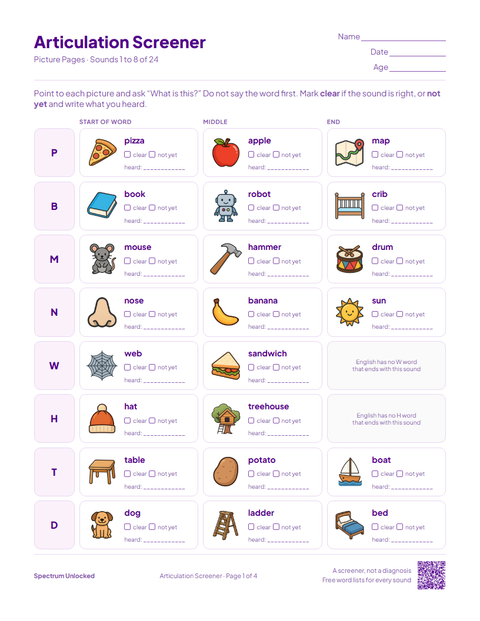
Articulation Screener (Free PDF)
Four pages: three picture pages covering 24 sounds and a summary page with the age most children say each one.
Download the Free ScreenerHow to Use the Screener
- Pick a quiet ten minutes when your child is rested. Sit side by side with the picture pages.
- Point to a picture and ask "What is this?" Do not say the word first, because a child who hears it can copy it.
- Listen for the one sound in that row. Mark clear if it was right, or not yet and write down what you heard, like "tun" for sun.
- If your child names the picture with another word, say "Yes, and what else could we call it?" or move on. Two rows use say-after-me prompts because no picture draws those words out.
- Copy every not yet onto the summary page and compare it with the age in that row.
How to Read the Results
The ages come from a 2020 review by Crowe and McLeod of 15 studies covering 18,907 children learning English in the United States, the review ASHA's practice guidance points to. Each age is when 90 in 100 children in those studies said the sound clearly.
A not yet before that age is usually part of normal learning. A sound still marked not yet after its age, several sounds missing at once, or speech that strangers find hard to understand are good reasons to ask a speech-language pathologist for an evaluation.
A screener only notices. An SLP's evaluation looks at sounds in conversation, patterns across many words, and how your child hears and moves the mouth, and only that can say whether therapy would help.
Speech Sound Ages and Free Word Lists
Every sound on the screener, the age 90 in 100 children say it clearly, and the free word list to practice it with:
| Sound | Start, Middle, End | 90 in 100 Children By | Practice |
|---|---|---|---|
| P | pizza, apple, map | Most children by 2 to 3 years | Free P WordsP Practice Pack |
| B | book, robot, crib | Most children by 2 to 3 years | Free B WordsB Practice Pack |
| M | mouse, hammer, drum | Most children by 2 to 3 years | Free M WordsM Practice Pack |
| N | nose, banana, sun | Most children by 2 to 3 years | Free N WordsN Practice Pack |
| W | web, sandwich | Most children by 2 to 3 years | Free W WordsW Practice Pack |
| H | hat, treehouse | Most children by 2 to 3 years | Free H WordsH Practice Pack |
| T | table, potato, boat | Most children by 3 to 4 years | Free T WordsT Practice Pack |
| D | dog, ladder, bed | Most children by 2 to 3 years | Free D WordsD Practice Pack |
| K | key, rocket, sock | Most children by 3 to 4 years | Free K WordsK Practice Pack |
| G | goat, wagon, frog | Most children by 3 to 4 years | Free G WordsG Practice Pack |
| NG | monkey, ring | Most children by 3 to 4 years | Free NG WordsNG Practice Pack |
| F | fork, elephant, leaf | Most children by 3 to 4 years | Free F WordsF Practice Pack |
| V | van, oven, five | Most children by 4 to 5 years | Free V WordsV Practice Pack |
| Y | yogurt, onion | Most children by 3 to 4 years | Free Y WordsY Practice Pack |
| TH (quiet) | thumb, toothbrush, mouth | Most children by 6 to 7 years | Free TH WordsTH Practice Pack |
| TH (buzzy) | this, feather, breathe | Most children by 5 to 6 years | Free Voiced TH WordsVoiced TH Practice Pack |
| S | soup, glasses, bus | Most children by 4 to 5 years | Free S WordsS Practice Pack |
| Z | zebra, lizard, maze | Most children by 4 to 5 years | Free Z WordsZ Practice Pack |
| SH | shoe, mushroom, fish | Most children by 4 to 5 years | Free SH WordsSH Practice Pack |
| ZH | treasure, garage | Most children by 5 to 6 years | Free ZH WordsZH Practice Pack |
| CH | chair, ketchup, peach | Most children by 4 to 5 years | Free CH WordsCH Practice Pack |
| J | juice, pajamas, bridge | Most children by 4 to 5 years | Free J WordsJ Practice Pack |
| L | lion, pillow, bell | Most children by 4 to 5 years | Free L WordsL Practice Pack |
| R | rabbit, carrot, car | Most children by 5 to 6 years | Free R WordsR Practice Pack |
For SLPs and Teachers
For a caseload or a class, the screener works as a quick informal screen: print one copy per student and run it in about ten minutes. Write the error you hear on the heard line, so a substitution, a distortion and an omission read differently when you look back.
It is a referral cue, not an assessment. The ages come from the same Crowe and McLeod (2020) review ASHA's practice guidance points to, with the 90% criterion, so a sound marked not yet past its age is a reason for a full evaluation, not a result on its own. Each row links the sound's free word list and practice sheets for the student's home practice.
FAQ
- What is an articulation screener?
- A short check of how a child says the speech sounds, usually one picture word with the sound at the start, middle and end. It shows which sounds may need a closer look. It does not diagnose anything; a speech-language pathologist's evaluation does that.
- What age is this screener for?
- Children who can name pictures, usually from about age 3. The summary page gives the age most children say each sound, so the same sheet works for a 3-year-old and a 7-year-old: what matters is which sounds are not yet clear compared with their ages.
- At what age should a child say every sound?
- In the US studies reviewed by Crowe and McLeod (2020), 90 in 100 children said most consonants by age 5, and the last one, the quiet TH in thumb, by age 6 to 7. These are typical ages, not deadlines.
- My child missed a sound. What should I do?
- Check the age on the summary page. If your child is younger, keep listening and practice in play. If your child is older than that age, or several sounds are missed, ask your pediatrician or school for a speech-language evaluation. Each sound's free word list is linked below for practice in the meantime.
- Is this screener free?
- Yes. The four-page PDF is free to download and print, with no sign-up.
- Can teachers use it with a class?
- Yes. Print one copy per child. It is a quick way to notice who might need a referral; the school SLP decides on any formal evaluation.
Sources
Wondering About a Sound at Home?
Beacon talks a speech question through with you: what a missed sound means at your child's age, how to fit practice into a day, and what to ask the speech therapist.
What Would Beacon Say?
"My child said tun for sun on the screener. Is that normal at 4?"