D Words For Speech Therapy
Word lists for the D sound at every position, picked for real practice: short words first, then blends, phrases, and sentences. Print a practice sheet from any list in one tap.
- Free practice sheets: two printable PDFs, ready now
- Initial D words: the sound at the start, short words first
- Medial D words: the sound in the middle, short words first
- Final D words: the sound at the end, where the voice often drops out
- DR words: two sounds run together, after single D is easy
Print And Practice
Two sheets from the D practice set are free to download and print. The complete pack has every level.
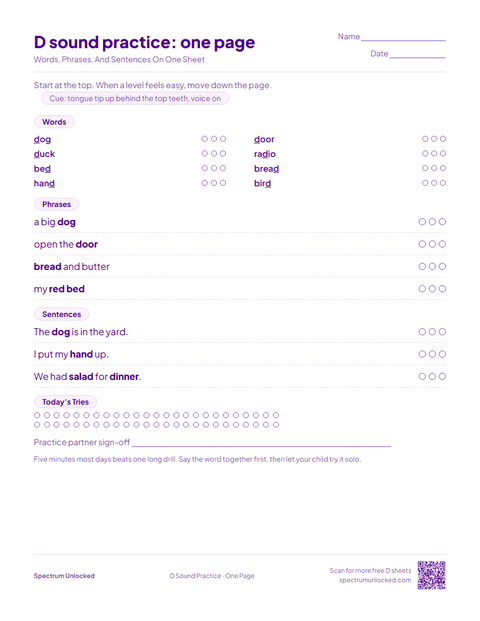
D Sound Practice: One Page
Words, phrases, and sentences on a single sheet, with a try counter and a practice partner sign-off. Five minutes, most days.
Download The PDF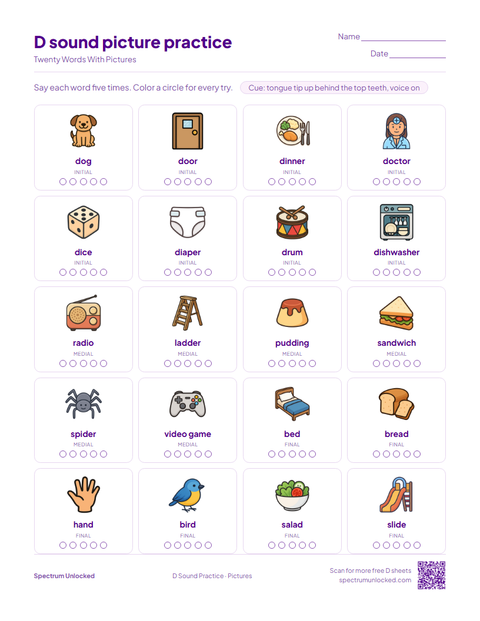
D Sound Picture Practice
Twenty D words with pictures, five tries each. Made for younger children who are not reading yet.
Download The PDFD Sound Pack
Every practice level, printed and ready: picture pages, word lists by position, drill sheets, phrases, sentences, the sound cue card, a weekly tracker, and the therapist data sheet. 15 sheets, each in full color and ink-saver black and white, so no color printer is needed.
Get The Pack For $4Initial D Words
The D sound at the start of the word, easiest first:
1 Syllable
dog · door · duck · desk · doll · dice · dish · day · down · dark · deep · dad · dip · dot · done · dance
2 To 3 Syllables
dinner · doctor · donut · diaper · dolphin · dinosaur · donkey · double · daisy · dolly · dentist · desktop · daddy · dozen
Print This List
One tap opens the worksheet maker with 30 starter words from these lists loaded, dotted and ready to trace or read aloud.
Make The Practice SheetMedial D Words
The D sound in the middle of the word, where it sits between two vowels:
2 To 3 Syllables
radio · ladder · window · pudding · shadow · reading · riding · hiding · body · order · medal · spider · cider · muddy · sandwich
3 Or More Syllables
yesterday · wonderful · elderly · president · video game · dandelion · calendar page
Print This List
One tap opens the worksheet maker with 22 starter words from these lists loaded, dotted and ready to trace or read aloud.
Make The Practice SheetFinal D Words
The D sound at the end of the word. Final D needs the voice to stay on right through the tap, so it often lands as a T instead:
1 Syllable
bed · bread · head · hand · food · bird · card · cloud · sad · red · road · ride · side · wide · loud · hard · slide
2 To 3 Syllables
salad · playground · backyard · hotdog stand · sandwich bread
Print This List
One tap opens the worksheet maker with 22 starter words from these lists loaded, dotted and ready to trace or read aloud.
Make The Practice SheetDR Blend Words
Two sounds run together with no vowel between them. Blends usually come after single D is comfortable:
DR Words
drum · dress · drink · draw · dry · drive · dragon · drop · dream · driveway · drawer · dresser
Print This List
One tap opens the worksheet maker with 12 starter words from these lists loaded, dotted and ready to trace or read aloud.
Make The Practice SheetPracticing more than a few minutes a week? The full pack has the drill sheets, the weekly tracker, and the therapist data sheet printed and ready, so practice runs itself.
See The D Sound PackHow To Practice At Home
Five minutes, most days. Say each word together first, so your child hears a clear model before trying it. Then move the word into a short phrase, like "a big dog," and when that feels easy, let your child build their own sentence around it. That word-phrase-sentence ladder is how speech practice usually climbs, and staying on a rung until it is comfortable beats hurrying up the ladder.
Keep it light. Sound practice works best in games, in the car, and at snack time, not as a drill at a desk. For a child who likes to see progress, tally correct tries on a sheet from the free data sheet maker, which prints a simple tracker your SLP can read at the next session. And when your child would rather trace than talk first, the practice sheets above double as handwriting pages built from the same words.
Common Questions
- Are these D word lists free?
- Yes. Every list and practice sheet on this page is free to print, with no account.
- At what age should a child say a clear D?
- D is an early sound, usually clear by around age three, often alongside T and B. A child without a clear D at three and a half is worth raising with a speech-language pathologist.
- My child says T instead of D. Is that normal?
- It is the most common D pattern and it is a voicing swap. T and D are made in exactly the same place, tongue tip on the ridge behind the top teeth, and differ only in whether the voice is on. Put your child's hand on your throat and hold each one: D buzzes, T does not.
- My child says G instead of D. Is that normal?
- It is less common than the T swap and it is the reverse of velar fronting: instead of moving a back sound forward, the child is moving a front sound back, so "dog" comes out "gog." The cue is the tongue TIP. Ask for the tip to touch the ridge behind the top teeth, and press gently under the chin so the back of the tongue stays down.
- My child drops the D at the end of words. Is that normal?
- It is common, and it has a name: final consonant deletion. "bed" becomes "beh" and "hand" becomes "han." Final D is hard because the voice has to keep going while the tongue taps and nothing follows to carry it. Hold the ending a beat longer than feels natural when you model.
- Should we practice T or D first?
- Usually T. The two share a mouth position and differ only in voicing, and T is the simpler version. Once T is clear, D is often a short step: hold the same tongue position and add the hum.
- How many words should we practice at a time?
- Five to ten words in a sitting is plenty. Saying a short list well beats rushing a long one, and coming back to the same words across several days is what makes the sound stick.
- Is there a printable pack for the D sound?
- Yes. The D Sound Pack collects every practice level: picture pages, word lists by position, drill sheets, phrases, sentences, the cue card, a weekly tracker, and the therapist data sheet, with every sheet in full color and ink-saver black and white. The two sheets above stay free either way.