Bedroom and Personal Space Routines for Teens
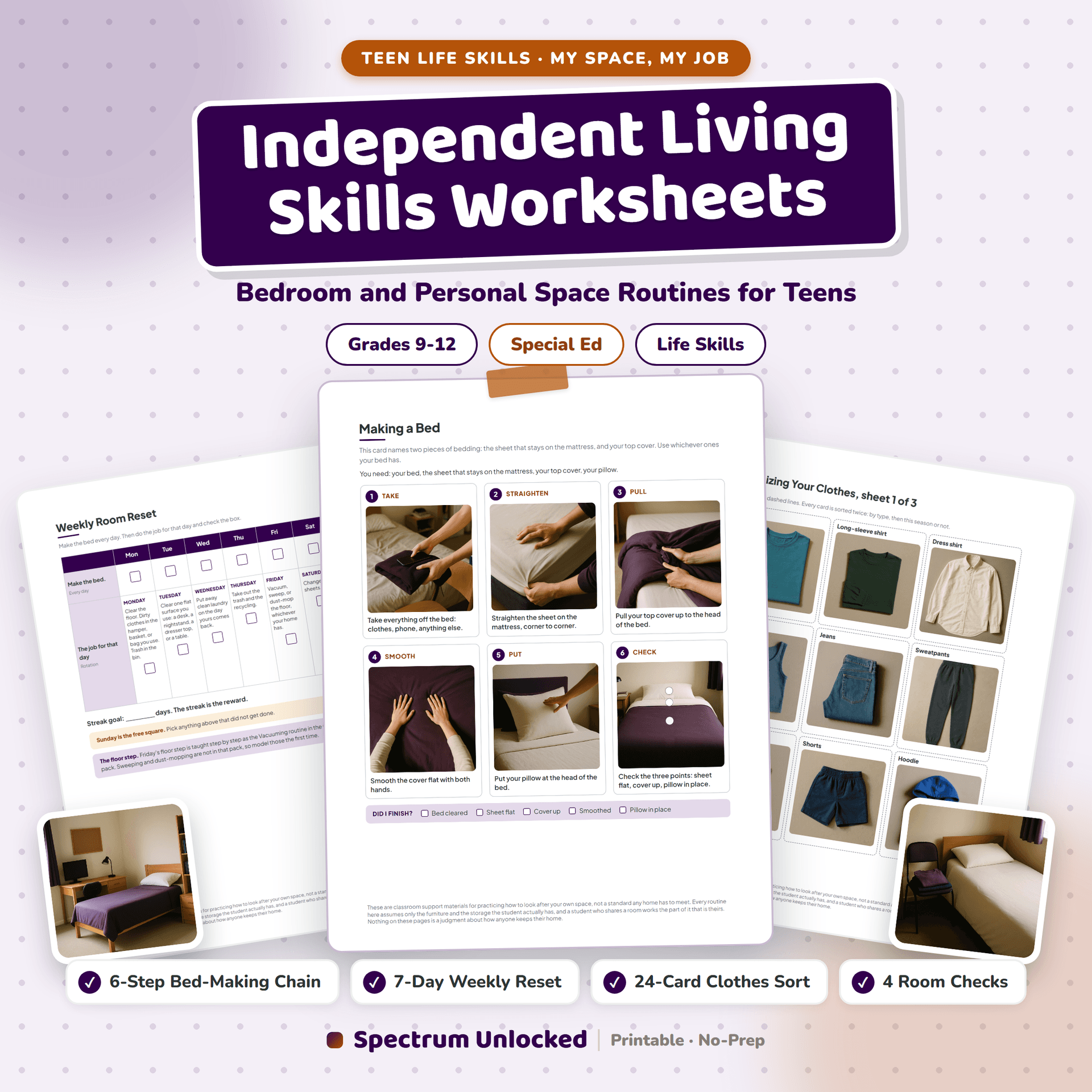
Bedroom and personal space routines for teens and young adults in special education: a six-step bed-making chain, a seven-day room reset, a 24-card clothes sort and a room check with four before-and-after photo pairs. The bed-making chain is one action per step and ends on a three-point standard that is printed on its own card, so the goal scores against something the student can see; the optional fold sits off the numbered chain, so skipping it costs nothing. The reset grid runs all seven days with the bed as a daily row above the rotation, not a weekday slot. The clothes sort is two passes, six zones by type and then this season or not, with write-in cards for what the zones do not cover. The room check prints the priority rule it scores. Nothing assumes a private room, a closet, a hamper or a vacuum. Plus three levels, a checklist of eight lines, a data sheet and two copy-paste IEP goals.
$4
Instant download after checkout. No account needed.
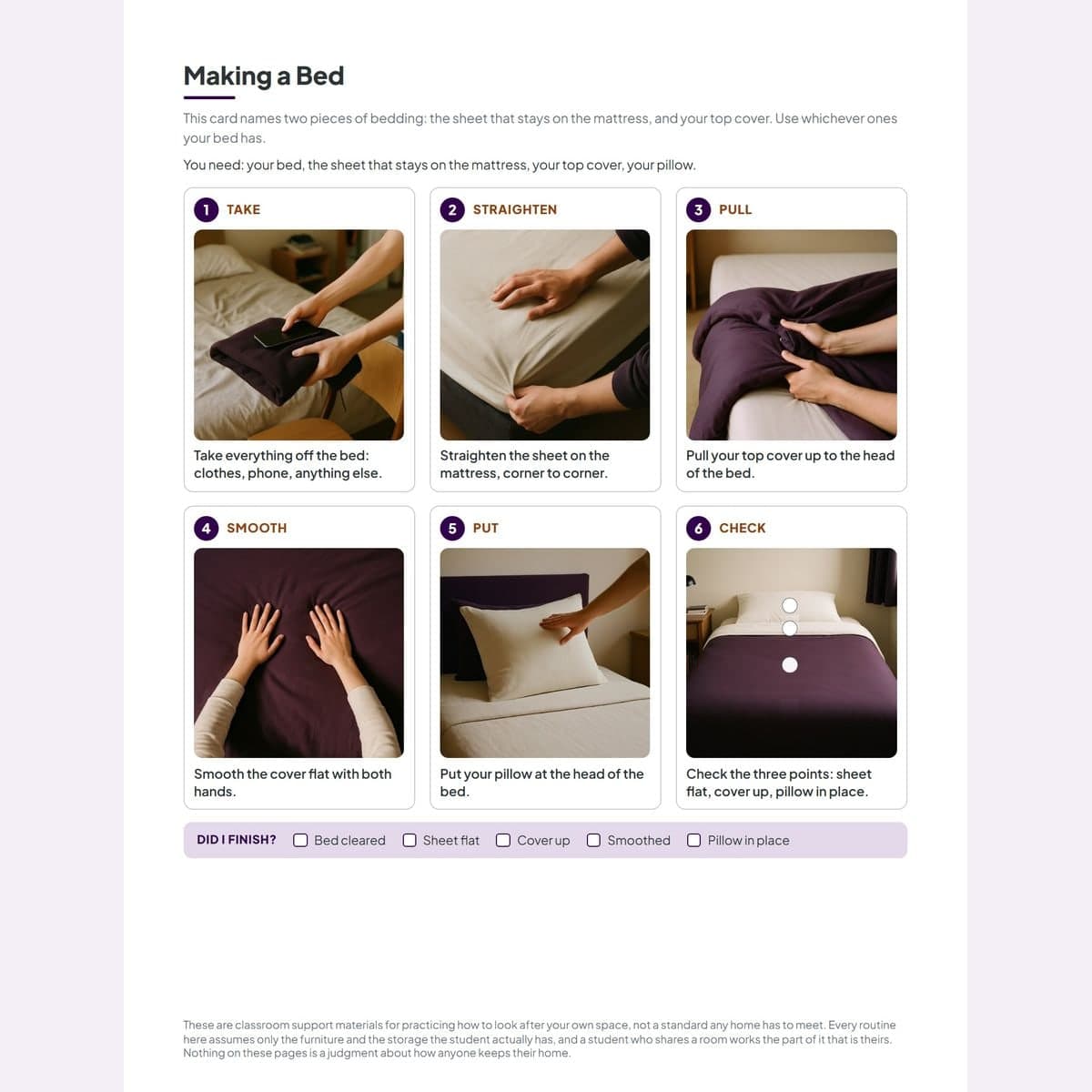
Making a bed looks like one action and is really six, and the last one is the one that usually goes missing: knowing when it is done. This pack prints a three-point standard on its own card, so a student can look at the bed and check it against something, and so an IEP goal has something real to score. The chain is one action per step and it starts where a real bed starts, with taking everything off it. The optional folded edge is not step five of a numbered chain, because a student who follows chains literally has no rule for optional, and a data sheet that scores six steps should not mark someone down for correctly skipping one; it sits on an extension card instead. The weekly grid runs all seven days with the bed as a daily row above the rotation, so the daily task is not stuck in a Tuesday slot, and Saturday changes the sheets, which the bed-making chain quietly assumed had happened. The clothes sort is two passes rather than one muddle: six zones by type, then the same cards again for this season or not, with write-in cards for the clothes a fixed zone list never covers. Nothing here assumes a private room, a closet, a hamper or a vacuum.
What is included
- The six-step bed-making chain as photo steps, one action each, ending on the three-point check, with cut-apart step cards and a sequence mat to lay them on
- The three-points card the IEP goal scores against: sheet flat, cover up, pillow in place
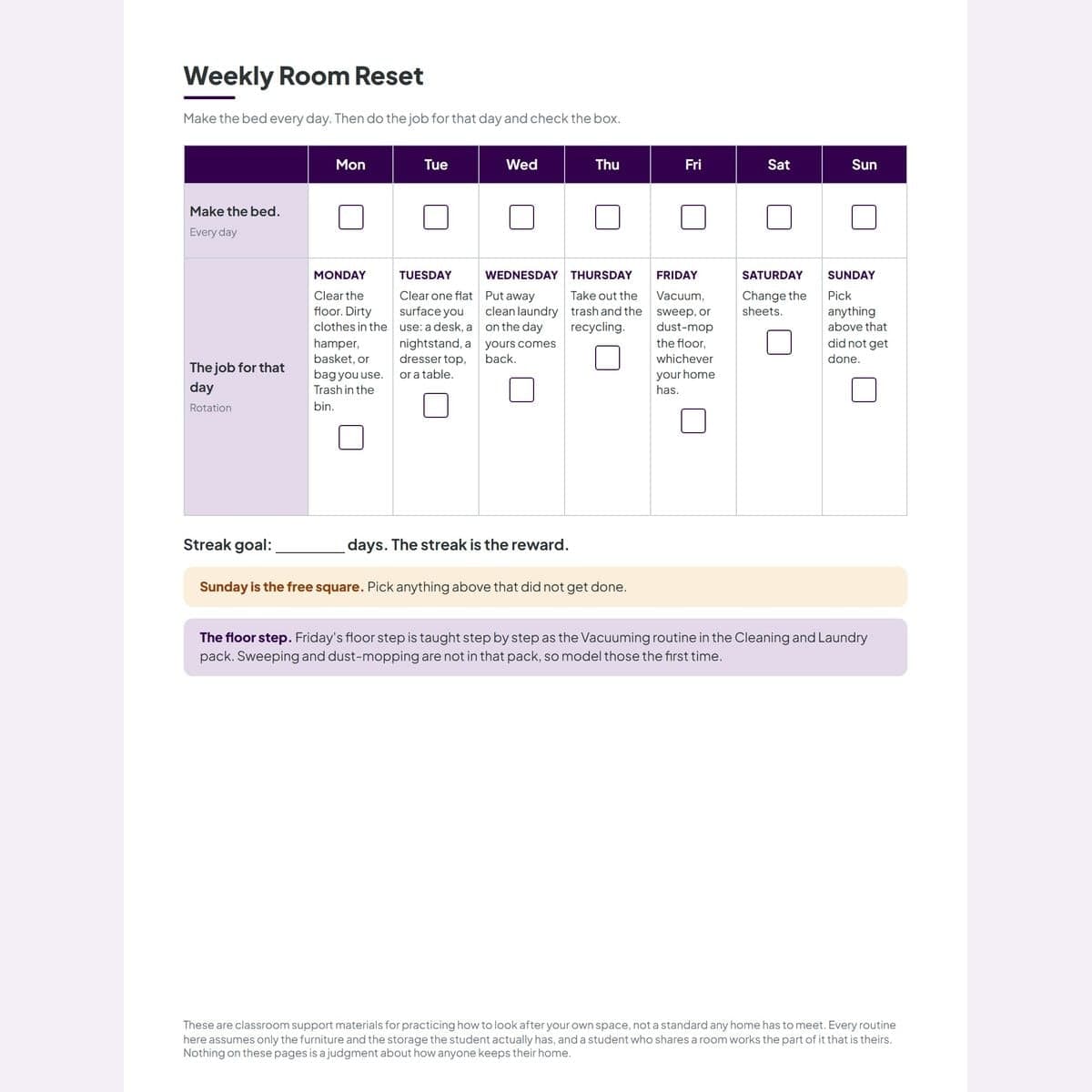
- The seven-day Weekly Room Reset with a daily bed row and a streak goal, a task a day including changing the sheets, and a free square
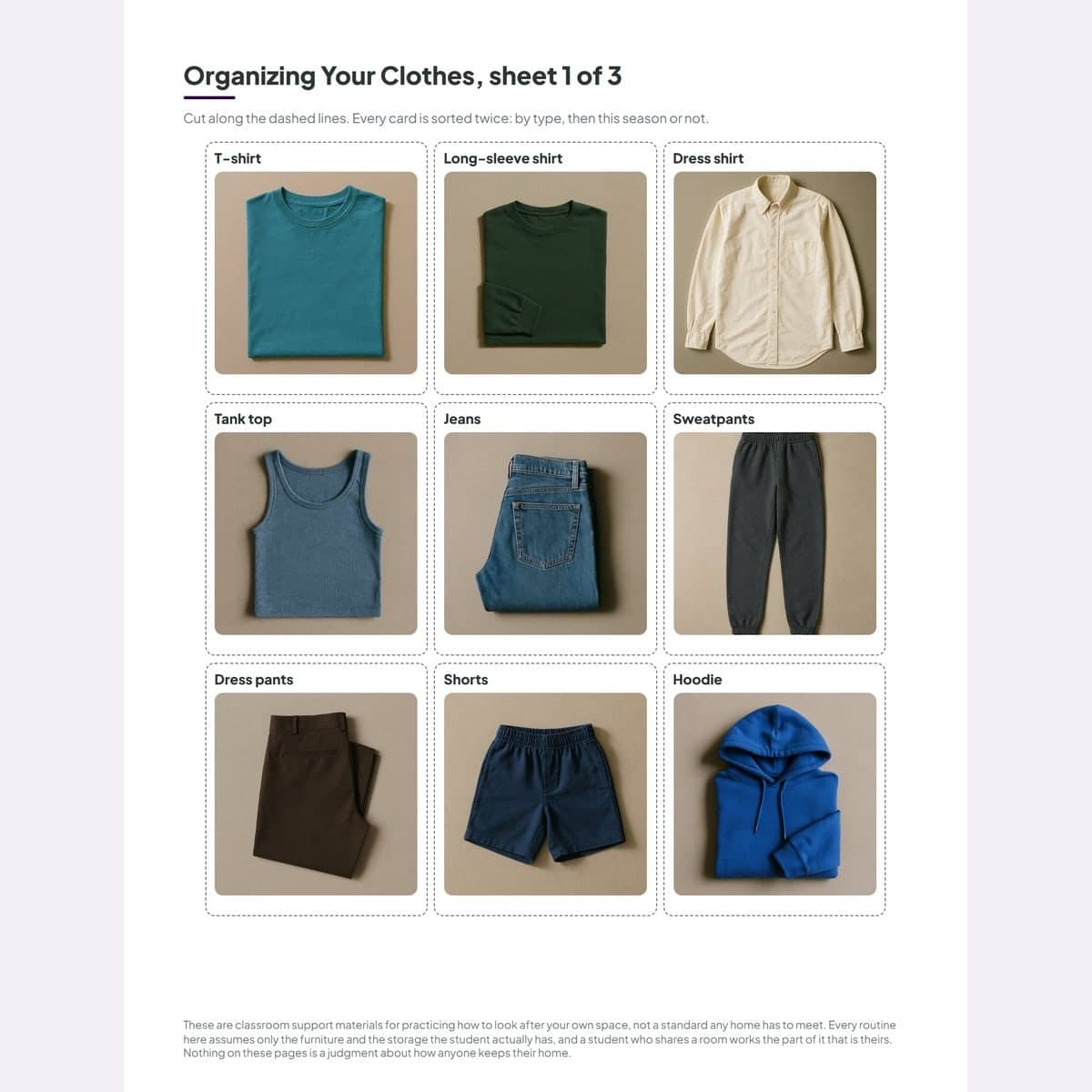
- The clothes sort, 24 photo cards across six type zones, then a second pass for this season or not, with a printed key and write-in cards
- Room Check, four before-and-after photo pairs with the priority rule printed on every room page and an answer key for every pair
- Three levels, a weekly reset of eight lines, a data sheet with derived denominators, and two copy-paste IEP goals
- Neutral wording throughout for a shared room, a group home, or a room with no closet, dresser or vacuum, plus the home-connection note for families
- US Letter and A4 print files, everything single-sided
Formats, license and delivery
- Formats
- Print-ready PDF, US Letter and A4, everything single-sided. Sort cards print best on cardstock; every page still reads in black and white.
- License
- Licensed for personal and single-classroom use by the purchaser. For another classroom or teacher, please add a license for each.
- Delivery
- The download unlocks the moment Stripe checkout completes and the link is emailed to you. The pack also stays in your My Resources library, reachable anytime through a magic link sent to your email.
- Refunds
- Because this is an instant digital download, all sales are final. If a file will not open or you bought the wrong pack, email info@spectrumunlocked.com and Spectrum Unlocked will make it right.
Questions from teachers
- Who is this pack for?
- Teens and young adults from about 13 to 22 in special education, life skills and transition programs, and the families doing the same routines at home. The framing is that this is the student's own space and their own job, not a chore chart someone else grades.
- What is the three-point standard?
- It is the finish line for making a bed, printed on its own card so it is not a private judgment: the sheet on the mattress is flat, the top cover is pulled up to the head of the bed, and the pillow is at the head. The IEP goal scores against those three points, the last step of the chain checks them, and all three say the same words, so two different adults score the same bed the same way.
- What if the student does not have their own room, a closet, or a vacuum?
- None of those is assumed. The pack says your space, or the part of the room that is yours; clothes go wherever your clothes live, a closet, a dresser, a bin or a shelf; the floor task says vacuum, sweep or dust-mop, whichever your home has; and the clothes-away task happens on the day your laundry actually comes back. There is also a home-connection line inviting a family to tell you how they do it so the routine can match.
- Why is the weekly grid seven days instead of five?
- Because a student uses their room on Saturday and Sunday, and those are the two days they are most likely to be in it. A five-weekday rotation strands the weekend, and it also parked making the bed, which is a daily job, inside a Tuesday slot. The grid now runs Monday to Sunday with the bed as its own daily row, one task a day, and Sunday as a free square for whatever did not get done.
- Does the clothes sort work for every student's wardrobe?
- It sorts by one dimension at a time, which is what makes it work: six zones by type first, then the same cards again for this season or not. Anything the fixed zones do not cover, a dress, a skirt, a school uniform, a team jersey, a hijab, gets a write-in card rather than being filed somewhere it does not belong, and the printed key covers every card in the deck.
Want to try it first?
Grab the free Make Your Bed Visual Steps for Teens: Bedroom Routines sample. It is a real, print-ready slice of this pack, yours to download at no cost. You can browse all free samples too.
Get the Free Make Your Bed Visual Steps for Teens: Bedroom Routines SamplePrefer to build your own for free?
This pack is the finished, done-for-you set. If you would rather make your own from scratch, the free Visual Schedule Creator on Spectrum Unlocked does that at no cost.
Try the Free Visual Schedule CreatorPacks that go together
Cleaning & Laundry Life Skills Visual Routines
Six home maintenance routines for teens as full-page six-step visuals: washing and drying laundry with the sticker-dot machine trick, dishes, bathroom cleaning with a mandatory safety card, vacuuming, and trash day. Each routine has a Did I Finish self-check strip, cut-apart sequencing cards, and a comprehension check, plus a weekly chore tracker with a streak goal, wallet-size mini cards, a home connection letter, a reusable data sheet with a safety-steps column, and copy-paste IEP goals. Three levels: match, sequence, independent.
Life Skills Task Boxes: Home Organization Work Bins for Teens (Laundry, Junk Drawer, Mail, Chores)
Five home task boxes for teens and young adults in special education: sort 24 laundry cards into three piles, put 18 junk-drawer items back into six compartments, match 16 lids to their containers, sort 20 pieces of mail into keep, later, recycle or ask someone you trust, and put five home routines in order. Photo cards, a mat that looks like the real surface, a rule card and a teacher key for every box; three levels, a data sheet that says what one point is, a portfolio cover and two copy-paste IEP goals. US Letter and A4.
Hygiene Routines: 8 Self-Care Task Cards
Eight self-care routines as full-page visual task cards for teens, with a Did I Finish self-check strip, cut-apart sequencing cards, comprehension checks, a weekly self-monitoring tracker, wallet-size mini cards, and three difficulty levels.
Looking for more? Browse all classroom packs.
Reviews
Be the first to review this pack.