Slanted Line Cutting Strips
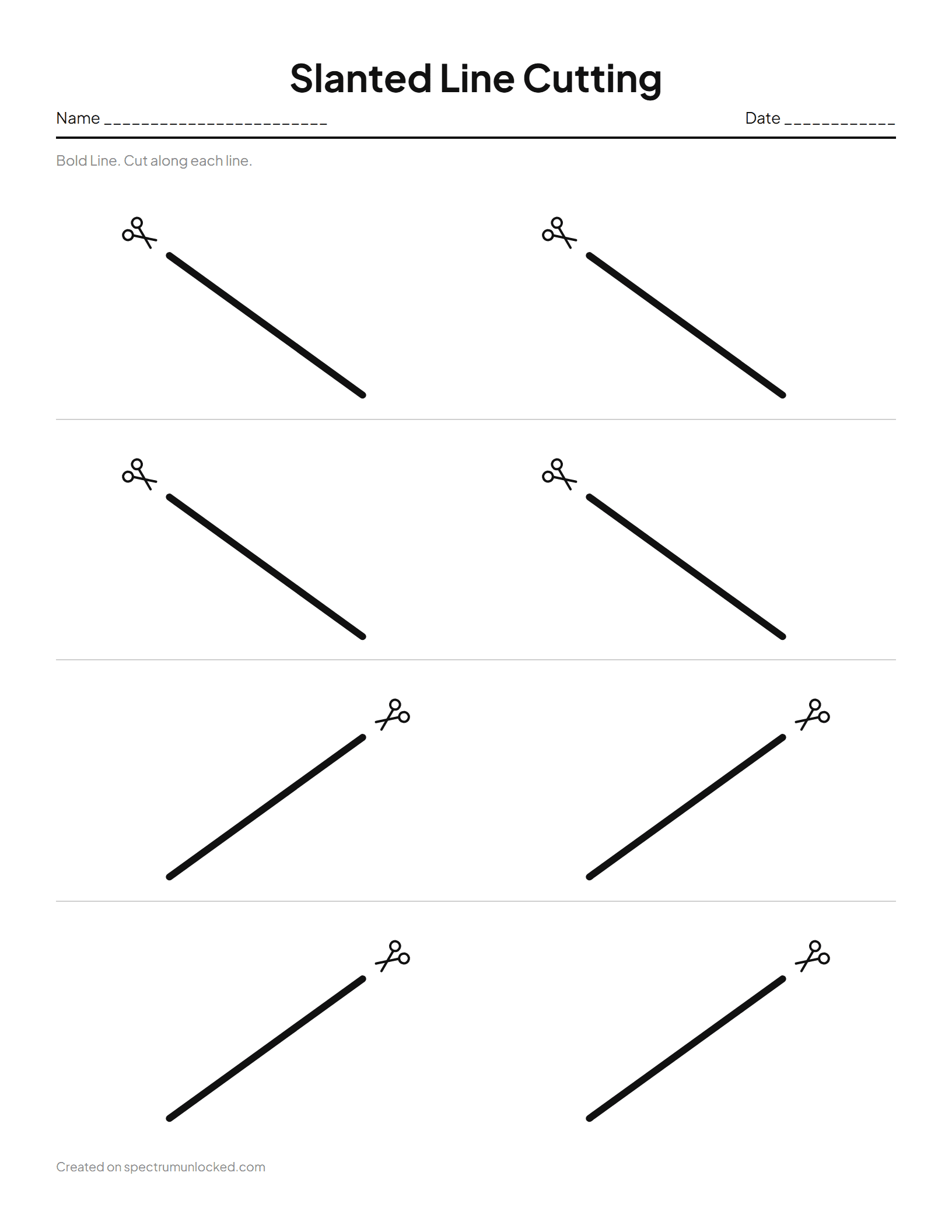
Free slanted line cutting practice: bold diagonal lines in both directions that teach the helper hand to angle the paper.
- When should a child practice slanted cutting lines?
- Why does my child turn the scissors instead of the paper?
- Which direction should we start with?
- Is there an easier version of this sheet?
Nothing left to prepare. Three finished sets, $8 each, and every page prints exactly as it is.
Why Slanted Lines Get Their Own Sheet
A slanted line is the first cut where the helper hand has to angle the paper instead of just holding it. That is a new job, so it gets its own page: both diagonal directions, nothing else mixed in.
Both Directions Matter
Cutting down to the right and down to the left use the helper hand differently, and most children find one direction easier. Practice both; the harder one is quietly building the paper-turning skill that zigzags and curves need next.
Make It Easier Or Harder
This set prints with a bold line. In the generator the same slants fade from a wide gray guide down to dashes and dots, and the zigzag set is the natural next step once both directions are steady.
Common Questions
- When should a child practice slanted cutting lines?
- After straight-across lines are comfortable, typically somewhere past age three. Slants are the bridge between straight lines and zigzags.
- Why does my child turn the scissors instead of the paper?
- It is the natural first instinct. Pause and practice turning the paper alone with no cutting, then put the two together; the thumb-up helper hand does the angling.
- Which direction should we start with?
- Whichever the child finds easier, then the other. Both directions are on the sheet so neither gets skipped.
- Is there an easier version of this sheet?
- Yes. Open it in the generator and switch the line style to Wide Guide for a broad gray channel around the same slants.