Pre-Writing Strokes Worksheets
Free pre-writing strokes worksheets that mix all fourteen strokes on one page, from straight lines to loops. Print the PDF or pick your own mix in the free worksheet maker.
- What are the pre-writing strokes?
- What order should the strokes be taught in?
- Is this sheet too hard for a beginner?
- Is this worksheet free?
Nothing left to prepare. Three finished sets, $8 each, and every page prints exactly as it is.
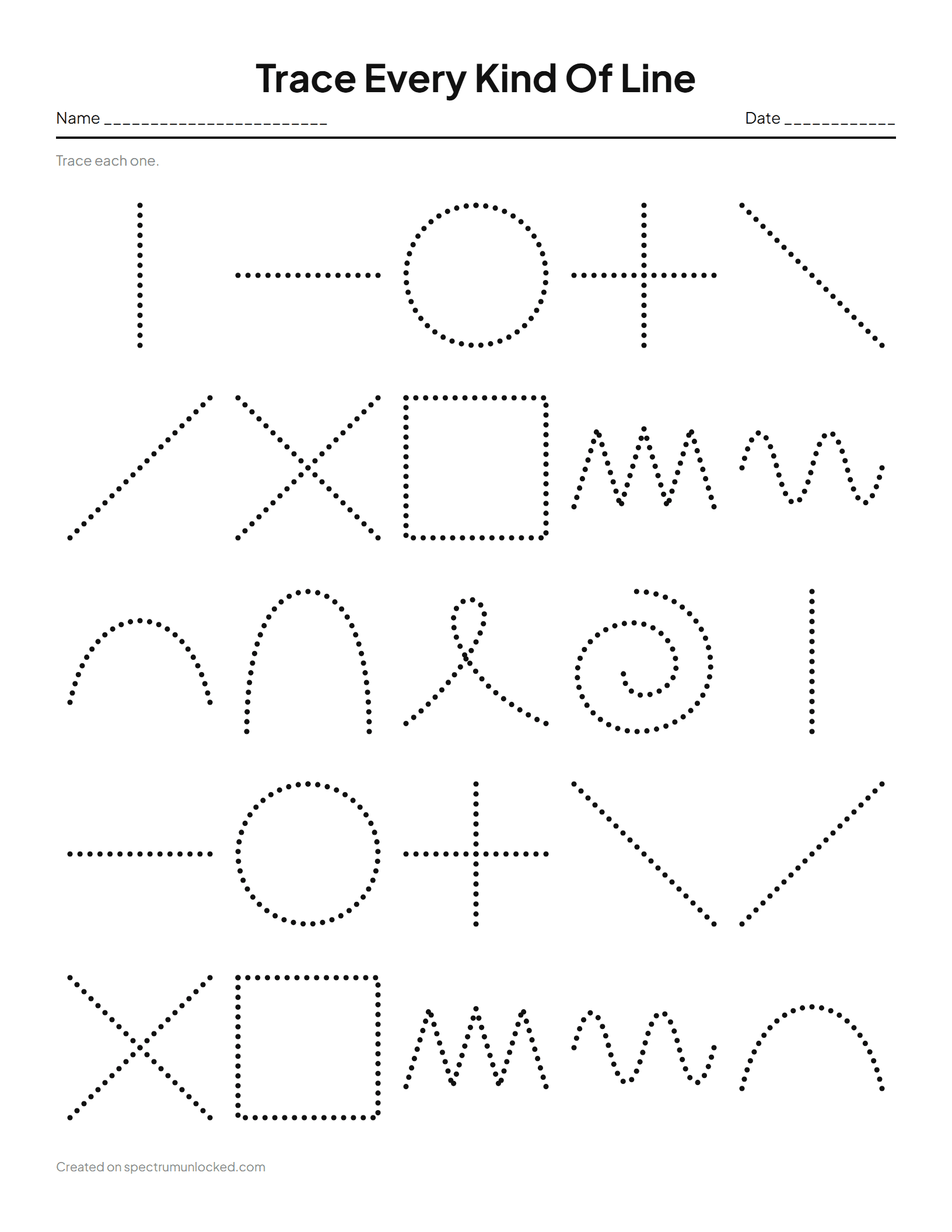
The Whole Bank On One Page
This sheet cycles every stroke in the bank, from the first vertical line to the spiral and the loop, small and mixed. It is the review page: the one to print when a child has met most of the strokes and the job is keeping them all warm rather than introducing anything new.
Mixed practice is genuinely harder than a page of one stroke, because every cell asks the hand to re-decide what movement comes next. That difficulty is the point, and it is also why this is the wrong first sheet for a beginner.
What The Strokes Add Up To
The bank follows the developmental sequence: vertical and horizontal lines first, then the circle and cross, then diagonals and their combinations, then the curved family of waves, arches, spirals and loops. Together they cover every movement the print alphabet uses, and the loop reaches ahead to cursive.
A teacher can read the page as an informal audit. The strokes a child skips, rushes or turns into something else are the ones that want their own single-stroke sheet for a week.
Building A Custom Mix
Fourteen strokes is a lot of variety, and most children need a narrower mix at any given moment. Open the sheet in the free worksheet maker and keep only the strokes in play this week; the page refills from whatever is selected, so two strokes or ten both make a full sheet.
The single-stroke and single-family sets on this site, vertical lines, diagonals, curves and zigzags, are ready-made versions of exactly that narrowing.
Common Questions
- What are the pre-writing strokes?
- The short list of movements letters are built from: vertical and horizontal lines, circles, crosses, both diagonals, the X, squares, zigzags, waves, curves, arches, spirals and loops. Children practice them before letters because each can be learned without also remembering a letter's shape.
- What order should the strokes be taught in?
- Vertical, then horizontal, then circle and cross, with diagonals and their combinations last. The curved family runs alongside from about age three. The order follows how hard the movement is, and it matters more than any specific age.
- Is this sheet too hard for a beginner?
- As printed, probably. It mixes every stroke at the smallest size, which suits review. A beginner does better starting from the vertical line set, or from this sheet opened in the free worksheet maker with a bigger size and only two or three strokes selected.
- Is this worksheet free?
- Yes. The PDF download is free, with no account and no watermark, along with everything else the worksheet maker prints.