Fish Feeding Visual Schedule for Autism (Plus Dog, Cat, Plant)
Free printable fish feeding visual schedule for autistic kids, plus dog walking, cat litter scooping, and plant watering templates. Picture cards that make daily pet care predictable, with icon libraries, apps, and the science behind why pet care builds executive function.
A pet care visual schedule is a printable sequence of picture cards that walks an autistic child through one specific chore (feeding the fish, walking the dog, scooping the cat box) so the routine becomes predictable instead of demanding. For autistic kids, pet care is one of the highest-value chore categories because it bundles routine-keeping, motor sequencing, and care for a living thing into a daily practice. The visual schedule removes the executive-function tax so your child can focus on doing the chore, not remembering the order. Below are four free templates for the most common starter chores, plus icon libraries, apps, and the reasoning behind why these chores work so well.
Why Pet Care Builds Executive Function for Autistic Kids
Occupational therapists recommend pet care as a starter chore for autistic kids because the demand is structured and the feedback is concrete. A bedtime routine has no immediate consequence if you skip it. A fish goes belly-up if you forget for three days. A dog stops eating its dry food if no one refills the water bowl. That tangible cause-and-effect is exactly what executive-function practice needs.
The other piece is the chore stays consistent. Unlike school assignments (which vary daily) or social interactions (which shift unpredictably), pet care is the same sequence every time. That repetition is where autistic kids tend to gain ground fastest, because the cognitive load drops once the sequence is memorized and the child can run the routine on autopilot. The visual schedule shortens the memorization phase from months to weeks.
Free Pet Care Visual Schedule Templates (SU)
Fish Feeding (5 steps)
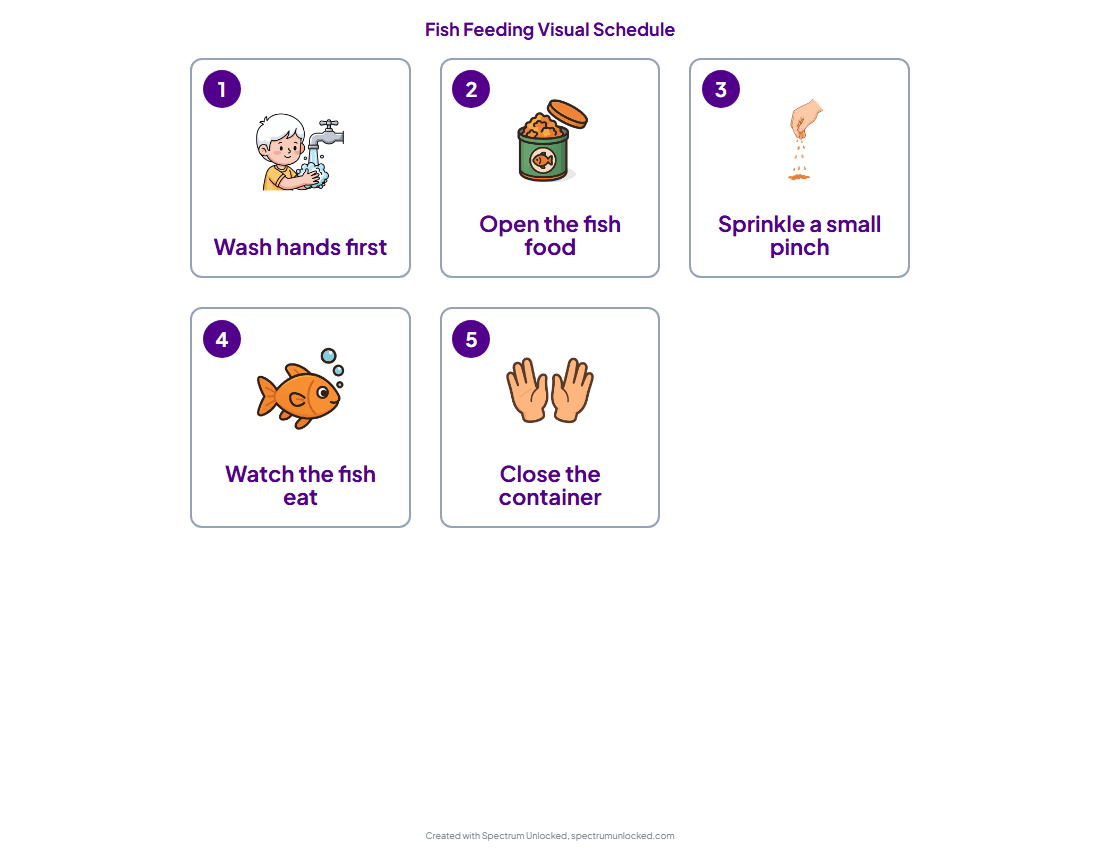
This free printable fish feeding visual schedule breaks the chore into five picture steps an autistic child can follow on their own. Wash hands, open food, sprinkle a pinch, watch the fish eat, close container. Designed to prevent overfeeding (the #1 cause of pet fish death in kid households). Best starter chore for autistic kids ages 4 to 8.
Dog Walking (6 steps)
Clip on leash, walk outside, bag the poop, walk home, refill food and water, wash hands. The full loop, not just the walk itself. Best for kids ages 7 and up who are building toward solo neighborhood walks at age 10 to 12.
Cat Litter Box (5 steps)
Put on gloves, open bag, scoop, tie bag, wash hands. Built to lower the sensory and disgust hurdles that usually stop kids from doing this chore. Best for ages 8 and up.
Plant Watering (5 steps)
Get watering can, fill with water, pour into each plant, check the leaves, put can back. The gentlest starter chore. Plants forgive missed days and over/under-watering teaches care without catastrophic stakes.
All four templates are free, no email required, customizable in the editor, and print as PDF.
Free Pet Care Icon Libraries
ARASAAC (Aragonese Center for AAC)
Search ARASAAC for any specific pet care step ("dog leash," "fish food," "cat litter," "watering can," "scoop," "trash bag"). Over 40,000 free pictograms, CC-BY-NC-SA licensed, designed for AAC and visual supports. Particularly strong for pet-specific items that generic icon libraries skip.
Twinkl Pet Care Cards (Free Tier)
Search "pet care visual schedule," "dog routine cards," or "fish feeding sequence." Twinkl's free tier has ready-to-print pet care sequence cards in a few formats.
Apps and Digital Visual Schedules for Pet Care
Choiceworks (iOS)
A widely-used visual schedule app from BeeVisual. Build a per-chore schedule, add reminders, and let your child check off each step on a tablet. Useful when your child is past the printable stage and wants the satisfaction of digital check-offs.
Brili Routines (iOS / Android)
Routine-tracking app that pairs schedules with timers and gamification. Particularly useful for autistic kids who respond well to time-bounded chunks (e.g., a 20-minute dog walk with a visible timer).
Visual Schedule Planner (iOS)
Pricier ($14.99) but more customizable than the free options. Worth it if your child uses visual schedules across many domains and you want one app that holds everything.
How to Pick the Right Starter Pet Care Chore
If your child has never done a regular chore, start with plants. The stakes are low, the sensory experience is pleasant, and the feedback loop is gentle. Give them three to six months of consistent plant watering before promoting to a higher-stakes chore.
If your child has done some chores and you want them on a real pet, fish feeding is the next step up. Short routine, real living creature, but the consequence of forgetting one day is reversible. Most kids ages 6 to 8 can hold this chore for a full year.
Dog walking and cat litter scooping are the highest-skill of the four. Reserve these for kids ages 8 to 10 who have proven they can hold an earlier chore for at least six months. The visual schedule helps but it does not replace the underlying capacity.
Related SU Resources
Want the powered-up version?
This is the free version. Beacon is the powered-up version: personalized to your child, always available, and it remembers everything.
Talk to Beacon →