Velar Fronting: Minimal Pairs, Examples, And Activities
Fronting is when a child makes a back-of-the-mouth sound at the front, so “key” comes out as “tea” and “gate” as “date.” Below are 21 picture pairs for K and G at the start and the end of words, with a free practice sheet and a short home routine.
- Free practice sheet: picture pairs, ready to print
- What fronting is: examples, and when it usually stops
- Initial K To T Pairs: key and tea, cape and tape
- Final K To T Pairs: back and bat, bike and bite
- Initial G To D Pairs: gust and dust, gate and date
- Final G To D Pairs: bug and bud, mug and mud
- Activities for home: five minutes, most days
- When to see a speech-language pathologist
What Is Fronting?
Fronting, often called velar fronting, is one of the patterns young children use while their speech is still developing. K and G are made at the back of the mouth, with the back of the tongue lifting up. A child who fronts makes them at the front instead, with the tongue tip, so “cup” sounds like “tup,” “go” like “doe,” and “duck” like “dut.”
The swapped word is often a real word, so fronting changes the meaning: “key” and “tea,” “back” and “bat,” “mug” and “mud.” That is why the pairs below put two pictures side by side: making the sound at the back is what makes the right picture the answer.
Initial K To T Pairs
Each pair is the same word with the K, or with a T in its place. Name both pictures, then say one and ask your child to point to it. When that is easy, swap roles: your child says one and you point to what you heard.
 tea
tea keyThe back of the tongue goes up for K; the tip taps for T.
 tape
tape capeA hero’s cape, a roll of tape.
 tub
tub cubA bear cub, a bath tub.
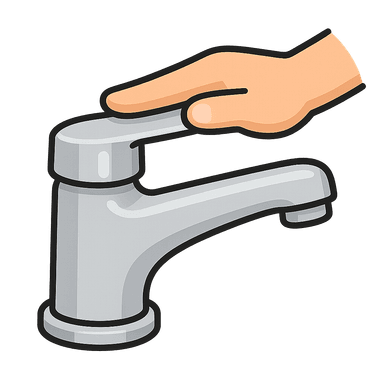 tap
tap capPut on a cap, turn the tap.
 top
top copA cop helps; a top spins.
 torn
torn cornEat the corn; the paper is torn.
Print This List
One tap opens the worksheet maker with 12 words from these pairs loaded, dotted and ready to trace or read aloud.
Make The Practice SheetFinal K To T Pairs
Each pair is the same word with the K, or with a T in its place. Name both pictures, then say one and ask your child to point to it. When that is easy, swap roles: your child says one and you point to what you heard.
 bat
bat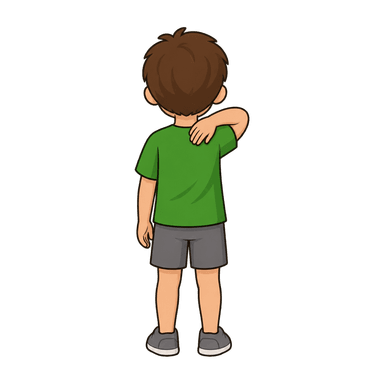 backThe K is at the back of the mouth, at the end of the word.
 bite
bite bikeRide a bike, take a bite.
 rat
rat rackPlates on a rack, a rat in the barn.
 net
net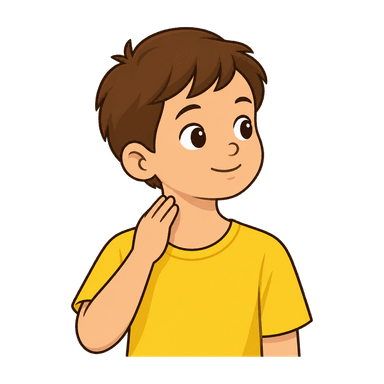 neckTouch your neck, catch it in a net.
 beat
beat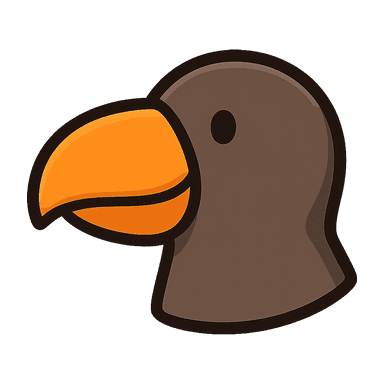 beakA bird’s beak, a drum beat.
 bait
bait bakeBake a cake, put bait on the hook.
Print This List
One tap opens the worksheet maker with 12 words from these pairs loaded, dotted and ready to trace or read aloud.
Make The Practice SheetInitial G To D Pairs
Each pair is the same word with the G, or with a D in its place. Name both pictures, then say one and ask your child to point to it. When that is easy, swap roles: your child says one and you point to what you heard.
 dust
dust gustG is K with a hum; it starts at the back too.
 date
date gateOpen the gate, pick a date.
 down
down gownA long gown; point down.
 deer
deer gearA metal gear, a deer in the woods.
 dill
dill gillA fish breathes with its gill; dill is a herb.
Print This List
One tap opens the worksheet maker with 10 words from these pairs loaded, dotted and ready to trace or read aloud.
Make The Practice SheetFinal G To D Pairs
Each pair is the same word with the G, or with a D in its place. Name both pictures, then say one and ask your child to point to it. When that is easy, swap roles: your child says one and you point to what you heard.
 bud
bud bugHold the back of the tongue up at the end of bug.
 mud
mud mugDrink from a mug, stomp in the mud.
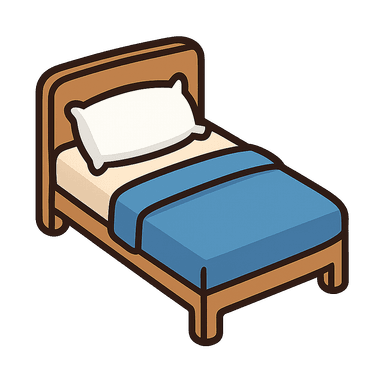 bed
bed begThe dog will beg; time for bed.
 bad
bad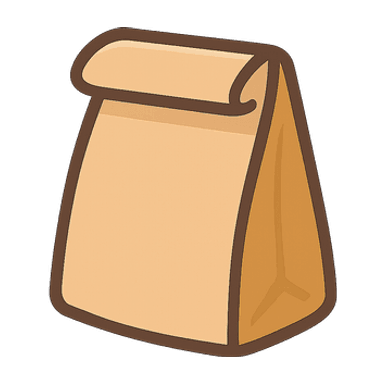 bagA lunch bag; thumbs down means bad.
Print This List
One tap opens the worksheet maker with 8 words from these pairs loaded, dotted and ready to trace or read aloud.
Make The Practice SheetHow To Practice At Home
Use any pair below. Keep it short and stop while it is still fun.
- Name both pictures for your child, making the K at the back of the mouth: “tea,” then “key.”
- Say one of the two words and let your child point to the picture you said.
- Swap roles: your child says a word and you point to the picture you heard. If they meant “key” and you point to the tea, show them the K comes from the back of the mouth and try again.
- When a pair is easy, move to the next one, then try the words in short phrases like “a gold key.”
When To See A Speech-Language Pathologist
Most children stop fronting by about 3 and a half to 4. Caroline Bowen’s table, built on Grunwell’s research, puts it at about 3 years and 6 months, and ASHA gives 4 as the likely age it goes away.
If your child is past 4 and still makes K and G at the front, or people outside the family often cannot understand them, ask a speech-language pathologist for an evaluation. Under IDEA, a parent can ask the public school district in writing to evaluate a child aged 3 or older, and the evaluation is free; our lisp guide walks through the request. For a child under 3, start with your state’s Early Intervention program.
Sources: ASHA, Selected Phonological Patterns; Caroline Bowen, Table 3: Elimination of Phonological Processes.
Print And Practice
One sheet of 8 pairs is free to download and print. The complete pack has every pair at every level.
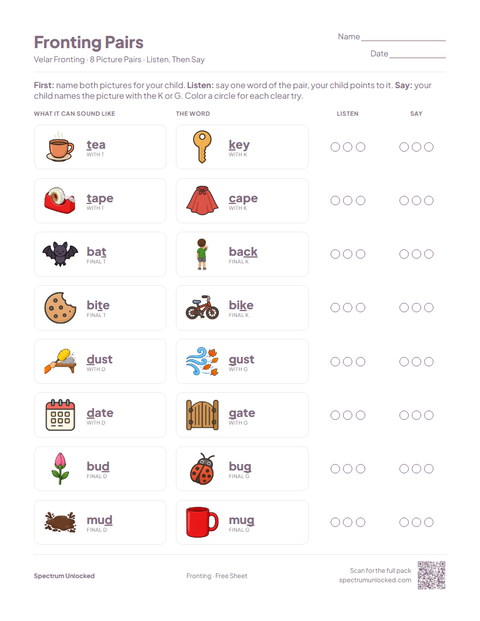
Fronting Pairs
Two pairs for each of K and G, at the start and the end of words, with pictures. Listen and point, then say, with circles to color for every clear try. A QR code on the back leads to every pair.
Download The PDFFronting Minimal Pairs Worksheets Pack
24 no-prep fronting sheets built on 21 picture minimal pairs for K and G at the start and the end of words: pair sheets, listening and saying sheets, 42 cut-apart picture cards, phrases and sentences, home practice pages and an SLP data sheet, in Color and Ink-Saver PDFs.
Get The Pack For $4Common Questions
- What is fronting in speech?
- Fronting, or velar fronting, is a speech pattern where a child makes K and G at the front of the mouth instead of the back, so “cup” sounds like “tup” and “go” like “doe.” It is common in young children whose speech is still developing, and ASHA lists it among the patterns that usually fade.
- At what age should fronting stop?
- Usually between about 3 and a half and 4. Caroline Bowen’s table, based on Grunwell’s research, says fronting is usually gone by about 3 years and 6 months, and ASHA gives 4 as the likely age it goes away. Children vary, so treat these as guides rather than deadlines.
- What are minimal pairs for fronting?
- They are two words that differ only by a K or G and a T or D, like key and tea, back and bat, gate and date, or bug and bud. Each word has its own picture, so a child who fronts ends up pointing to the wrong one and hears why the sound matters.
- What are some examples of fronting?
- Common examples are “tup” for cup, “tea” for key, “doe” for go, “date” for gate, “bat” for back and “mud” for mug. The child keeps the rest of the word and makes the K or G with the tongue tip, so it comes out as T or D.
- How do I practice fronting at home?
- Name both pictures in a pair first, making the K or G clearly at the back of the mouth. Then say one word and let your child point to it, and swap roles so your child says a word while you point to the picture you heard. Keep it short and stop while it is fun.
- When should my child see a speech-language pathologist?
- If your child is past 4 and still makes K and G at the front, or people outside the family often cannot understand them, ask for an evaluation. Under IDEA, a parent can ask the public school district in writing to evaluate a child aged 3 or older, and the evaluation is free.
- Are these word pairs free to print?
- Yes. Every pair on this page, with its pictures, and the practice sheet are free to print, with no account needed. You can also practice straight from the screen: name the two pictures, say one word, and let your child point to it.
Working on fronting at home?
Beacon talks a speech question through with you: what the pattern means for your child, how to fit practice into a day, and what to ask the speech therapist.
What would Beacon say?
"My 4 year old says "tup" for "cup" and "tea" for "key". How do I help them make the sound at the back?"