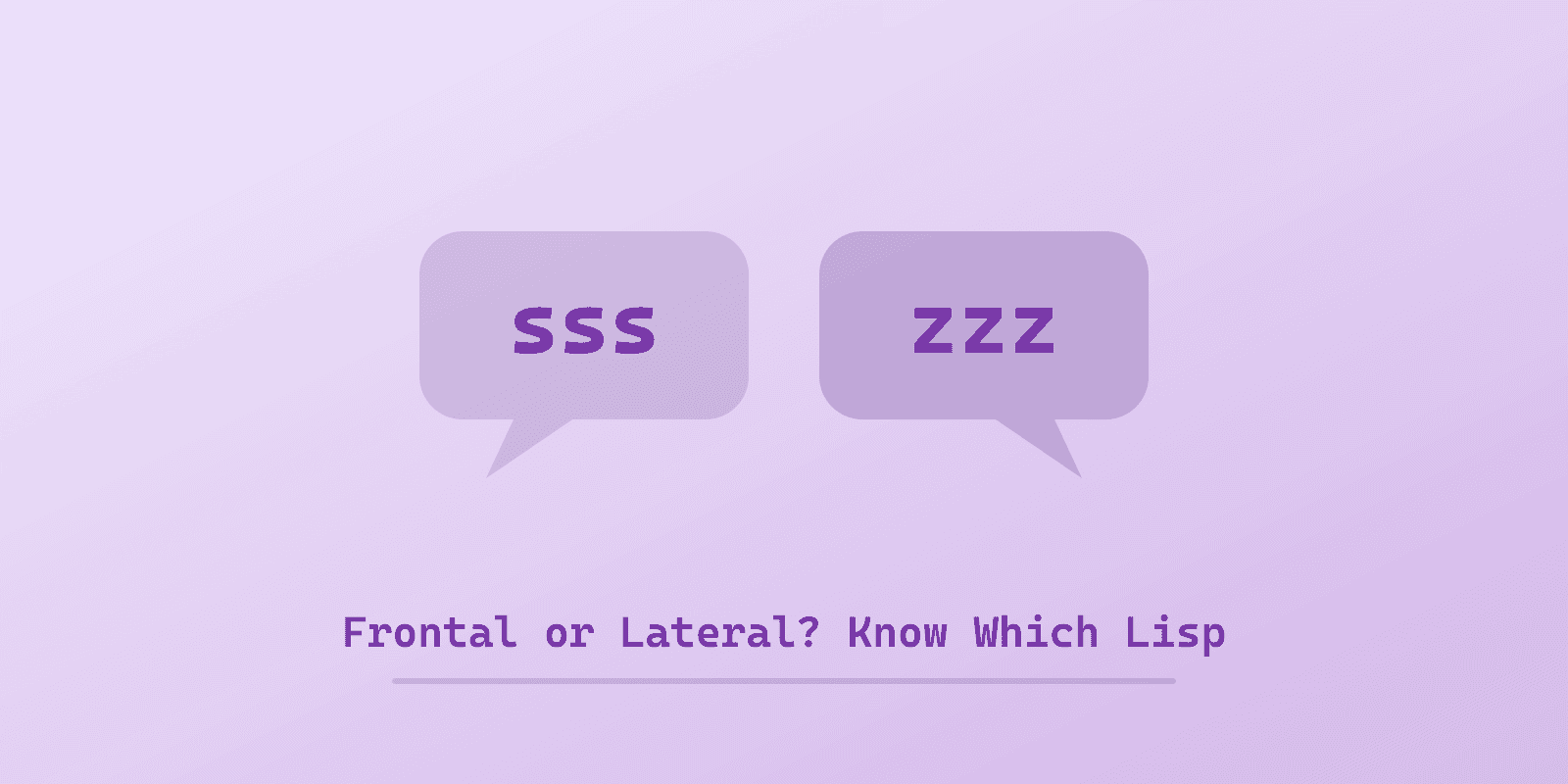
How to Fix a Lisp: Frontal, Lateral, and When to See an SLP
What a lisp is, the four types, which ones fade on their own and which need a speech-language pathologist, plus how to help at home and get a free school evaluation.
Key Takeaways
- A lisp is an articulation difference: the tongue sits in a spot that distorts S and Z, most often between or against the front teeth (frontal) or with air escaping over the sides (lateral)
- Frontal and dentalized lisps are a normal phase for some children until about age 4 and a half; one that is still there after that is worth an SLP assessment
- Lateral and palatal lisps are not part of typical speech development, so a child with either should be assessed by an SLP without waiting
- S and Z are made in the same spot, so a child who lisps on one tends to lisp on the other
- Word lists and games are home practice, not therapy; parents of children 3 and up can ask the public school district in writing for a free evaluation under IDEA
You hear it most on the words your child says all the time. "Thithter" for sister. "Yeth" for yes. You want to know how to fix a lisp, and the first honest answer is that it depends on which kind it is. Some lisps are a stage a young child passes through. Others call for a speech-language pathologist (SLP) without any waiting.
This guide covers what a lisp is, the four types SLPs describe, the ages that matter, how therapy works, and what you can do at home in the meantime.
What Is a Lisp?
A lisp is a type of articulation disorder. Boston Children's Hospital defines an articulation disorder as "incorrect placement of the tongue, lips, or teeth that distorts the sound of words." In a lisp, the sounds that get distorted are mainly S and Z.
The American Speech-Language-Hearing Association (ASHA) lists distortions as one kind of speech sound error, and the example it gives is "a lateral /s/," which is one of the lisp types below. Speech sound differences are common at this age, too. ASHA's summary of the research gives estimates ranging from 2.1% to 23% of 4- to 6-year-olds with a speech sound disorder.
The Four Types of Lisp
These descriptions come from Caroline Bowen, a retired speech-language pathologist and a Fellow of ASHA:
- Interdental (frontal) lisp. The tongue pokes out between the front teeth and the air is directed forward. Jamaica Hospital Medical Center describes the result as a "th" sound in place of S or Z.
- Dentalized lisp. The tongue rests on or pushes against the front teeth without poking through, which gives a slightly muffled S.
- Lateral lisp. The tongue sits close to where it would be for L, and the air flows out over the sides of the tongue instead of forward.
- Palatal lisp. The middle of the tongue touches the soft palate, far back in the mouth.
The first two can be developmental. The last two are not, and that difference decides whether you can wait.
Frontal and Interdental Lisp: Is It Developmental?
Frontal and interdental are two names for the same thing. Bowen writes that it is "a perfectly normal developmental phase for some (not all) children to produce interdental or dentalised /s/ and /z/ sounds until they are about 4½ years of age."
That number is the closest thing to a frontal lisp age of elimination you will find from a clinical source. It fits the wider research on when children learn these sounds. A 2020 review by Crowe and McLeod pooled 15 studies covering 18,907 children learning English in the United States, and put the average age for S and Z, along with SH, CH, J, V and L, at around 4 years. The same summary notes that typically developing 4- to 5-year-olds are usually understood even by strangers.
What if your child turns 5 and the frontal lisp is still there? Bowen is direct: "If they don't 'disappear' an SLP/SLT assessment is indicated." She also warns against a long wait, because "the longer the child waits the stronger any 'habit factor' will be."
Lateral Lisp: Why It Needs an SLP Now
A lateral lisp is a different story. Bowen states that "neither lateral or palatal lisps are part of the normal developmental progression," and that a child with either one "should be assessed, by a qualified speech-language pathologist/speech and language therapist, without delay."
So the answer to how to fix a lateral lisp starts with an evaluation, whatever your child's age. The 4 and a half guideline for frontal lisps does not apply here. Bowen also notes that children who lisp on S and Z sometimes have tongue placement trouble on SH, ZH (the middle sound in "measure"), CH and J, so mention those to the SLP if you hear them too.
Why a Lisp Shows Up on Both S and Z
S and Z are made in the same place. For both, the narrowing that makes the hiss sits between the blade of the tongue and the ridge just behind the upper teeth. The difference is voice: Z is voiced and S is not. You can feel this with your fingers on your throat while you say "sss" and then "zzz."
Because the tongue does the same job for both sounds, a child who lisps on S tends to lisp on Z as well. That is why the free Z word lists and the Z sound practice pack include S and Z word pairs, so a child can hear and feel the one thing that changes between them.
How an SLP Fixes a Lisp
A speech evaluation looks at more than the lisp. ASHA notes that a hearing screening is part of a full speech sound assessment, and that an oral mechanism exam checks "whether the system is adequate for speech production." If you have questions about teeth, bite or tongue movement, raise them with the SLP and your dentist rather than guessing from a blog post.
Treatment then follows a sequence that ASHA describes in three steps:
- Establishment: getting the child to make the target sound correctly on purpose.
- Generalization: carrying that sound into "increasingly challenging levels (e.g., syllables, words, phrases/sentences, conversational speaking)."
- Maintenance: making the new sound automatic, with the child noticing and correcting their own errors.
The first step is where the SLP matters most. Helping You Communicate, a family site built on ASHA's expertise, lists what treatment can include, starting with helping a child learn the correct way to make sounds and recognize when sounds are correct or incorrect. Once the sound is established, home practice earns its keep. Boston Children's Hospital notes that most children with speech disorders get weekly therapy "with a home programming component to help them practice their skills."
How to Fix a Lisp at Home (Alongside Therapy)
A word list is home practice. It is not therapy, and it cannot tell you whether your child's lisp is the kind that fades or the kind that needs treatment. With that said, a parent can do a lot, especially once an SLP has shown your child the new tongue position.
- Ask the SLP for the cue. Find out what words or gesture the SLP uses for the new placement, and use the same ones at home so your child is not juggling two sets of instructions.
- Practice at the level the SLP sets. If your child is working on S in single words, stay with single words until the SLP moves you on.
- Keep it short and regular. A few minutes fitted into something you already do, like the drive to school or bath time, is easier to keep up than a long weekend session.
- Practice both sounds. The free S word lists and Z word lists group words by where the sound falls, at the start, middle or end. For printed sheets, the S sound worksheets pack and the matching Z pack run from single words up to sentences.
- Listen together. Say a word both ways and ask your child which one sounded right. Hearing the difference is one of the skills therapy works on.
- Track the tries. A simple tally of correct and incorrect attempts gives the SLP real information between visits. The free data sheet maker prints a clean tracking sheet for this.
If your child is autistic and already sees an SLP for language or communication, ask whether S and Z can fit into the current plan rather than starting a separate program. If your child likes routine, keeping practice the same each time (same sheet, same cue, same reward) is an easy way to make it feel predictable.
Try to keep corrections for practice time. Ordinary conversation can stay ordinary, which keeps talking relaxed for a child who is already working hard on one sound.
When to Ask for an Evaluation
Putting the sources above together, these are the points where an SLP evaluation makes sense:
- Your child has a lateral or palatal lisp, at any age.
- A frontal or dentalized lisp is still there past about 4 and a half.
- The lisp also affects SH, CH or J, or strangers still have trouble understanding your child by age 5.
- You are worried about your child's speech for any reason. Helping You Communicate puts it simply: "If you're concerned about your child's speech development, consult a speech-language pathologist (SLP)."
Getting a Free Evaluation Through Your School District
For a child aged 3 or older, you can go straight to the public school district. Under the federal special education law, the Individuals with Disabilities Education Act (IDEA), a free appropriate public education "must be available to all children residing in the State between the ages of 3 and 21, inclusive." The regulations say that "either a parent of a child or a public agency may initiate a request for an initial evaluation." IDEA's definition of speech or language impairment names "impaired articulation" as one of the communication disorders it covers.
The Center for Parent Information and Resources, produced under a U.S. Department of Education grant, puts the cost plainly: "This evaluation is free of charge." Make the request in writing, address it to the principal or the special education administrator, and keep a copy for your records. After you sign consent, federal rules give the district 60 days to complete the evaluation, unless your state has set its own timeframe.
Whether a lisp qualifies for school speech services depends on whether it "adversely affects a child's educational performance," and the evaluation team makes that call. Even if it does not qualify, the evaluation tells you which kind of lisp you are dealing with, which settles whether to wait or to start therapy.
Which therapy first? That depends entirely on your child.
Beacon learns about YOUR child and gives guidance specific to them.
What would Beacon say?
"Which therapy should we start first?"
Beacon weighs your child's age, biggest challenges, and your insurance reality, then tells you what to prioritize instead of starting everything at once.
Spectrum Unlocked Editorial Team
Editorial Team
The Spectrum Unlocked editorial team combines lived experience as autism parents with research-backed guidance to create resources families can trust.
Frequently asked questions
- What is a lisp?
- A lisp is a type of articulation disorder, meaning the tongue, lips or teeth are placed in a way that distorts a sound. In a lisp the sounds affected are mainly S and Z. The tongue may push between the front teeth, rest against them, let air escape over its sides, or touch the soft palate far back in the mouth.
- At what age should a frontal lisp go away?
- Speech-language pathologist Caroline Bowen describes interdental (frontal) and dentalized S and Z as a normal developmental phase for some children until they are about 4 and a half. If the lisp has not faded by then, an assessment by a speech-language pathologist is the next step, and Bowen notes that waiting well past 4 and a half is not good advice.
- Is a lateral lisp something kids grow out of?
- A lateral lisp, where air flows out over the sides of the tongue instead of down the middle, is not part of typical speech development. The same is true of a palatal lisp. A child with either one should be assessed by a speech-language pathologist without waiting to see whether it fades.
- Can I fix my child's lisp at home?
- Home practice helps, but it works as a partner to therapy rather than a replacement for it. A speech-language pathologist teaches the child the correct way to make the sound, which a word list cannot do. Once the sound is there, short practice at home with words, phrases and sentences supports the therapy, and most children in speech therapy have a home practice component.
- Why does my child lisp on both S and Z?
- S and Z are made in the same place, with the blade of the tongue near the ridge behind the upper teeth. The difference is that Z is voiced and S is not. Because the tongue does the same job for both sounds, a child who lisps on one tends to lisp on the other.
- How do I get a free speech evaluation for my child?
- Under the federal special education law (IDEA), a parent can ask the public school district to evaluate a child aged 3 or older, and the evaluation is free. Put the request in writing to the principal or the special education administrator and keep a copy. Impaired articulation is one of the communication disorders IDEA names under speech or language impairment.