Phonological Processes: What They Are, Examples, And A Chart By Age
Phonological processes are the patterns young children use to make adult words easier to say, like “tar” for car or “bu” for bus. Every child uses them while learning to talk, and each one goes away by a typical age. When a pattern lasts well past that age, a speech-language pathologist may call it a phonological disorder.
- What they are: three families of patterns
- List of phonological processes: all 11, with examples
- Chart by age: when each one goes away, by ASHA and by Bowen
- Normal or a disorder: when to ask a speech-language pathologist
- Practice at home: picture pairs for 3 processes
- Free chart PDF: one page, every process and age
- FAQ
What Are Phonological Processes?
A phonological process is a pattern, not a single sound. A child who says “tar” for car and “date” for gate is not missing one sound: they are making every K and G at the front of the mouth. Speech-language pathologists name these patterns so they can see which ones a child still uses and teach the pattern, not one word at a time.
ASHA sorts them into three families. Syllable structure patterns leave a sound or a syllable out (“bu” for bus). Substitution patterns swap one kind of sound for another (“tea” for see). Assimilation patterns make one sound copy another in the same word (“guck” for duck). Caroline Bowen’s table adds two voicing patterns.
A pattern that is part of a child’s dialect or home language is not an error. ASHA’s example: a speech-language pathologist does not call it final consonant deletion when a Spanish-speaking child leaves off a final S that their dialect does not say.
List Of Phonological Processes
Syllable structure
- Final consonant deletion: leaving off the last consonant of a word, “bu” for bus, “coe” for comb. Practice pairs →
- Weak syllable deletion: dropping the quiet syllable of a longer word, “nana” for banana, “tato” for potato.
- Cluster reduction: saying one consonant where two sit together, “top” for stop, “keen” for clean.
Substitution
- Fronting: making K and G at the front of the mouth, as T and D, “tar” for car, “date” for gate. Practice pairs →
- Stopping: a short, popped sound in place of a long, flowing one, “tea” for see, “pun” for fun, “dump” for jump. Practice pairs →
- Gliding: W or Y in place of R and L, “wabbit” for rabbit, “yeyo” for yellow.
- Deaffrication: a hissing sound in place of CH or J, “ship” for chip.
Assimilation
- Velar assimilation: a sound turning into K or G because a K or G is in the word, “kack” for tack, “guck” for duck.
- Nasal assimilation: a sound turning into M or N because an M or N is in the word, “money” for funny, “nunny” for bunny.
Voicing (Bowen’s table only)
- Prevocalic voicing: a quiet sound before a vowel said with the voice on, “big” for pig.
- Word-final devoicing: a voiced sound at the end of a word said with the voice off, “pick” for pig.
Phonological Processes Chart: Age Of Elimination
The age of elimination is the age by which most children have stopped using a pattern. Two trusted sources give slightly different ages, so the chart shows both: ASHA’s likely age, and Caroline Bowen’s table, after Grunwell. A child past both ages who still uses a pattern is worth a speech-language pathologist’s look.
| Process | Example | ASHA: likely age of elimination (years) | Bowen: gone by about (years;months) |
|---|---|---|---|
| Syllable structure | |||
| Final consonant deletion | “bu” for bus, “coe” for comb | ASHA3 | Bowen3;3 |
| Weak syllable deletion | “nana” for banana, “tato” for potato | ASHA4 | Bowen4;0 |
| Cluster reduction | “top” for stop, “keen” for clean | ASHAwith S: 5without S: 4 | Bowen4;0 |
| Substitution | |||
| Fronting | “tar” for car, “date” for gate | ASHA4 | Bowen3;6 |
| Stopping | “tea” for see, “pun” for fun, “dump” for jump | ASHAF, S: 3Z, V: 4SH, CH, J, voiced TH: 5 | BowenF, S: 3;0V, Z: 3;6SH, J, CH: 4;6TH: 5;0 |
| Gliding | “wabbit” for rabbit, “yeyo” for yellow | ASHA6 to 7 | Bowen5;0 |
| Deaffrication | “ship” for chip | ASHA4 | Bowennot listed |
| Assimilation | |||
| Velar assimilation | “kack” for tack, “guck” for duck | ASHA3 | Bowen3;9 (consonant harmony) |
| Nasal assimilation | “money” for funny, “nunny” for bunny | ASHA3 | Bowen3;9 (consonant harmony) |
| Voicing (Bowen’s table only) | |||
| Prevocalic voicing | “big” for pig | ASHAnot listed | Bowen3;0 |
| Word-final devoicing | “pick” for pig | ASHAnot listed | Bowen3;0 |
3;6 means 3 years and 6 months. “Not listed” means that source’s table does not include the pattern.
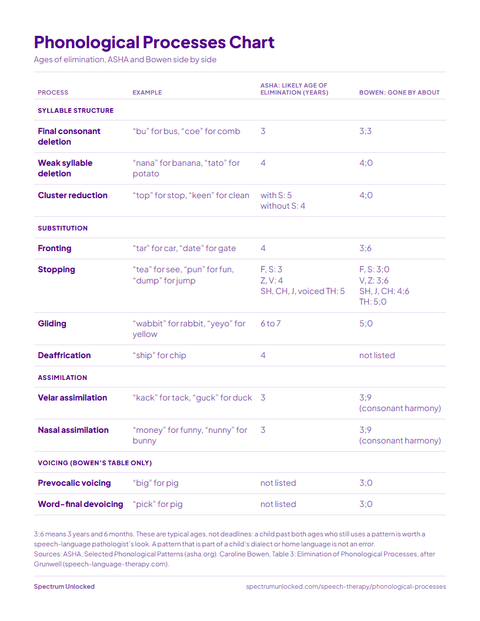
Phonological Processes Chart (Free PDF)
Every process above, an example and the age it goes away by ASHA and by Bowen, on one printable page. Page two links to the picture pairs.
Download The Free ChartPhonological Processes Or A Phonological Disorder?
Using these patterns is a normal part of learning to talk. It is worth a closer look when a child keeps a pattern past the ages in the chart, or when people outside the family often cannot understand them.
Then ask a speech-language pathologist for an evaluation. Under IDEA, a parent can ask the public school district in writing to evaluate a child aged 3 or older, and the evaluation is free; our lisp guide walks through the request. For a child under 3, start with your state’s Early Intervention program.
Practice At Home: Picture Pairs For 3 Processes
Each page teaches one pattern with picture pairs, two words that differ by one sound, so saying it clearly is what picks the right picture. Each has a free practice sheet and a $4 pack.
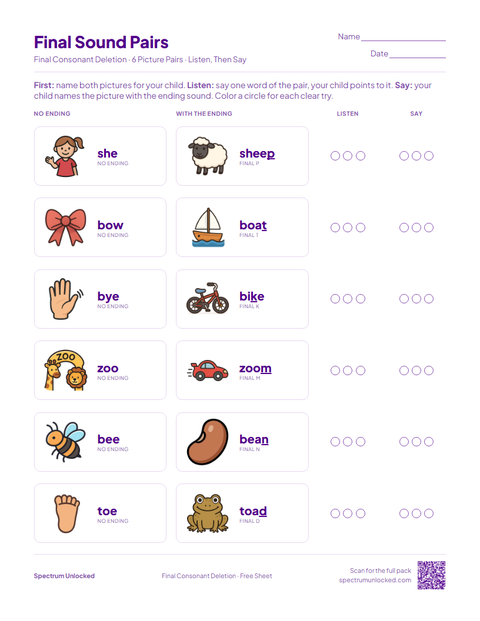
Final Consonant Deletion
Picture word pairs for final P, T, K, M, N and D, with a free practice sheet.
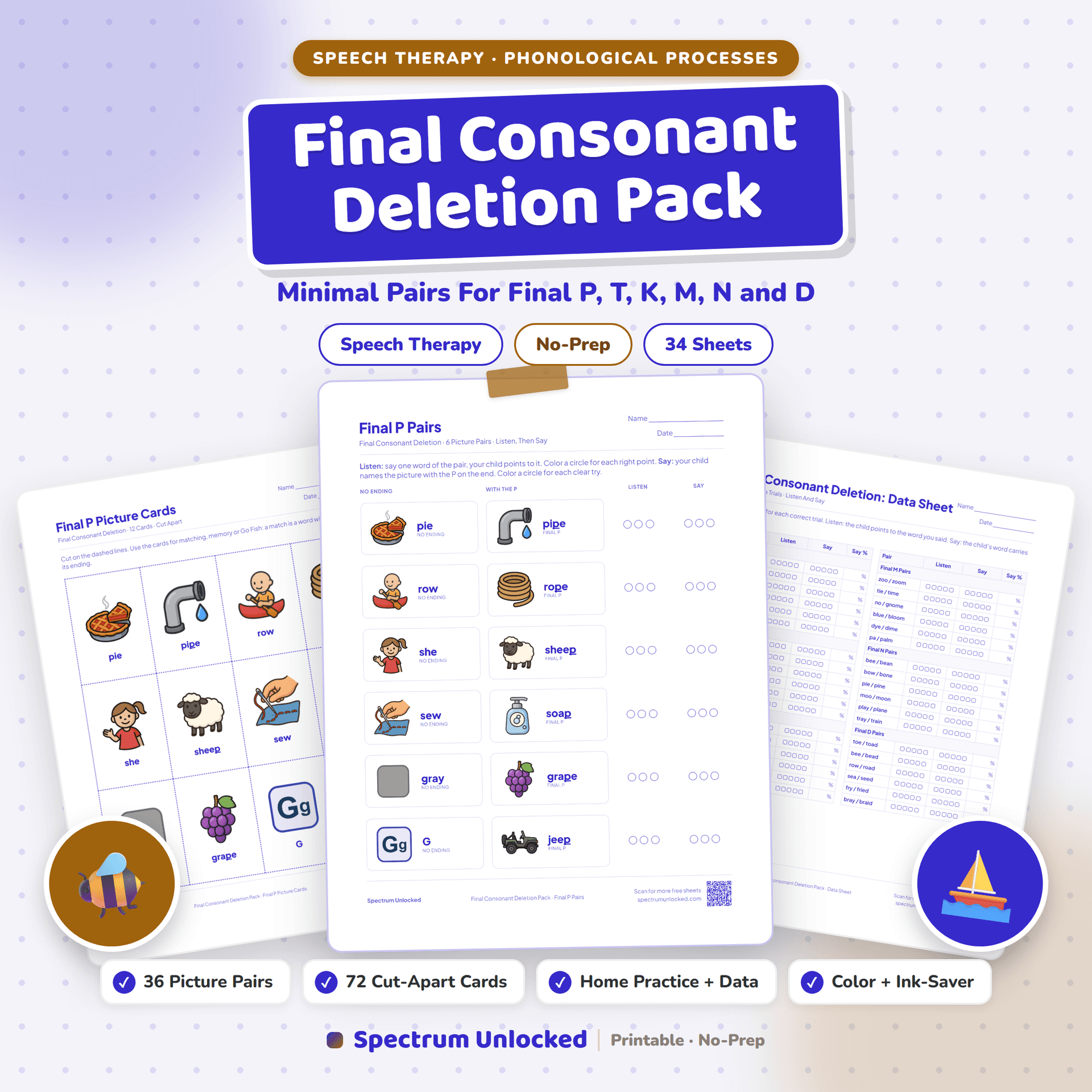 Printable Final Consonant Deletion Pack, $4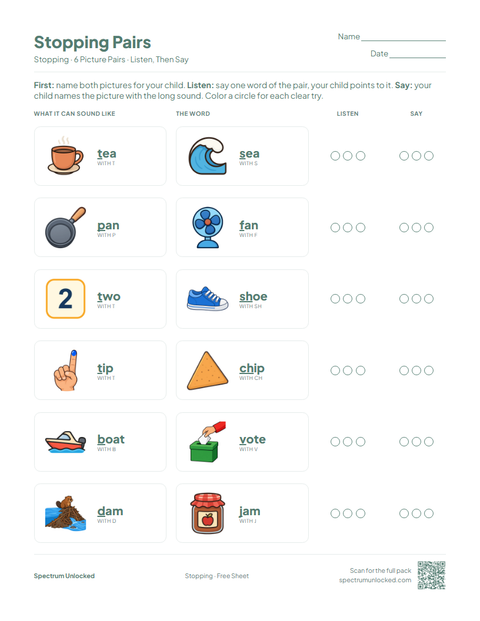
Stopping
Picture word pairs for S, F, SH, CH, V and J, with a free practice sheet.
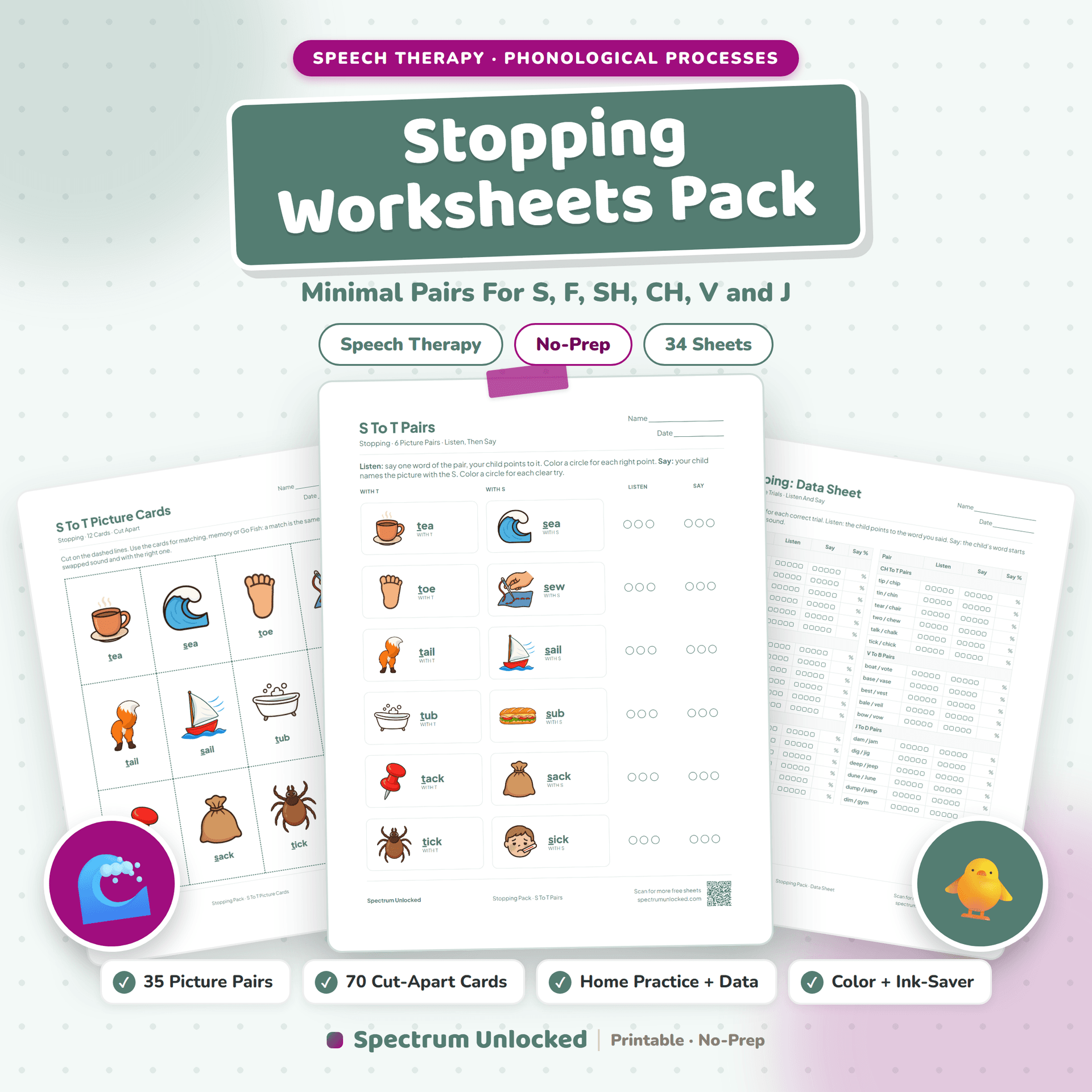 Printable Stopping Pack, $4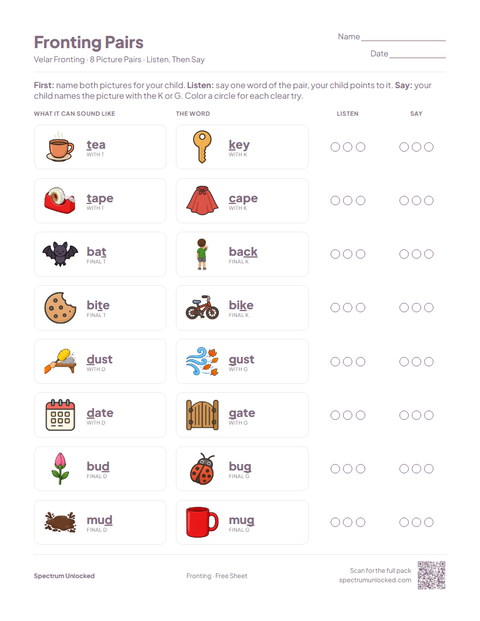
Fronting
Picture word pairs for K and G, start and end of words, with a free practice sheet.
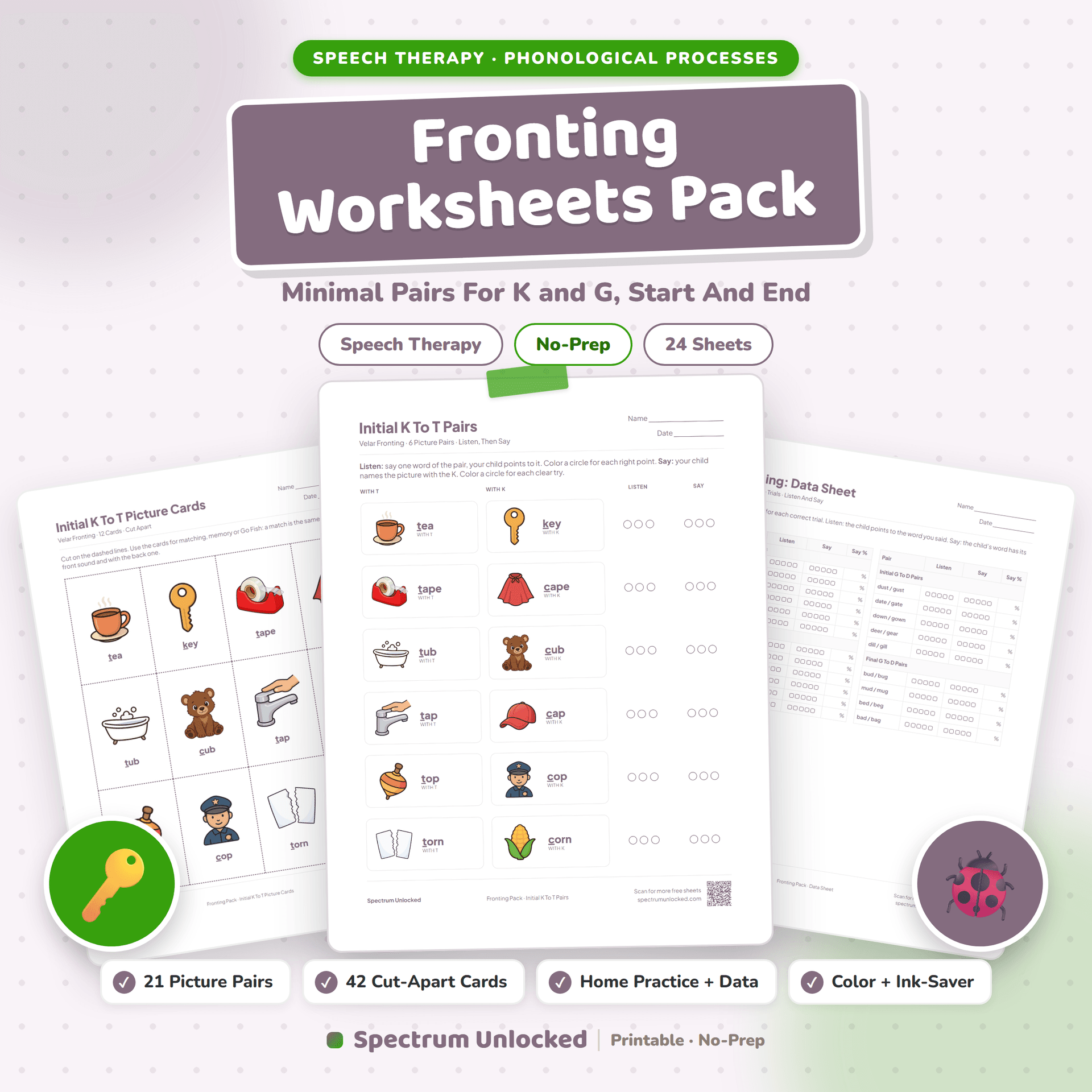 Printable Fronting Pack, $4
FAQ
- What are phonological processes?
- They are the patterns young children use to make adult words easier to say, like “tar” for car or “bu” for bus. Every child uses some while learning to talk, and each one has a typical age by which it goes away.
- What is the difference between a phonological process and an articulation error?
- An articulation error is about making one sound: a lisp puts the tongue in the wrong place for S. A phonological process is a pattern across a group of sounds: a child who stops S, F and SH swaps all three for popped sounds for the same reason. A child can have both, and a speech-language pathologist can tell which is which.
- At what age do phonological processes go away?
- Most are gone between 3 and 5; that age is called the age of elimination. Final consonant deletion is among the first, around 3; gliding (W for R) lasts longest, to 5 in Bowen’s table and 6 to 7 in ASHA’s. The chart above gives the age for every one.
- Why do ASHA and Bowen give different ages?
- Bowen’s table follows Grunwell’s research. ASHA’s ages draw on newer reviews of children learning English, including Crowe and McLeod (2020), and on Bowen’s table too. Both are typical ages, not deadlines, so a difference of a few months between them is expected.
- What is a phonological disorder?
- It is when a child keeps using these patterns past the typical ages, so their speech stays hard to understand. A speech-language pathologist decides that after an evaluation.
- How many phonological processes are there?
- There is no fixed number. ASHA’s table lists 9 and Bowen’s table lists 9; between them they name the 11 in the chart above, which are the ones most children use.
- How do you work on phonological processes at home?
- With picture pairs: two words that differ only by the pattern, like “tea” and “see.” Your child says a word and you point to the picture they said, so a wrong sound picks the wrong picture. We have free pairs for final consonant deletion, stopping and fronting below.
Sources
More For Speech
Wondering about a speech pattern at home?
Beacon talks a speech question through with you: what the pattern means for your child, how to fit practice into a day, and what to ask the speech therapist.
What would Beacon say?
"My 4-year-old still says “tar” for car. Is that a phonological process, and should I worry?"