First Aid Worksheets for Teens: What To Do and When to Get Help
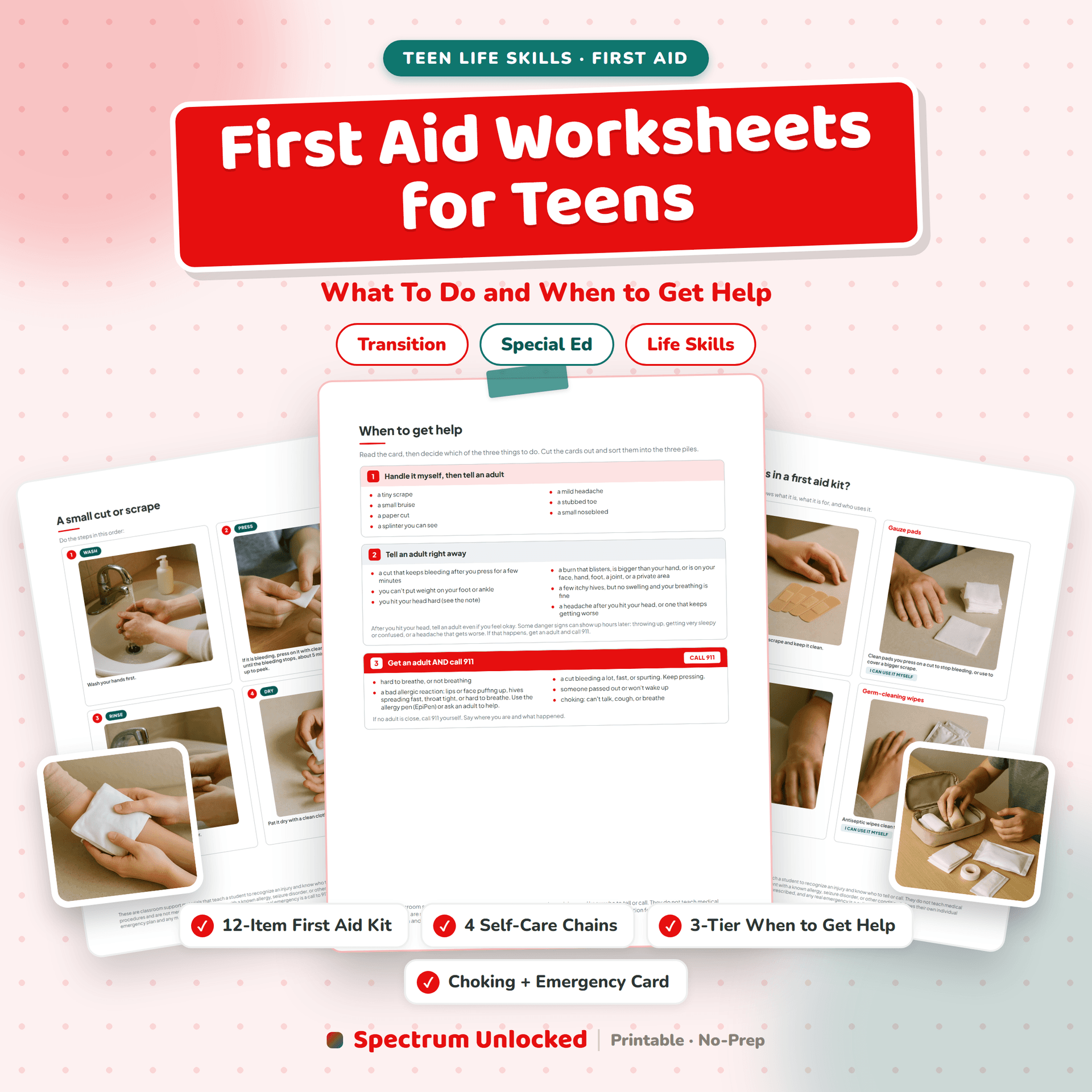
Basic first aid for teens and young adults in special education, taught as recognizing what happened and knowing who to tell or call, never as a medical procedure. A first-aid-kit sort with 12 item cards separates what a student can use from what an adult helps with. Four self-care chains with a photo per action step cover a small cut (starting with pressing to stop the bleeding), a bump or bruise, a small burn and a nosebleed. The heart of the pack is a three-tier sort that teaches when to handle something and tell an adult, when to tell an adult right away, and when to get an adult and call 911, with the real thresholds for allergic reactions, burns, bleeding and head injuries. Plus a choking recognition card, a fill-in emergency card with the Poison Help line, 15 vocabulary words, teacher notes, a data sheet and three copy-paste IEP goals.
$5
Instant download after checkout. No account needed.
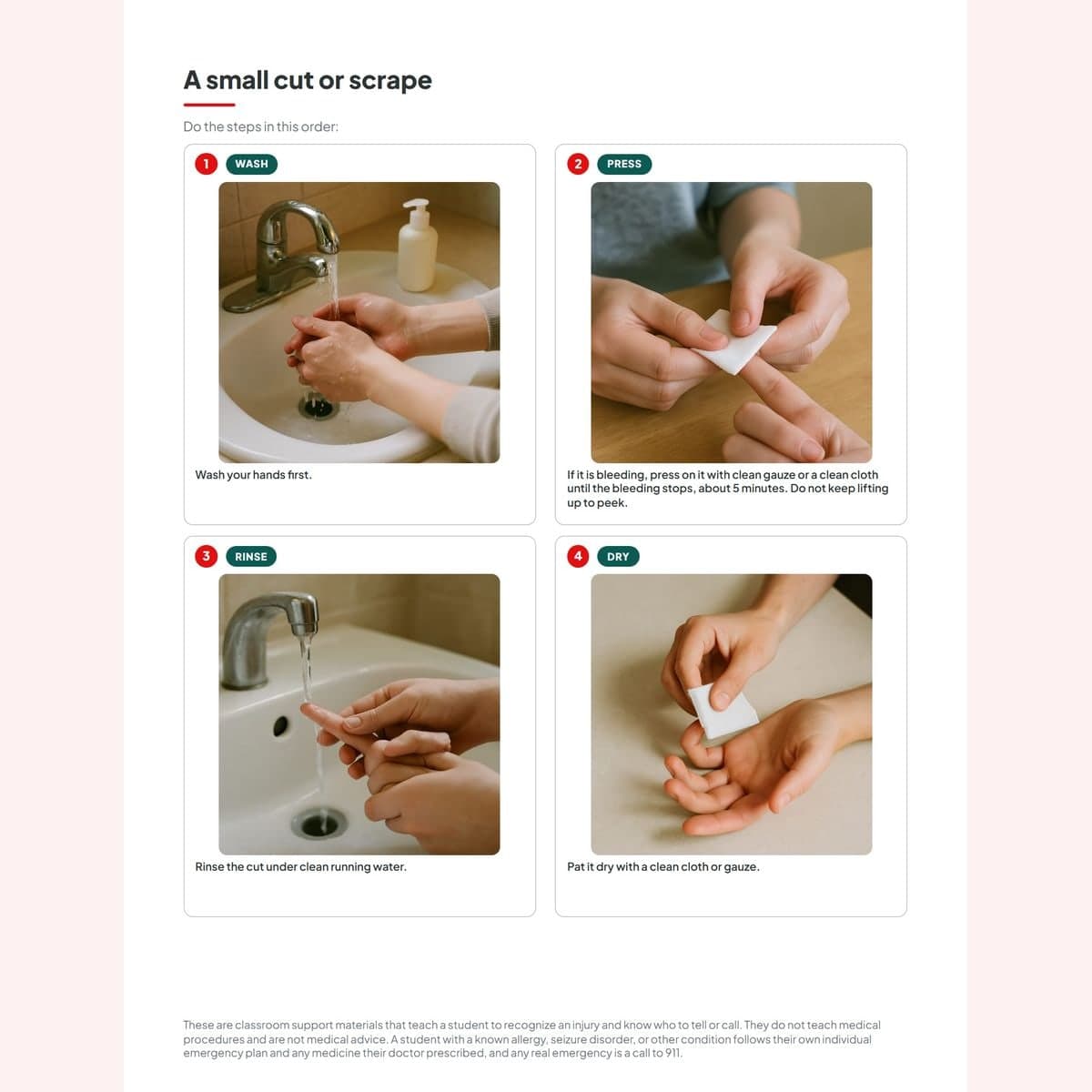
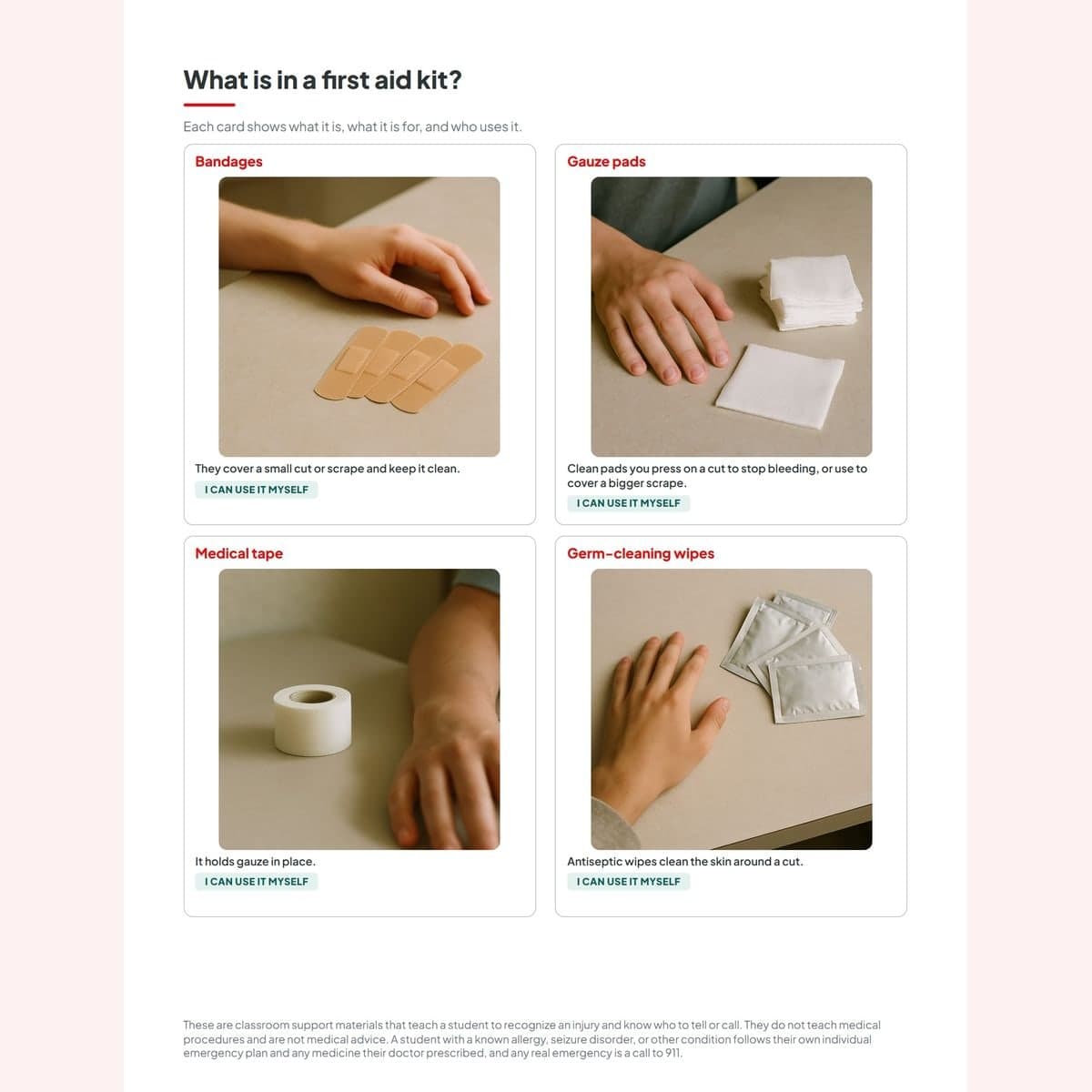
First aid for a teen living more independently is really two skills: doing the small things safely, and knowing the moment something is bigger than you. This pack teaches both. A first-aid-kit sort with twelve item cards separates what a student can use alone from what an adult helps with, so tweezers, scissors and medicine sit on the adult side. Four self-care chains with a photo per action step walk through a small cut, starting with pressing to stop the bleeding before cleaning it, a bump or bruise with a cold pack held on a cloth for about fifteen to twenty minutes, a small burn cooled under running water, and a nosebleed pinched shut leaning forward. The heart of the pack is a three-tier When to Get Help sort: handle it and tell an adult, tell an adult right away, or get an adult and call 911, with the real thresholds a wrong worksheet gets dangerously wrong, so a bad allergic reaction routes to 911 and the allergy pen, a burn that blisters or covers more than a hand is an adult's job, and a head injury's danger signs are taught to show up hours later. A choking recognition card and a fill-in emergency card with the Poison Help line round it out. Every safety line was checked twice against Red Cross, AAP, Mayo Clinic, the CDC and Poison Control.
What is included
- The twelve-item first-aid-kit sort, each card with what it is for and whether you use it yourself or an adult helps
- The small-cut chain with a photo per action step, teaching pressure to stop the bleeding before cleaning under clean running water
- The bump-or-bruise chain, with the cold pack held on a cloth for about fifteen to twenty minutes
- The small-burn chain, cooled under running water, and the nosebleed chain, leaning forward and pinching for about ten minutes
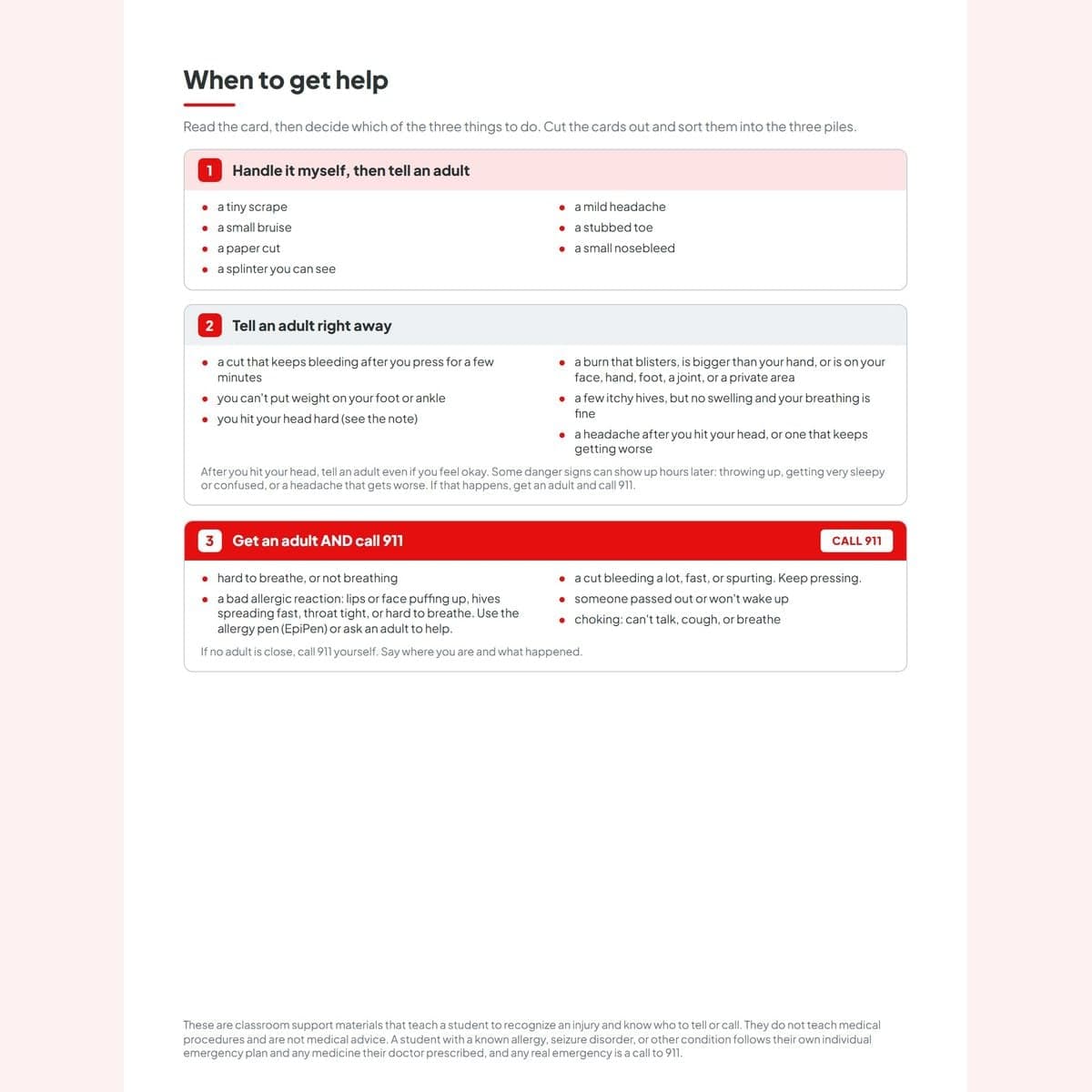
- The three-tier When to Get Help sort: handle it and tell an adult, tell an adult right away, or get an adult and call 911, with the real thresholds
- A choking recognition card and a fill-in emergency card with 911 and the Poison Help line, 1-800-222-1222
- 13 check questions, fifteen vocabulary words and an answer key
- Teacher notes on the three tiers, head-injury danger signs and known-allergy plans, three levels, a data sheet and three scoreable IEP goals
- US Letter and A4 print files, everything single-sided
Formats, license and delivery
- Formats
- Print-ready PDF, US Letter and A4, everything single-sided. Color prints best; every page still reads in black and white.
- License
- Licensed for personal and single-classroom use by the purchaser. For another classroom or teacher, please add a license for each.
- Delivery
- The download unlocks the moment Stripe checkout completes and the link is emailed to you. The pack also stays in your My Resources library, reachable anytime through a magic link sent to your email.
- Refunds
- Because this is an instant digital download, all sales are final. If a file will not open or you bought the wrong pack, email info@spectrumunlocked.com and Spectrum Unlocked will make it right.
Questions from teachers
- Does this teach students to perform first aid or give medicine?
- No. The pack teaches a student to recognize what happened and know who to tell or call. It does not teach medical procedures, and it does not tell a student to give anyone medicine. The one exception is the allergy pen (EpiPen), which the emergency tier says to use or ask an adult to help with, because for a severe allergic reaction using it quickly can save a life. A student with a known allergy, seizure disorder or other condition follows their own individual emergency plan and any medicine their doctor prescribed.
- Is the safety information accurate? Who checked it?
- Every safety line was fact-checked twice, the second check independent, against primary sources: the American Red Cross, the American Academy of Pediatrics, the Mayo Clinic, the CDC's HEADS UP concussion guidance and America's Poison Control. The burn thresholds are the AAP's (blisters, bigger than a hand, or on the face, hand, foot, a joint or a private area), the head-injury danger signs are the CDC's, and a severe allergic reaction routes to 911 and the auto-injector as the Red Cross and Mayo direct. No threshold is set so high that it would teach a student not to get help.
- What is the three-tier sort?
- Real first aid has three answers, not two. Some things a student can handle and then tell an adult, like a paper cut or a small nosebleed. Some things mean tell an adult right away, like a cut that keeps bleeding after pressing or a burn that blisters. And a few things are emergencies where the answer is get an adult and call 911: trouble breathing, a bad allergic reaction, heavy or spurting bleeding, someone who will not wake up, or choking. The sort teaches the student to place each situation in the right tier, and if no adult is close, to call 911 themselves.
- What if a student has a known allergy or other medical condition?
- The pack teaches recognizing a reaction and calling for help, not dosing or diagnosis. A student with a diagnosed allergy already has a prescribed epinephrine auto-injector and an individual emergency plan, and the cover teacher note says plainly that the student follows that plan. The point of the pack is that a student can act, and call for help, in the moment.
- Is it too scary for the students it is for?
- It is written to be calm and concrete. The self-care chains are ordinary and reassuring, the copy is plain and free of fear language, and the emergency pages are matter-of-fact steps rather than alarming scenes. The photographs show hands and objects doing the action, never an injury, a face or anything upsetting. The goal is confidence, not fear.
- What formats do I get, and how is it delivered?
- Print-ready US Letter and A4 PDFs, everything single-sided. Color prints best, and every page still reads in black and white. Delivery is instant: the download unlocks as soon as you buy, a copy of the link is emailed to you, and the file stays in your My Resources library.
Want to try it first?
Grab the free Printable First Aid Worksheets Sample for Teens: Kit, Cuts, and When to Get Help sample. It is a real, print-ready slice of this pack, yours to download at no cost. You can browse all free samples too.
Get the Free Printable First Aid Worksheets Sample for Teens: Kit, Cuts, and When to Get Help SamplePrefer to build your own for free?
This pack is the finished, done-for-you set. If you would rather make your own from scratch, the free Visual Schedule Creator on Spectrum Unlocked does that at no cost.
Try the Free Visual Schedule CreatorPacks that go together
Kitchen Safety & Appliance Task Boxes
Five print-cut-laminate kitchen task boxes for teens: sort safe and unsafe kitchen scenes, match foods to appliances, identify twenty kitchen tools, sort fridge, freezer, and pantry storage, and sequence six kitchen routines. Over ninety cards with picture mats, answer keys, box labels, and copy-paste IEP goals, and the whole system costs under ten dollars to build.
Basic Home Repair Task Boxes: Tools, Who to Call, DIY Fixes and Safety Sort for Teens
Four home repair task boxes for teens and young adults in special education: match 16 tools to the job each one does, sort twelve things that go wrong at home to a mat of eight real trades, put four simple fixes in order four steps at a time, and sort 16 jobs into do it yourself or get help. Photo cards, mats, rule cards that carry the landlord line and the 911 line, teacher keys, a data sheet and two IEP goals. Instant download.
Community Safety Signs & Scenarios
Twenty real-world safety sign flashcards and fifteen what-would-you-do scenario cards for teens, with a community walk checklist, two matching worksheets, a reusable data sheet, copy-paste IEP goals, and three difficulty levels.
Looking for more? Browse all classroom packs.
Reviews
Be the first to review this pack.