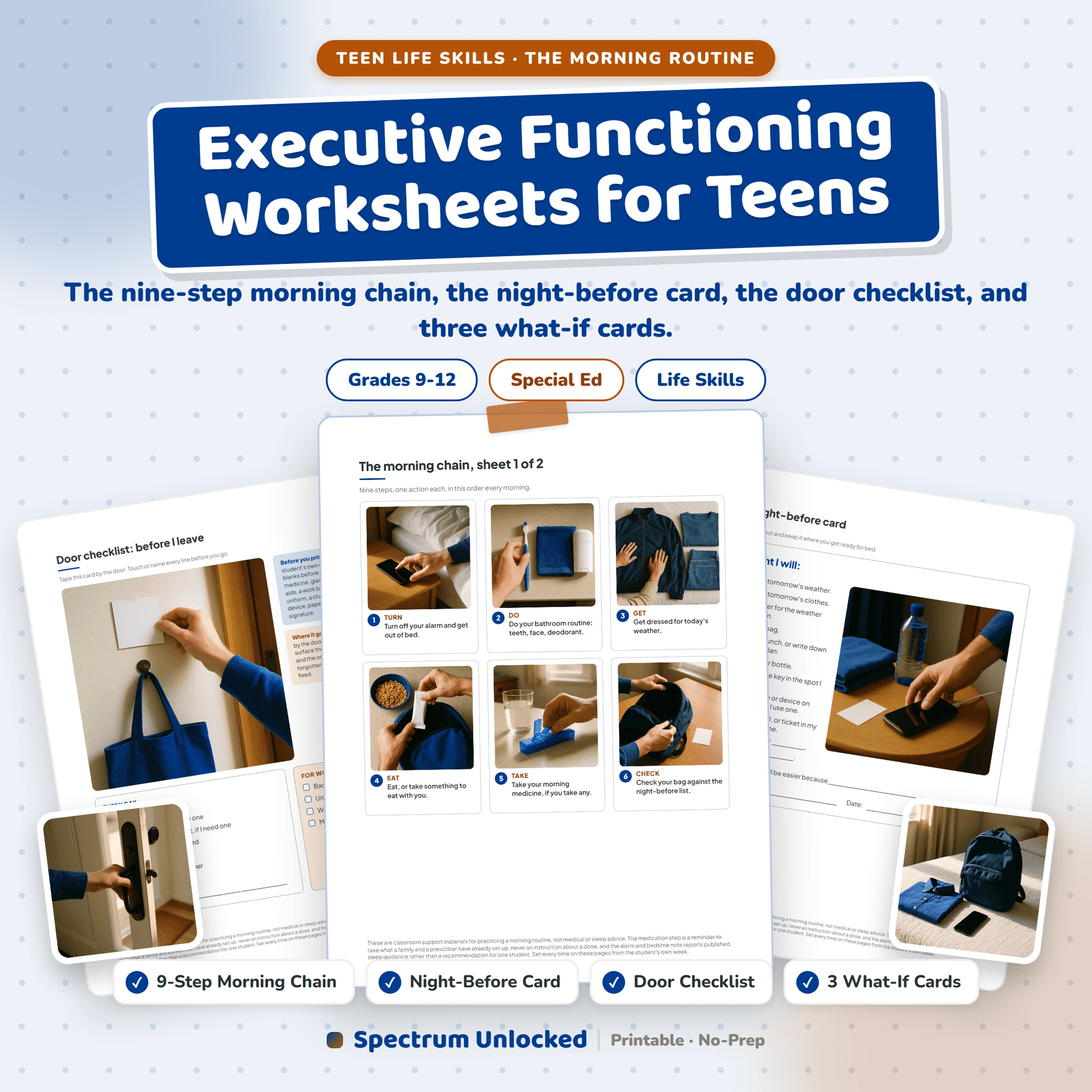
Executive Functioning Worksheets for Teens: The Morning Routine
A morning routine for teens and young adults in special education, from the alarm to the door: a nine-step visual chain, a night-before card, a door self-check and three what-if scenarios. The chain puts one action on each step and ends on a self-check, so the routine itself triggers the skill the goals measure; the medicine step is in the chain rather than assumed; the door card lists seven items that do not assume a phone, a bus pass or money for lunch, plus three blanks for the student's own, and a column for a first job. The night-before card produces every item the door card checks. Plus three levels, a 5-column data sheet, a teacher guide and two copy-paste IEP goals, both written to be measurable with no time default printed in them.
$4
Instant download after checkout. No account needed.
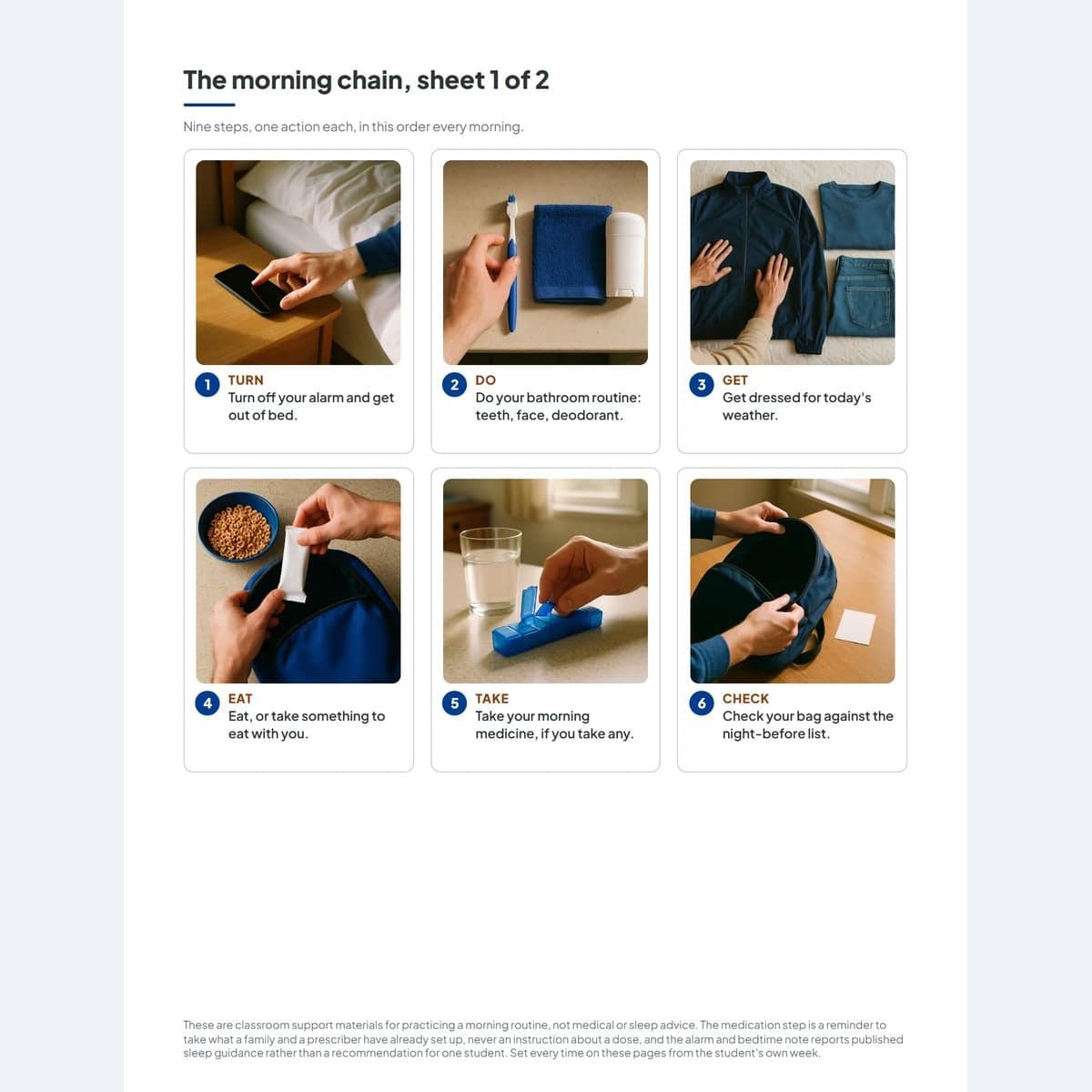
A morning is not one skill, it is a chain, and a chain breaks at whichever link nobody taught. This pack prints the whole chain: nine steps from turning the alarm off to walking out the door, one action on each step, each with its own photograph. The steps a morning pack usually leaves out are in here on purpose. Taking morning medicine is a step, not an assumption. Checking the door list is the last step, so the routine itself triggers the self-check rather than hoping a student remembers to do it. The night-before card produces every item the door list checks, which sounds obvious and is the thing most checklists get wrong: a door list that asks about a lunch nothing made is a list a student fails through no fault. Nothing here assumes a phone, a bus pass or money for lunch, and there are three blanks for what this student actually carries, plus a column for a first job. The two IEP goals are written to be measurable and neither prints a time limit, because a catalog default measures how fast a student is rather than whether they can do it alone.
What is included
- The nine-step morning chain as photo steps, one action each, ending on the door self-check the goals measure
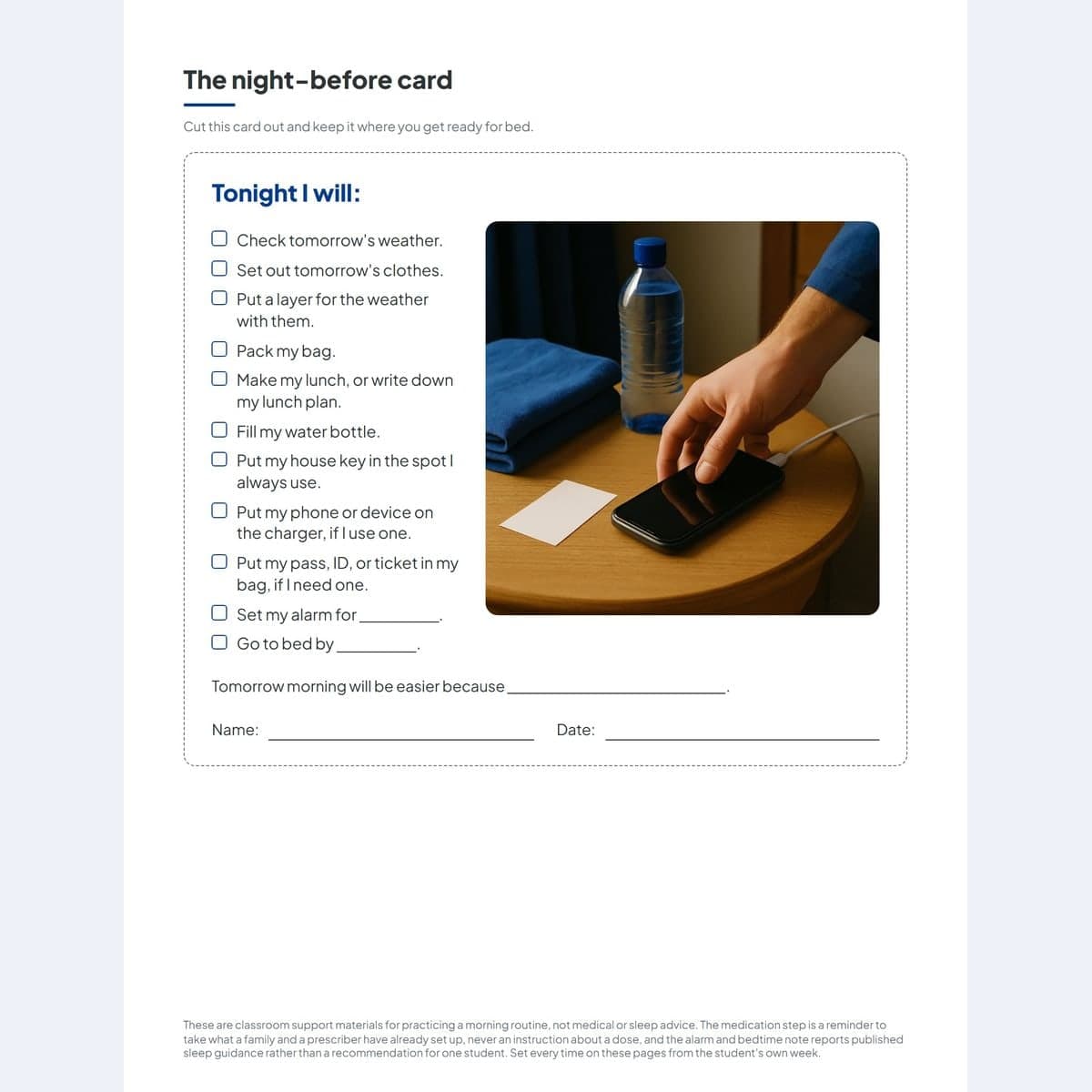
- The night-before card, eleven verb-led items with blanks for the alarm time and the bedtime, which produces every item the door list checks
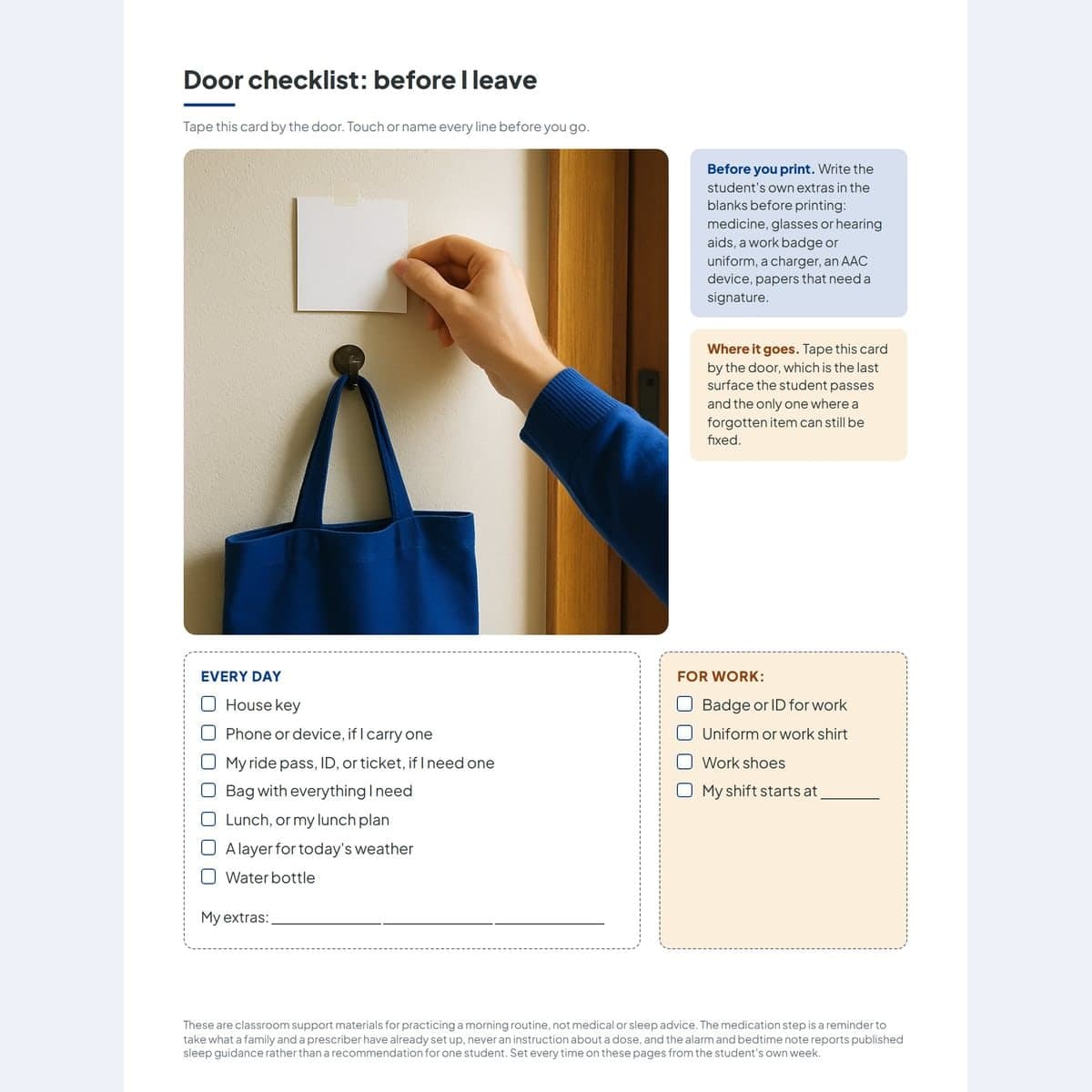
- The door checklist, seven items that assume no phone, no bus pass and no lunch money, plus three write-in blanks and a for-work column
- Three what-if scenario cards, including the ten-minute morning and the overslept morning, and a short list card already in order, so a late morning is never a judgment call
- Three levels, from pointing along the chain to running it with no adult reminder
- A 5-column data sheet with a row per step and its own row for the door self-check, and two copy-paste IEP goals with no printed time default
- A teacher guide covering bedtime alongside the alarm, and teaching getting out of bed on its own when that is the hard step
- US Letter and A4 print files, everything single-sided
Formats, license and delivery
- Formats
- Print-ready PDF, US Letter and A4, everything single-sided. The door card prints best on cardstock; every page still reads in black and white.
- License
- Licensed for personal and single-classroom use by the purchaser. For another classroom or teacher, please add a license for each.
- Delivery
- The download unlocks the moment Stripe checkout completes and the link is emailed to you. The pack also stays in your My Resources library, reachable anytime through a magic link sent to your email.
- Refunds
- Because this is an instant digital download, all sales are final. If a file will not open or you bought the wrong pack, email info@spectrumunlocked.com and Spectrum Unlocked will make it right.
Questions from teachers
- Who is this morning routine pack for?
- Teens and young adults from about 13 to 22 in special education, life skills and transition programs, and the teachers, paraprofessionals and parents who run their mornings. The photographs and the wording are age-respectful: no cartoon suns, no reward stickers, no baby talk. A student heading to a first job gets the same chain with a work column on the door card.
- Why is there no time limit in the IEP goals?
- Because a printed number becomes the number an IEP team copies, and a speed cap measures the wrong thing. Sleep problems are common in autistic teens, so a morning clock records last night rather than today's skill, and a student who is independent but slow would fail a goal about independence. The goal measures completing the chain across opportunities, and there is a separate opt-in line with a blank for a team that has baselined this student over a week.
- Does the pack tell students not to hit snooze?
- No, and that is deliberate. A controlled sleep study found no harm from a short snooze, and snoozers did slightly better on cognitive tests right after waking, so a no-snooze rule would be a claim the evidence does not support. What the pack does instead is put the bedtime next to the alarm on the night-before card, because sleep length is the variable that actually matters, and it teaches getting out of bed as its own step for the student who finds that the hard part.
- What if my student does not have a phone, a bus pass, or money for lunch?
- The door checklist is written so none of those is assumed. Items read as conditions, such as a phone or device if I carry one, and a ride pass, ID or ticket if I need one, and the lunch line says lunch or my lunch plan so a student on a school meal has something true to check. Three blanks are there for what this student actually carries: medicine, glasses or hearing aids, a charger, a work badge, an AAC device, or papers that need a signature.
- How is this different from your other morning-work packs?
- The morning-work packs are seatwork a student does after arriving. This is the routine that gets them there: a task-analysis chain, a night-before card, a door self-check and the scenarios for when a morning goes wrong. It pairs with the hygiene pack for the bathroom step and with Dressing for the Forecast for the getting-dressed step, and each of those packs teaches its step in full.
- Can I use just part of it?
- Yes. The chain, the night-before card, the door checklist and the scenario cards each stand alone, and the data sheet scores whichever of them you are running. Many classrooms start with the door checklist by itself, because it is the piece a student can own in a week.
Want to try it first?
Grab the free Morning Routine Checklist Printable for Teens: Getting Ready sample. It is a real, print-ready slice of this pack, yours to download at no cost. You can browse all free samples too.
Get the Free Morning Routine Checklist Printable for Teens: Getting Ready SamplePrefer to build your own for free?
This pack is the finished, done-for-you set. If you would rather make your own from scratch, the free Visual Schedule Creator on Spectrum Unlocked does that at no cost.
Try the Free Visual Schedule CreatorPacks that go together
Hygiene Routines: 8 Self-Care Task Cards
Eight self-care routines as full-page visual task cards for teens, with a Did I Finish self-check strip, cut-apart sequencing cards, comprehension checks, a weekly self-monitoring tracker, wallet-size mini cards, and three difficulty levels.
Daily Living Skills Worksheets for Teens: Dressing for the Forecast
Dressing for the weather, for teens and young adults in special education: nine weather cards matched to 22 clothing cards, eight forecast practice cards and a six-step layering sequence. Every weather card prints on its face how many items to pick, and every practice forecast prints the same count as the card it matches, so the two parts cannot disagree. The layering rule is two rules, not one: under 50 degrees means a jacket, and rain or snow means the outer layer has to be waterproof, whichever the temperature. Thunderstorm is not a clothing choice and ships as its own safety card with the go-inside rule and the wait before going back out. The hot-weather cards carry water and shade and stop there. Plus four blank cards for the weather where you live, three levels, a five-item daily self-check, a data sheet and two copy-paste IEP goals.
Cleaning & Laundry Life Skills Visual Routines
Six home maintenance routines for teens as full-page six-step visuals: washing and drying laundry with the sticker-dot machine trick, dishes, bathroom cleaning with a mandatory safety card, vacuuming, and trash day. Each routine has a Did I Finish self-check strip, cut-apart sequencing cards, and a comprehension check, plus a weekly chore tracker with a streak goal, wallet-size mini cards, a home connection letter, a reusable data sheet with a safety-steps column, and copy-paste IEP goals. Three levels: match, sequence, independent.
Looking for more? Browse all classroom packs.
Reviews
Be the first to review this pack.