Voting Worksheets for Teens: Registering, Voting and Your Rights
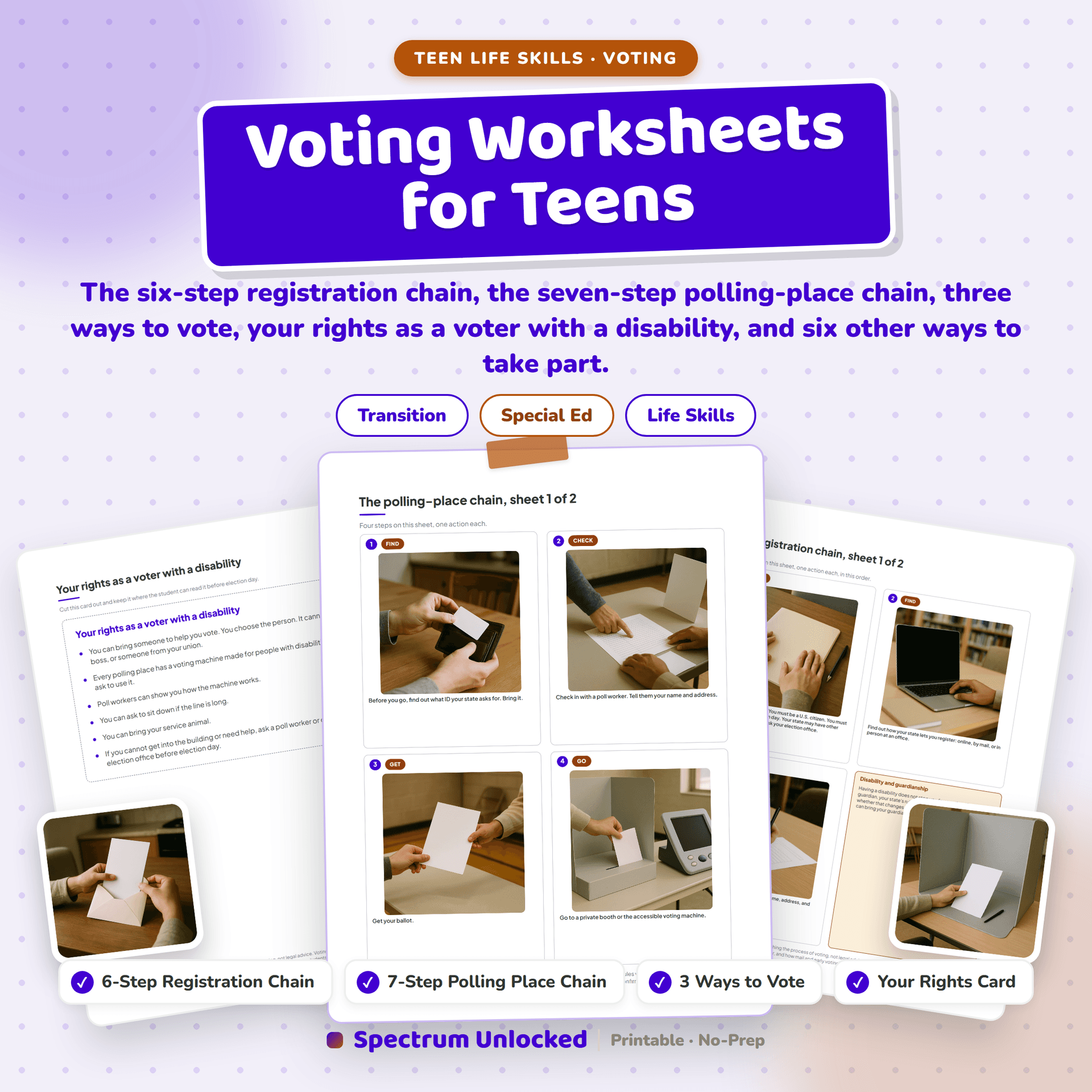
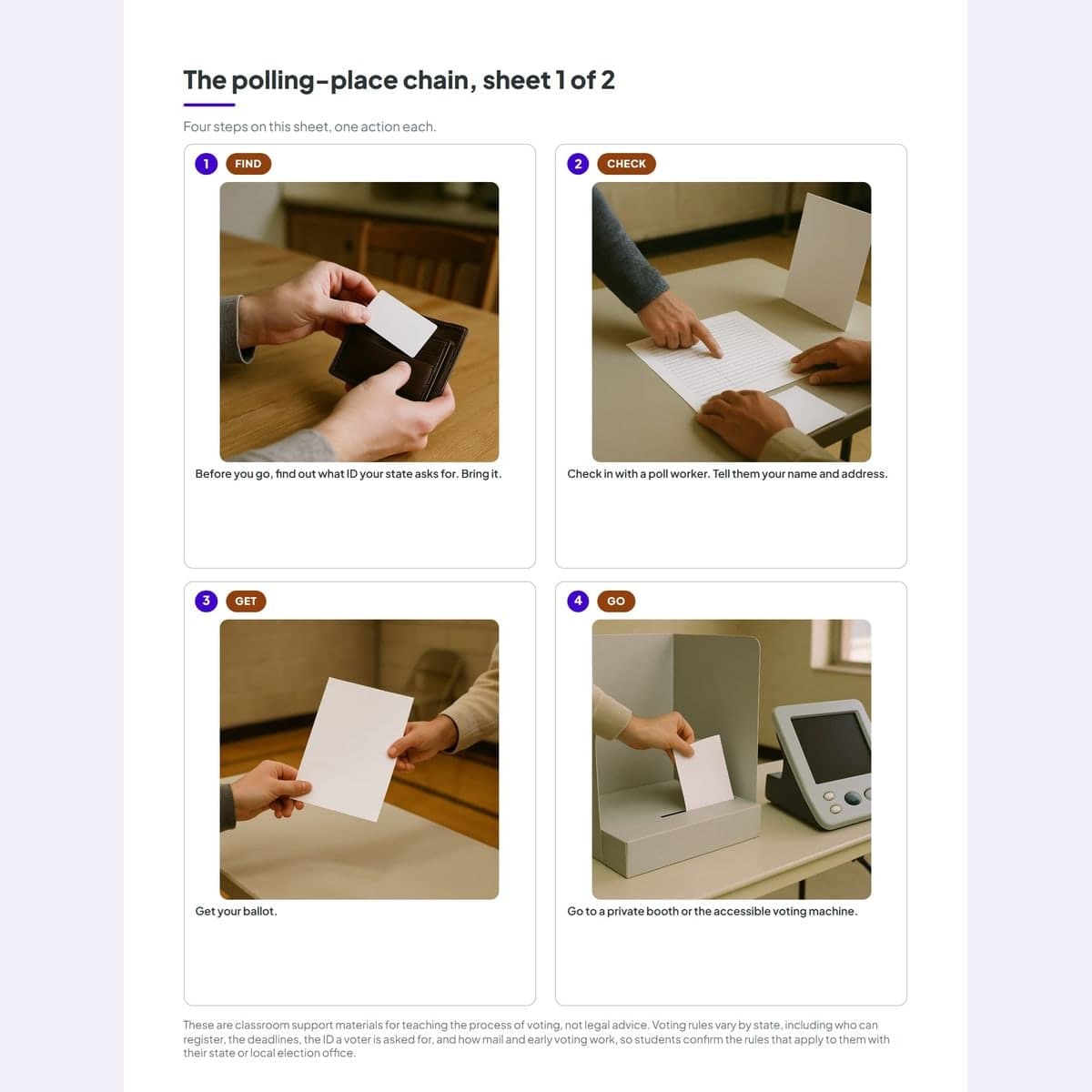
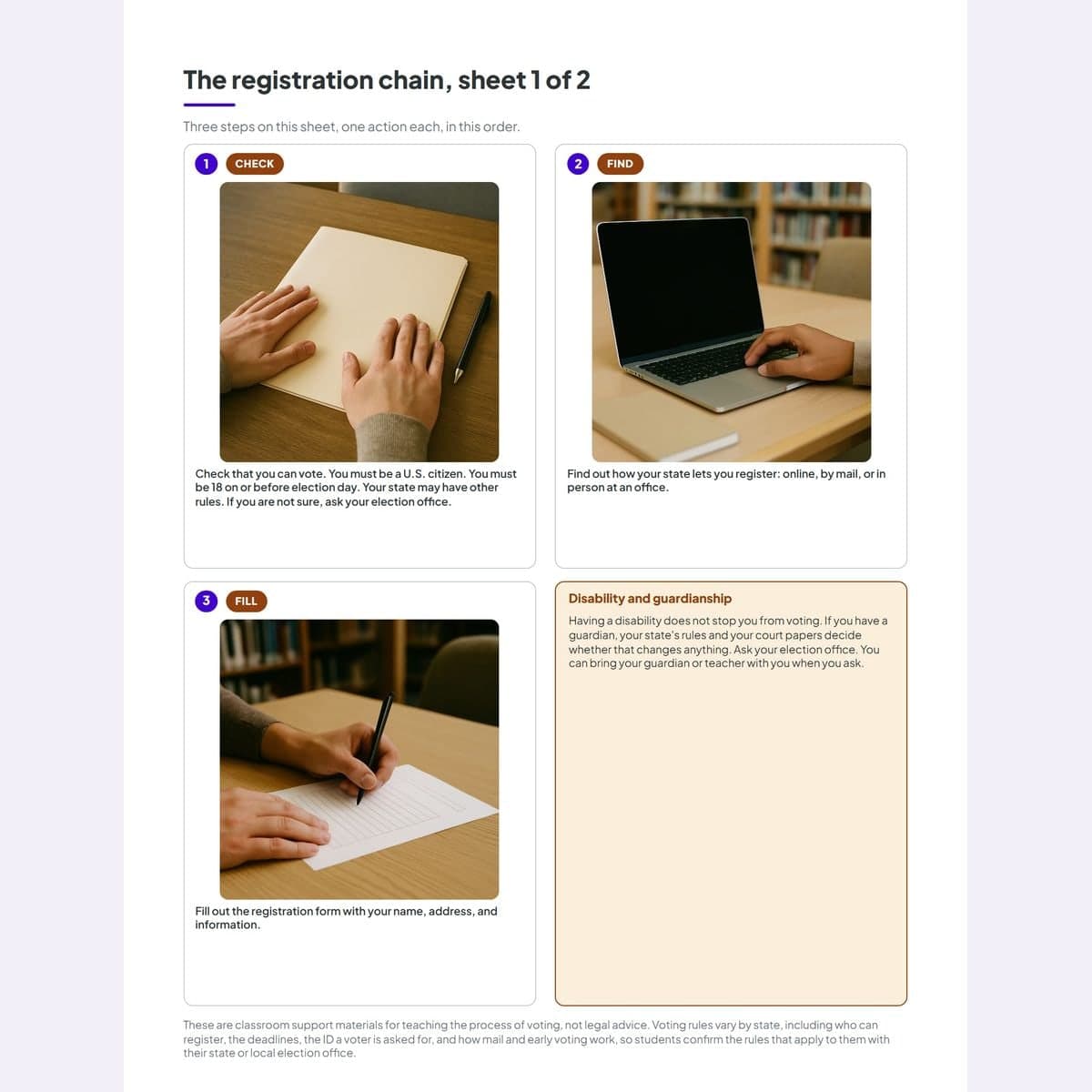
Voting for teens and young adults in special education, taught as a process and never as a choice: the pack never names or favors a candidate, party or position. A six-step registration chain with a photo per step starts where eligibility starts, with citizenship and age, and sends a student to the election office whenever a rule depends on the state. The seven-step polling-place chain comes with an If Something Goes Wrong box of three answers, including asking for a provisional ballot when a name cannot be found. The rights card lists six rights for voters with disabilities, among them help from a person the voter chooses, the accessible voting machine, asking to sit down in a long line and bringing a service animal. Plus three ways-to-vote cards, six other ways to take part, a voting plan card, 13 vocabulary words, teacher notes on state rules and guardianship, a data sheet and two copy-paste IEP goals.
$4
Instant download after checkout. No account needed.
A first vote goes wrong in small, specific ways: a name the poll worker cannot find, an ID nobody said to bring, a mark in the wrong bubble. A student who has only a tidy six-box poster goes home. This pack teaches the process of voting, never a candidate, party or position, and it teaches the branches. The six-step registration chain starts where eligibility starts, with being a U.S. citizen and being 18 on or before election day, and every step that depends on the state says so and sends the student to the election office rather than guessing. The seven-step polling-place chain has an If Something Goes Wrong box beside it: ask for a provisional ballot if your name cannot be found or you do not have the ID, ask where your polling place is if you are at the wrong one, and ask a poll worker for a new ballot rather than crossing out a mistake. Because this audience is voters with disabilities, the pack carries a rights card too: help from a person you choose, the accessible voting machine every polling place has, asking to sit down in a long line, and your service animal. The teacher notes cover state rules and guardianship, and the pack prints no date, so it stays correct after this election.
What is included
- The six-step registration chain with a photograph per step, from checking that you can vote to making a voting plan
- The seven-step polling-place chain with a photograph per step and the If Something Goes Wrong box of three answers
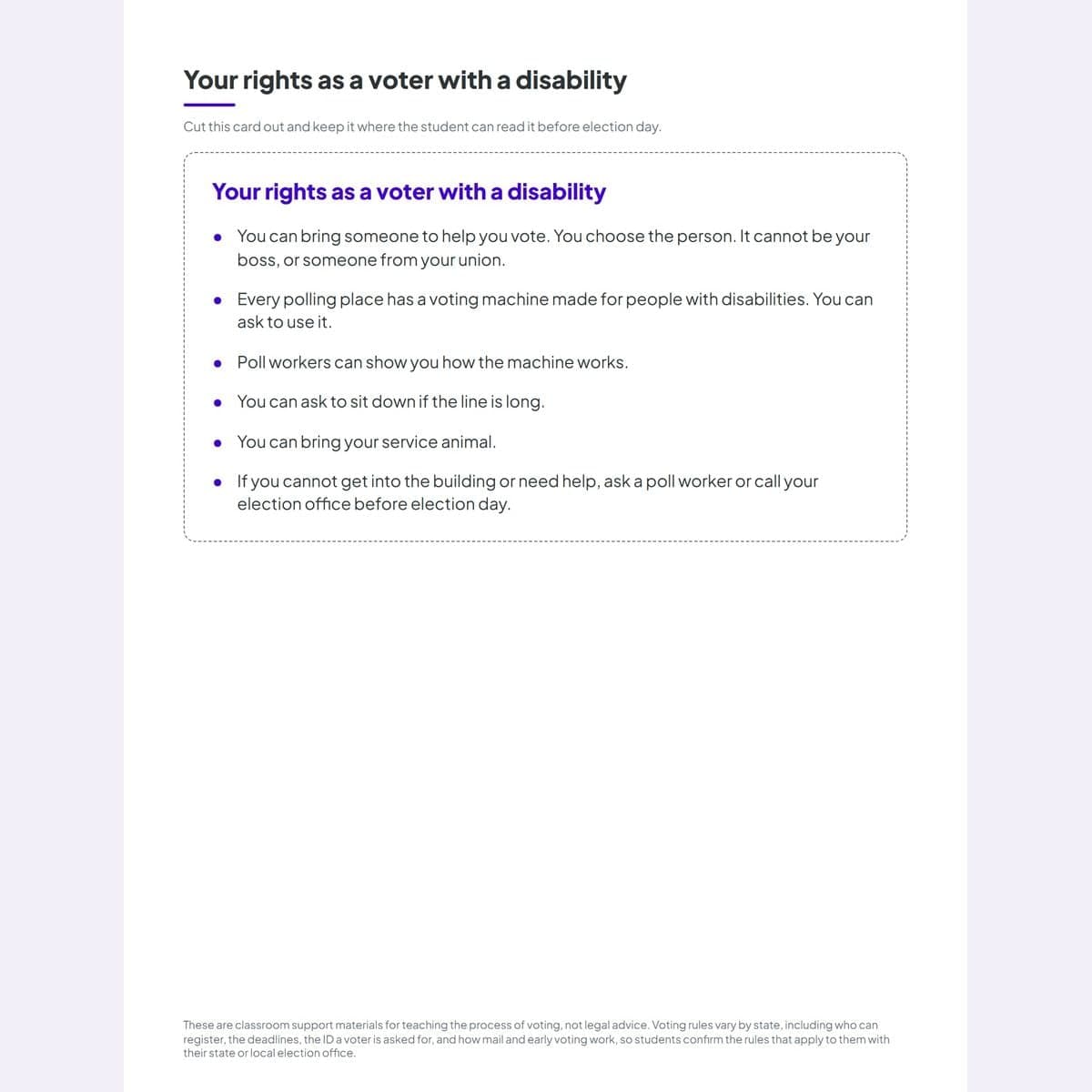
- The rights card for voters with disabilities, six rights in plain words
- A typeset sample ballot to practice reading contests and filling in the oval, with neutral placeholder names and questions
- Three ways-to-vote cards, in person, early where the state offers it, and by mail, each saying where the rules differ by state
- Six other ways to take part in the community, neutral by design, and a fill-in voting plan card
- Seven check questions, thirteen vocabulary words and an answer key
- Teacher notes on state rules, pre-registration and guardianship, three levels, a data sheet and two scoreable IEP goals
- US Letter and A4 print files, everything single-sided
Formats, license and delivery
- Formats
- Print-ready PDF, US Letter and A4, everything single-sided. Color prints best; every page still reads in black and white.
- License
- Licensed for personal and single-classroom use by the purchaser. For another classroom or teacher, please add a license for each.
- Delivery
- The download unlocks the moment Stripe checkout completes and the link is emailed to you. The pack also stays in your My Resources library, reachable anytime through a magic link sent to your email.
- Refunds
- Because this is an instant digital download, all sales are final. If a file will not open or you bought the wrong pack, email info@spectrumunlocked.com and Spectrum Unlocked will make it right.
Questions from teachers
- Does this pack tell students who or what to vote for?
- No. This pack is factual and non-partisan. It teaches the process of voting. It never names or favors a candidate, party, or position, and the examples on the take-part page use school and neighborhood topics like a crosswalk, a bus stop or a park rather than a real issue. The photographs show no campaign signs, party colors, logos or real ballots; any ballot in frame is a blank sample.
- Voting rules differ by state. How does a national pack handle that?
- By teaching the steps that are the same everywhere and sending the student to their election office for every rule that is not. Deadlines, ID, same-day registration, mail ballots and early voting all vary, so each of those steps says so plainly instead of stating one state's rule as if it were everyone's. The teacher notes ask you to look up your own state's rules before teaching the registration page, and there is a note for North Dakota, which does not have voter registration.
- What about a student who has a guardian?
- The pack neither promises nor denies the right to vote, because no printed page can know a student's state or court order. Most voters with disabilities have the same right to vote as anyone else. In some states a court order in a guardianship case can affect a person's right to vote, and many states do not remove that right. The student page tells them that having a disability does not stop them from voting and to ask their election office, bringing a guardian or teacher if they like. The teacher note asks you to help the student and family contact the election office and read the court order.
- What rights for voters with disabilities does it teach?
- The rights card lists six in plain words: you can bring someone to help you vote, a person you choose who is not your boss or someone from your union; every polling place has a voting machine made for people with disabilities, and poll workers can show you how it works; you can ask to sit down if the line is long; you can bring your service animal; and if you cannot get into the building or need help, you can ask a poll worker or call your election office before election day.
- Can a 16- or 17-year-old use it?
- Yes. You must be 18 on or before election day to vote, but many states let students sign up at 16 or 17 so they are ready to vote at 18. The teacher notes say so, and the first registration step teaches both checks a student makes before registering: being a U.S. citizen and being 18 by election day.
- Does it print this year's election dates?
- No, on purpose. A printed date would make the pack wrong after one election, so the last registration step teaches making a voting plan (the day, the way you will vote, and how you will get there) and the plan card has a line to write the date in. Nothing in the pack needs reprinting next year.
Want to try it first?
Grab the free Polling Place Steps and Voter Rights Card for Teens: Voting Worksheets sample. It is a real, print-ready slice of this pack, yours to download at no cost. You can browse all free samples too.
Get the Free Polling Place Steps and Voter Rights Card for Teens: Voting Worksheets SamplePrefer to build your own for free?
This pack is the finished, done-for-you set. If you would rather make your own from scratch, the free Visual Schedule Creator on Spectrum Unlocked does that at no cost.
Try the Free Visual Schedule CreatorPacks that go together
Self-Advocacy & Student-Led IEP Kit
A self-advocacy kit that puts the IEP meeting in the student's hands. The About Me builder turns circle-first menus into a one-pager in the student's own voice, in three formats: worksheet, presentation one-pager, and slide text. Accommodations wallet cards make what-helps-me something a student can hand to any adult, with the hand-the-card script. Meeting scripts climb a three-level participation hierarchy, from attend-and-greet with response cards to leading sections from an agenda card, with a practice rubric and meeting reflection. The four-week goal sheet keeps progress data with the student, plus one simple weekly planner spread and three copy-paste IEP goals.
Travel Training Worksheets: Public Transportation Scenario Cards
Twenty what-would-you-do public transportation cards for teens and young adults in special education. Every card is a real bus situation, three responses, and one question: What do you do? The teacher answer key and the why line are kept off the student cards, and the correct answer is rotated so it is not always A. Plus a route card with nine fields that plans the ride home as well as the ride out, a rider script page carrying the twelve sentences the deck asks a student to say, a show-the-driver card of eight lines for AAC users and students who do not speak, a blank autism ID card of five lines, a teacher page of eight notes on fares, transfers, reduced fare, paratransit and the ADA, a reusable 20-row data sheet with a prompt-level column, a portfolio sheet and four copy-paste IEP goals. Three levels: choose, explain, practice.
Community Safety Signs & Scenarios
Twenty real-world safety sign flashcards and fifteen what-would-you-do scenario cards for teens, with a community walk checklist, two matching worksheets, a reusable data sheet, copy-paste IEP goals, and three difficulty levels.
Looking for more? Browse all classroom packs.
Reviews
Be the first to review this pack.