Travel Training Worksheets: Public Transportation Scenario Cards
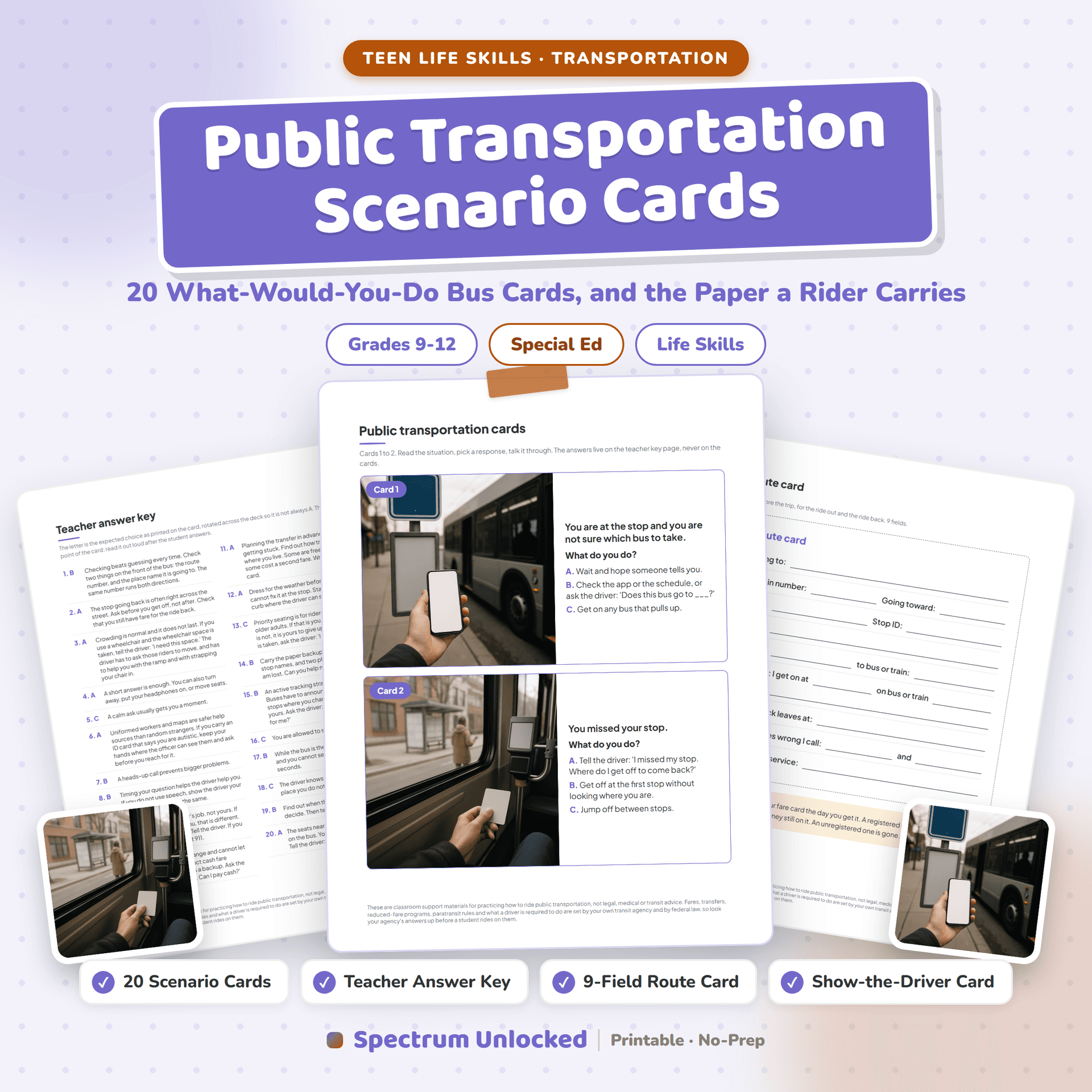
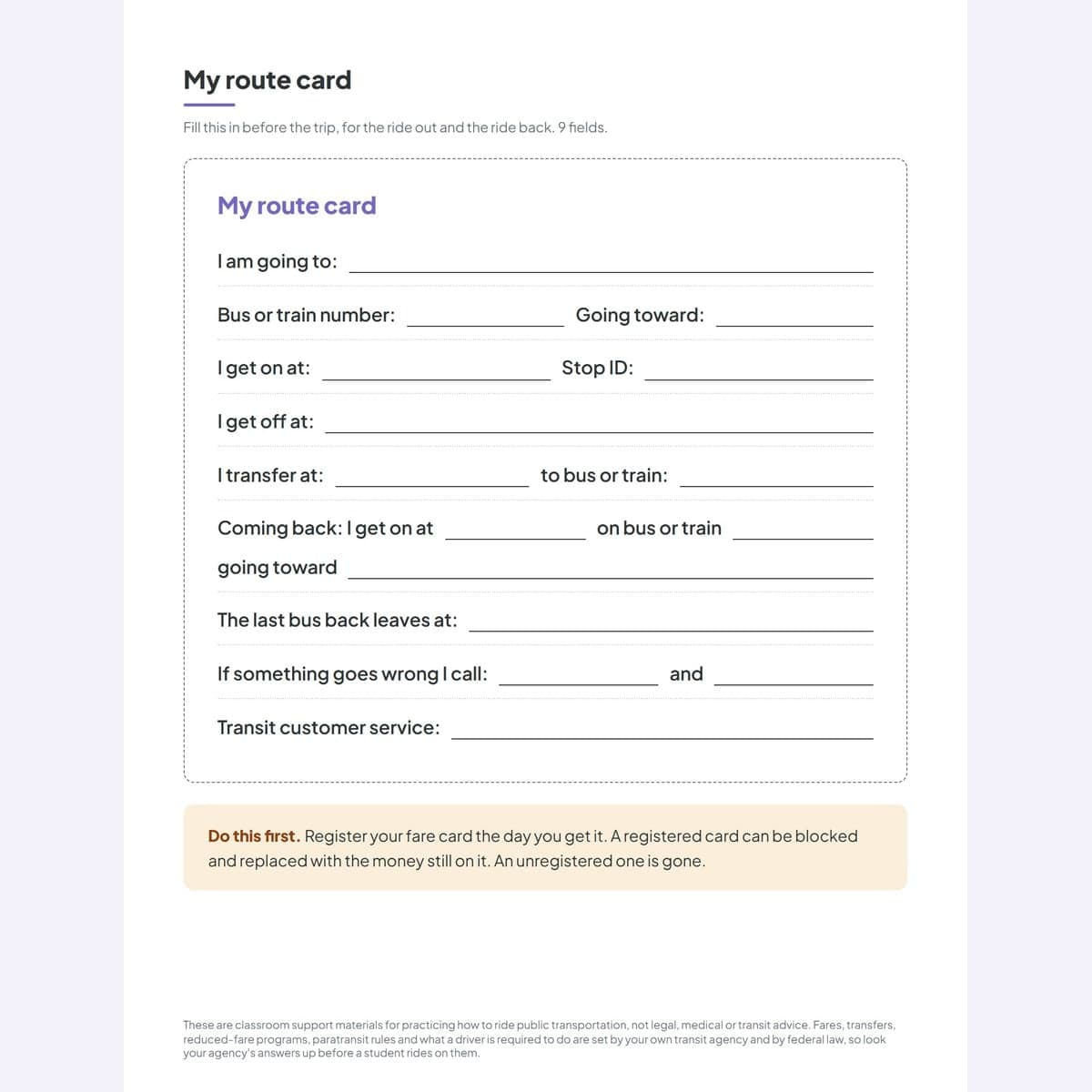
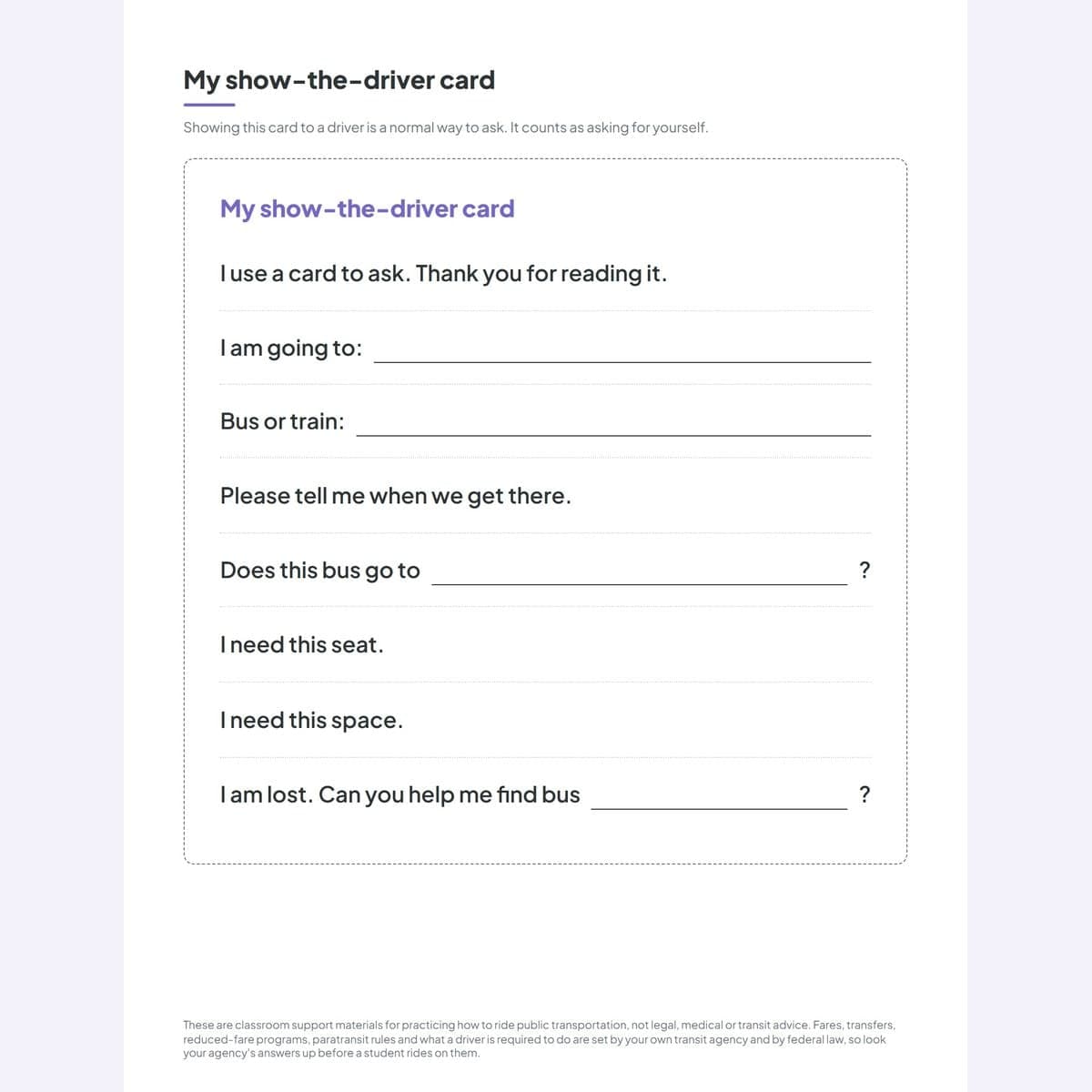
Twenty what-would-you-do public transportation cards for teens and young adults in special education. Every card is a real bus situation, three responses, and one question: What do you do? The teacher answer key and the why line are kept off the student cards, and the correct answer is rotated so it is not always A. Plus a route card with nine fields that plans the ride home as well as the ride out, a rider script page carrying the twelve sentences the deck asks a student to say, a show-the-driver card of eight lines for AAC users and students who do not speak, a blank autism ID card of five lines, a teacher page of eight notes on fares, transfers, reduced fare, paratransit and the ADA, a reusable 20-row data sheet with a prompt-level column, a portfolio sheet and four copy-paste IEP goals. Three levels: choose, explain, practice.
$4
Instant download after checkout. No account needed.
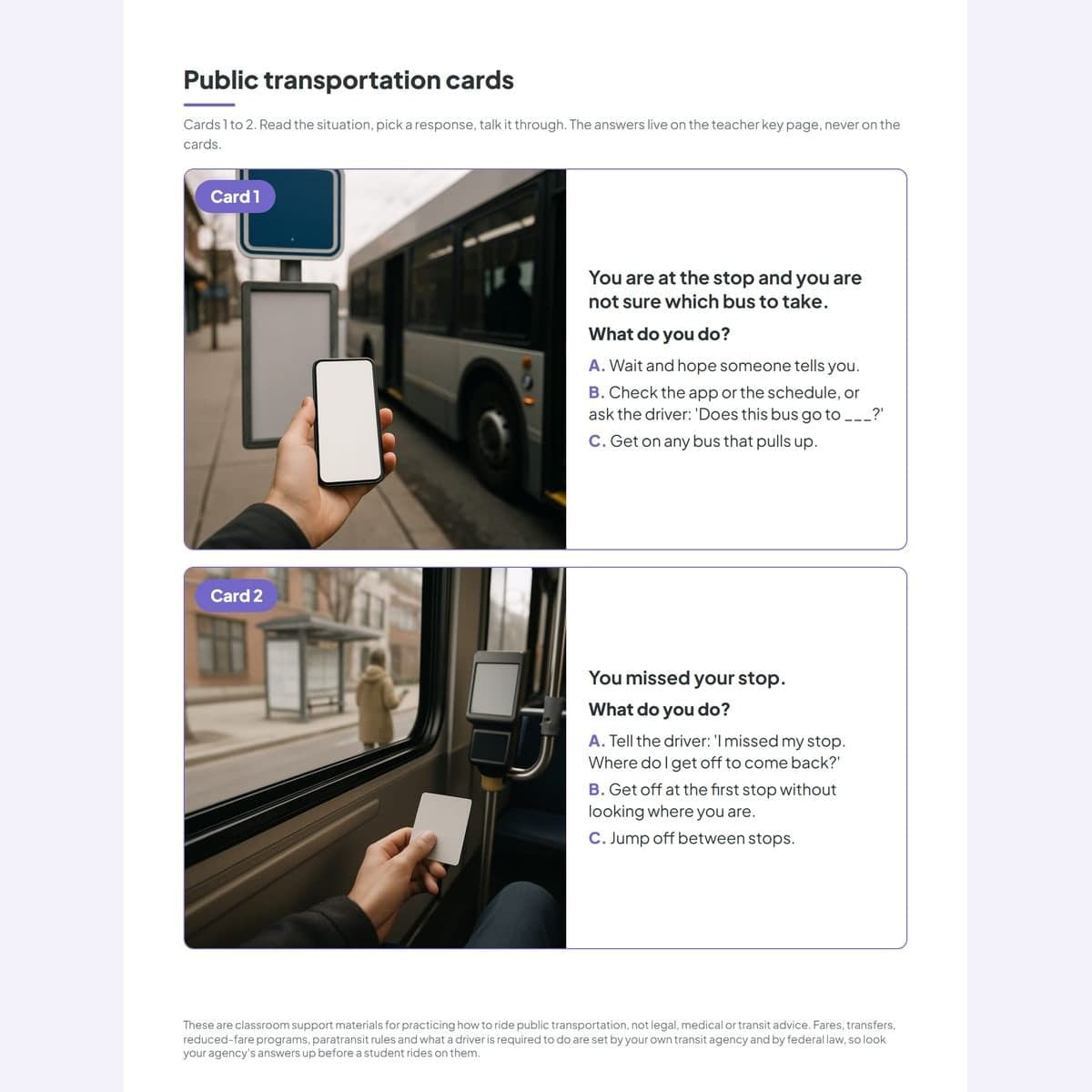
Travel training is the name for teaching a student to get somewhere on their own, and these are the worksheets for the part of it that happens on a city bus. Twenty cards, each one a real situation with three responses, all of them asking the one question the deck ever asks: What do you do? The deck opens with these. You are at the stop and you are not sure which bus to take. You missed your stop. The bus is very crowded. Someone sits next to you and starts talking a lot. The expected choice and the why line live on a separate teacher key, so the cards work for independent reading without giving anything away. Around the deck sits the paper a student carries when the phone is not the answer: a route card with nine fields that plans the ride home as well as the ride out, a rider script page with the twelve sentences the cards ask for, a show-the-driver card for AAC users and students who do not speak, and a blank autism identification card. Panicking is not a wrong answer anywhere in this deck: every card asks what you do next, and none of them grades how you felt while you did it.
What is included
- Twenty what-would-you-do public transportation cards, each with a photo, a situation and three lettered responses
- A teacher answer key with the why behind every card, kept off the student cards, and the correct answer rotated so a student cannot learn to always pick A
- A route card with nine fields, including the stop ID, the direction the bus is going, the transfer, the return leg and the time the last bus back leaves
- A rider script page: the twelve sentences the deck asks a student to say, pulled out of the cards themselves so a card and its script line cannot drift apart
- A show-the-driver card of eight lines for AAC users and students who do not speak, and a blank autism identification card of five lines
- A teacher page of eight notes the cards do not say to the student: how fares and transfers work locally, registering the fare card so a lost one is replaceable, reduced fare, ADA paratransit, and the ramp, the securement space and the priority seat
- A reusable 20-row data sheet with a prompt-level column and a setting column, a student portfolio sheet and four copy-paste IEP goals
- US Letter and A4 print files, everything single-sided
Formats, license and delivery
- Formats
- Print-ready PDF, US Letter and A4, everything single-sided. Color prints best; every page still reads in black and white.
- License
- Licensed for personal and single-classroom use by the purchaser. For another classroom or teacher, please add a license for each.
- Delivery
- The download unlocks the moment Stripe checkout completes and the link is emailed to you. The pack also stays in your My Resources library, reachable anytime through a magic link sent to your email.
- Refunds
- Because this is an instant digital download, all sales are final. If a file will not open or you bought the wrong pack, email info@spectrumunlocked.com and Spectrum Unlocked will make it right.
Questions from teachers
- What is travel training, and who are these cards for?
- Travel training is instruction in getting somewhere independently on public transit, and it is a standard part of transition services for students with disabilities. This pack is the classroom half of it, for teens and young adults from about 13 to 21 in special education, life skills and transition programs, and for the job coaches and SLPs who run community-based instruction. It is written at a plain reading level, without childish framing, about city buses rather than school buses.
- Do the cards show the correct answer?
- No. Each card carries the situation and the responses only; the expected choice and the why line live on a separate teacher key. The correct response is rotated across the deck rather than sitting in one position, so a student cannot learn to always pick A and still be right.
- Does it work for a student who does not speak, or who uses a wheelchair?
- Yes, and both were built in rather than bolted on. The show-the-driver card prints eight lines a student can hand over instead of speaking, and the note on it says that showing the card counts as asking for yourself. Two cards carry the wheelchair rider's own lines: the driver has to help with the ramp and the securement and has to ask riders to clear the securement space, and the priority seat may be the reader's own. The rider script page prints every sentence the deck asks for, so nothing is ever asked for that the pack did not print.
- The fare rules are different in every city. How does the pack handle that?
- By saying so, and by sending you to look it up once. The teacher page says plainly that how you pay is local: a fare can be a tap card, a phone, a paper pass or exact cash, and transfers are free for a set time in some cities, a second fare in others, and not issued at all in others again. The route card has a line to write your own agency's answer on. The teacher page also covers three things the cards themselves do not: register the fare card the day the student gets it so a lost card can be replaced with its balance, reduced-fare programs need an application before the discount starts, and ADA paratransit exists and learning the fixed route does not take it away.
- Is being upset a wrong answer on any card?
- No, and the teacher page asks you to say that out loud the first time you run the deck. Freezing, going quiet or getting upset when a trip goes wrong is a thing that happens to a body, not a choice on a card. Every card asks what you DO next, and none of them grades how you felt while you did it. The responses that are marked wrong are wrong for what the student does, never for what they feel.
- What formats do I get, and how is it delivered?
- Print-ready PDFs in US Letter and A4, everything single-sided so no page has to be flipped. Delivery is instant: the download unlocks the moment Stripe checkout completes, a copy of the link is emailed to you, and the files stay in your My Resources library behind a magic link, so a lost download is never a problem. The pack is licensed for personal and single-classroom use by the purchaser.
Want to try it first?
Grab the free Community Based Instruction Worksheets: Bus Scenario Cards sample. It is a real, print-ready slice of this pack, yours to download at no cost. You can browse all free samples too.
Get the Free Community Based Instruction Worksheets: Bus Scenario Cards SamplePacks that go together
Community Safety Signs & Scenarios
Twenty real-world safety sign flashcards and fifteen what-would-you-do scenario cards for teens, with a community walk checklist, two matching worksheets, a reusable data sheet, copy-paste IEP goals, and three difficulty levels.
Grocery Store Math for Teens
A money-math pack for teens: read real grocery prices, learn the next-dollar-up strategy to pay without exact change, then budget five shopping trips on an original store flyer. Every price and answer key is computed and checked. Three levels, a store-trip checklist, a data sheet, and copy-paste IEP goals.
Restaurant Scenario Cards and Menu Math for Teens
Sixteen what-would-you-do restaurant cards for teens: ordering, a wrong order, a loud room, a declined card, the check and the tip, three responses each with a teacher answer key kept off the student cards. A printed menu with a menu-math practice page, a tipping practice page, an ordering script card with a point-to version, a blank allergy chef card, a reusable 16-row data sheet, a portfolio sheet, and two copy-paste IEP goals. Three levels: choose, explain, practice it.
Looking for more? Browse all classroom packs.
Reviews
Be the first to review this pack.