Zigzag Tracing Worksheets
Free zigzag tracing worksheets that practice sharp direction changes. Print the PDF or adjust the size and support in the free worksheet maker.
- What age can a child trace a zigzag?
- My child turns the zigzag into a wave. Is that wrong?
- Why practice zigzags at all?
- Is this worksheet free?
Nothing left to prepare. Three finished sets, $8 each, and every page prints exactly as it is.
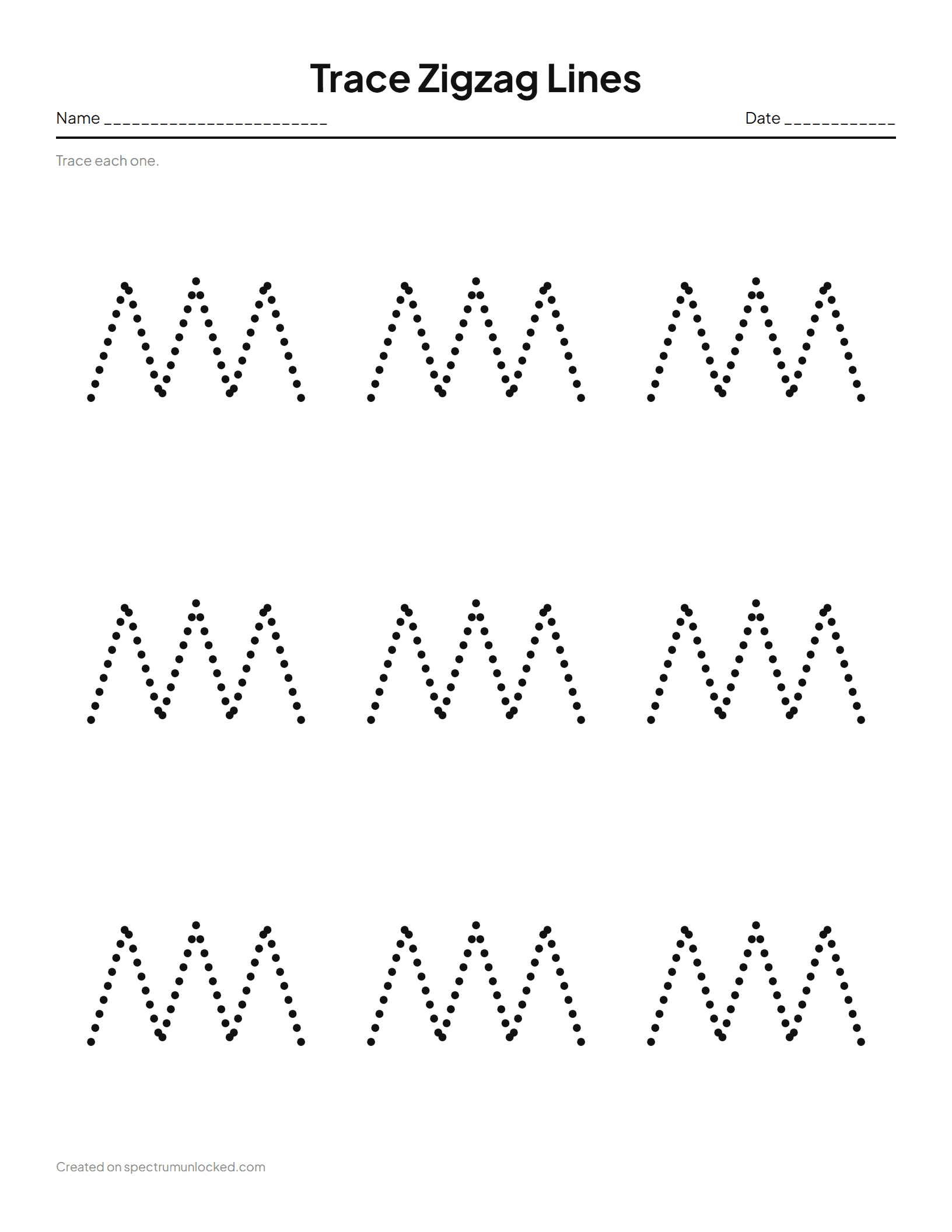
What A Zigzag Actually Practices
A zigzag is a string of diagonals with a full stop between each one. The pencil has to travel a slant, halt, and set off on the opposite slant, over and over. That stop-and-turn is the skill: it is the same control that letters with corners demand, and it is harder than any single stroke on its own.
Because of that, zigzags belong late in the pre-writing sequence, after a child can manage both slant directions separately. The diagonal line set on this site is the natural sheet before this one.
Corners, Not Curves
The tell on a zigzag sheet is what happens at the points. A child who is ready makes a real corner: the line stops and changes direction. A child who is not ready rounds the point into a wave, because continuous steering is easier than stopping. Neither is wrong, but they are different skills, and the rounded version means the wave sheet is the better fit for now.
Grade the corners, not the straightness. Wobbly slants with honest stops beat clean slants that melt into curves.
Making It Easier Or Harder
Bigger is easier. A large zigzag gives the arm room to commit to each slant before the turn arrives, so size up in the free worksheet maker when the points keep rounding off. To make it harder, size down, or switch the support level so the dots fade and the child carries more of the path alone.
The mixed pre-writing strokes sheet adds zigzags into rotation with every other stroke once this page is comfortable.
Common Questions
- What age can a child trace a zigzag?
- Zigzags come late in the pre-writing sequence, usually around four and a half to five, because each point asks for a full stop and a direction change. Treat the age as a typical window and let the child's corners tell you if it is time.
- My child turns the zigzag into a wave. Is that wrong?
- It is informative rather than wrong. Rounding the points means continuous steering is still easier than stopping and turning, so a week on the wave and diagonal sheets first will make the zigzag land better.
- Why practice zigzags at all?
- The stop-and-turn at each point is the control behind every letter with a corner, and behind the M, N, V and W family in particular. Scissor paths and mazes lean on the same skill.
- Is this worksheet free?
- Yes. The PDF download is free, with no account and no watermark.