Communication Board for Autism: Free Printable + How to Use It
What a communication board is, how to make and use one for a nonspeaking or minimally speaking autistic child, a core-word example, and a free printable.
Key Takeaways
- A communication board is a printed grid of words and symbols a nonspeaking or minimally speaking person points to in order to make themselves understood, without any device or app.
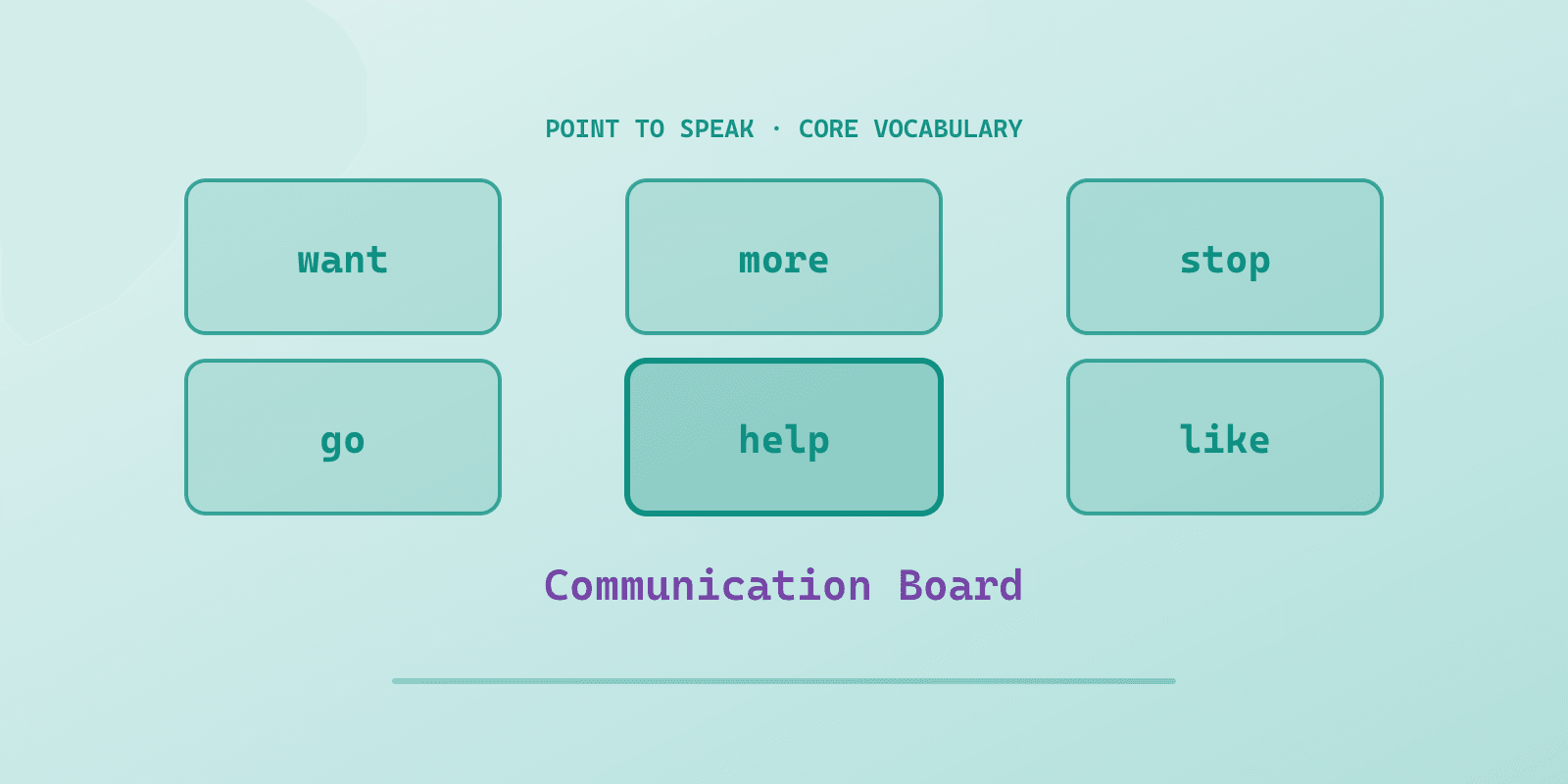
- The boards that work in the long run are built on core vocabulary, the small set of high-frequency words like want, stop, more, go, and help that make up most of what anyone says, rather than a page of nouns.
- A board only becomes communication when adults model on it, pointing to words as they talk, every day for weeks, the same way a hearing child hears thousands of words before saying one.
- Start low-tech and printed. A laminated board is the fastest, cheapest way to see whether symbol communication clicks, and it stays useful as a backup even after a student moves to an AAC app or device.
When a nonspeaking or minimally speaking student has something to say and no reliable way to say it, the message still comes out, usually as grabbing, guiding an adult by the hand, or a meltdown. A communication board gives that message an easier route: a page of words to point to. It is the simplest tool in AAC, and for many autistic learners it is where communication finally clicks.
What a communication board is
A communication board is a printed grid of words, pictures, or symbols that a person points to in order to communicate without speaking. Instead of producing a word out loud, the student points to it and a partner reads it back. There are two broad kinds:
- Core-word boards: one page of high-frequency words like want, more, stop, go, help, like, and no that work across every activity, all day.
- Topic (fringe) boards: a smaller board for one activity, such as snack, recess, or art, holding the specific nouns for that moment.
It is the lowest-tech, lowest-cost form of augmentative and alternative communication (AAC), and for a lot of students it is the right place to start. No charging, no app, no waiting on a device evaluation. Print it, laminate it, and a learner has a voice the same afternoon.
Why core vocabulary is the whole game
The instinct is to fill a board with pictures of things: apple, ball, bus, dog. Nouns feel like the obvious words to teach. But look at a transcript of anything you say in a day and the nouns are a rounding error. Around 80 percent of everything anyone says comes from a small set of about 50 to 100 core words, and almost none of them are nouns. Want, more, stop, go, help, that, mine, turn, all done.
Core words are what make a board grow into real communication instead of a labeling exercise. Want works at snack, at recess, in the book corner, and in the bathroom line. A picture of a specific truck works in exactly one moment and then the student has nothing to say. Build the board on core vocabulary and add just a handful of the student's own fringe words (names, favorite foods, a beloved character), not the other way around. This is the same principle behind a strong core word board, and it is why the free maker below defaults to core vocabulary.
How to make and use a communication board: step by step
- Start with core, not nouns. Choose a core-word board sized to the learner, from a small starter grid of 6 to 12 words up to a full board. Resist the urge to load it with pictures of objects.
- Keep the layout stable. Put the same words in the same spots every time and color-code them by word type. Motor memory does a lot of the work, so a word that moves around the page is a word that gets lost.
- Laminate it and put it everywhere. One copy on the desk, one by the door, one in the backpack for home. A board a student has to go find is a board that goes unused.
- Model, model, model. Point to words on the board as you talk, without demanding the student do the same. "You want the ball? Let's go." This is called aided language input, and it is the single biggest predictor of whether a board works.
- Accept every attempt. A glance, a reach, an imperfect point all count. Honor the message the student sends before you shape a cleaner one.
- Give it weeks, not days. A hearing child soaks up thousands of words before saying one. Expect the same lag before a student points on their own, and keep modeling the whole time.
A core-word board in action
Here is what a single snack routine can sound like when an adult models on the board instead of just narrating:
| What the student does | What the adult models on the board | The message that lands |
|---|---|---|
| Reaches toward the crackers | Points to want + more | "You want more." |
| Pushes the cup away | Points to stop + no | "No, you want to stop." |
| Looks at the cabinet | Points to help + want | "You want help? Let's go." |
Notice that not one of those words is a noun, and every one of them will be just as useful at recess, in math, and at pickup. That is the payoff of a core board: the vocabulary transfers. A student who learns want, stop, more, help, and go on a printed board carries those words into every part of the day, and later into whatever AAC app or device they may move to. For a young student, a help-request social story pairs well with the help square: it walks through going to a helper and saying "Help, please" or showing a help card. The turn square pairs the same way with a social story about asking before taking, which rehearses asking "May I have a turn?" instead of taking a friend's toy.
Communication board vs PECS vs an AAC device
A communication board is one option on a spectrum, and it pairs naturally with the others rather than competing with them:
- Communication board: a fixed grid the student points to. Fastest to set up, best for combining words by pointing to several in a row. Start here.
- PECS: individual picture cards the student hands to a partner to make a request. Structured around initiating an exchange, taught in a set sequence.
- High-tech AAC: a speech-generating app on a tablet or a dedicated device. The natural next step when a student outgrows a printed board and needs a bigger, spoken vocabulary. A dedicated device is usually funded through Medicaid or insurance, not bought retail.
Most classrooms run more than one at once. The printed board never becomes useless, either. It is the backup when the tablet dies, the fast option in a noisy hallway, and the low-pressure way to introduce symbol communication before an AAC evaluation. For where boards like this live across a full classroom build, the self-contained classroom setup guide maps communication into every zone. If PECS is the route you want to try, you can build a card set in the free PECS Card Maker and print it the same day, or start with the ready-made classroom PECS cards and the matching I need sentence strip for students who are building requests. For the few cards a student reaches for most, the single card pages for help, break, yes and no, my turn, open, snack and all done and more each print a full sheet of one card, so every desk can have its own. If you are weighing the options for one student, this comparison of AAC, PECS, and sign language walks through when each one fits, and the free speech therapy worksheets and activities hub keeps all of these makers on one page.
Tips for a board that actually gets used
- Model without demanding. Pointing to words as you talk teaches the board. Quizzing the student ("show me want") turns it into a test and shuts communication down.
- Never take the board away as a consequence. It is the student's voice. Removing it is removing their ability to speak, which is exactly backward.
- Match the vocabulary to the person. A free printable communication board for adults uses age-respectful words and real photos, not childlike clip art. Same core-word approach, different faces on it. A free sample prints one board so you can check the cell size against your learner's pointing before buying the set.
- Grow the board, do not restart it. When a student masters a small grid, move up to a larger one that keeps the same words in the same places and adds more around them.
- Take a card to the gathering. A noisy room full of relatives is the hallway problem at its worst, and a printed line is faster than a device there. Social Scripts for Holidays and Family Gatherings prints every script on a card a teen can point to or hand over, including a credit-card-size card that says hello with a wave instead of a hug; the free conversation cards for teens are its twenty small-talk topics, cut to the same size. A Thanksgiving table is the same noisy-room problem, and a printed answer beats a search for words: Gratitude and Thanksgiving Conversation Scripts print thankful-for sentence frames and small-talk starters a teen can point to or read aloud, and the free thankful-for sample is the fill-in frames, cut to card size.
Make and download a free communication board
You can build a communication board in your browser right now with the free Communication Board Maker: pick a grid size, and it lays out color-coded core vocabulary you can print and laminate the same day. It is the fastest way to get a working board in front of a student without waiting on anything.
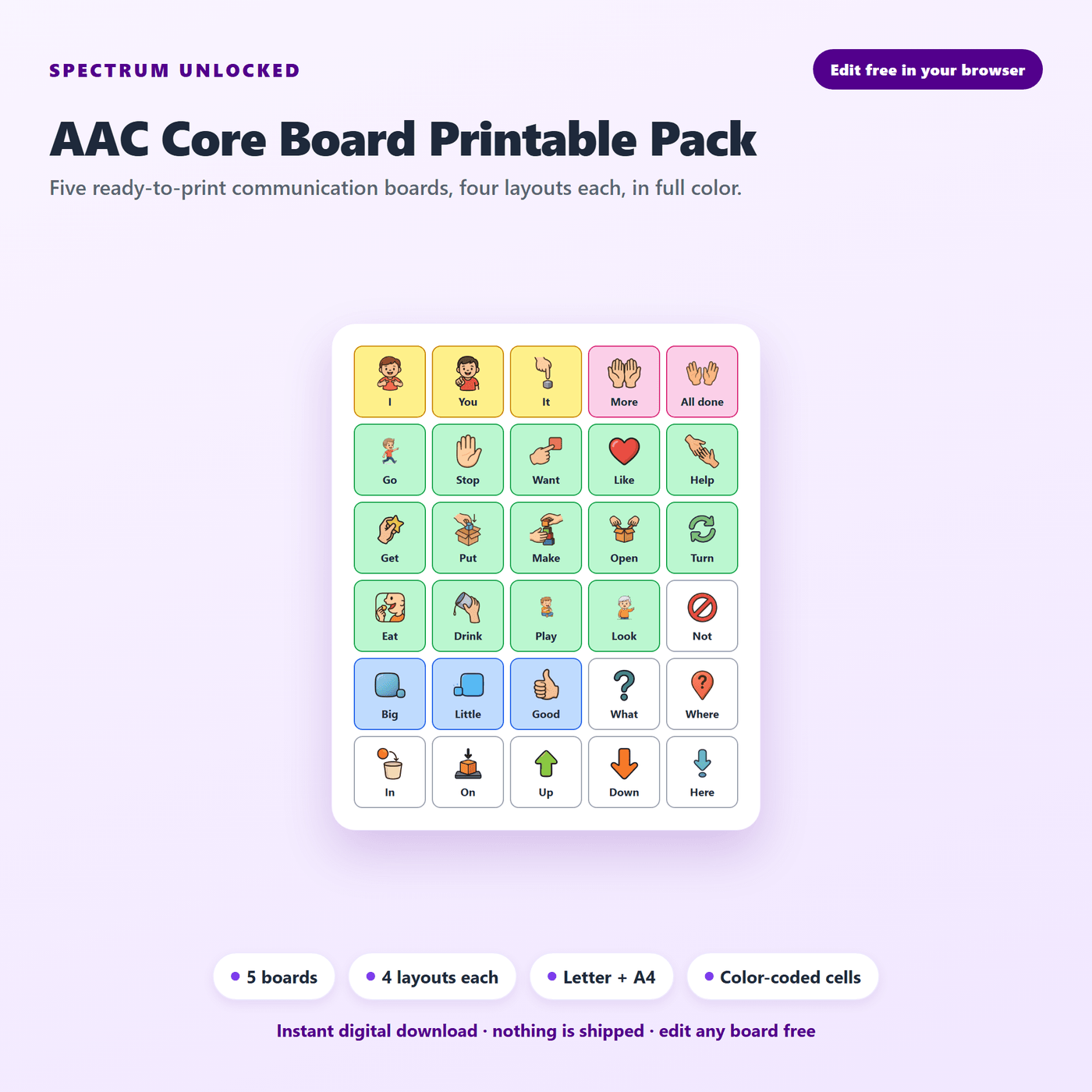
When you want the ready-made set the classroom runs on, the AAC Core Board Pack collects low-tech core word boards in multiple grid sizes, color-coded by word type, in US Letter and A4 with a setup guide for printing, laminating, and modeling. You can also grab a free starter board from the Educators resources page to try the approach first. Parents supporting a nonspeaking child at home can track which words are starting to stick in Beacon, which logs each new word as a saved win and shows progress over the weeks it takes a board to click.
To bind a set of boards or a picture-card book so it survives daily handling, see how to bind a book at home and the best binding machine guide for the ring, comb, and coil options.
The student has something to say. The route is the problem.
Beacon remembers your students and your setting, so you are not re-explaining them every time.
What would Beacon say?
"What communication support fits this student?"
Beacon looks at how the student communicates today and suggests the next step up, then gives you the boards to print for it.
Spectrum Unlocked Editorial Team
Editorial Team
The Spectrum Unlocked editorial team combines lived experience as autism parents with research-backed guidance to create resources families can trust.
Frequently asked questions
- What is a communication board?
- A communication board is a printed sheet or grid of words, pictures, or symbols that a person who cannot rely on speech points to in order to communicate. Instead of saying a word out loud, the person points to it, and a partner reads it back. Boards range from a single page of core words like want, stop, and more to topic boards for a specific activity such as snack or recess. It is the simplest, lowest-cost form of augmentative and alternative communication (AAC).
- How do communication boards help autistic students?
- For a nonspeaking or minimally speaking autistic student, a communication board gives a reliable way to be understood that does not depend on producing spoken words in the moment. Pointing to want, break, or all done can replace behavior that was doing the communicating before, like grabbing or melting down. Because the board is visual and stays in one place, it also fits the way many autistic learners process information more comfortably than spoken language that disappears the instant it is said.
- What words should be on a communication board?
- Start with core vocabulary: the 50 to 100 high-frequency words that make up around 80 percent of everything we say, such as want, more, stop, go, help, like, no, and turn. Core words work across every activity, so a student can use them all day. Add a smaller set of fringe words, the specific nouns for that student's world like names, foods, and favorite characters, but keep core words front and center so the board grows communication rather than just labeling objects.
- Are communication boards only for children?
- No. Communication boards are used by autistic teens and adults, people recovering from stroke or brain injury, and anyone in a setting where speech is hard to rely on, such as a hospital. A free printable communication board for adults uses the same core-word approach but swaps in age-respectful vocabulary and photos rather than childlike clip art. The tool is defined by the need, not the age.
- What is the difference between a communication board and PECS?
- A communication board is a fixed grid the person points to; the symbols stay on the board. PECS (the Picture Exchange Communication System) uses individual picture cards the person physically hands to a partner to make a request, and it follows a specific teaching sequence. Boards are faster to set up and better for building sentences by pointing to several words in a row. PECS is structured around initiating a request by exchanging a card. Many classrooms use both.
- Do communication boards stop a child from talking?
- No. This is a common worry, and the research points the other way: AAC, including low-tech communication boards, is associated with more spoken language over time, not less. Giving a reliable way to communicate lowers the frustration that blocks speech and models the words a child may later say. A board is a bridge to communication, not a replacement for speech.