Token Board for Autism: How Token Economy Works (Free Printable)
What a token board is and how a token economy motivates autistic students. Step-by-step setup, common mistakes, and a free printable token board.
Key Takeaways
- A token board is a visual reinforcement system: a student earns tokens for a target behavior, and a set number of tokens trades in for a reward they chose ahead of time.
- Token economies work because they bridge the gap between doing the hard thing now and getting the payoff later. The tokens make progress toward the reward visible, which keeps a student going through a task they would otherwise quit.
- The two make-or-break details are picking a reward the student actually wants (let them choose) and delivering tokens immediately and generously at first, then thinning them out as the behavior gets stronger.
- A token board is a support to fade, not a permanent bribe. Start with a short board and frequent rewards, then stretch the number of tokens and swap tangible rewards for natural ones as the behavior becomes a habit.
A token board is the classroom tool that turns "I don't want to" into "how many more until I'm done?" A student earns a token for doing the hard thing, watches the board fill up, and trades a full board for something they actually want. For a lot of autistic learners, that visible countdown is the difference between finishing a task and walking away from it.
What a token board is
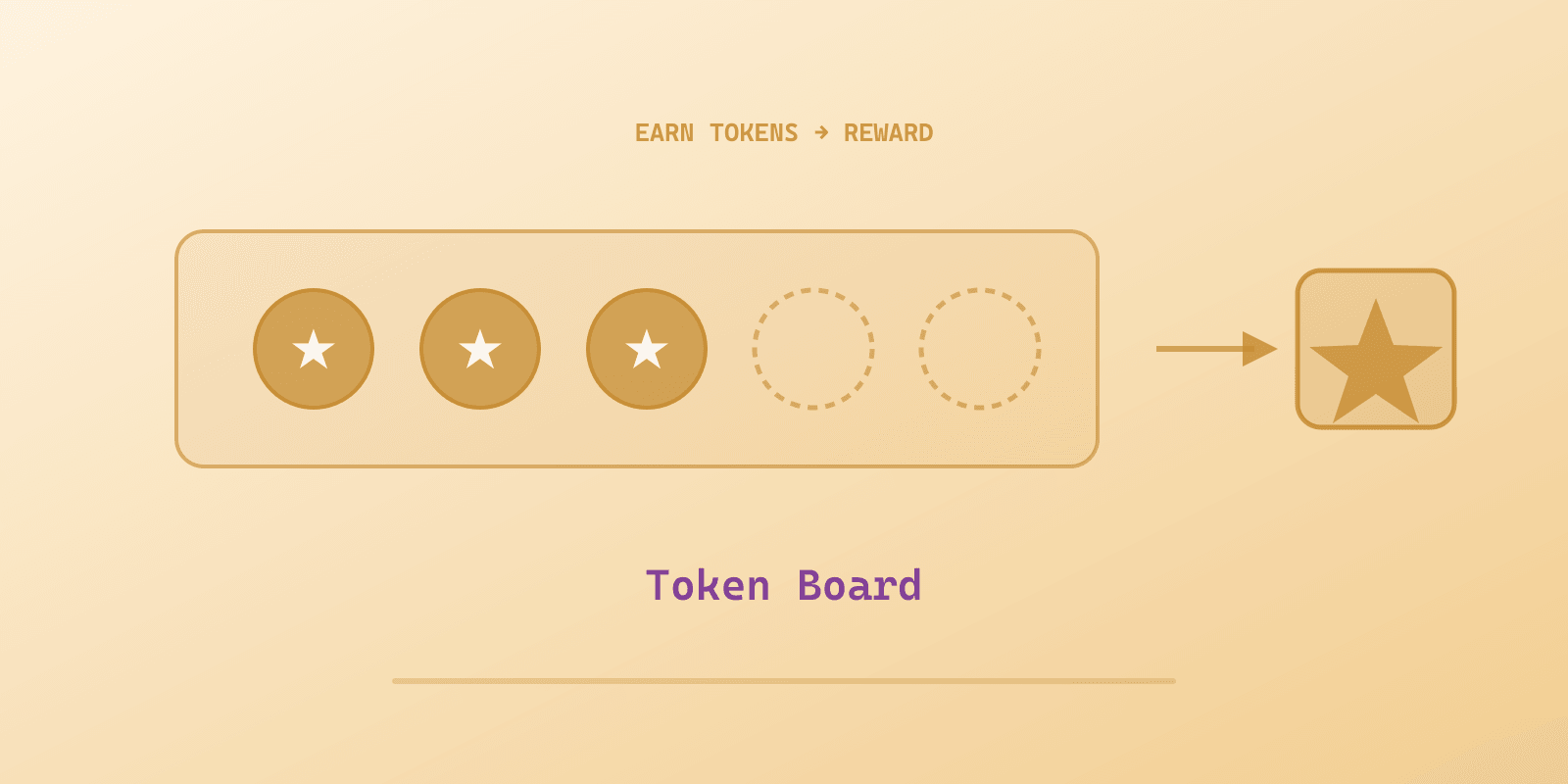
A token board is a visual reinforcement system. A student earns a token (a star, a coin, a themed picture) each time they show a target behavior, and once the board is full, they exchange the tokens for a reward they chose ahead of time. It makes an abstract promise (keep working and something good happens) into something the student can see and count.
The whole system has three moving parts:
- The target behavior: the specific, observable thing the student earns tokens for, like "raise your hand" or "stay in your seat for five minutes."
- The tokens: the countable currency, laid out in a row the student fills in.
- The reward: what a full board trades in for, chosen by the student in advance. For a child who works hardest for movement, that reward might be going outside, which the 6-token outside-time board is built around.
How a token economy works
A token economy borrows the logic of money. You do not eat a paycheck, but you work for it because you know it trades for the things you want. Tokens do the same job for a student: they bridge the gap between doing something hard now and getting the payoff later.
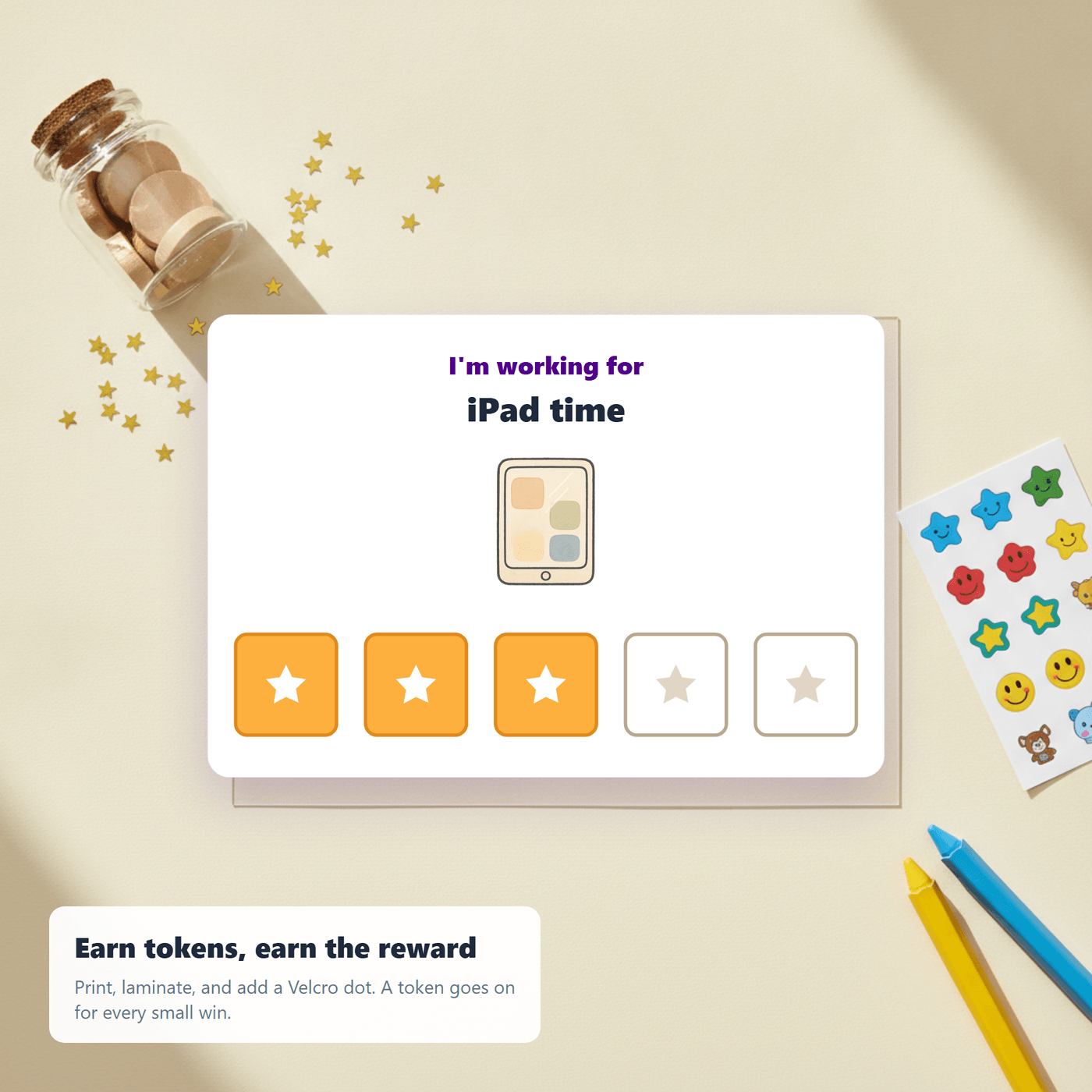
That bridge is the point. Many autistic students find delayed rewards genuinely hard to hold onto. "Finish your work and you can have iPad time after lunch" asks them to keep an invisible promise in mind for an hour. A token board makes the promise visible: every token is a chunk of progress they can see, so the reward stops feeling far away and starts feeling close. That is also why a token board pairs so well with a first-then board, which shows the single next step, while the token board shows the distance to the reward.
How to set up a token board: step by step
- Pick one target behavior and define it clearly. Choose a single behavior to start, described so anyone would score it the same way. "Stays seated during circle time" beats "behaves." Use ABC data if you are not sure which behavior to target first.
- Let the student choose the reward. Offer a few options and let them pick. A reward the student does not care about will not motivate anything, and the same reward will get stale, so keep a small menu. If the reward they pick is a favorite snack, the 4-token snack board is set up for exactly that.
- Start with a short board. Three to five tokens for a new learner. The reward has to feel close enough to be worth working for. A ten-token board is where most token systems quietly die. For a brand-new learner, the 3-token starter board keeps that first board short enough to finish in one sitting.
- Deliver tokens immediately and name the behavior. The instant the behavior happens, hand over a token and say what earned it: "You raised your hand, here's a star." The delay between behavior and token should be near zero at first.
- Trade the full board right away. When the last token lands, the student cashes in immediately. Making them wait breaks the connection the board is built on.
- Thin it out as the behavior gets stronger. Once the behavior is reliable, require a little more for each token and add tokens to the board. This is fading, and it is how a token board becomes a stepping stone rather than a crutch.
A token board in action
Here is how the same board can grow with a student over a few weeks:
| Stage | Target behavior | Tokens to fill | Reward |
|---|---|---|---|
| Week 1 | Raises hand once instead of calling out | 3 | 3 minutes with a preferred toy |
| Week 2 | Raises hand across a full lesson | 5 | Choice of classroom job |
| Week 4 | Raises hand across the morning | 8 | Ten minutes of a favorite activity |
Notice what changed: the behavior got bigger, the board got longer, and the reward moved from an immediate tangible toward a natural privilege. That drift, from many tokens and quick rewards toward fewer tokens and natural payoffs, is the entire arc of a well-run token economy.
Common token board mistakes
- The board is too long. If the reward is 10 tokens away on day one, the student gives up before the first cash-in. Start short and stretch later. Once a student reliably fills a short board, the 10-token reward board stretches the same system toward a bigger payoff like a trip to the park.
- The reward is the adult's idea, not the student's. Sticker charts fail when the sticker is the reward. The student has to actually want what the board buys.
- Tokens come too slowly. Early on, generous and immediate wins. Stingy tokens teach the student the board is not worth the effort.
- Taking tokens away as punishment. Response cost (removing earned tokens) is a specific technique that backfires when used casually. For a student learning the system, earned tokens stay earned.
- Using it as an in-the-moment bribe. Offering a token to stop a tantrum rewards the tantrum. The board is set up in advance for the behavior you want, which is what separates it from a bribe.
Where a token board fits in behavior support
A token board is a reinforcement tool, and reinforcement is only half of a good plan. The other half is teaching what to do instead of the behavior you are trying to reduce. A token board that reinforces "asks for a break with a card" works far better than one that just rewards "no meltdowns," because it pays off a specific replacement behavior the student can actually perform.
That is why token boards show up inside a formal behavior intervention plan: the plan identifies the function of a behavior, names the replacement skill, and a token board is often the reinforcement engine that makes the replacement worth doing. Used on its own, a token board motivates. Used inside a plan, it changes behavior. In a self-contained classroom, it is also one piece of the visual behavior infrastructure you set up before students arrive, which the self-contained classroom setup guide walks through zone by zone.
Make and download a free token board
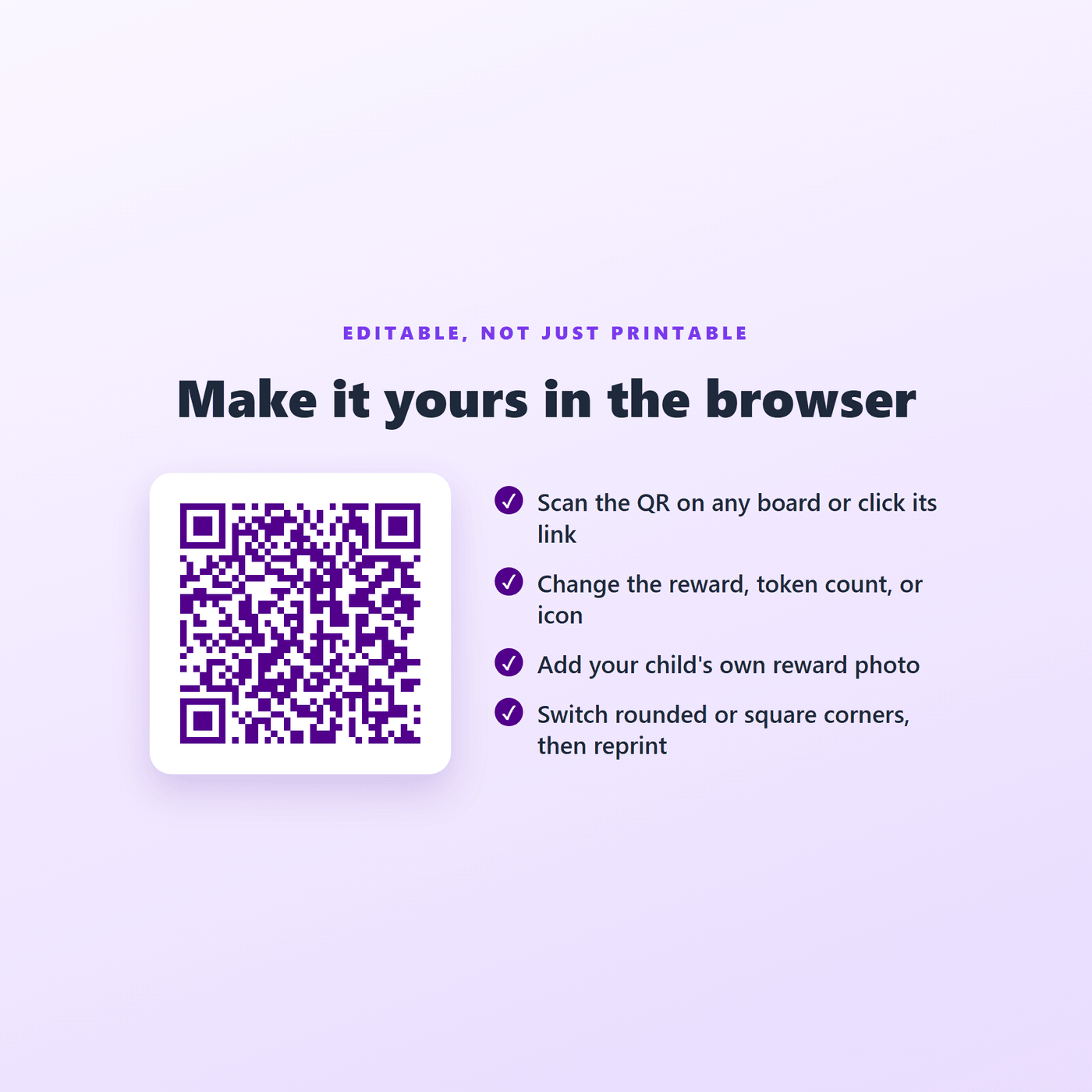
You can build a token board in your browser right now with the free Token Board Maker: choose the number of tokens and a theme, and print a board sized to your student. It is the fastest way to get a working board on a desk today.
When you want the ready-made classroom set, the Token Board Pack collects token economy boards with a range of token counts, sheets of cut-out tokens and reward strips, working-for and first-this-then-reward layouts, and themed designs, in US Letter and A4 with a setup guide. You can also grab a free starter board from the Educators resources page to try the system first. Parents building a reinforcement routine at home can plan it inside Beacon, which helps you connect a target behavior to a reward and track whether the plan is working over time. There is also a free sample with one board and its tokens.
Planning for a room where every student needs something different?
Beacon remembers your students and your setting, so you are not re-explaining them every time.
What would Beacon say?
"Help me plan a week for a mixed-goal group"
Beacon works from the goals and levels already in your room, then gives you something you can run on Monday. Not a blank template to fill in on Sunday night.
Spectrum Unlocked Editorial Team
Editorial Team
The Spectrum Unlocked editorial team combines lived experience as autism parents with research-backed guidance to create resources families can trust.
Frequently asked questions
- What is a token board?
- A token board is a visual reinforcement tool used in autism and special education. A student earns a token, such as a star, coin, or themed picture, each time they show a target behavior, and once the board is full they exchange the tokens for a reward they picked in advance. It makes an abstract idea, keep going and you will earn something, concrete and visible, so the student can see how close the payoff is.
- How does a token economy work?
- A token economy connects a behavior you want to see more of with a reward the student wants, using tokens as the in-between currency. You define the target behavior, decide how many tokens earn the reward, and hand over a token immediately each time the behavior happens. When the board fills up, the student trades the tokens for the reward. Over time you require more behavior per token and stretch the board, so the same system supports bigger goals with less frequent rewards.
- What can you use as tokens and rewards?
- Tokens can be anything countable and visual: stars, coins, checkmarks, stickers, or themed pictures a student likes, such as dinosaurs or trains. Rewards should be things the student genuinely wants and does not get for free, like time with a preferred toy, a favorite activity, a small snack, or a break. The single most important rule is that the student helps choose the reward, because a reward they do not care about will not motivate anything.
- How many tokens should a token board have?
- Start small. For a young or new learner, a board that fills with three to five tokens keeps the reward close enough to stay motivating. As the behavior gets stronger, gradually increase the number of tokens needed and the amount of behavior each token requires. Jumping straight to a ten-token board is the most common reason a token system fails, because the reward feels too far away to work toward.
- Is a token board just bribery?
- No. A bribe is offered in the middle of a problem behavior to make it stop, which rewards the behavior you do not want. A token board is set up in advance, earns rewards for the behavior you do want, and is designed to be faded out as the behavior becomes a habit. It is a structured, temporary reinforcement system with a plan to remove it, which is the opposite of an in-the-moment bribe.
- How do you fade a token board?
- Fade a token board along two dimensions. First, thin the schedule: require more of the target behavior for each token, and more tokens for each reward. Second, shift the reward from tangible to natural, moving from a toy or snack toward praise, a privilege, or the natural result of the behavior itself. Fade gradually and only when the behavior is stable. If it slips, step back to a richer schedule for a while, then thin again.