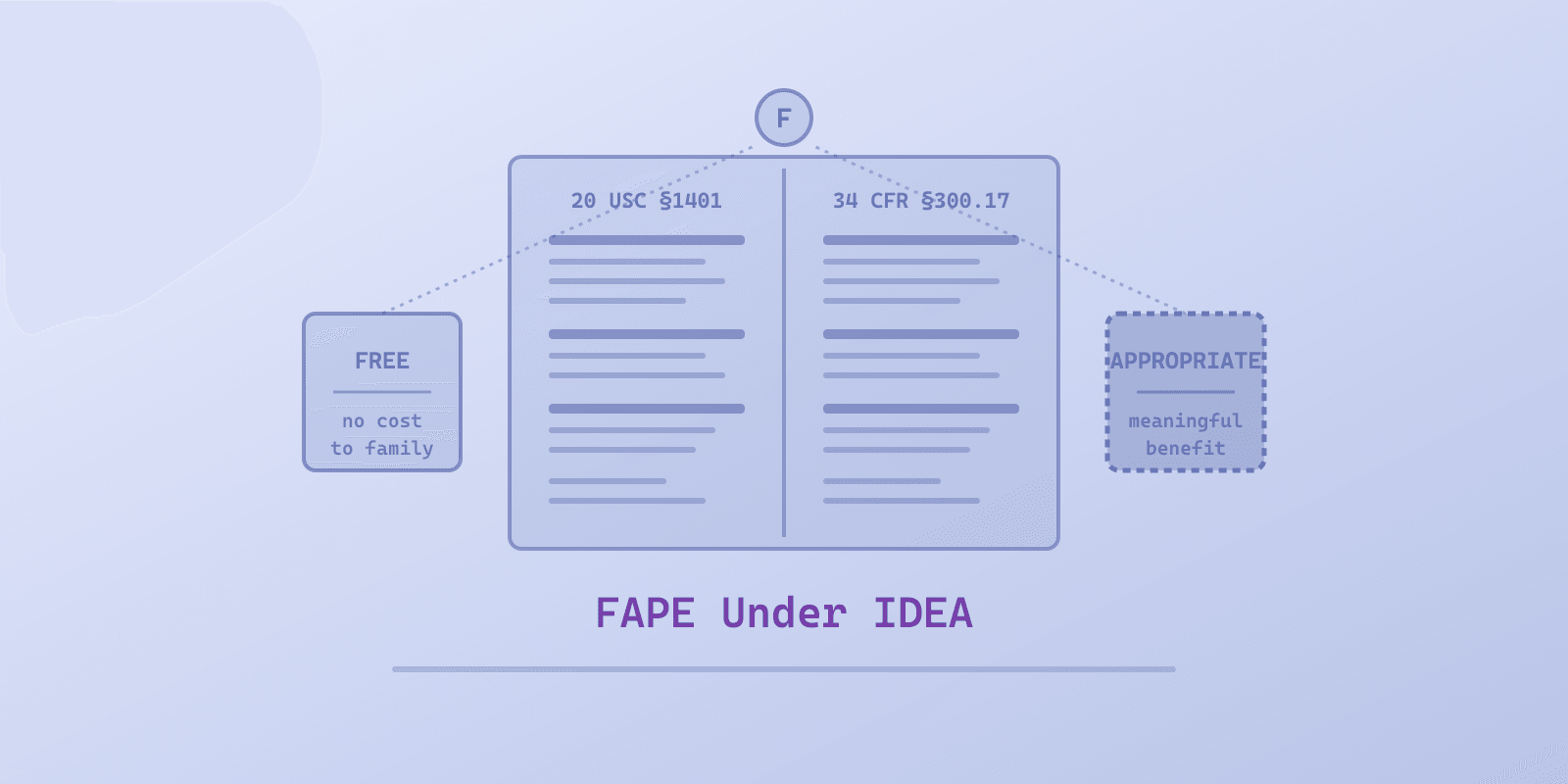
FAPE Under IDEA: Your Child's Right to Free Appropriate Public Education
FAPE is the legal anchor for every IEP, related service, and accommodation under IDEA. Here are the 4 pillars of FAPE, the post-Endrew F. meaningful-benefit standard, and how to recognize when a school's denial puts FAPE at risk.
Key Takeaways
- FAPE (Free Appropriate Public Education) is your child's right under IDEA: special education and related services provided at public expense, under public supervision, that meet state standards and conform to the child's IEP (20 USC §1401(9); 34 CFR §300.17).
- FAPE has 4 pillars: free (no cost to the family), appropriate (meaningful benefit standard post-Endrew F.), public (provided by the school district), and education (designed to meet the child's unique needs).
- The Supreme Court in Endrew F. v. Douglas County School District (137 S. Ct. 988, 2017) held that FAPE requires an IEP reasonably calculated to enable a child to make progress appropriate in light of the child's circumstances, a meaningful-benefit standard well above 'merely more than de minimis.'
- When a school's proposed or refused action raises a FAPE concern, the IEP Advocacy Letter Builder generates a written request that names the data, cites the regulation, and asks the team to reconvene around the FAPE standard.
FAPE is the legal anchor for every IEP, every related service, every accommodation. It stands for Free Appropriate Public Education, and it is the right that IDEA secures for every eligible child with a disability. When a school refuses something, the question is always the same: does this denial leave the IEP unable to provide FAPE?
The statutory definition lives at 20 USC §1401(9), and the federal regulation at 34 CFR §300.17 breaks that definition into the 4 pillars parents need to recognize. The state's obligation to provide FAPE is anchored at 20 USC §1412(a)(1), which conditions IDEA Part B funding on the state's assurance that FAPE is available to all eligible children residing in the state aged 3 through 21.
This guide walks through what FAPE means in plain English, the 4 pillars of the federal definition, the Supreme Court's Endrew F. meaningful-benefit standard, an autism-specific example of a FAPE-implicating service reduction, and how to recognize when a school's proposed or refused action raises a FAPE concern.
The 4 Pillars of FAPE
The federal definition at 34 CFR §300.17 breaks into 4 pillars, each load-bearing. A district that drops any one of them is not providing FAPE under IDEA.
- Free. Special education and related services are provided at public expense, under public supervision and direction, at no cost to the parent (34 CFR §300.17(a)). Parent contribution to insurance co-pays, related-service fees, or transportation is not permitted as a condition of FAPE.
- Appropriate. The services must meet the standards of the state educational agency and conform to the child's IEP (34 CFR §300.17(b) and (d)). After the Supreme Court's 2017 decision in Endrew F. v. Douglas Cnty. Sch. Dist., 137 S. Ct. 988 (2017), "appropriate" means the IEP is reasonably calculated to enable the child to make progress appropriate in light of the child's circumstances, which is a meaningful-benefit standard, not a minimal-benefit standard.
- Public. The services are provided by the public school district under public supervision and direction (34 CFR §300.17(a)); private placement at public expense is a remedy available in specific procedural circumstances, but the underlying obligation runs to the public district.
- Education. The services include preschool, elementary, and secondary education provided in conformity with the IEP (34 CFR §300.17(c)); FAPE covers special education itself plus the related services (speech, OT, PT, behavioral support, counseling, assistive technology, transportation) the child needs to benefit from special education (20 USC §1401(9)).
Together these 4 pillars define what FAPE requires. The federal regulation at 34 CFR §300.101 confirms that FAPE must be available to all children with disabilities aged 3 through 21 who reside in the state, and the limited exceptions are named at 34 CFR §300.102 (graduation with a regular diploma, certain incarcerated students, and certain age ranges where state law does not require general education for nondisabled students).
The Endrew F. "Meaningful Benefit" Standard
The substantive content of "appropriate" was the contested question for decades. Lower federal courts split on whether IDEA required only "some" educational benefit or whether it required more. In 2017 the Supreme Court resolved the split in Endrew F. v. Douglas Cnty. Sch. Dist., 137 S. Ct. 988 (2017) by holding that an IEP must be reasonably calculated to enable a child to make progress appropriate in light of the child's circumstances.
The Endrew F. opinion rejected the lower "merely more than de minimis" standard the Tenth Circuit had applied. In the Court's words, "a student offered an educational program providing 'merely more than de minimis' progress from year to year can hardly be said to have been offered an education at all." The standard the Court set is higher: the IEP must be ambitious in light of the child's circumstances, and the district must be able to explain why the goals are appropriate.
For parents, the Endrew F. standard does several things. It anchors disagreements over service intensity, goal ambition, and progress monitoring to a written Supreme Court standard parents can name in writing. It pairs with the PLAAFP (Present Levels of Academic Achievement and Functional Performance) data section of the IEP: if the PLAAFP shows a child capable of meaningful progress on a goal area and the IEP sets only token goals, that is a FAPE concern under Endrew F. And it raises the substantive bar at the IEP table without changing the procedural process: the same IEP meetings, the same data, the same goal-setting framework, evaluated against a higher substantive standard.
The standard is implementation-specific. The Court did not name a single threshold or formula. The phrase "appropriate in light of the child's circumstances" is the load-bearing language, and the district's IEP must be defensible against that phrase. Where the parent reads the IEP and concludes the goals or services are not ambitious enough in light of the child's circumstances, the FAPE-under-Endrew-F. concern is properly named in writing and put to the team.
An Autism-Specific Example: A Proposed Reduction in Speech Services
Consider a 9-year-old autistic learner whose IEP includes 90 minutes per week of direct speech-language services targeting expressive language goals. The child's PLAAFP shows steady progress over the past two years: from 3-word phrases to 7-to-9-word sentences with consistent grammar, expanded social-pragmatic language, and increasing classroom participation. At the annual IEP meeting, the district proposes to reduce direct speech services from 90 minutes per week to 30 minutes per week, citing the child's "good progress."
The FAPE concern attaches at several layers. First, the proposed reduction triggers Prior Written Notice (PWN) under 34 CFR §300.503; the PWN must explain the basis, name the data, and list alternatives considered. If the team acts without it, you can request prior written notice so that basis and those alternatives end up on paper. Second, the Endrew F. standard asks whether the post-reduction IEP is still reasonably calculated to enable progress appropriate in light of the child's circumstances. The child's circumstances include continued expressive-language growth and continued classroom-participation gains; a 67% reduction in direct services is substantial and needs a substantive defense.
In this scenario, the parent's response is not a directive demand and is not litigation-by-letter. The response is documented analysis. The parent can ask for the data the team relied on, can ask whether the team considered alternatives (a graduated fade rather than a 67% one-step reduction; a consultative model alongside reduced direct minutes; a progress-monitoring threshold that would trigger restoration if regression is observed), and can name the Endrew F. standard in writing. The IEP Advocacy Letter Builder drafts this written request with the regulation cited inline and the FAPE concern framed against the Endrew F. standard.
The service reduction may still be defensible on the data, and the IEP team may still document the reduction in a compliant PWN. The parent's written response anchors the conversation to the FAPE standard; the team's documented response anchors its determination to the data. That is the procedural shape of every FAPE conversation: a data-driven IEP team determination, a written PWN, and a parent's documented response, each tied to the regulation.
When a FAPE Concern Arises: What the Path Looks Like
A FAPE concern arises whenever a proposed or refused action by the district reasonably calls into question whether the resulting IEP is still reasonably calculated to enable the child to make progress appropriate in light of the child's circumstances. The most common triggers parents see are a reduction in services, a placement change that constricts access to the general education curriculum, a refusal to add a related service the data supports, or a refusal to evaluate in an area where the child shows need.
When a FAPE concern arises, the path forward is the same procedural shape every IDEA dispute follows. The district issues a PWN under 34 CFR §300.503 explaining the proposal or refusal, the basis, the data, and the alternatives considered. The parent reads the PWN, gathers the underlying data, and responds in writing by naming the FAPE concern, citing the regulation, and asking the IEP team to reconvene around the concern. The Services Dispute letter template frames the FAPE citation pattern (20 USC §1401(9) + 34 CFR §300.17 + Endrew F.) against the specific action; the full IEP Advocacy Letter Builder drafts a custom version when your situation needs more nuance.
Other surfaces in the IDEA framework matter too. The least restrictive environment (LRE) standard intersects FAPE: a placement that meets FAPE but violates LRE is still not FAPE under the broader procedural framework. The extended school year (ESY) standard intersects FAPE: ESY services are provided only when the IEP team determines services are necessary for the child to receive FAPE under 34 CFR §300.106(a)(2). The accommodations versus modifications distinction intersects FAPE: a modification that pulls the child off the standard graduation pathway is a substantive FAPE question for any student whose data supports the standard pathway. The free IEP Meeting Prep checklist walks through the document-gathering and question-list a parent uses to prepare for the meeting where the FAPE concern is on the table.
If the IEP team does not reconvene, or reconvenes and does not adjust the proposal, the IDEA procedural safeguards at 34 CFR §300.500 and following provide formal routes: state complaint under 34 CFR §300.151, mediation, and due process hearing under 34 CFR §300.507. The technical procedural rules and short timelines make a consultation with a special-education attorney a sensible first step before pursuing any of those formal routes. Free legal help is available in every state through Parent Training and Information centers; you can find yours at the Center for Parent Information and Resources.
Why State Rules Matter Less Here Than Elsewhere
Procedural questions in special education turn heavily on your state. The deadline for a prior written notice, the name of the IEP team, the dispute-resolution clock: all of these are set state by state on top of the federal floor, which is why the prior written notice explainer spends real time on state variation.
FAPE is the exception in this cluster. The substantive standard from Endrew F. is a Supreme Court holding and applies in every state, and the federal definition at 34 CFR §300.17 is the floor every state that takes IDEA Part B money must meet. No state can define "appropriate" downward. That is worth knowing before a meeting, because "that is not how we do it in this district" is not an answer to a FAPE concern in the way it can sometimes be an answer to a procedural one.
Where state law does change the picture is in the services running alongside IDEA rather than inside it. California's Lanterman Act and Regional Center system is the clearest example: a parallel entitlement that can supply what the IEP does not, without altering what the school district owes.
How to Tell Whether Your Child Is Actually Receiving FAPE
FAPE is the only part of this cluster that is a standard rather than a procedure. Prior written notice either arrived or it did not. Specially designed instruction is either written into the grid or it is not. FAPE is a judgment about whether what your child receives is appropriate for your child, which means it is the one question you have to answer with your own child's data rather than by checking a box.
Endrew F. gives you the test. The IEP must be reasonably calculated to enable progress that is appropriate in light of your child's circumstances. Applied to a real IEP, that becomes five questions, and you need last year's progress reports in front of you to answer them.
1. Did the goals move? Pull the progress reports for each annual goal. Not the narrative comments, the actual measurement. A goal reported at 40% accuracy in October and 45% in May has moved, barely. A goal reported "making progress" four times running with no number has not been measured at all, which is its own finding.
2. Were this year's goals more ambitious than last year's? Compare the two IEPs side by side. If the same goal reappears at the same criterion for a second or third year, the team is either not expecting progress or not getting it. Both are FAPE questions, and they have different answers.
3. Are the goals ambitious in light of what your child can already do? This is where the PLAAFP earns its place. If the present levels describe a child reading at one level and the reading goal targets something well below it, the goal is not ambitious in light of that child's circumstances, whatever the percentage attached to it says.
4. Is the child receiving the services the IEP promises? A service grid saying 120 minutes weekly of speech is a commitment. Ask for the service logs. Minutes missed and not made up are a FAPE implementation question, distinct from whether the IEP itself is appropriate.
5. Can the team explain why these goals are right for this child? Endrew F. requires that the district be able to explain its choices. A team that cannot say why a goal is set where it is has not met the standard the Court described, and asking the question in the meeting puts it in the minutes.
If several answers come back uncomfortable, that is a FAPE concern rather than a disagreement about preferences, and it is worth naming as one in writing. The IEP Advocacy Letter Builder will put the data, the regulation and the request into one document the team has to respond to, and a written response under 34 CFR §300.503 is exactly what a prior written notice is for.
For more on navigating the IEP process, see the IEP vs 504 Plan walkthrough, the least restrictive environment guide, the present levels (PLAAFP) explainer, the 504 Accommodations for Autism guide, the prior written notice explainer, the accommodations vs modifications walkthrough, and the extended school year (ESY) eligibility guide; or use the IEP Advocacy Letter Builder to draft a written request when a school's proposal or refusal raises a FAPE concern.
Need help preparing for YOUR next IEP meeting?
Beacon learns about YOUR child and gives guidance specific to them.
What would Beacon say?
"Help me prep for my IEP meeting"
Beacon pulls your child's goals, challenges, and history, then gives you the exact questions to ask, the red flags to watch for, and what to push back on.

Spectrum Unlocked Editorial Team
Editorial Team
The Spectrum Unlocked editorial team combines lived experience as autism parents with research-backed guidance to create resources families can trust.
Frequently asked questions
- What does FAPE stand for?
- FAPE stands for Free Appropriate Public Education. It is the legal right of every eligible child with a disability to receive special education and related services at no cost to the family, under public supervision, that meet state standards and conform to the child's IEP (20 USC §1401(9); 34 CFR §300.17).
- What does FAPE require under IDEA?
- FAPE requires the school district to provide special education and related services that are designed to meet the child's unique needs and reasonably calculated to enable the child to make progress appropriate in light of the child's circumstances (Endrew F. v. Douglas Cnty. Sch. Dist., 137 S. Ct. 988, 2017). The federal regulation at 34 CFR §300.101 confirms that FAPE must be available to all children with disabilities aged 3 through 21 who reside in the state.
- Who is entitled to FAPE?
- Every child with a disability who is eligible for special education under IDEA is entitled to FAPE, with limited exceptions for certain age ranges, students who have graduated with a regular high school diploma, and certain incarcerated students (34 CFR §300.101; 34 CFR §300.102). The right attaches once the child is found eligible through the evaluation and eligibility process; it continues through the duration of the child's IEP.
- What is the Endrew F. standard?
- In Endrew F. v. Douglas County School District (137 S. Ct. 988, 2017), the Supreme Court held that an IEP must be reasonably calculated to enable a child to make progress appropriate in light of the child's circumstances. The Court rejected the lower 'merely more than de minimis' standard. For parents, this means FAPE requires meaningful benefit, not minimal benefit, and the IEP must be ambitious in light of the child's unique circumstances.
- What should I do if I think the school is not providing FAPE?
- When a proposed or refused action raises a FAPE concern, the path forward is documentation. Ask the school to issue a Prior Written Notice (PWN) under 34 CFR §300.503 that explains the basis, the data, and the alternatives considered. The IEP Advocacy Letter Builder drafts a written request that names the FAPE concern, cites the regulation, and asks the IEP team to reconvene. Talk to a special-education attorney before pursuing formal dispute resolution (state complaint, mediation, due process hearing).
- Does FAPE include related services like speech and OT?
- Yes. FAPE includes special education and related services such as speech, occupational therapy, physical therapy, counseling, behavioral support, transportation, assistive technology, and any other developmental, corrective, or supportive service required to help the child benefit from special education (20 USC §1401(9); 34 CFR §300.17). The services must be named in the IEP and provided at no cost to the family.
- Is FAPE the same under Section 504?
- No. FAPE under IDEA (Part B) is a special-education entitlement defined at 20 USC §1401(9) and 34 CFR §300.17. FAPE under Section 504 is a civil-rights concept defined separately at 34 CFR §104.33, and it requires regular or special education and related aids and services designed to meet the educational needs of qualified students as adequately as the needs of students without disabilities are met. The IEP vs 504 Plan walkthrough covers the framework distinction in detail.