Specially Designed Instruction (SDI): What It Is, How It Differs From General Instruction, and Autism-Specific Examples
Specially Designed Instruction is the heart of special education under IDEA. Here is the federal definition of SDI, the 4 differences from general instruction, autism-specific SDI examples, and how to request more SDI in your child's IEP.
Key Takeaways
- Specially Designed Instruction (SDI) is the federally defined core of special education: instruction adapted to your child's disability, in content, methodology, or delivery, to meet the child's unique needs and ensure access to the general curriculum (34 CFR §300.39(b)(3); 20 USC §1401(29)).
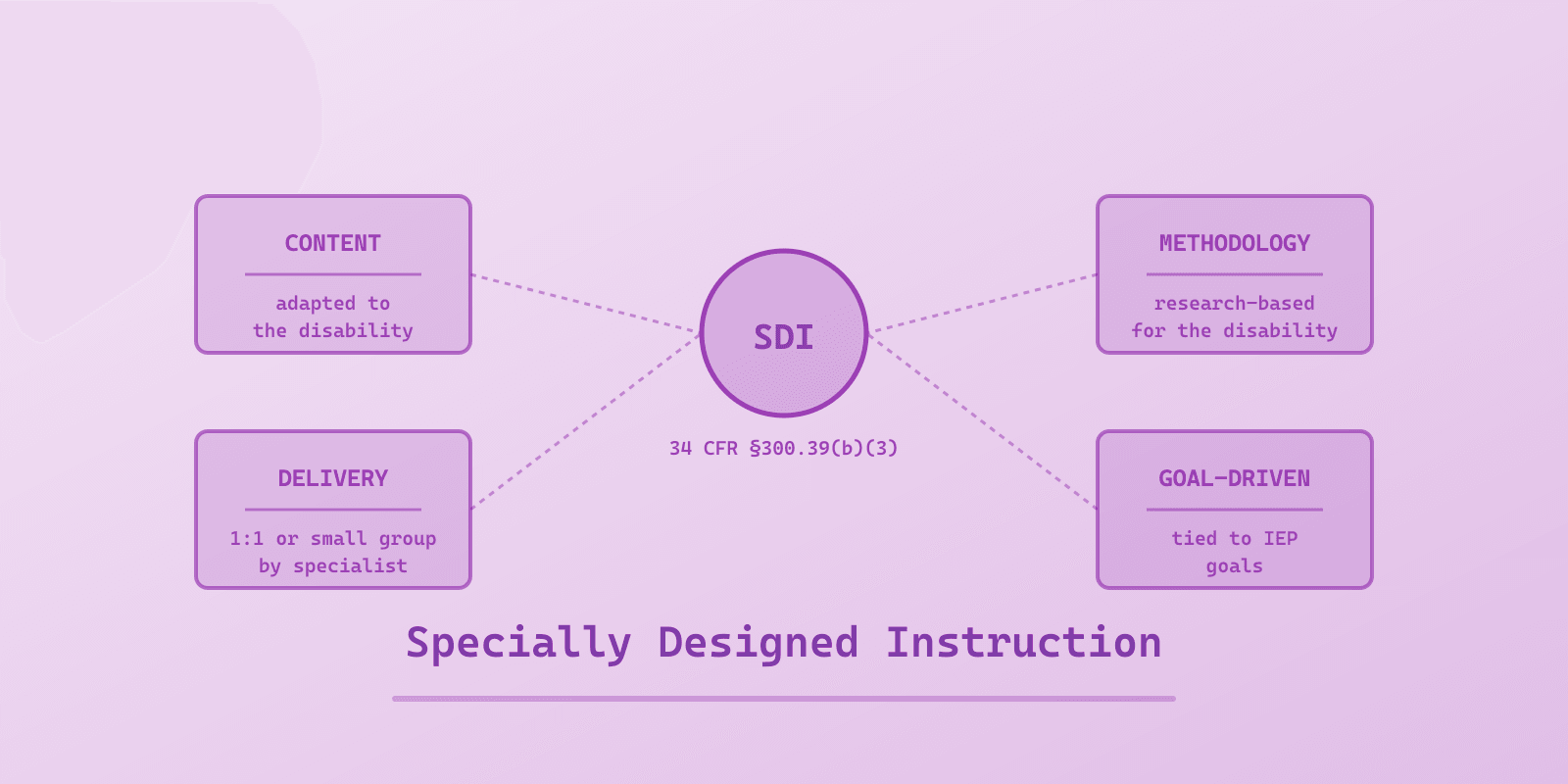
- SDI differs from general instruction in 4 ways: content (adapted to the disability), methodology (research-based for the disability), delivery (often 1:1 or small-group, by a trained specialist), and goal-driven (each session ties to specific IEP goals).
- Autism-specific SDI includes discrete-trial instruction (DTI) for early language, structured social-skills curricula (Social Thinking, Skillstreaming), AAC programming and modeling for non-speaking or minimally-speaking learners, and explicit executive-function instruction for autistic adolescents.
- When your child's IEP minutes do not reflect actual SDI (the IEP says 'specially designed instruction' but the schedule shows a paraprofessional re-reading the same general-education worksheet), the IEP Advocacy Letter Builder generates a written request that names the data, cites 34 CFR §300.39, and asks the team to revise the service grid.
Specially Designed Instruction (SDI) is the heart of special education. It is what makes an IEP an IEP: instruction adapted to your child's disability, delivered by someone trained to teach that way, tied to specific goals. Without SDI, you have accommodations on a regular education program; with SDI, you have special education.
The federal regulation that defines SDI lives at 34 CFR §300.39(b)(3), and the broader definition of "special education" at 34 CFR §300.39 and the statutory anchor at 20 USC §1401(29) tie SDI directly to the IDEA framework every IEP operates under. The substantive standard for the methodology and the delivery model comes from Endrew F. v. Douglas Cnty. Sch. Dist., 137 S. Ct. 988 (2017): the IEP must be reasonably calculated to enable the child to make progress appropriate in light of the child's circumstances.
This guide explains what SDI means in plain English, the 4 ways SDI differs from general instruction, 4 categories of autism-specific SDI with concrete examples, who is qualified to provide SDI, how to request more SDI in your child's IEP, and how to recognize when the IEP grid says "specially designed instruction" but the actual school day does not deliver it. If the service-grid wording on your own IEP reads like code, the IEP Translator can translate the SDI language line by line.
4 Ways SDI Differs From General Instruction
The federal definition at 34 CFR §300.39(b)(3) names adaptation in content, methodology, or delivery. Read alongside the statutory definition at 20 USC §1401(29) and the IEP-services regulation at 34 CFR §300.320, the practical contrast with general instruction reduces to 4 differences parents can recognize on any service grid.
- Content. SDI adapts the content to the disability. A general fourth-grade reading curriculum covers grade-level decoding, fluency, vocabulary, and comprehension on a uniform scope and sequence. SDI for a fourth-grader with a reading-specific learning disability might shift to systematic phonics instruction starting from the child's actual mastery point, even if that is below grade level, with a different scope (more decoding, less inference) and a different sequence (mastery-based progression, not calendar-based progression). The adaptation is to the disability, anchored to 34 CFR §300.39(b)(3)(i).
- Methodology. SDI uses research-based methodology for the specific disability. Multisensory structured-language instruction (Orton-Gillingham, Wilson, LiPS) for dyslexia is methodology-specific SDI. Discrete-trial instruction for early language acquisition in autism is methodology-specific SDI. Naturalistic developmental behavioral intervention (NDBI) protocols for early-childhood autism are methodology-specific SDI. The methodology is not "more support" or "more time" but a different way of teaching that the child's disability profile requires, anchored to 34 CFR §300.39(b)(3)(ii).
- Delivery. SDI is often 1:1 or small-group, by a teacher or specialist trained in the methodology. A general-education reading block delivers instruction to 22 to 28 students at the same time. SDI for autism early language might be 1:1 with the speech-language pathologist, 30 minutes per session, 3 sessions per week. SDI for adolescent executive-function instruction might be small-group (3 to 5 students) with the special education teacher, 45 minutes per session, 2 sessions per week. The grouping is determined by the methodology and the child's needs, not by classroom logistics.
- Goal-driven. Every SDI block ties to a specific IEP goal with measurable progress data. A general-education reading block tracks performance against grade-level standards on quarterly report cards. SDI tracks performance against the child's IEP goals (for example, "decode 90% of CVCe-pattern single-syllable words in connected text across 3 consecutive probes") on the schedule the IEP names (often biweekly or monthly). Goal-driven progress monitoring is the data layer that makes SDI accountable.
Together these 4 differences define what SDI looks like in practice. A district that lists "specially designed instruction" on the service grid but delivers paraprofessional re-reading of general-education worksheets is not providing SDI under 34 CFR §300.39(b)(3); the substantive standard from Endrew F. asks whether the resulting IEP is still reasonably calculated to enable the child to make progress appropriate in light of the child's circumstances, and absent the 4 differences the answer is usually no.
4 Categories of Autism-Specific SDI
The general definition lives in the regulation; the practical question for autistic learners and their parents is what SDI looks like in the IEP service grid. The 4 categories below are the most common SDI categories for autistic children across the K-12 age range, each grounded in research-based methodology and each routinely written into autism IEPs by special education teachers and related-services providers.
Discrete-Trial Instruction (DTI) for Early Language
Discrete-trial instruction breaks a skill (a vocabulary word, a phonemic discrimination, a receptive instruction, a manding request) into a sequence of short, structured trials. Each trial includes a discriminative stimulus (the teacher's prompt), the child's response, and a contingent consequence (reinforcer for a correct response; correction or error-correction protocol for an incorrect response). DTI is delivered 1:1 or in small groups of 2 to 3 children with similar profiles by a special education teacher, a board-certified behavior analyst, or a speech-language pathologist trained in the methodology.
For an autistic 4-year-old in early intervention or preschool, an IEP that lists DTI as SDI might specify "30 minutes of discrete-trial instruction targeting receptive object identification and 2-word combinations, 4 sessions per week, delivered 1:1 by the speech-language pathologist in the resource room." The methodology is named (DTI), the goal is named (receptive object ID + 2-word combinations), the provider is named (SLP), the grouping is named (1:1), the location is named (resource room), and the frequency is named (4x30 min per week). All 4 SDI differences are visible on the service grid.
Structured Social-Skills Curricula
Social cognition is taught explicitly for autistic learners rather than expected to develop incidentally. Two of the most common research-based curricula are Social Thinking (Michelle Garcia Winner) and Skillstreaming (Goldstein and McGinnis); both break social skills into teachable components (perspective-taking, conversational repair, group entry, hidden-rule recognition) and deliver them through modeling, role-play, video review, and structured practice. SDI in this category is usually delivered in small groups of 3 to 6 students with the school psychologist, the special education teacher, or the speech-language pathologist trained in the curriculum.
For an autistic 8-year-old whose PLAAFP data shows difficulty with group entry, conversational repair, and reading peer non-verbal cues, an IEP that lists structured social skills as SDI might specify "45 minutes of Social Thinking small-group instruction targeting group-entry and conversational-repair skills, 2 sessions per week, delivered by the school psychologist in the social-skills room, with generalization probes during 1 lunch period per week." The methodology, goal, provider, grouping, location, and frequency are all named.
AAC Programming and Modeling
For non-speaking or minimally-speaking autistic learners, augmentative and alternative communication (AAC) is not an accommodation; it is the child's language. SDI in this category includes selecting and programming the AAC system (typically a tablet-based speech-generating device with a robust core-and-fringe vocabulary), modeling robust language on the device throughout the school day (aided language input), tracking independent symbol use across communicative functions (request, comment, protest, ask question), and progressing the vocabulary as the child's expressive language grows. The provider is the speech-language pathologist with assistive-technology training, often co-delivered with the special education teacher and a paraprofessional trained in AAC modeling.
For a non-speaking autistic 6-year-old whose IEP includes AAC SDI, the service grid might specify "60 minutes of AAC instruction and modeling per day, delivered by the speech-language pathologist (3 sessions per week, 1:1 and in small group) with paraprofessional-supported aided language input during all academic and unstructured periods, targeting independent use of 50 core-vocabulary symbols across 4 communicative functions by end of year." The grouping varies by activity (1:1 with SLP for direct instruction; whole-class with paraprofessional support for aided modeling), the methodology is named (aided language input + direct symbol instruction), the goal is concrete and measurable (50 symbols x 4 functions), and the data is gathered continuously across the school day.
Explicit Executive-Function Instruction for Adolescents
By middle school, executive-function demands (multi-step task management, time estimation, working-memory support, self-monitoring, materials organization) become the primary academic and life-skill challenge for many autistic adolescents. SDI in this category is delivered explicitly: the special education teacher teaches a self-monitoring protocol, walks the student through implementation with structured fading, gathers data on independent use across settings, and adjusts the protocol based on the data. The methodology might be cognitive-behavioral-therapy-informed self-management training, the "Unstuck and On Target" curriculum, or another research-based executive-function intervention.
For an autistic 13-year-old whose accommodations are no longer sufficient to support multi-step assignment completion, the IEP might list "40 minutes of explicit executive-function instruction targeting task-initiation and time-estimation skills, 3 sessions per week, delivered by the special education teacher 1:1 in the resource room, with weekly generalization probes in 2 general-education classes." The methodology is named, the goal is named, the provider is named, the grouping is named, the frequency is named, and the generalization measure is explicit.
Who Provides SDI
SDI is provided by a special education teacher or a related-services provider (speech-language pathologist, occupational therapist, board-certified behavior analyst, school psychologist, physical therapist) trained in the methodology the IEP names. The provider's training in the methodology is the qualification, not just the credential. A special education teacher trained in Orton-Gillingham can provide multisensory-structured-language SDI; the same teacher without that training cannot.
Paraprofessionals (instructional aides) can support SDI under the direction of the special education teacher or the related-services provider, but the SDI itself is the teacher's or specialist's responsibility under 34 CFR §300.39. A paraprofessional re-reading a general-education worksheet to a child does not satisfy the SDI obligation even when the IEP grid lists "specially designed instruction." When parents observe paraprofessional-only delivery of what should be teacher-led or specialist-led SDI, the data point is documented and put to the team in writing, with 34 CFR §300.39 cited inline.
How to Recognize When the IEP Grid Says SDI But the School Day Does Not Deliver It
The most common autism-SDI gap parents see is a mismatch between the IEP service grid and the actual school day. The grid lists "300 minutes of specially designed instruction per week"; the schedule shows the child sitting in the back of the general-education classroom with a paraprofessional being asked to do the same worksheet as the rest of the class. The 4-difference test makes the gap visible: where is the disability-specific content adaptation, the research-based methodology, the trained-provider delivery, the goal-driven progress data?
When the gap is visible, the parent's response is documented analysis. Gather the data: the work samples from the SDI block, the daily schedule, the progress reports, the names of who delivered each block, the PLAAFP data showing what was supposed to grow and what actually grew. Bring the question to the IEP team in writing: "the IEP grid lists 300 minutes of specially designed instruction per week; the schedule shows paraprofessional-supported general-education curriculum during those minutes; the 4 differences in 34 CFR §300.39(b)(3) (content adapted to disability, research-based methodology, trained-provider delivery, goal-driven progress) are not visible in the data; please reconvene the IEP team to revise the service grid to specify the methodology, the trained provider, the grouping, and the goal each SDI block addresses."
The IEP Advocacy Letter Builder drafts this written request with 34 CFR §300.39 cited inline and the SDI gap framed against the Endrew F. meaningful-benefit standard. The team may agree to revise the grid, may schedule additional data collection, or may issue a Prior Written Notice (PWN) under 34 CFR §300.503 explaining the basis for declining to revise. If they decline, you can dispute the services on offer in a formal letter that names the gap and the regulation. The parent's documented analysis anchors the conversation; the team's documented response anchors its determination.
How SDI Intersects Other IEP Surfaces
SDI is the heart of the IEP, but it does not stand alone. The IEP framework includes accommodations (changes to how the child accesses general instruction), modifications (changes to what the child is expected to learn), related services (speech, OT, PT, counseling, behavioral support), extended school year (ESY) services for children whose data shows regression across breaks, and the least restrictive environment (LRE) standard that governs where SDI is delivered.
The intersections matter at the IEP table. SDI delivered in the resource room implicates the LRE standard at 34 CFR §300.114: the IEP team documents why removal from the general-education setting is necessary for the child to receive FAPE under 34 CFR §300.101. SDI that ties to a 504 Plan accommodation does not exist; 504 Plans cover accommodations and related aids and services under 29 USC §794, not specially designed instruction (which is IDEA-only). SDI provided across the summer break under ESY is anchored to 34 CFR §300.106 and tied to the same 4-difference test the regular-year SDI is tied to.
For autistic learners in California, school-based SDI under IDEA runs in parallel with Regional Center / Lanterman Act services for many therapy and intervention categories (early-intervention behavior support, AAC device funding, ABA hours outside school). The two service systems are distinct: IDEA SDI is delivered by the school district during the school day and named in the IEP; Lanterman services are delivered by the Regional Center vendor pool outside school hours and named in the IPP (Individual Program Plan). When a Regional Center authorizes an ABA program for a young autistic child and the school district proposes SDI in a similar methodology, the IEP team documents the coordination so the two systems do not duplicate or contradict. A similar parallel-systems analysis applies in other states with strong state-level developmental-disabilities service systems.
When the IEP team proposes changes to SDI (a reduction in minutes, a shift from teacher-delivered to paraprofessional-delivered, a change in methodology) and the parent disagrees, the procedural path is the same one every IDEA dispute follows. The team issues a PWN under 34 CFR §300.503 naming the proposed change, the basis, the data, and the alternatives considered. The parent reads the PWN, gathers the SDI data, and responds in writing with the 4-difference analysis and the Endrew F. substantive standard cited inline. The IEP Meeting Prep checklist walks through the document-gathering and question-list a parent uses to prepare for the meeting where the SDI proposal is on the table.
A Quick Recap for Parents
Before any IEP meeting where the SDI service grid is on the table, keep these 5 anchors in mind:
- SDI is federally defined at 34 CFR §300.39(b)(3) and 20 USC §1401(29); it is instruction adapted to the disability in content, methodology, or delivery, designed to address the unique needs of the child and ensure access to the general curriculum.
- SDI differs from general instruction in 4 ways: content (adapted to the disability), methodology (research-based for the disability), delivery (often 1:1 or small-group, by a trained provider), and goal-driven (tied to specific IEP goals with measurable progress data).
- Autism-specific SDI categories include discrete-trial instruction for early language, structured social-skills curricula (Social Thinking, Skillstreaming), AAC programming and modeling for non-speaking or minimally-speaking learners, and explicit executive-function instruction for adolescents; each is delivered by a trained provider and tied to specific IEP goals.
- SDI is provided by a special education teacher or related-services provider trained in the methodology; paraprofessionals support but do not deliver SDI, and a service grid listing "specially designed instruction" that the daily schedule does not actually deliver is a documentable IEP gap under 34 CFR §300.39.
- When the IEP grid does not match the school day, the response is documented analysis: gather the data, bring the 4-difference test to the team in writing, and use the IEP Advocacy Letter Builder to draft a written request that names the data, cites the regulation, and asks the team to revise the service grid.
For more on navigating the IEP process, see the IEP vs 504 Plan walkthrough, the least restrictive environment guide, the PLAAFP (present levels) explainer, the 504 Accommodations for Autism guide, the prior written notice explainer, the accommodations vs modifications walkthrough, the extended school year (ESY) eligibility guide, and the FAPE under IDEA walkthrough; or use the IEP Advocacy Letter Builder to draft a written request when the IEP service grid does not match the SDI your child's data shows is needed.
Need help preparing for YOUR next IEP meeting?
Beacon learns about YOUR child and gives guidance specific to them.
What would Beacon say?
"Help me prep for my IEP meeting"
Beacon pulls your child's goals, challenges, and history, then gives you the exact questions to ask, the red flags to watch for, and what to push back on.

Spectrum Unlocked Editorial Team
Editorial Team
The Spectrum Unlocked editorial team combines lived experience as autism parents with research-backed guidance to create resources families can trust.
Frequently asked questions
- What is specially designed instruction in special education?
- Specially designed instruction (SDI) is the federal definition of special education at 34 CFR §300.39(b)(3): adapting the content, methodology, or delivery of instruction to address the unique needs of the child that result from the child's disability, and to ensure access of the child to the general curriculum so that the child can meet the educational standards that apply to all children. The statutory anchor at 20 USC §1401(29) defines 'special education' itself as specially designed instruction at no cost to parents to meet the unique needs of a child with a disability. SDI is what makes an IEP an IEP; without SDI, you have accommodations on a regular education program.
- What are examples of specially designed instruction for autism?
- Common autism-specific SDI categories include: discrete-trial instruction (DTI) for early language acquisition, where the teacher breaks a skill into small steps and delivers structured trials with prompting and reinforcement; structured social-skills curricula like Social Thinking or Skillstreaming, where social-cognition concepts are taught explicitly rather than caught from observation; AAC (augmentative and alternative communication) programming and modeling for non-speaking or minimally-speaking autistic learners, where the IEP team selects vocabulary, models robust language on the device, and tracks independent symbol use as a measurable goal; and explicit executive-function instruction for autistic adolescents, covering task initiation, time estimation, working-memory supports, and self-monitoring. Each of these is delivered by someone trained in the methodology and tied to specific IEP goals.
- How is SDI different from general education?
- SDI differs from general instruction in 4 ways grounded in 34 CFR §300.39(b)(3). Content: SDI adapts the content to the disability (a different set of skills, a different scope, or a different sequence). Methodology: SDI uses research-based methodology for the specific disability (discrete-trial for early language acquisition, structured-teaching protocols for autism, multisensory methods for dyslexia, signed-language methods for deaf learners). Delivery: SDI is often 1:1 or small-group, delivered by a teacher or specialist trained in the methodology. Goal-driven: every session ties to a specific IEP goal with measurable progress data. General instruction lacks all 4 of these layers.
- Who provides specially designed instruction?
- SDI is provided by a special education teacher or a related-services provider (speech-language pathologist, occupational therapist, behavior analyst, school psychologist) who is trained in the methodology the IEP requires. Paraprofessionals can support SDI under the direction of the special education teacher, but the SDI itself is the teacher's or specialist's responsibility. A paraprofessional re-reading a general-education worksheet to your child does not satisfy the SDI obligation under 34 CFR §300.39 even if the IEP lists 'specially designed instruction' on the service grid.
- Is SDI always 1-on-1?
- Not always, but it is delivered in the grouping appropriate for the methodology and the child. Many autism SDI categories (early-language DTI, AAC modeling, individualized executive-function coaching) are delivered 1:1 or in groups of 2-to-3 children with similar profiles. Some autism SDI categories (structured social-skills curricula, small-group reading instruction with multisensory methods) are delivered in groups of 4-to-8 children. The IEP team documents the grouping decision based on the methodology, the child's needs, and the data. SDI is never 'whole class with a paraprofessional in the back of the room' unless the methodology explicitly supports that grouping, which is rare for autism.
- How do I request more SDI in my child's IEP?
- Submit a written request to the IEP team naming the specific SDI gap you have observed (for example, 'the IEP grid lists 300 minutes of specially designed instruction per week, but the daily schedule shows my child sitting with a paraprofessional during reading block being asked to do the same worksheet as the rest of the class'), the data sources (work samples, observation notes, progress reports), and a request for the team to revise the service grid to specify the methodology, the trained provider, and the goal each SDI block addresses. The IEP Advocacy Letter Builder drafts this request with 34 CFR §300.39 cited inline. Talk to a special-education attorney before pursuing formal dispute resolution if the team declines the revision.
- What does the Endrew F. case mean for SDI?
- Endrew F. v. Douglas County School District (137 S. Ct. 988, 2017) held that an IEP must be reasonably calculated to enable a child to make progress appropriate in light of the child's circumstances. The substantive standard applies to SDI: the methodology selected must be one the child's data supports as reasonably calculated to enable meaningful progress, not minimal progress. When a district proposes a methodology with weak research support for the child's disability, or proposes a delivery model (paraprofessional-only, large-group) that the data does not support, the Endrew F. standard is the substantive anchor parents name in writing alongside 34 CFR §300.39(b)(3).