Independent Educational Evaluation (IEE)
An independent educational evaluation is the assessment you can request at public expense when you disagree with the school's evaluation. Here is when, how, and who qualifies.
Key Takeaways
- If you disagree with the school's evaluation, federal law gives you the right to an independent educational evaluation at public expense under 34 CFR §300.502, paid by the district.
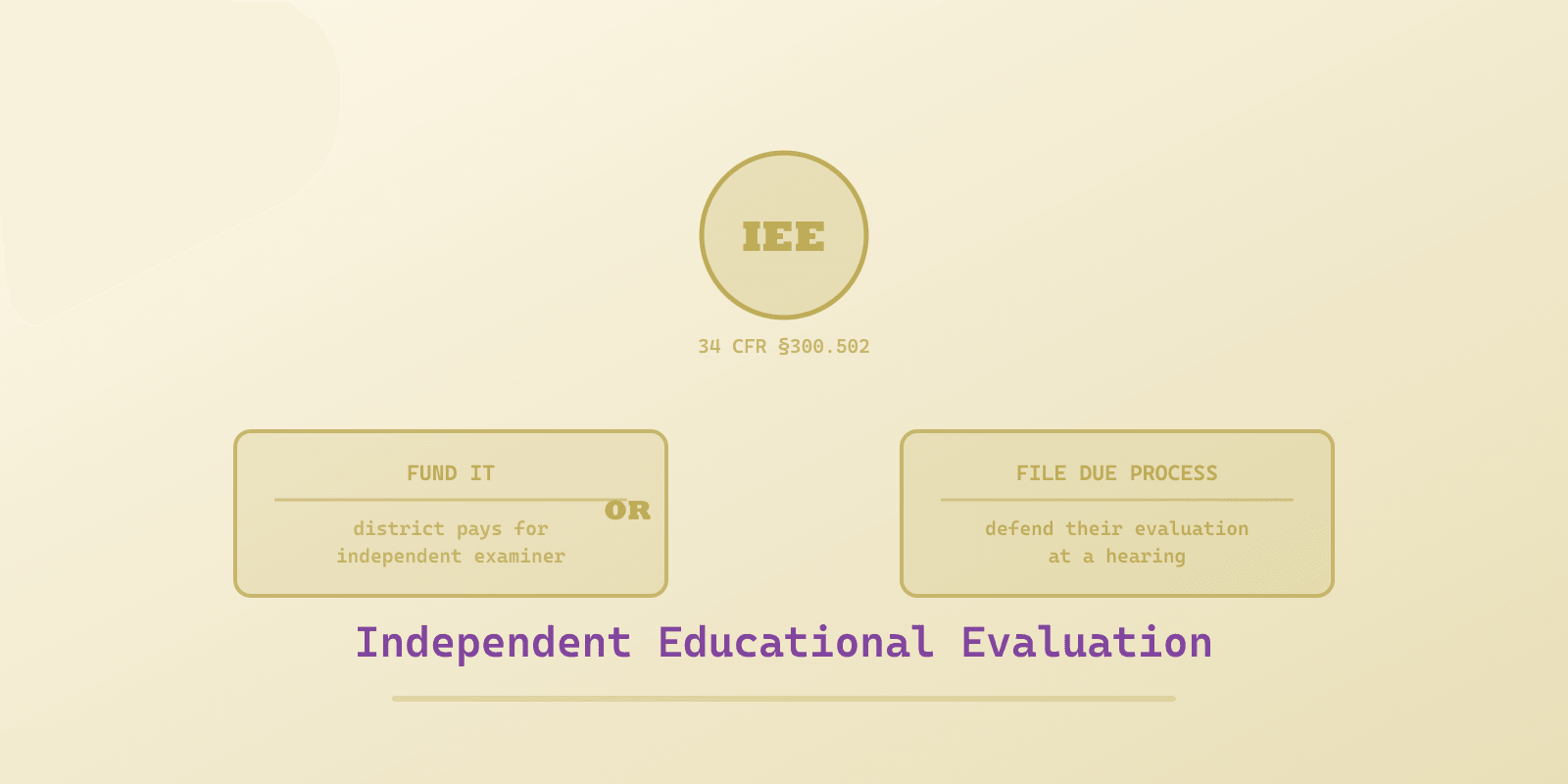
- Once you request an IEE, the district must either agree to fund it OR file due process to defend their own evaluation. They cannot deny it without one of those two responses.
- An IEE is conducted by a qualified examiner not employed by the school district, using criteria as broad as the original district criteria (qualifications, location, cost).
- The IEP team must consider the IEE results in any decision about FAPE for your child under 34 CFR §300.502(c). 'Consider' is not 'agree with,' but the team must address it on the record.
An independent educational evaluation, or IEE, is the assessment your school district must pay for when you disagree with the evaluation they conducted. The federal right lives at 34 CFR §300.502, and it is one of the strongest procedural protections IDEA gives parents. The school cannot quietly deny the request; they must either fund the IEE or file due process to defend their own evaluation. Refusing to do either is a procedural violation.
Take a parent whose 7-year-old was evaluated by the district and found ineligible for autism services despite a private clinician's autism diagnosis. The school's evaluation skipped pragmatic language testing, used a single classroom observation, and relied on teacher rating scales the parent disagreed with. Under federal law, the parent has the right to ask for an IEE conducted by a qualified examiner not employed by the district, paid for by the district, and the IEP team has to consider the IEE results when revisiting eligibility.
This guide walks through what an IEE is, when you can request one, how to request it in writing, the district's response options, who qualifies as an independent examiner, and what happens after the IEE is complete.
What an IEE Is and What It Is Not
An IEE is defined at 34 CFR §300.502(a)(3)(i) as an evaluation conducted by a qualified examiner who is not employed by the public agency responsible for the education of the child in question. The examiner can be a licensed clinical psychologist in private practice, a board-certified behavior analyst working independently, a speech-language pathologist in a clinic, a developmental pediatrician, or any qualified professional outside the district's roster.
What an IEE is not:
- An evaluation by a district staff member temporarily assigned to a "different" department
- An evaluation by a clinician under contract to the district
- An evaluation by the same university or clinical group that does the district's evaluations under a service contract
- A second opinion by another district employee
The "not employed by the public agency" rule is strict. If the examiner is on the district's payroll or under regular contract, the evaluation does not qualify as independent.
When You Can Request an IEE
Under 34 CFR §300.502(b)(1), a parent has the right to an IEE at public expense if the parent disagrees with an evaluation obtained by the public agency. The right attaches to a specific district evaluation; you cannot pre-emptively request an IEE before the district has evaluated. The right is forward-looking after the district produces its evaluation report. The most common trigger for an IEE request is the triennial re-evaluation: if the district's triennial misses domains or interprets the data more conservatively than the family experiences, the IEE is the procedural lever.
"Disagree" is interpreted broadly:
- Disagree with the conclusion (e.g., the district found your child ineligible; you believe they are eligible)
- Disagree that the evaluation was comprehensive (e.g., a domain was skipped)
- Disagree that a specific instrument was properly chosen
- Disagree that the evaluation interpreted the data correctly
- Disagree that the evaluation included sufficient input from outside sources
You do not need to itemize the disagreement in legal-style detail. You just need to state, in writing, that you disagree and you are requesting an IEE at public expense. The district may ask why; you are not required to provide a reason under 34 CFR §300.502(b)(4).
How to Request an IEE in Writing
A clean IEE request has four elements:
- Date the letter
- Address it to the special education director and the case manager
- State that you disagree with the district's evaluation dated [date]
- Request an IEE at public expense under 34 CFR §300.502(b)
A short example:
Date [Special education director], [Case manager]
Re: Request for Independent Educational Evaluation (IEE), [Child's name], [grade], [school]
I am writing to inform the district that I disagree with the evaluation completed on [date] for my child, [Name]. Under 34 CFR §300.502(b), I am requesting an independent educational evaluation at public expense. Please respond within a reasonable time with either (a) confirmation that the district will fund the IEE and a list of the agency criteria (qualifications, location, cost) the IEE must meet, OR (b) notice that the district will file a due process hearing to defend its own evaluation.
Sincerely, [Parent name + signature + date]
The IEP Advocacy Letter Builder drafts this letter with the federal citations and language formatted.
After you send the letter, keep a dated copy. The 60-day federal evaluation clock is not the relevant timeline here; the standard for the district's response is "without unnecessary delay" under 34 CFR §300.502(b)(2). Several courts have held that anything beyond 30 days is presumptively unreasonable delay.
The District's Two Response Options
Under 34 CFR §300.502(b)(2), when a parent requests an IEE at public expense, the district must either:
- File a due process complaint to request a hearing to show that its evaluation was appropriate, OR
- Ensure that an IEE is provided at public expense unless the district demonstrates in a hearing that the parent's IEE did not meet agency criteria.
The district cannot ignore the request. The district cannot deny without a due process filing. Failure to do one of the two responses within a reasonable time is grounds for a state complaint under 34 CFR §300.151.
If the district files due process, the IEE is paused while the hearing proceeds. If the hearing officer finds the district's evaluation appropriate, you can still obtain an IEE at private expense, and the district must still consider it under 34 CFR §300.502(c)(2).
Who Qualifies and What Criteria Apply
Under 34 CFR §300.502(e)(1), if an IEE is at public expense, the criteria under which the evaluation is obtained, including the location of the evaluation and the qualifications of the examiner, must be the same as the criteria the public agency uses when it initiates an evaluation, to the extent those criteria are consistent with the parent's right to an IEE.
In practice this means three categories of district criteria typically apply:
- Qualifications of the examiner (license, certification, training in autism or the relevant area)
- Location (typically a reasonable commuting distance from the district)
- Cost (some districts publish a cost cap; the cap must be reasonable given the local market rate for the type of evaluation)
The district must provide you with these criteria on request under 34 CFR §300.502(a)(2)(i). If the district publishes an unreasonably low cost cap that makes it impossible to find a qualified examiner, that is grounds for a state complaint or due process.
You can select your own examiner within the criteria. The district cannot require you to use a specific list of approved examiners, though they can provide a list.
Common Domains for an IEE
The IEE can cover the same domains as the original district evaluation, or it can be targeted to the specific domain you disagree with. Common targets for autism IEEs:
- Comprehensive psychological / autism-specific diagnostic (ADOS-2, ADI-R, autism-specific battery)
- Speech and language including pragmatics, social communication, and AAC assessment
- Sensory processing and occupational therapy assessment
- Functional behavior assessment (often when the district FBA was rushed or inadequate)
- Cognitive assessment with attention to processing speed and working memory
- Adaptive behavior (Vineland, ABAS)
- Educational/academic with attention to specific learning disability eligibility
You can request a partial IEE targeted to one domain (e.g., just speech-language pragmatics) rather than a full reevaluation, especially if your disagreement is specific.
After the IEE: What the IEP Team Must Do
Under 34 CFR §300.502(c)(1), the IEP team must consider the results of the IEE in any decision made with respect to the provision of FAPE to the child. "Consider" is the operative word. The team is not required to agree with the IEE, but they must address it on the record. If a full re-evaluation is on the table, you can prepare for a re-evaluation meeting the same careful way.
In practice this means:
- The team must meet to discuss the IEE results
- The discussion should be documented in the meeting minutes
- If the IEP team accepts the IEE findings, the IEP should be updated accordingly
- If the IEP team rejects the IEE findings, prior written notice under 34 CFR §300.503 must explain the reasons and the data the team relied on
If the IEP team refuses to schedule a meeting or refuses to address the IEE in writing, that is a procedural violation. You can file a state complaint.
The IEE can also be presented in any due process hearing. Hearing officers are required to consider both the district evaluation and any IEE.
How IEEs Connect to the Larger Evaluation Process
The IEE right sits inside the larger special education evaluation process. If the district's initial evaluation found your child eligible but the team rejects the IEE conclusion that additional services are needed, you have escalation options. If the initial evaluation found your child ineligible and the IEE supports eligibility, the IEP team must reconsider eligibility under 34 CFR §300.306. Eligibility analysis is covered in iep eligibility criteria for autism, and the federal disability categories are covered in IDEA disability categories explained.
The IEE also feeds back into PLAAFP data and changes the goals the team writes in the IEP. If the IEE identifies additional domains of need not captured in the district's evaluation, the IEP must be updated to reflect them.
Tools that pair with the IEE step:
- IEP Advocacy Letter Builder for the IEE request
- IEP Meeting Prep for the team meeting that follows the IEE; if the post-IEE conversation is heading toward a state-mediator-led table, the Facilitated IEP meeting prep template is the right shape
- Accommodations Bank for the candidate accommodations the IEE may surface
- IEP Goal Bank for example goals tied to common IEE findings
How IEEs Work in Your State
The federal IEE-at-public-expense rule applies in all 50 states. State law adds procedural detail on response timelines, criteria publication, and the format of the district's response. The callout below covers five high-population states.
Outside those five, the federal rule still governs and your state DOE will publish IEE procedural guidance that mirrors it. The state-by-state evaluation directory covers all 51 jurisdictions with the exact procedural details for each.
The independent educational evaluation is one of the strongest tools IDEA gives parents. Knowing when to request it, how to request it in writing, what the district must do in response, and how the IEP team must use the result turns "the school's evaluation missed what we see at home" into "let us get an independent professional opinion the team is legally required to consider."
This guide covers the basics. But every child is different.
Beacon learns about YOUR child and gives guidance specific to them.
What would Beacon say?
"My child was just diagnosed, what do I do first?"
Beacon looks at your child's age, communication style, and biggest challenges, and gives you a specific starting point instead of a generic checklist.

Spectrum Unlocked Editorial Team
Editorial Team
The Spectrum Unlocked editorial team combines lived experience as autism parents with research-backed guidance to create resources families can trust.
Frequently asked questions
- What is an independent educational evaluation?
- An independent educational evaluation, or IEE, is an evaluation conducted by a qualified examiner who is not employed by the school district responsible for the education of your child (34 CFR §300.502(a)(3)(i)). Parents have a right to an IEE at public expense whenever they disagree with the school's evaluation.
- When can I request an IEE?
- Any time you disagree with an evaluation the school district conducted under 34 CFR §300.502(b)(1). 'Disagree' is interpreted broadly: it can mean disagreeing with the conclusion, disagreeing that the evaluation was comprehensive, or disagreeing that a domain was properly assessed. There is no specific procedural requirement to itemize the disagreement.
- How do I request an IEE in writing?
- Write a dated letter to the special education director and case manager stating that you disagree with the district's evaluation and request an independent educational evaluation at public expense under 34 CFR §300.502(b). Reference the date of the district's evaluation you disagree with. The IEP Advocacy Letter Builder generates a formatted version.
- Can the school refuse to pay for an IEE?
- The school can deny the IEE at public expense, but ONLY by filing a due process hearing to demonstrate that the district's evaluation was appropriate under 34 CFR §300.502(b)(2)(i). If the school does not file due process and does not pay for the IEE, that is a procedural violation that grounds a state complaint.
- Who qualifies to conduct an IEE?
- Under 34 CFR §300.502(e)(1), the IEE must meet the same agency criteria the school district uses for its own evaluations, including the qualifications of the examiner, location, and cost, when those criteria are consistent with the parent's right to an IEE. Districts must provide parents with the agency criteria on request.
- What happens after I get the IEE?
- Under 34 CFR §300.502(c)(1), the IEP team must consider the IEE results in any decision made with respect to FAPE for the child. 'Consider' is not 'agree with,' but the team must address the IEE on the record. The IEE can also be presented in any due process hearing.