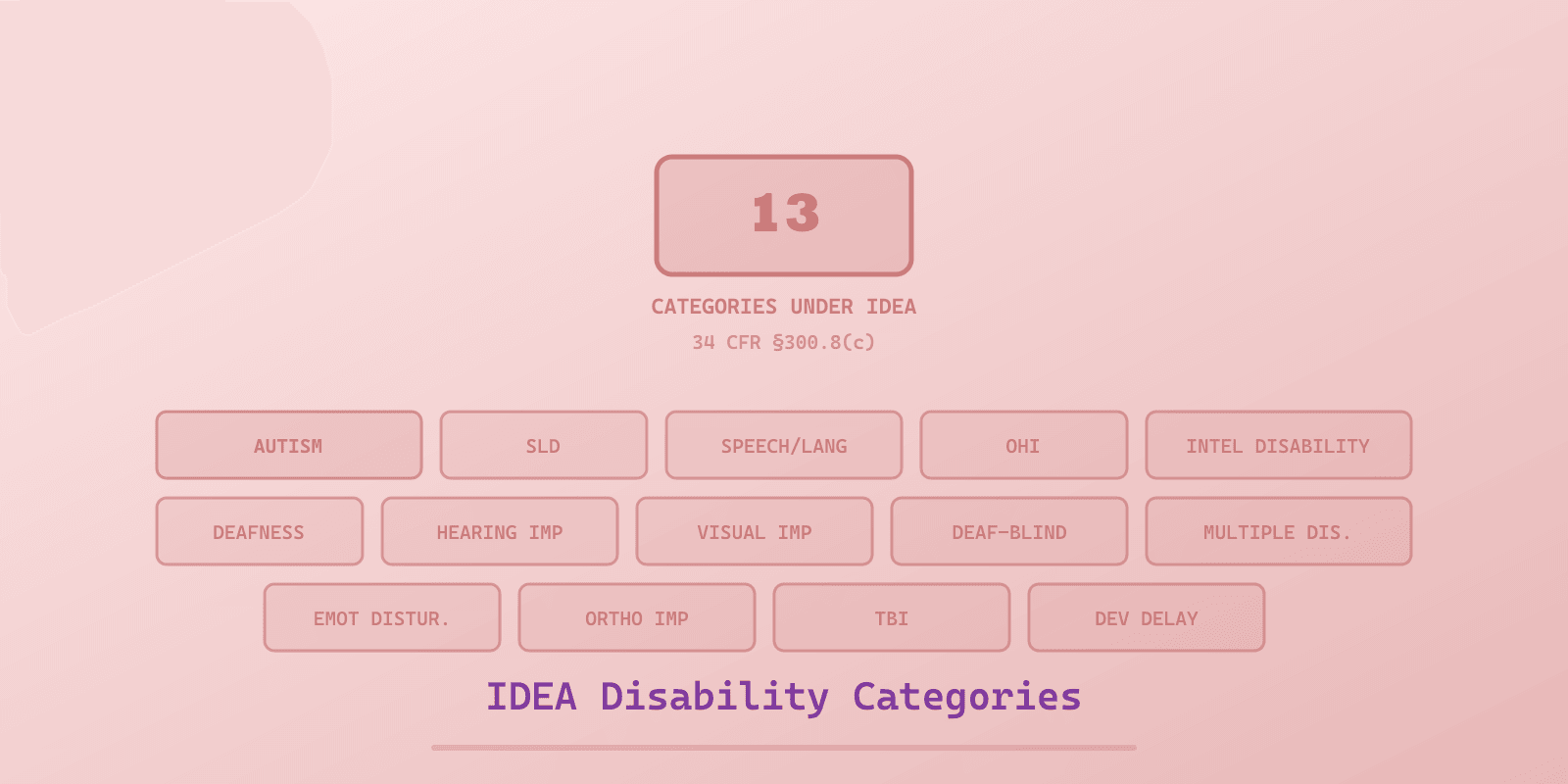
The 13 IDEA Disability Categories Explained
Federal law lists 13 disability categories under IDEA. Here is what each one covers, where autism fits, and how the category drives the services your child receives.
Key Takeaways
- IDEA lists exactly 13 disability categories under 34 CFR §300.8(c), and a child must be classified under one of them to qualify for an IEP.
- Autism is its own category at 34 CFR §300.8(c)(1) and requires three elements: developmental disability significantly affecting communication, social interaction, and educational performance.
- Children can be classified under more than one category (e.g., Autism + Speech/Language Impairment) when multiple categories apply.
- The category drives evaluation focus and reporting requirements but does not by itself dictate services. Services are individualized to the child under 34 CFR §300.323.
IDEA lists exactly 13 disability categories. To qualify for an IEP, your child must (1) meet the federal definition of one or more of those categories and (2) need special education and related services because of the disability. The categories live at 34 CFR §300.8(c), and the two-prong eligibility test is at 34 CFR §300.8(a)(1).
For autism families, the category most often considered is Autism at 34 CFR §300.8(c)(1), but children with autism also often qualify under co-occurring categories such as Speech or Language Impairment, Specific Learning Disability, or Other Health Impairment. The IEP team's job during eligibility is to identify every category the evaluation data supports.
This guide walks through all 13 categories, the federal definition for each, where autism overlaps with other categories, how multiple classifications work, and what to do when the team disagrees with your view of which category fits.
The Two-Prong Eligibility Test
Federal law has two requirements before a child qualifies for an IEP:
- The child meets the definition of one or more of the 13 disability categories at 34 CFR §300.8(c).
- The child needs special education and related services because of the disability under 34 CFR §300.8(a)(1).
Both prongs matter. A child can have a medical diagnosis of autism and still fail the second prong if the school can show educational performance is not adversely affected. This is one of the most common eligibility disputes; the school argues that grades, classroom behavior, or test scores show the disability does not require special education. Parents who disagree have the right to an independent educational evaluation.
The reverse is also true. A child without a medical autism diagnosis can be found eligible under Autism if the school's evaluation team concludes the child meets the IDEA definition. The federal definition is education-based, not medical; the IEP team is the entity making the eligibility call, not the pediatrician.
The 13 Categories
The federal definitions are paraphrased below for clarity; the exact regulatory language is at 34 CFR §300.8(c).
1. Autism (34 CFR §300.8(c)(1)) A developmental disability significantly affecting verbal and nonverbal communication and social interaction, generally evident before age three, that adversely affects a child's educational performance. Other characteristics often associated with autism include engagement in repetitive activities and stereotyped movements, resistance to environmental change or change in daily routines, and unusual responses to sensory experiences. The term does not apply if the educational performance is adversely affected primarily by an emotional disturbance.
2. Deaf-blindness (34 CFR §300.8(c)(2)) Concomitant hearing and visual impairments, the combination of which causes such severe communication and developmental and educational needs that the child cannot be accommodated in special education programs solely for children with deafness or with blindness.
3. Deafness (34 CFR §300.8(c)(3)) A hearing impairment that is so severe the child is impaired in processing linguistic information through hearing, with or without amplification, that adversely affects educational performance.
4. Emotional Disturbance (34 CFR §300.8(c)(4)) A condition exhibiting one or more characteristics over a long period of time and to a marked degree that adversely affects educational performance: inability to learn that cannot be explained by intellectual, sensory, or health factors; inability to build or maintain satisfactory interpersonal relationships; inappropriate types of behavior or feelings; a general pervasive mood of unhappiness or depression; or a tendency to develop physical symptoms or fears.
5. Hearing Impairment (34 CFR §300.8(c)(5)) An impairment in hearing, whether permanent or fluctuating, that adversely affects educational performance but is not included under the definition of deafness.
6. Intellectual Disability (34 CFR §300.8(c)(6)) Significantly subaverage general intellectual functioning, existing concurrently with deficits in adaptive behavior and manifested during the developmental period, that adversely affects educational performance. (Historically called "mental retardation"; the federal statute was renamed by Rosa's Law in 2010.)
7. Multiple Disabilities (34 CFR §300.8(c)(7)) Concomitant impairments (such as intellectual disability-blindness, intellectual disability-orthopedic impairment), the combination of which causes such severe educational needs that the child cannot be accommodated in special education programs solely for one of the impairments. Does not include deaf-blindness.
8. Orthopedic Impairment (34 CFR §300.8(c)(8)) A severe orthopedic impairment that adversely affects educational performance. Includes impairments caused by congenital anomalies, impairments caused by disease (e.g., poliomyelitis, bone tuberculosis), and impairments from other causes (e.g., cerebral palsy, amputations, fractures, or burns that cause contractures).
9. Other Health Impairment (OHI) (34 CFR §300.8(c)(9)) Limited strength, vitality, or alertness, including a heightened alertness to environmental stimuli, that adversely affects educational performance and is due to chronic or acute health problems such as asthma, attention deficit disorder or attention deficit hyperactivity disorder, diabetes, epilepsy, a heart condition, hemophilia, lead poisoning, leukemia, nephritis, rheumatic fever, sickle cell anemia, and Tourette syndrome.
10. Specific Learning Disability (SLD) (34 CFR §300.8(c)(10)) A disorder in one or more of the basic psychological processes involved in understanding or using language, spoken or written, that may manifest in an imperfect ability to listen, think, speak, read, write, spell, or do mathematical calculations. Includes such conditions as perceptual disabilities, brain injury, minimal brain dysfunction, dyslexia, and developmental aphasia. Does not include learning problems that are primarily the result of visual, hearing, or motor disabilities, of intellectual disability, of emotional disturbance, or of environmental, cultural, or economic disadvantage.
11. Speech or Language Impairment (34 CFR §300.8(c)(11)) A communication disorder, such as stuttering, impaired articulation, a language impairment, or a voice impairment, that adversely affects educational performance.
12. Traumatic Brain Injury (34 CFR §300.8(c)(12)) An acquired injury to the brain caused by an external physical force, resulting in total or partial functional disability or psychosocial impairment, or both, that adversely affects educational performance. Includes open or closed head injuries; does not include congenital, degenerative, or birth-trauma-induced injuries.
13. Visual Impairment Including Blindness (34 CFR §300.8(c)(13)) An impairment in vision that, even with correction, adversely affects educational performance. Includes both partial sight and blindness.
How Autism Overlaps with Other Categories
Many autistic children meet the definition of more than one IDEA category. Common overlaps:
- Autism + Speech or Language Impairment. When language delays are significant beyond what autism alone explains, or when articulation/voice are independently impaired.
- Autism + Specific Learning Disability. When the child has a learning disability in reading, math, or writing that exists independently of the autism (often diagnosed via the IDEA-defined patterns under 34 CFR §300.309).
- Autism + Other Health Impairment. When ADHD co-occurs with autism, OHI typically covers the ADHD specifically.
- Autism + Intellectual Disability. When cognitive functioning is significantly subaverage and adaptive behavior deficits exist concurrently.
- Autism + Emotional Disturbance. Rare; the federal definition of Autism specifically excludes children whose educational performance is primarily affected by emotional disturbance. The two categories are mutually exclusive when the issue is purely emotional disturbance, but can coexist when both genuinely apply.
Multiple classifications are not a paperwork issue. They drive evaluation focus, reporting on progress in the IEP, and sometimes the lead service provider. The IEP team can designate one as the primary category for state reporting purposes while honoring both in the IEP itself.
What Happens at the Eligibility Meeting
Under 34 CFR §300.306, the IEP team meets after the evaluation to decide whether the child qualifies under one or more of the 13 categories and whether the child needs special education and related services. The team considers all evaluation data, parent input, and observations.
The eligibility meeting walkthrough sits in detail at iep eligibility criteria for autism. The key procedural points:
- Parents are equal team members and contribute observations + history
- The team must provide a written prior written notice of the eligibility decision under 34 CFR §300.503
- If found eligible, the team has 30 calendar days to develop the initial IEP under 34 CFR §300.323(c)(1)
- If found ineligible, parents can request an IEE, file a state complaint, request mediation, or file for a due process hearing
When You Disagree with the Category Decision
A common dispute is the team classifying your child under one category when you believe another is more accurate. Examples:
- Team classifies under Speech or Language Impairment; parent believes Autism is more accurate
- Team classifies under Other Health Impairment (for ADHD-like presentation); parent believes Autism is appropriate
- Team classifies under Specific Learning Disability; parent believes Autism + SLD applies
- Team finds the child ineligible; parent believes the child qualifies under Autism
In all cases, the options are:
- Request the team's written prior written notice of the decision
- Provide outside evaluations, medical records, or developmental history that support your view
- Request an independent educational evaluation at public expense
- Request mediation through your state DOE
- File a state complaint under 34 CFR §300.151
- File for a due process hearing under 34 CFR §300.507
Use the IEP Advocacy Letter Builder to put your disagreement in writing with the federal citations the team will recognize.
Categories and the Larger IEP
The category establishes eligibility; it does not by itself dictate services. The specially designed instruction, accommodations vs modifications, present levels, and goal language all flow from the documented needs in the evaluation, not from the category label. The least restrictive environment analysis is also independent of category.
Two practical points for autism families:
- The Autism category does not mean the child must be placed in a separate classroom. LRE analysis is independent.
- The Autism category does not preset which related services the child receives. Speech, OT, social work, and behavior services are individualized based on the evaluation.
Tools that pair with category determination:
- IEP Advocacy Letter Builder for category-dispute letters
- IEP Meeting Prep for the eligibility meeting
- Accommodations Bank for category-appropriate accommodation candidates
- IEP Goal Bank for category-appropriate goal examples
How Categories Work in Your State
All 50 states use the federal 13 categories as the floor. State law adds procedural detail on eligibility criteria specific to each category, how multiple classifications are reported, and any state-specific additional categories (California's Established Medical Disability for ages 3-5 is one example). The callout below covers five high-population states.
Outside those five, the federal categories still govern and your state DOE publishes eligibility criteria documents.
The 13 IDEA disability categories are the gate to special education services. Knowing where autism fits, where it overlaps with other categories, what the two-prong eligibility test requires, and what to do when the team's category decision does not match what you see in your child turns "we are determining eligibility" into a structured conversation grounded in the federal definitions and your evaluation data.
Need help preparing for YOUR next IEP meeting?
Beacon learns about YOUR child and gives guidance specific to them.
What would Beacon say?
"Help me prep for my IEP meeting"
Beacon pulls your child's goals, challenges, and history, then gives you the exact questions to ask, the red flags to watch for, and what to push back on.

Spectrum Unlocked Editorial Team
Editorial Team
The Spectrum Unlocked editorial team combines lived experience as autism parents with research-backed guidance to create resources families can trust.
Frequently asked questions
- How many disability categories are there under IDEA?
- There are 13 disability categories listed at 34 CFR §300.8(c): Autism, Deaf-blindness, Deafness, Emotional Disturbance, Hearing Impairment, Intellectual Disability, Multiple Disabilities, Orthopedic Impairment, Other Health Impairment (OHI), Specific Learning Disability (SLD), Speech or Language Impairment, Traumatic Brain Injury, and Visual Impairment Including Blindness.
- Where does autism fit in the 13 categories?
- Autism is its own category at 34 CFR §300.8(c)(1). Federal law defines it as a developmental disability significantly affecting verbal and nonverbal communication and social interaction, generally evident before age three, that adversely affects a child's educational performance.
- Can a child qualify under more than one category?
- Yes. A child with autism and significant speech delays might be classified under Autism + Speech or Language Impairment. A child with autism and a co-occurring learning disability might be classified under Autism + Specific Learning Disability. The IEP team decides based on the evaluation data; multiple classifications are allowed when supported by evidence.
- Does the category determine what services my child gets?
- No. The category establishes eligibility, but the services are individualized based on the child's specific needs from the evaluation. A child classified under Autism and a child classified under Other Health Impairment can receive completely different services depending on what the evaluation shows they need.
- What if my child has autism but the school says they do not qualify?
- Eligibility requires BOTH a qualifying disability AND that the disability adversely affects educational performance such that the child needs special education (34 CFR §300.8(a)(1)). A medical diagnosis of autism is not automatically eligibility under IDEA. If the team says no, you have rights including a request for an independent educational evaluation and the right to a due process hearing.
- Is ADHD a category under IDEA?
- ADHD is not its own category. Children with ADHD typically qualify under Other Health Impairment (OHI) at 34 CFR §300.8(c)(9), which covers limited strength, vitality, or alertness, including a heightened alertness to environmental stimuli, that adversely affects educational performance.