Special Education Evaluation Process for Autism
Federal law gives you 60 days from written consent to a complete special education evaluation. Here is what the school must assess, the timeline, and how to request one in writing.
Key Takeaways
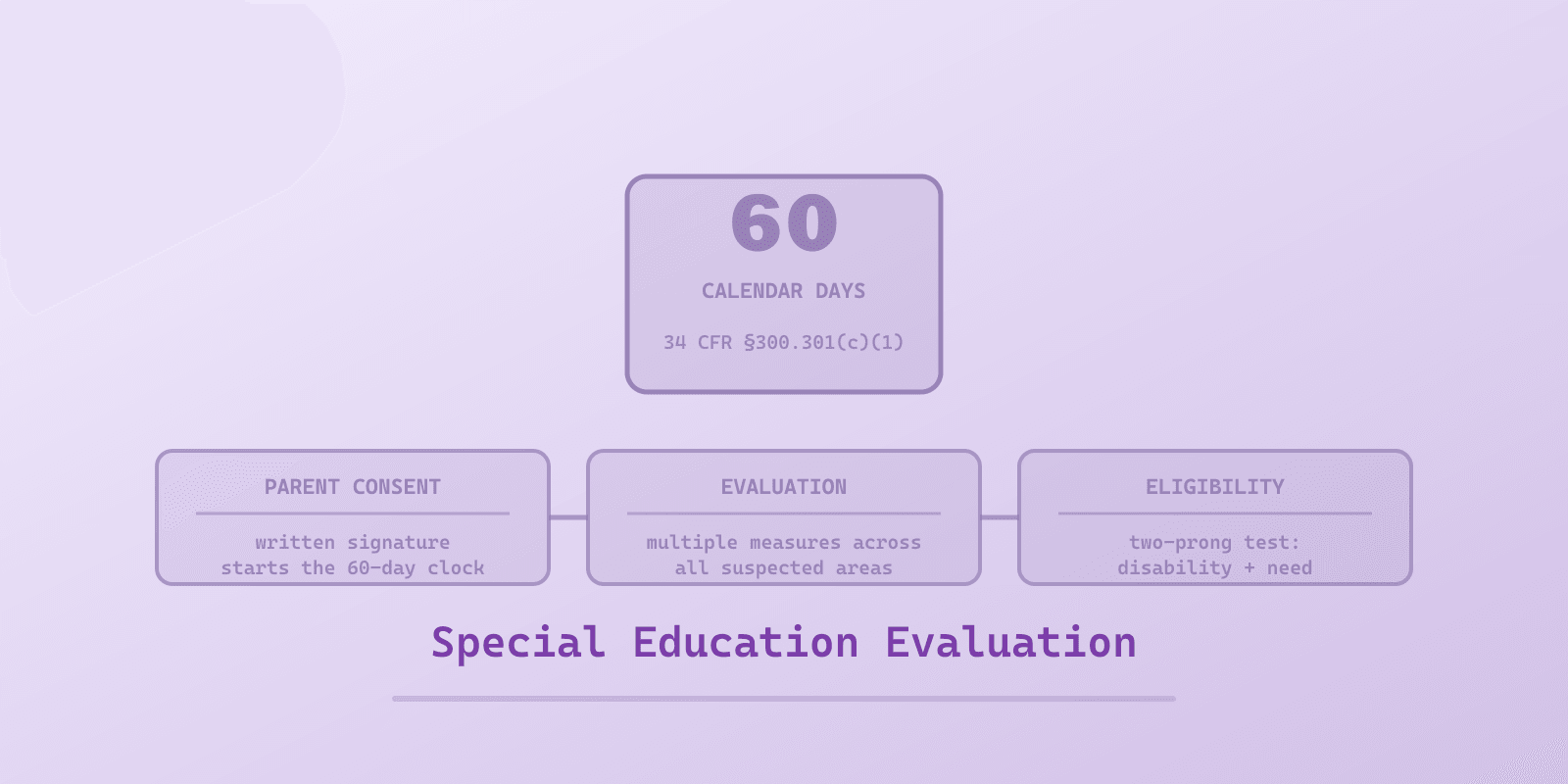
- Federal law sets a 60-day clock from the date you sign written consent: the school must complete a full evaluation across all areas of suspected disability under 34 CFR §300.301(c)(1).
- Parents can request an evaluation in writing at any time; the school must respond with prior written notice and either agree to evaluate or deny with reasons (34 CFR §300.503).
- Districts have a federal Child Find obligation under 34 CFR §300.111 to identify, locate, and evaluate every child with a suspected disability whether or not the parent requests it.
- An evaluation must use multiple measures (not a single test), assess all relevant developmental areas, and produce the data that grounds the IEP that follows.
A special education evaluation is the formal, multi-source assessment your school district conducts to decide whether your child has a disability under IDEA and, if so, whether they need special education and related services. Federal law gives the district 60 days from the date you sign written consent to complete the evaluation, and the assessment has to cover every area of suspected disability before the IEP team can move forward.
Take a kindergartener whose teacher reports trouble with transitions, limited verbal language, and intense reactions to noise. A real evaluation does not stop at "the teacher is concerned." It pulls data from a cognitive assessment, a speech-language evaluation that includes pragmatics, a sensory profile, classroom observations, parent and teacher interviews, and an adaptive-behavior measure. The output is a written report the IEP team uses to decide whether autism (or another category) is the right fit and what supports the child needs.
This guide walks through what the law requires, the 60-day timeline, how to request an evaluation in writing, what areas the team has to assess, and what your rights are if you disagree with the result.
When an Evaluation Is Required
Federal law has two triggers for a special education evaluation. The first is a parent request. Parents can request an evaluation in writing at any time when they suspect their child may have a disability under IDEA. The school must respond with prior written notice under 34 CFR §300.503 within a reasonable time and either agree to evaluate or deny with reasons.
The second trigger is Child Find under 34 CFR §300.111. Every state and every public school district has an affirmative obligation to identify, locate, and evaluate all children with disabilities who are residing in the state, including children who are wards of the state and children attending private schools, regardless of the severity of the disability. Child Find is not a parent's burden alone; if the school suspects a disability, federal law requires them to act on the suspicion.
In plain terms, the school cannot wait for you to push every time. If the teacher is reporting concerns, if Response to Intervention (RTI) data shows your child is not making expected progress, or if the school is suspending repeatedly, the Child Find obligation is triggered. Documenting that you raised the concern in writing makes the obligation concrete.
The 60-Day Federal Timeline
The federal evaluation timeline lives at 34 CFR §300.301(c)(1)(i). The initial evaluation must be conducted within 60 calendar days of receiving parental consent for the evaluation, or within whatever state timeframe applies if the state has set one.
Several states use a shorter or different clock:
- Texas: 45 school days (19 TAC §89.1011)
- California: 60 days excluding school vacation longer than 5 days (Cal. Ed. Code §56043)
- New York: 60 calendar days (8 NYCRR §200.4)
- Florida: 60 calendar days (Fla. Admin. Code 6A-6.0331)
- Pennsylvania: 60 calendar days (22 Pa. Code §14.123)
If your state isn't listed, the full state-by-state evaluation directory covers all 51 jurisdictions with the exact statutory timeline, Part C referral process, and Medicaid waiver details.
The clock starts on the date the school receives your written consent, not the date you initially asked about an evaluation. Two date stamps that matter:
- The date you sign the consent form (when the 60-day clock starts)
- The date the school district must complete and present the evaluation report (60 days after step 1, with state adjustments)
If the district misses the deadline, you have grounds for a state complaint to your state DOE under 34 CFR §300.151. Missed deadlines are one of the most common procedural failures parents see.
How to Request an Evaluation in Writing
A clean parent-request letter has five elements:
- Date the letter
- Address it to the case manager, the special education director, and the principal
- Describe specific behaviors or academic concerns (frequency, duration, settings)
- Reference the federal trigger: 34 CFR §300.301 (initial evaluation) and 34 CFR §300.111 (Child Find)
- Request a response with prior written notice within a reasonable time
A short example:
Dear [Case manager], [Special education director], [Principal],
I am writing to request a special education evaluation for my child, [Name], grade [grade], at [school]. I have specific concerns in the following areas: [communication, behavior, academic, social, sensory, motor]. Recent observations: [3 to 5 dated bullets]. I am requesting a full evaluation across all areas of suspected disability under 34 CFR §300.304(c)(4). Please respond with prior written notice within a reasonable time per 34 CFR §300.503.
Sincerely, [Parent name + signature + date]
The Request IEP Evaluation letter template is a ready-to-send version of the letter above with the federal citations pre-filled; the IEP Advocacy Letter Builder is the AI version for custom drafts.
After you send the letter, keep a dated copy. If you send it by email, request a read receipt; if you hand-deliver it, ask for a signed acknowledgment. The paper trail matters when timelines slip.
What the Evaluation Must Cover
Under 34 CFR §300.304(b)(1), the evaluation must use a variety of assessment tools and strategies to gather relevant functional, developmental, and academic information about the child. No single procedure may be used as the sole criterion for determining eligibility or programming. Under 34 CFR §300.304(c)(4), the evaluation must be sufficiently comprehensive to identify all of the child's special education and related services needs.
For autism specifically, a complete evaluation typically covers:
- Cognitive assessment (general intellectual functioning, often via a WISC, Stanford-Binet, or similar)
- Academic achievement (reading, math, writing)
- Speech-language evaluation including pragmatics and social communication
- Sensory profile (often via the Sensory Profile-2 or similar)
- Social-emotional and behavior (behavior rating scales, classroom observation)
- Adaptive behavior (often via Vineland or ABAS)
- Autism-specific diagnostic measure (ADOS-2, ADI-R, CARS-2, or equivalent) when appropriate
- Motor (fine and gross, especially for younger children or where indicated)
- Functional behavior assessment if behavior is a presenting concern
The team must also conduct classroom observations and gather input from parents and teachers. Parent input is required at the evaluation stage, not just at the IEP meeting after.
If the school proposes to skip a domain you think is relevant, push back in writing. The evaluation has to be comprehensive enough to inform the IEP; gaps at the evaluation stage produce gaps in present levels and downstream goal-writing.
Who Conducts the Evaluation
The evaluation team must include qualified professionals selected by the school district under 34 CFR §300.304(c)(1)(iv). Typical members:
- School psychologist (cognitive and behavior data)
- Special education teacher (academic and curriculum-based measures)
- Speech-language pathologist (communication)
- Occupational therapist (sensory, fine motor, adaptive)
- Physical therapist (gross motor, where indicated)
- Social worker or counselor (social-emotional)
- General education teacher (classroom observations and curriculum context)
- Parent (equal team member, contributes observations and history)
- Autism specialist or board-certified behavior analyst when appropriate
Parents are equal team members during evaluation, not just observers. Your input on behaviors at home and in the community, developmental history, medical history, and prior assessments belongs in the record.
What Happens After the Evaluation
When the evaluation is complete, the team holds an eligibility meeting under 34 CFR §300.306 to decide whether your child has a disability and needs special education and related services. The eligibility decision is two-pronged: (1) the child has a disability under one of the 13 IDEA categories listed at 34 CFR §300.8, and (2) the disability adversely affects educational performance such that special education is needed. In Texas this meeting is called the ARD committee meeting, and you can prepare for an ARD meeting with the eligibility questions ready.
If the team finds your child eligible, the IEP team has 30 calendar days from the eligibility determination to develop the initial IEP under 34 CFR §300.323(c)(1). For autism specifically, the eligibility framework under 34 CFR §300.8(c)(1) requires a developmental disability significantly affecting verbal and nonverbal communication and social interaction that adversely affects educational performance. Once that initial meeting is scheduled, an initial IEP meeting guide helps you walk in ready.
The deeper dive on the 13 IDEA categories sits in Spectrum Unlocked's IDEA disability categories guide. The eligibility meeting walkthrough and what-to-bring checklist lives in iep eligibility criteria for autism.
If You Disagree With the Evaluation
If you disagree with the school's evaluation, you have the right to an independent educational evaluation (IEE) at public expense under 34 CFR §300.502. The school must either agree to fund the IEE or file due process to defend its own evaluation; they cannot deny the request without one of those two responses. The detailed IEE workflow sits in the independent educational evaluation rights guide.
You can also:
- Request that the school re-evaluate specific domains you believe were missed
- File a state complaint under 34 CFR §300.151 if procedure was violated
- Request mediation through your state DOE
- File for a due process hearing under 34 CFR §300.507
Before pursuing formal dispute resolution, consult a special-education attorney or credentialed parent advocate. Free help is available through Parent Training and Information centers in every state (find yours at the Center for Parent Information and Resources).
How the Evaluation Connects to the Rest of the IEP
The evaluation produces the data foundation for the entire IEP. The PLAAFP describes where the child is right now in measurable terms; that description has to be grounded in the evaluation results. The specially designed instruction and accommodations vs modifications flow from the documented needs. The least restrictive environment analysis depends on whether the supports identified by the evaluation can succeed in the regular classroom. The same evaluation procedure repeats every three years as the triennial re-evaluation under 34 CFR §300.303, so the playbook here applies again in three years.
Tools and resources that pair with the evaluation step:
- IEP Advocacy Letter Builder for the request letter
- IEP Meeting Prep to prepare for the eligibility meeting
- Accommodations Bank to start a candidate list of accommodations before the IEP meeting
- IEP Goal Bank for example goals tied to common autism evaluation findings
How Evaluation Works in Your State
The federal 60-day timeline applies in all 50 states; state law adds procedural detail (assessment plan deadlines, school-day vs calendar-day counting, who can serve on the evaluation team). The callout below covers five high-population states.
A complete, well-timed special education evaluation is the foundation of every IEP that actually fits your child. Knowing the 60-day clock, the parent-request workflow, what the team has to assess, and your rights when you disagree puts you on equal footing with the school and turns "we are concerned about your child" into a structured process with deadlines and procedural anchors.
Need help preparing for YOUR next IEP meeting?
Beacon learns about YOUR child and gives guidance specific to them.
What would Beacon say?
"Help me prep for my IEP meeting"
Beacon pulls your child's goals, challenges, and history, then gives you the exact questions to ask, the red flags to watch for, and what to push back on.

Spectrum Unlocked Editorial Team
Editorial Team
The Spectrum Unlocked editorial team combines lived experience as autism parents with research-backed guidance to create resources families can trust.
Frequently asked questions
- What is a special education evaluation?
- A special education evaluation is the formal, multi-source assessment a school district conducts to decide whether your child has a disability covered by IDEA and, if so, whether they need special education and related services. The evaluation gathers data across academic, cognitive, language, social-emotional, behavioral, sensory, motor, and adaptive areas as relevant to the suspected disability (34 CFR §300.304-305).
- How long does a special education evaluation take?
- Federal law gives the district 60 calendar days from the date the parent signs written consent to complete the evaluation under 34 CFR §300.301(c)(1)(i), unless the state has set a different timeframe. Several states use a shorter or longer timeline; the federal 60-day rule is the floor and applies when the state does not set its own.
- How do I request a special education evaluation in writing?
- Write a dated letter to the case manager, the special education director, and the school principal. State the specific concerns (academic, behavior, language, social, sensory), reference 34 CFR §300.301, and request a response with prior written notice within a reasonable time. The IEP Advocacy Letter Builder generates a formatted version with the federal citations.
- Can the school refuse to evaluate my child?
- Yes, but only with written prior written notice under 34 CFR §300.503 explaining the reasons and the evaluation data the district relied on to reject the request. If the district refuses, you can request an independent educational evaluation at public expense, file a state complaint, or file for a due process hearing.
- What areas does the evaluation have to cover for autism?
- Under 34 CFR §300.304(b)(1) and §300.304(c)(4), the evaluation must assess all areas related to the suspected disability. For autism this typically includes cognitive, academic, communication and language (including pragmatics), social-emotional, behavior, sensory processing, motor, and adaptive behavior, with diagnostic input from an autism-specific assessment when appropriate.
- Who pays for the evaluation?
- The school district pays for the evaluation; parents owe nothing under IDEA (34 CFR §300.301(d)(1)). If you disagree with the school's evaluation, you have the right to an independent educational evaluation (IEE) at public expense under 34 CFR §300.502.