IEP Eligibility Criteria for Autism
Eligibility for an IEP requires two things: a qualifying disability under IDEA and a need for special education. Here is what the eligibility meeting decides and what to bring.
Key Takeaways
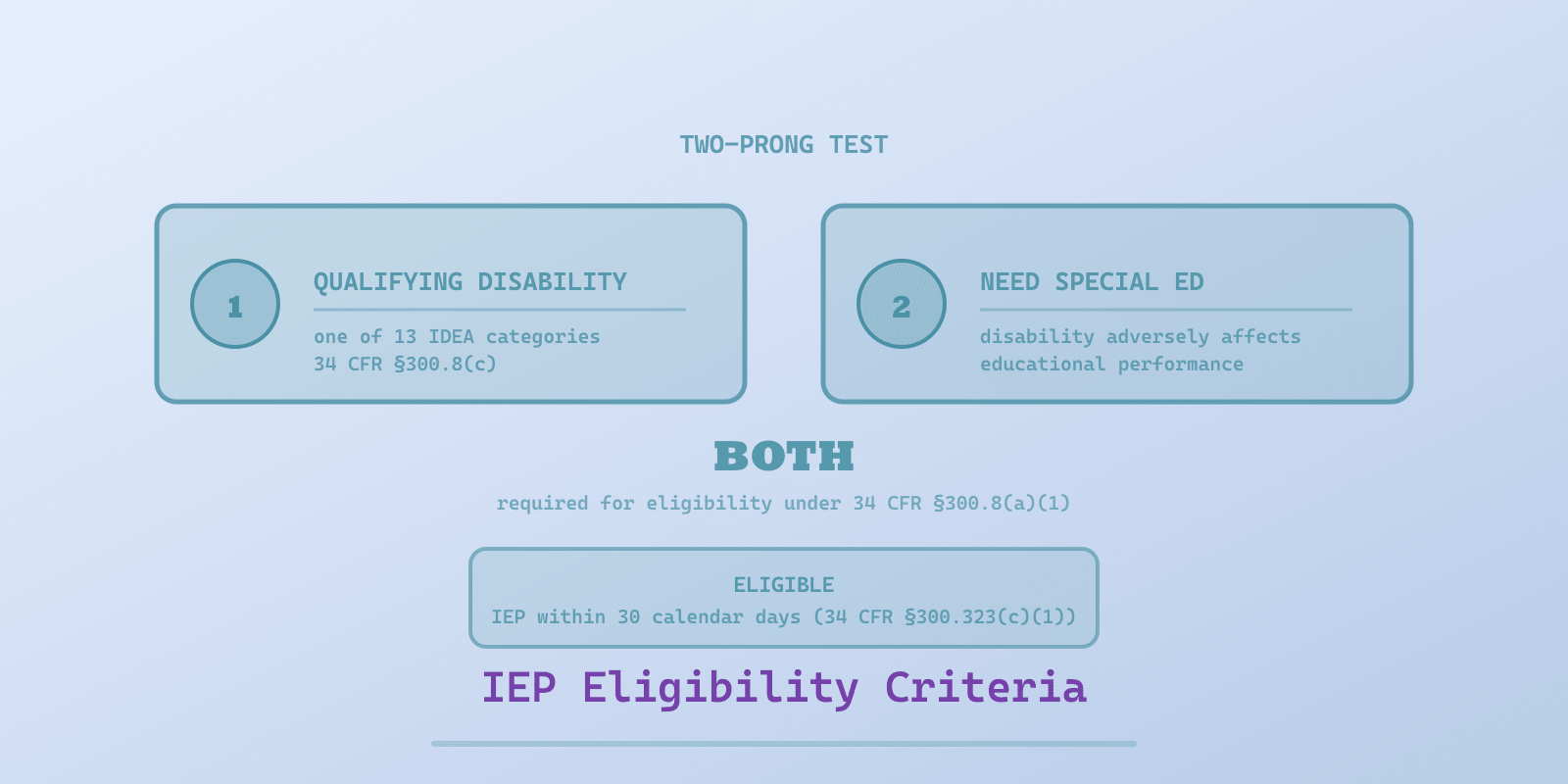
- IEP eligibility under IDEA requires two prongs: a qualifying disability under one of 13 categories AND a need for special education and related services because of the disability (34 CFR §300.8(a)(1)).
- The IEP team holds an eligibility meeting after the evaluation under 34 CFR §300.306; parents are equal team members.
- A medical autism diagnosis does not automatically equal IEP eligibility; the team must determine the disability adversely affects educational performance.
- If the team finds your child eligible, the IEP must be developed within 30 calendar days under 34 CFR §300.323(c)(1).
IEP eligibility under IDEA is decided by a two-prong test. First, your child must have a disability under one of the 13 federal categories listed at 34 CFR §300.8(c). Second, the disability must adversely affect educational performance such that the child needs special education and related services. Both prongs must be met before an IEP can be written.
For autism families, the eligibility meeting is often where the procedural rubber meets the road. A medical autism diagnosis is meaningful but not automatic; the team has to decide on the evaluation data, not the medical record. This is why a thorough special education evaluation and, when needed, an independent educational evaluation matter so much. That evaluation only happens once you send an evaluation request letter to the district, which starts the eligibility clock.
This guide walks through the two-prong test, who attends the meeting, what to bring, what the team is supposed to discuss, autism-specific eligibility nuance, and what to do when the team's decision does not match what you see in your child.
The Two-Prong Eligibility Test
The federal eligibility rule lives at 34 CFR §300.8(a)(1). A "child with a disability" means a child evaluated under IDEA as having one of the disabilities listed AND who, by reason thereof, needs special education and related services. Both elements are required.
Prong 1: A qualifying disability. The 13 federal categories sit at 34 CFR §300.8(c). The full walkthrough of each category is in Spectrum Unlocked's IDEA disability categories explained guide. Autism is at §300.8(c)(1). To qualify under Autism, the team must find:
- A developmental disability significantly affecting verbal and nonverbal communication
- Significant impact on social interaction
- Generally evident before age three (newer interpretation; this is no longer a strict bar)
- Educational performance is adversely affected
Prong 2: Need for special education. Even with a qualifying disability, the team must find the disability adversely affects educational performance such that the child needs specially designed instruction. The standard "adversely affects" is interpreted broadly under 34 CFR §300.39(b)(3), which defines specially designed instruction as adapting content, methodology, or delivery to address the child's unique needs.
A common dispute: the school argues the child is making "adequate" academic progress and therefore does not need an IEP. Federal law and case law (notably Endrew F. v. Douglas Cnty. Sch. Dist., 137 S. Ct. 988 (2017)) reject the bare-minimum-progress standard. The FAPE under IDEA standard is meaningful progress in light of the child's circumstances, not whatever progress is convenient.
Who Attends the Eligibility Meeting
Under 34 CFR §300.321, the IEP team includes:
- The parents
- At least one general education teacher of the child (if the child is, or may be, participating in the regular education environment)
- At least one special education teacher
- A representative of the public agency who is qualified to provide or supervise the provision of special education, is knowledgeable about general education curriculum, and is knowledgeable about the availability of resources
- An individual who can interpret the instructional implications of evaluation results
- At the discretion of the parent or agency, other individuals who have knowledge or special expertise regarding the child
- Whenever appropriate, the child
For initial eligibility, the team typically also includes the evaluators (school psychologist, speech-language pathologist, occupational therapist, etc.). Parents are equal team members under federal law; the team is not a school panel reviewing a parent.
You have the right to bring an advocate, an attorney, or a credentialed parent advocate to the eligibility meeting. The school does not get to limit who you bring. The only restriction is reasonable advance notice if the team's composition changes.
What to Bring to the Eligibility Meeting
Prepare three categories of materials.
Evaluation documents:
- The school's evaluation report (request a copy in advance, ideally a week before the meeting)
- Any private or outside evaluations (medical autism diagnosis, neuropsych eval, speech-language eval from a clinic)
- Developmental history (milestones, medical history, family history)
- Prior IEPs or 504 plans from other schools
Observation evidence:
- Examples of behavior at home (behavior log, video if available)
- Examples of communication challenges (specific incidents, settings)
- Examples of sensory reactions
- Work samples or photos of work the child has produced
Questions and goals:
- A written list of questions you want the team to answer
- Your specific concerns ranked by priority
- A note-taker (someone you trust to take notes so you can listen and engage)
The IEP Meeting Prep tool generates a customized prep packet with the questions, concern list, and family input form ready for the meeting. If you would rather work through it step by step, you can organize what to bring to the eligibility meeting and walk in with the documents and questions sorted by priority. In Texas, the eligibility meeting is called an ARD (Admission, Review, Dismissal) committee meeting; the ARD Meeting prep template is tailored to the TEA-specific procedural language. The Accommodations Bank is worth reviewing before the meeting so you have a candidate list of supports you would want included if the child is found eligible.
What the Team Is Supposed to Discuss
Under 34 CFR §300.306(a), the eligibility determination must be made on the basis of the evaluation report. The team is required to:
- Review all evaluation data including aptitude and achievement tests, parent input, teacher recommendations, physical condition, social/cultural background, and adaptive behavior
- Decide whether the child meets one or more of the 13 IDEA categories
- Decide whether the disability adversely affects educational performance
- Decide whether the child needs special education and related services
- Document the decision in writing
The eligibility report must NOT find a child eligible based primarily on:
- Lack of appropriate instruction in reading, including the essential components of reading instruction
- Lack of appropriate instruction in math
- Limited English proficiency
These exclusions are under 34 CFR §300.306(b) and prevent districts from finding a child eligible based on factors the school district itself could have addressed through general education.
A key procedural protection: under 34 CFR §300.306(a)(2), the public agency must provide a copy of the evaluation report and the documentation of determination of eligibility to the parent.
Autism-Specific Eligibility Nuance
For autism eligibility specifically, several patterns matter.
A medical diagnosis is not automatic eligibility. Schools sometimes dispute a private autism diagnosis. Federal law treats the educational eligibility decision as the IEP team's, but the team must consider all evaluation data including outside diagnoses. The right move is to bring the medical/private diagnosis to the table and ask the team to address it on the record.
Lack of "behavioral problems" is not a basis for ineligibility. Some districts argue that a quiet, internally-coping autistic child does not need special education. This is wrong. The IDEA Autism definition focuses on communication, social interaction, and educational performance, not on visible behavior problems. A child who is significantly impaired in social communication but academically average can still qualify if educational performance includes the social and adaptive domains (which it does under §300.39(b)(3)).
The "before age 3" language is no longer interpreted strictly. Under the federal definition, autism is "generally" evident before age three. Many children are evaluated and identified later, especially girls and children with subtle presentation. The age-three language does not bar eligibility for children identified later; it describes typical onset, not an eligibility cutoff.
Co-occurring conditions matter. Autism often co-occurs with ADHD, language disorders, sensory processing differences, anxiety, or learning disabilities. The team can classify the child under multiple categories (Autism + Speech/Language Impairment is common). Categorizing under multiple categories does not duplicate services; it accurately documents the full need.
After the Eligibility Decision
If found eligible: The team has 30 calendar days from the eligibility determination to develop the initial IEP under 34 CFR §300.323(c)(1). Parents must provide written consent to the initial provision of services before services can begin under 34 CFR §300.300(b).
If found ineligible: The team must provide prior written notice under 34 CFR §300.503 explaining the reasons, the evaluation data the decision relied on, and the procedural safeguards available to you.
Your options after an ineligibility finding:
- Request an independent educational evaluation at public expense
- Request the evaluation be reopened to cover additional domains
- File a state complaint under 34 CFR §300.151 if procedure was violated
- Request mediation through your state DOE
- File for a due process hearing under 34 CFR §300.507
Use the IEP Advocacy Letter Builder to put your disagreement in writing.
Before pursuing formal dispute resolution, consult a special-education attorney or credentialed parent advocate. Free help is available through Parent Training and Information centers in every state (find yours at the Center for Parent Information and Resources).
Re-evaluation and Continuing Eligibility
Eligibility is re-confirmed at the triennial re-evaluation. The triennial evaluation details what changes at the 3-year mark, when the team can waive a full re-evaluation, and what the parent can request.
If you and the school agree the child no longer needs special education, the IEP team can determine the child is no longer eligible. The team must conduct an evaluation before making that decision under 34 CFR §300.305(e), except when the termination is due to graduation with a regular diploma or exceeding the age of eligibility.
How Eligibility Connects to the IEP
The eligibility decision is upstream of every other IEP element. The PLAAFP describes where the child is now in light of the eligibility findings. The specially designed instruction addresses the documented needs. The least restrictive environment analysis depends on whether the child's needs can be met in the regular classroom with supports. The accommodations bank candidates are filtered by the eligibility category's typical accommodations.
Tools that pair with the eligibility step:
- IEP Meeting Prep for the eligibility meeting itself
- IEP Advocacy Letter Builder for any written follow-up
- Accommodations Bank for the candidate accommodations list
- IEP Goal Bank for example autism IEP goals
How Eligibility Works in Your State
All 50 states use the federal two-prong test. States add procedural detail on category-specific criteria, the team composition for eligibility, and the format of the eligibility report. The callout below covers five high-population states.
Knowing the two-prong test, who attends, what to bring, what the team must address, and your rights when you disagree turns "the school is deciding if my child qualifies" into a structured procedural moment where you are an equal participant with documented federal protections.
Need help preparing for YOUR next IEP meeting?
Beacon learns about YOUR child and gives guidance specific to them.
What would Beacon say?
"Help me prep for my IEP meeting"
Beacon pulls your child's goals, challenges, and history, then gives you the exact questions to ask, the red flags to watch for, and what to push back on.

Spectrum Unlocked Editorial Team
Editorial Team
The Spectrum Unlocked editorial team combines lived experience as autism parents with research-backed guidance to create resources families can trust.
Frequently asked questions
- What does the IEP eligibility meeting decide?
- Under 34 CFR §300.306, the IEP team decides whether the child has a disability under one of the 13 IDEA categories AND whether the child needs special education and related services because of the disability. Both prongs must be met. The team also identifies the primary disability category and any secondary categories that apply.
- Who attends the eligibility meeting?
- The IEP team attends, which includes parents, the case manager or special education teacher, the general education teacher, a district representative authorized to commit resources, an evaluator who can interpret the data, and any individuals with knowledge or expertise about the child invited by either the parent or the agency under 34 CFR §300.321.
- What should I bring to the eligibility meeting?
- Bring your child's evaluation report (or your annotated copy), any outside medical or developmental evaluations, recent IEPs or 504 plans from other schools, examples of work samples or behavior incidents, a list of questions, and a note-taker (someone you trust to take notes so you can listen). The IEP Meeting Prep tool generates a customized prep packet.
- What if my child has a medical autism diagnosis but the school says they do not qualify?
- A medical autism diagnosis is significant but does not automatically equal IEP eligibility. The team must determine the disability adversely affects educational performance such that special education is needed. If the team says no, you have rights including a request for an independent educational evaluation at public expense, a state complaint, mediation, or a due process hearing.
- Can the team find my child eligible under a different category than autism?
- Yes. The team determines the category that best fits based on the evaluation data. Children can also qualify under multiple categories (e.g., Autism + Speech or Language Impairment). If you disagree with the category decision, request prior written notice and provide outside evaluations supporting your view.
- What happens after the eligibility meeting?
- If found eligible, the team has 30 calendar days to develop the initial IEP under 34 CFR §300.323(c)(1). Parents must consent to the initial provision of services before they can begin. If found ineligible, the team must provide prior written notice explaining the reasons and the evaluation data the decision relied on.