Name Tracing Worksheets That Actually Teach: A Progression, Not a Page
Why one tracing page repeated forever stalls, the four-stage progression from full trace to blank line, and how to run name practice for a whole class without writing anyone's name by hand.
Key Takeaways
- A child's name is the highest-motivation word they will ever practice, which is exactly why one tracing page repeated forever stalls: the page fades nothing, so the child traces the same full model in October that they traced in August.
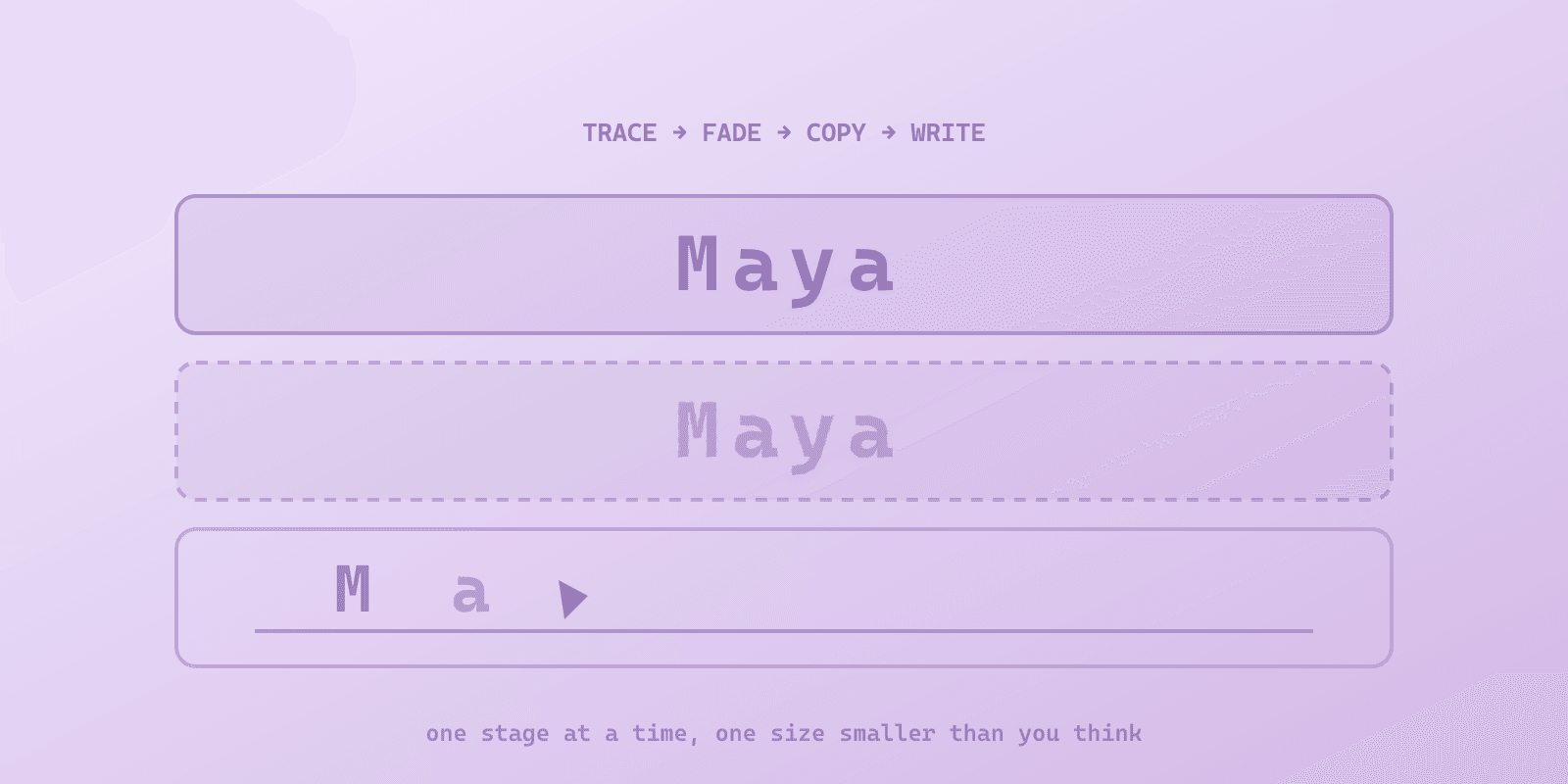
- The progression that works has four stages: trace the full model, trace a faded model, copy from a model on the same page, write on a blank line. Move one stage when the current one is easy, not on a date.
- Letter size should shrink as control grows. Starting huge is right for most children; staying huge past the point of control practices the wrong motor pattern.
- The first letter deserves separate attention: it is capitalized, it usually gets overpracticed, and many children can write it while the rest of the name collapses. Practice the whole name as a unit once the letters exist.
- For a classroom, the bottleneck is production, not pedagogy. Typing thirty names into pages one at a time is the reason name practice defaults to one generic page; an editable generator that takes a pasted class list removes the bottleneck.
A child's name is the first word they want to write. It is on their cubby, their coat hook, their artwork, and eventually the top of every worksheet they will ever be handed. That motivation is a gift, and most name tracing materials waste it the same way: one page, full dotted letters, traced over and over until June.
The child who traces the same full model in October that they traced in August is not practicing writing. They are practicing tracing, which is a different skill, and the page never asks them for more.
The four-stage progression
Name writing is learned by removing support, one kind at a time. It sits slightly outside the usual order, because most children learn their name as one memorized pattern well before the underlying strokes are secure; the pre-writing skills sequence covers what those strokes are and how to check them separately.
- Trace the full model. Every letter dotted or grayed, the child follows the whole path. This teaches letter shape and stroke order in the one word the child cares most about.
- Trace a faded model. The dots thin out, or only the tricky letters keep their guides. The child supplies more of each stroke from memory.
- Copy from a model. The name is printed at the top of the page; the child writes it on a line below. Looking is allowed. Producing the strokes is not supported.
- Write on a blank line. The model is gone. This is the goal stage, and it is the only one most forms and worksheets will ever offer the child again.
Move a child one stage when the current stage is easy, not on a calendar date. Some children spend a week at stage two; some spend a term. Both are fine. What is not fine is a year at stage one, and a year at stage one is exactly what a single-page name worksheet delivers.
Size is a stage of its own
Early writers steer the pencil from the shoulder and the elbow. The wrist and fingers join later. Tall letters, an inch or more, match how the young hand actually moves, which is why starting huge works.
The part that gets missed is the shrink. As control moves down the arm, the letters should come down in size toward standard primary ruling. A five-year-old still tracing two-inch letters is rehearsing an arm movement they need to retire. If a page series offers sizes, use them as a ladder rather than picking one and staying.
The first-letter trap
The first letter of a name gets triple practice: it is the letter the child sees capitalized, the letter adults praise first, and the letter that starts every attempt, including the abandoned ones. The result is familiar to any early childhood teacher: a beautiful first letter followed by a collapsing tail.
Two adjustments help. Practice the name as a whole unit rather than always starting from the front, sometimes starting practice at the second letter with the first already printed. And once individual letters exist, judge the name by its worst letter, not its first one, when deciding whether to advance a stage.
If the child is still working on recognizing the letters of their own name rather than forming them, that is a recognition task before it is a motor task, and recognition practice like letter-based color work does more good at that point than more tracing.
Running this for a whole class
Everything above is pedagogy a good teacher already half-knows. The reason it rarely happens in classrooms is production. Thirty students means thirty names, and four stages times several sizes times thirty names is hundreds of personalized pages that somebody has to make.
That is why name practice defaults to a single generic tracing sheet: not because anyone believes one page is right, but because typing names into pages one at a time is a weekend, and nobody has one.
The production problem is the solvable half. Our free editable name tracing worksheets take a typed name and produce clean traceable pages at the stage and size you pick, and the Classroom Name Practice Pack takes a pasted class list and builds nine page types per student for up to thirty students, sorted so each student's set comes off the printer stapled together. The pedagogy above is baked into the page types, so running the progression stops requiring anyone to build it.
For the children not yet ready for letters at all, the on-ramp is line tracing, and for the hand itself, cutting practice builds the same grip strength and bilateral control that pencil work draws on.
What to do on Monday
Print the child's name at the current stage and one size smaller than you think, watch one attempt without helping, and place them on the ladder. Then let the ladder, not the calendar, decide what next week's page looks like.
Planning for a room where every student needs something different?
Beacon remembers your students and your setting, so you are not re-explaining them every time.
What would Beacon say?
"Help me plan a week for a mixed-goal group"
Beacon works from the goals and levels already in your room, then gives you something you can run on Monday. Not a blank template to fill in on Sunday night.

Spectrum Unlocked Editorial Team
Editorial Team
The Spectrum Unlocked editorial team combines lived experience as autism parents with research-backed guidance to create resources families can trust.
Frequently asked questions
- At what age should a child trace their name?
- Most children are ready to trace between 3 and 4, and ready to write from a model between 4 and 5, but readiness is motor and attentional rather than a birthday. The honest checkpoints are earlier in the chain: the child can scribble with intent, can trace a straight line and a circle without the pencil leaving the page constantly, and can attend to a page for a few minutes. For many autistic children and children with fine motor delays the same sequence holds at later ages, and nothing about the progression changes, only the timeline. Starting name tracing before line tracing is comfortable usually produces frustration rather than letters.
- What order should name writing skills go in?
- Trace the full model first, with every letter shown. Then trace a faded model, where the letters are dotted or lightened so the child supplies more of the path. Then copy: the name is printed at the top and the child writes it below on their own line, still able to look. Last, write from memory on a blank line. Each stage removes one kind of support. The common mistake is jumping from full trace straight to blank line, which fails, and then concluding the child cannot write their name rather than that two stages were skipped.
- How big should the letters be for name tracing?
- Bigger than adult handwriting, and shrinking over time. Early tracing works best with tall letters, roughly an inch or more, because young fingers steer from the shoulder and elbow before they steer from the wrist. As control improves, size should come down toward standard primary ruling. The mistake in both directions is staying: staying huge practices arm-writing long after the wrist is ready, and starting small asks for precision the hand does not have yet.
- Should name tracing use uppercase or lowercase letters?
- First letter capitalized, the rest lowercase, from the beginning. All-caps names feel easier because capitals are mostly straight lines, but the child then has to relearn the name in the form every classroom expects, and unlearning an overpracticed all-caps name is slower than learning the mixed-case name once. The exception is a child already writing in all caps fluently; there, transition letter by letter rather than starting over.
- How do I make name tracing pages for a whole class?
- Use an editable generator rather than a font trick in a word processor. Word-processor dotted fonts break on descenders and punctuation, and typing names one page at a time is the real reason whole-class name practice rarely happens. A generator that accepts a pasted class list and produces one set per student, sorted so each student's pages come out of the printer together, turns a weekend job into minutes. Our free editable name tracing worksheets do exactly this, and the paid classroom pack extends the same names across nine page types per student.
- What if a child refuses to practice their name?
- Refusal is information. The usual causes are that the stage is too hard, the letters are too small, the pencil grip is effortful, or the page has been the same for weeks. Drop back a stage, enlarge the letters, offer a marker or crayon instead of a pencil, and change the format before concluding the child is not ready. Names carry emotional weight, and a child who has failed the same name page many times may need the name to disappear for a while in favor of line tracing and single letters, then return.