Replacement Behaviors for Autism at School
A replacement behavior is the skill the BIP teaches your autistic child to use instead of the target behavior. The replacement has to serve the same function or it will not work. Here are the categories that fit autism.
Key Takeaways
- A replacement behavior is the alternative skill the BIP teaches your child to use instead of the target behavior. The non-negotiable rule: the replacement must serve the same function as the target behavior, or it will not stick.
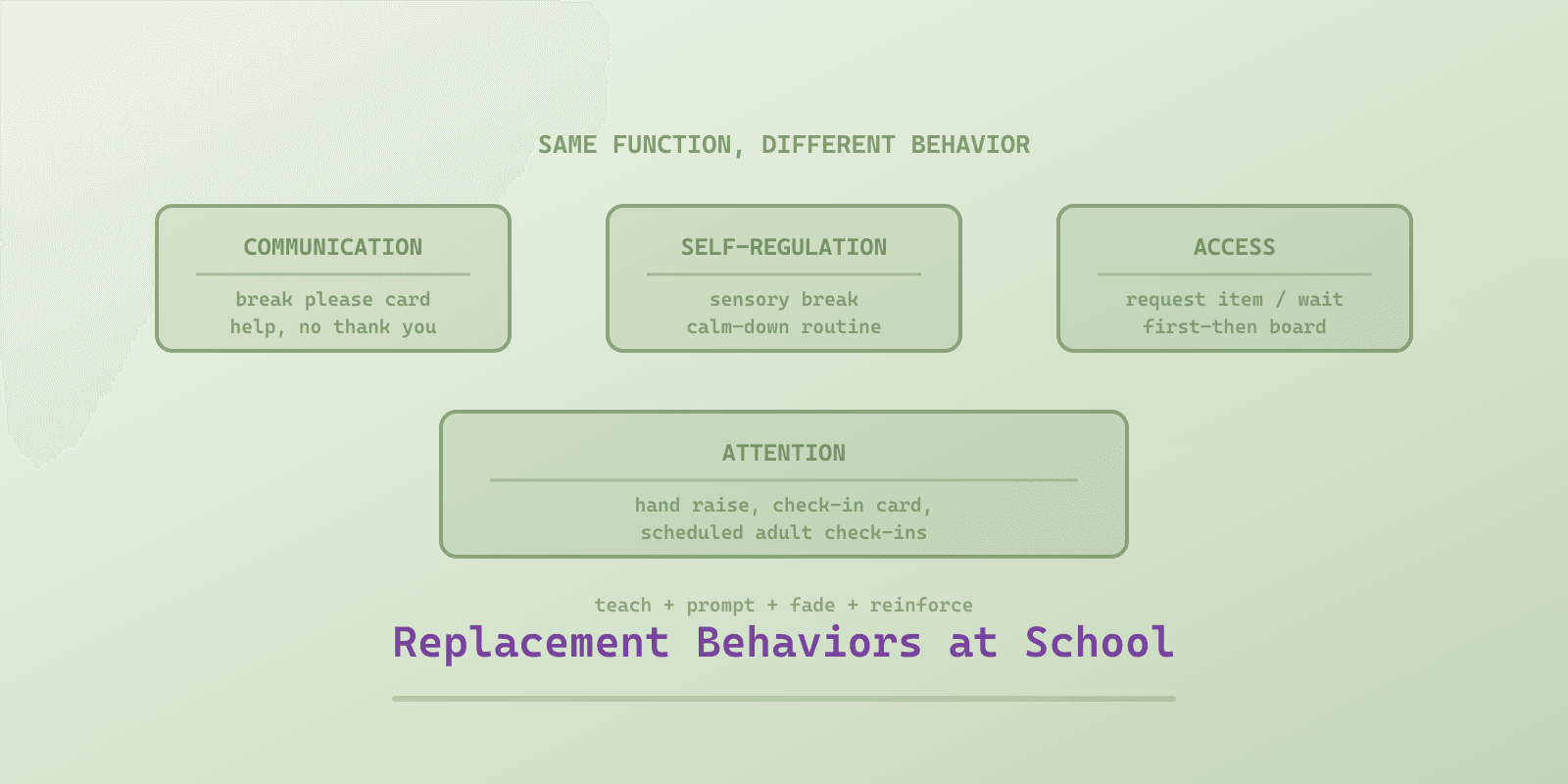
- For autism, the most useful replacement categories are communication (asking for a break, asking for help, refusing politely), self-regulation (sensory break, calm-down routine, breathing strategy), and access (using AAC to request a preferred item, asking to wait one minute).
- Replacement behaviors are taught, not just listed. The BIP should include explicit teaching plans, prompting hierarchies, mastery criteria, and reinforcement schedules.
- When a replacement is not working, the function was probably misidentified. Go back to the FBA before redesigning the replacement.
A replacement behavior is the alternative skill your autistic child's behavior intervention plan teaches your child to use instead of the target behavior. The replacement is the active ingredient in the BIP, and the single most common reason BIPs fail is that the chosen replacement does not serve the same function as the target behavior.
If a third grader hits peers to escape demanding academic tasks, a real replacement is "hand the teacher a 'break please' card and walk to the calm corner for 3 minutes," because that replacement serves the escape function. A made-up replacement like "earn a sticker for being quiet" does not serve the escape function, will not compete with hitting, and will not work no matter how many stickers the school offers.
This guide is a working catalog of replacement behaviors that fit autism, grouped by the function each replacement serves. Use it as a menu the IEP team can draw from when writing the behavior intervention plan, or as a starting point for the conversation if the BIP is missing this section entirely.
The Non-Negotiable Rule: Same Function
Function comes from the functional behavior assessment. Most behavior analysts group the function of behavior into four categories:
- Escape or avoidance (the child is trying to get out of a task, setting, or sensory experience)
- Attention (the child is trying to gain attention from adults or peers)
- Access (the child is trying to obtain a tangible item or activity)
- Sensory or automatic reinforcement (the behavior produces an internal experience the child seeks)
The replacement has to match. A behavior that serves escape needs a replacement that produces escape (asking for a break, signaling task too hard, requesting help). A behavior that serves attention needs a replacement that produces attention (raising hand, asking to share, signaling for a check-in). A behavior that serves access needs a replacement that produces access (requesting the item, asking to wait, negotiating timing). A behavior that serves sensory needs a replacement that meets the sensory need (movement break, fidget tool, deep pressure). For an urge like spitting, a calm-day story alongside the replacement skill gives the child words for the urge as well as somewhere to redirect it.
When the function is layered (a meltdown is often part escape and part sensory), the BIP often teaches two replacements, one for each function strand. That is fine and often necessary. If you want help to choose a same-function replacement skill before the meeting, working from the function the FBA named keeps the match honest.
Communication-Based Replacements
These work for behaviors driven by communication breakdown, which is a huge fraction of autism behavior at school. The replacement is a clear, explicit, taught communication act.
Asking for a break. Strongest replacement for escape-function behaviors. The child hands a "break please" card, taps a button on AAC, signs "break," or uses any communication system already in place. The break is granted immediately at first, fading to brief delays as the skill is fluent. Mastery includes the child returning from break and re-engaging with the task.
Asking for help. Strongest replacement for behaviors that signal task difficulty. The child hands a "help" card, signs "help," uses AAC, or in verbal language asks the teacher to help with a specific part of the task. Distinguishing "help" from "break" matters; they serve overlapping but different functions, and a child who hits when stuck on a math problem may need both as available replacements.
Refusing politely. Strongest replacement for behaviors that signal "no." The child uses a "no thank you" card, signs "no," or in verbal language says "I do not want to." Critically, when the child uses this replacement, the team has to respect it sometimes, or the replacement does not work. This is uncomfortable for teachers used to compliance-first classrooms, but it is the only way the replacement actually competes.
Requesting a specific item or activity. Strongest replacement for access-function behaviors. The child uses AAC, picture cards, or verbal request. The team responds with a "wait" or "first-then" structure so the request is honored but on a schedule.
Self-Regulation Replacements
These work for behaviors that are about regulation itself, where the child is overstimulated, dysregulated, or in fight-flight-freeze.
Sensory break with movement. Walking laps, jumping on a small trampoline in a sensory room, climbing on a built-in ladder, or other gross-motor activity. Strongest for escape-from-sensory-overload functions and for proprioceptive seekers.
Sensory break with deep pressure. Weighted vest, body sock, beanbag, lap pad, or pressure swing. Strongest for regulatory functions where the child is overstimulated and needs calming input.
Calm-down routine. A taught sequence the child can run independently. A typical example: notice body cues, name the feeling on a feelings card, choose a coping strategy from a menu of three, do the strategy for a set duration, return to the activity. The routine has to be practiced when the child is calm, not learned for the first time in a crisis.
Breathing or counting strategy. Box breathing (4-4-4-4), 5-4-3-2-1 grounding, counting backward from 10, or any taught self-soothing strategy. These tend to work better in late elementary and middle school once metacognition is developed; younger autistic children usually need more concrete sensory routines first.
Visual fidget or stim alternative. A fidget cube, putty, theraband, or other approved sensory tool the child can use during seated work to meet the regulatory function without disrupting class.
Access-Based Replacements
These work for behaviors that aim to get something tangible.
Asking to wait one minute. A "wait" card, sand timer, or visual timer the child uses when the answer to the request is not "yes right now." The child learns that waiting earns the request reliably, and the wait time gets longer as the replacement is mastered.
Token economy with cash-out. Earn tokens for completing a task, cash out for the desired item at a set interval. Works well for older children and for behaviors where the access function is delayed-but-honored. Token economies have to be designed with the child's tolerance for delay; for young or significantly dysregulated children, the interval has to be very short at first. A token tracker sheet keeps a running count of what was earned toward each cash-out, and where the system runs as a daily point card across periods, a check-in check-out point sheet scores each block so the reward is tied to data rather than memory.
First-then structure. Visual board showing the non-preferred task first, then the preferred activity, like the ready-made clean up, then play board that pairs tidying up with playtime. The replacement here is "wait and complete the task," and the access function (the preferred activity) is honored on a schedule. For a child just learning that a finished task earns the reward, a short 3-token starter board makes that wait visible and quick to pay off.
Attention-Based Replacements
These work for behaviors that aim to get attention from adults or peers.
Hand-raising or check-in card. The child raises a hand or holds up a check-in card, the teacher comes within 30 seconds at first, fading to longer intervals.
Scheduled adult check-ins. Regular adult attention on a known cadence (every 10 minutes, every 15 minutes), so the child does not have to escalate to get a check-in. This is especially useful at the start of a BIP when the child has learned that big behaviors get fast attention. As the student grows into it, a self-monitoring sheet lets them rate their own behavior at each check-in, which builds the regulation skill while it collects the data.
Peer-attention scripts. Taught social scripts for getting peer attention appropriately: "Can I sit with you?", "Do you want to play with me?", "Look at this." Works for attention-from-peers functions but takes longer to teach than adult-attention replacements. The same taught-script approach works for personal space: a short story that describes the invisible bubble around each person and coaches keeping an arm's distance gives a concrete shape to an expectation that is often assumed rather than taught.
Teaching the Replacement
Listing a replacement in the BIP is not the same as teaching it. A real teaching plan includes:
- The acquisition phase: explicit teaching with prompts (verbal, visual, gestural), with prompts faded as the child responds independently and each try recorded on a prompt-level data sheet that shows how much help the skill still needs
- The fluency phase: practice across settings, times of day, and contexts where the target behavior happens, checked with a generalization probe sheet so a skill that only shows up with one aide in one room is not mistaken for mastery
- The mastery criterion: a specific data point that defines "the child can do this." E.g., "3 independent uses per day for 5 consecutive school days," logged on a percent-of-opportunity data sheet that turns each day's uses into a percentage the team can graph
- The reinforcement schedule: every time at first, fading to intermittent as the replacement is fluent
- Who is responsible for teaching at each phase
- How the team handles errors (re-prompting, not just consequences)
Without a teaching plan, the replacement exists on paper but not in the child's repertoire. The teacher waits for the child to use the break card; the child does not know the card exists or how to use it; the target behavior continues; the BIP is judged a failure when in fact it was never implemented.
When the Replacement Is Not Working
A few diagnostic patterns when the BIP data shows the replacement is not catching:
- The function was misidentified. Go back to the FBA and revisit the data with the team. Sometimes "attention" is actually "access to a calmer adult," which is functionally different.
- The replacement is too hard relative to the target. If hitting is faster and produces a faster escape than handing a card, the cost-benefit ratio favors hitting. Make the replacement easier (a single sign or button) and richer (immediate granted break); a latency data sheet that times how long the child takes to use the replacement after the trigger shows whether the new skill is fast enough to compete.
- The replacement is being reinforced too thinly. Move back to continuous reinforcement (every use earns the consequence) before fading. Watching the rate data sheet for the target behavior next to the rate of replacement use tells you which one is winning over a week.
- The target behavior is still being reinforced. Even adult-attention when "ignoring" can reinforce attention-seeking behavior. Audit the consequence side of the BIP for accidental reinforcement.
- Setting events are driving the behavior. Sleep, food, family stress, illness, sensory overload from a noisy morning. These do not show up in the school's ABC data and need to be brought into the team conversation by parents.
The BIP should have a built-in review schedule (30-day, 60-day, quarterly are common). When the data is not moving, the review meeting is the venue for revision, not the annual IEP. And if the school is responding to the behavior with discipline instead, you can prep for a disciplinary meeting before that conversation.
How Replacements Fit the Larger IEP
Replacement behaviors are taught skills, and taught skills belong in the goals section of the IEP. A behavior goal might read: "By [date], when presented with a non-preferred academic task, [child] will hand the teacher a 'break please' card and walk to the calm corner for 3 minutes in 4 out of 5 opportunities across 3 consecutive school weeks, as measured by daily teacher data."
The IEP goal bank carries example behavior goals you can adapt during the IEP meeting. The accommodations bank carries antecedent supports that pair with the replacement (visual schedules, transition warnings, sensory tools).
The behavior plan itself sits in or attached to the IEP, with antecedent strategies, the taught replacement, consequence strategies, and data. The present levels describe the baseline; the goal describes the target; the specially designed instruction is the teaching; the BIP is the operational plan.
If you are at the point of needing to put a replacement behavior request in writing to the school, the IEP Advocacy Letter Builder drafts a letter with the federal anchors at 34 CFR §300.324(a)(2)(i) and the FBA / BIP rule at 34 CFR §300.530(f). And if a suspension is what brought you here, a manifestation determination letter asks the team to review whether the behavior was tied to disability before any removal sticks.
A replacement behavior that serves the same function as the target, that the team explicitly teaches with prompts and fading, that the staff reinforces generously, and that the data tracks across acquisition and fluency, is the difference between a BIP that changes behavior and a BIP that sits in a binder. Building the catalog of replacements that fit your autistic child is one of the most concrete things the IEP team and the parent can do together.
Behavior is communication. The question is what it's telling you.
Beacon learns about YOUR child and gives guidance specific to them.
What would Beacon say?
"Help me understand what's driving this behavior"
Beacon helps you map the trigger and the function, then plan a response that meets the same need, tailored to your specific child instead of a generic chart.
Spectrum Unlocked Editorial Team
Editorial Team
The Spectrum Unlocked editorial team combines lived experience as autism parents with research-backed guidance to create resources families can trust.
Frequently asked questions
- What makes a replacement behavior actually work?
- Three things. It serves the same function as the target behavior; the team explicitly teaches it with prompts, fading, and mastery criteria; and the team reinforces it generously when the child uses it. If any of those three pieces is missing, the replacement does not compete with the target.
- Can a replacement behavior be just 'use words instead'?
- No. 'Use your words' is not a replacement behavior; it is a general expectation. A real replacement is specific (e.g., 'hand the teacher a break card, then go to the calm corner for 3 minutes') and matches the function the FBA identified. For nonverbal or minimally verbal autistic children, AAC-based replacements are usually stronger than verbal ones.
- How long until a replacement behavior starts working?
- Acquisition (the child can do the skill when prompted) typically takes 2 to 6 weeks of explicit teaching. Fluency (the child uses the skill independently and consistently) takes 4 to 12 weeks. Maintenance and generalization across settings takes longer. The BIP should track all three stages with data, not just acquisition.
- What if the replacement behavior is happening but the target behavior also keeps happening?
- This usually means the replacement is being reinforced too thinly or the target behavior is still being reinforced (sometimes by adult attention even when staff are 'ignoring' it). Review the reinforcement schedule and the consequence side of the BIP. Sometimes the answer is to make the replacement easier and richer to reinforce, not to add more consequences to the target.
- Do replacement behaviors apply to stimming?
- It depends on the function. If a child's stimming is regulatory and not impeding learning, the goal is usually not to replace it but to allow it. If stimming is escalating into self-injurious behavior, the replacement focuses on the regulatory function (movement break, fidget tool, deep pressure) without targeting all stimming. Plans that try to extinguish all stimming generally backfire.