FBA in Special Education Explained
A functional behavior assessment is the data-driven process the IEP team uses to figure out why your autistic child is engaging in a behavior before any plan is written.
Key Takeaways
- An FBA is the structured process the IEP team uses to figure out the function of a behavior (escape, attention, access, sensory) before writing a behavior intervention plan.
- Federal law requires an FBA whenever a manifestation determination finds the behavior was a manifestation of disability and no FBA was previously conducted (34 CFR §300.530(f)).
- Parents can request an FBA in writing at any time. The school must respond with prior written notice within a reasonable time and either agree or deny in writing with reasons.
- An FBA grounded in real data turns the IEP behavior plan from a guess into a measurable intervention. Without it, the BIP is unlikely to work.
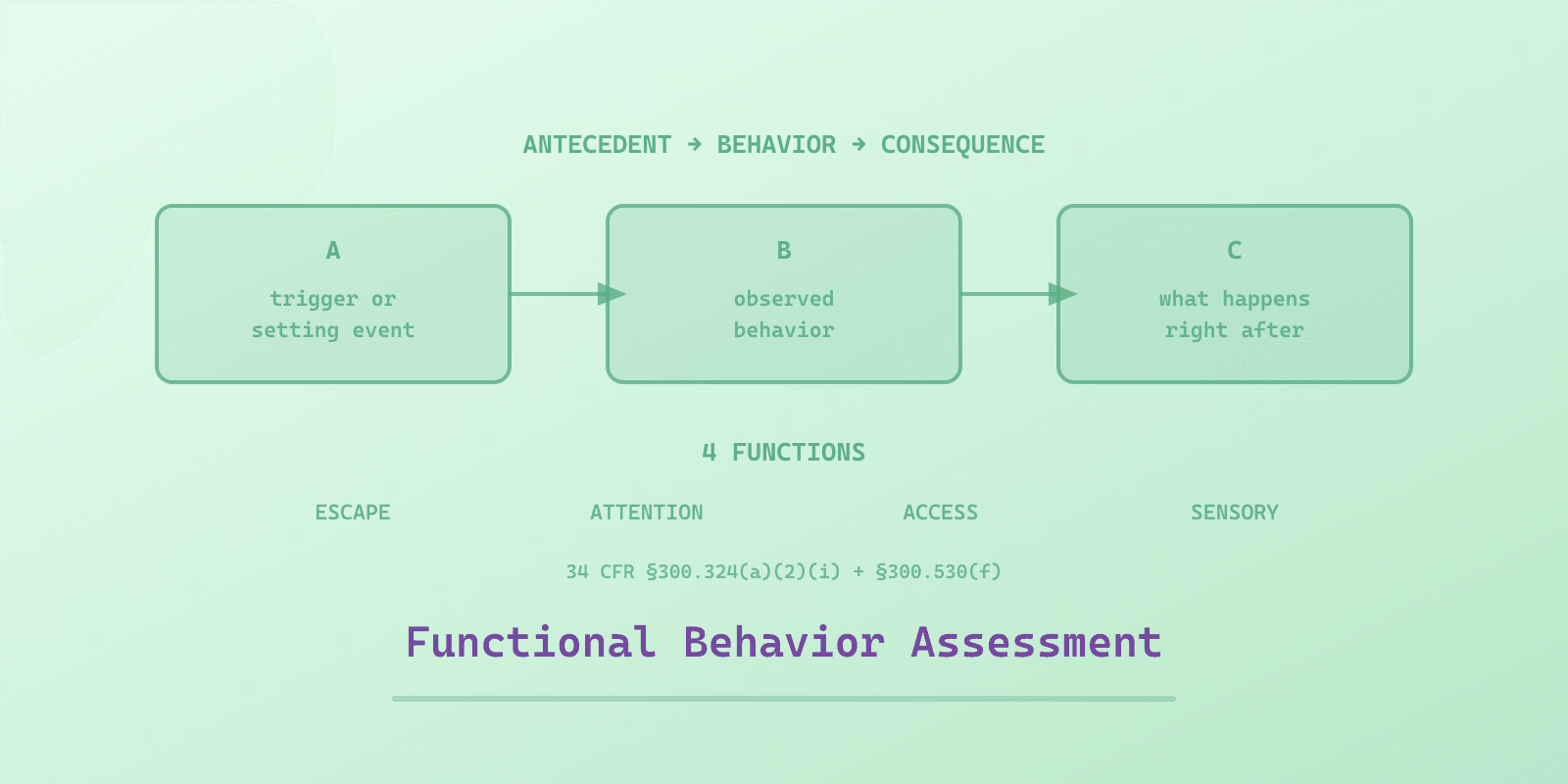
A functional behavior assessment, or FBA, is the IEP team's process for figuring out why your autistic child is engaging in a particular behavior. The team gathers data on what happens right before the behavior (antecedents), what the behavior looks like (frequency, duration, intensity), and what happens right after (consequences), and uses that data to identify the function the behavior serves for your child.
Take a third grader with autism who hits a peer on the playground during recess. An FBA does not start from the question "how do we stop the hitting." It starts from the questions "when does the hitting happen, who is around, what triggers it, what does the child get or avoid by hitting, and what was the school environment like when it happened." A good FBA answers those questions with real data, and the answers drive the behavior intervention plan that follows.
This guide walks through what the law requires, what data the team has to collect, who conducts the FBA, what the timeline looks like, and how to request an FBA in writing.
When an FBA Is Required and When It Is Recommended
Federal law has two separate triggers for an FBA. The first is the consideration mandate in 34 CFR §300.324(a)(2)(i). When a child's behavior impedes their learning or the learning of others, the IEP team must consider positive behavioral interventions and supports and other strategies to address the behavior. The regulation does not say "must conduct an FBA," but in practice, conducting one is the standard way the team meets that consideration mandate when a behavior is repeating.
The second trigger is the discipline rule in 34 CFR §300.530(f)(1)(i). If a manifestation determination finds the behavior was a manifestation of the child's disability, and the IEP team has not previously conducted an FBA, the team must conduct an FBA and implement a BIP. If a BIP was already in place, the team must review and modify it as necessary. When the discipline lands before any of that happens, a behavior and discipline letter puts your objection on the record in writing.
In plain terms, the law mandates an FBA after a manifestation finding when none exists, and it strongly implies one whenever behavior is interfering with education and the IEP does not yet have a current behavior plan.
What Data the Team Collects
A complete FBA pulls data from at least four sources.
- Direct observation across multiple settings (classroom, hallway, lunch, recess, specials)
- Indirect interviews with teachers, paraprofessionals, parents, and the child where developmentally appropriate
- Record review of incident reports, IEP progress notes, prior evaluations
- Antecedent-behavior-consequence (ABC) data collected over time, ideally across 2 to 4 weeks, on a printable ABC data sheet that logs one incident per row. The home side of that picture matters too, and you can bring real data to the FBA by logging what you see before and after each incident at home rather than describing it from memory at the meeting
The core analytic move is functional analysis. The team is trying to identify the function the behavior serves for the child. Behavior analysts generally group functions into four categories:
- Escape or avoidance (the child is trying to get out of a task, a setting, or a sensory experience)
- Attention (the child is trying to gain attention from adults or peers)
- Access (the child is trying to get a tangible item or activity)
- Sensory or automatic reinforcement (the behavior itself produces an internal experience the child seeks or avoids)
For autistic children, the function is often layered. A child hitting on the playground might be escaping sensory overload, communicating frustration that they cannot verbalize, and seeking the predictable adult response that follows. The FBA is what disentangles those overlapping drivers and turns them into measurable hypotheses the BIP can address.
Who Conducts the FBA
The FBA is typically conducted by a school psychologist or a board-certified behavior analyst (BCBA), with input from the classroom teacher, paraprofessionals, related-service providers (speech, occupational therapy), and the parents. The actual data collection is usually a team effort. The teacher records ABC data in the classroom on standard forms like the special education data sheets, adds a scatterplot data sheet when the question is which times of day the behavior clusters, and keeps an anecdotal record sheet for the narrative detail a grid cannot hold; the psychologist or BCBA observes across settings, parents provide context from home and community settings, and the team meets to analyze the data and write the report.
Parents are not passive observers. The federal rule treats parents as equal members of the IEP team, and parent observation of the same behavior in non-school settings is often the data point that confirms or rejects a function hypothesis. If your child elopes only at school but not at home, the function is likely environment-specific. If your child elopes at home, in the grocery store, and at school under the same trigger, the function is more general and the BIP needs broader supports.
If your school does not have a BCBA on staff or contracted, you can request that the FBA be conducted by an outside qualified evaluator at public expense as part of an independent educational evaluation. The right to an IEE is under 34 CFR §300.502; OSEP has confirmed in policy guidance (Letter to Christiansen, 2013) that an FBA used as part of an evaluation is subject to the §300.502 IEE-at-public-expense right.
The FBA Timeline
A complete FBA takes 2 to 6 weeks of active data collection in most cases. The team needs time to observe the behavior across the days and contexts where it actually happens, not just one or two probe sessions. State regulations on the formal completion timeline vary. California, New York, and several other states attach the FBA timeline to the evaluation timeline of 60 days from parent consent. Texas runs it through the ARD committee with no fixed federal-style deadline but a "reasonable time" standard.
Those weeks of active data collection are the part parents can actually see going well or badly, and the sheets the team uses are not secret. The ABA data sheets and therapy resources hub has the scatterplot, interval and ABC sheets an FBA usually runs on, free to print, which makes it easier to ask whether the team is collecting across the contexts where the behavior actually happens. ABA data collection methods compared explains what each of those methods can and cannot tell the team, including why interval data is an estimate and should be reported as one.
If the FBA is triggered by a manifestation determination, the 60-day evaluation clock starts on the date of the manifestation review. If the FBA is triggered by a parent request, the clock starts on the date the school receives written consent.
What the team should not do is rush the FBA. A 3-day quick-look assessment that produces a generic BIP ("when the student is aggressive, redirect to a calm-down area") is not a real FBA, and a BIP built on that is unlikely to change the behavior.
How to Request an FBA
Parents can request an FBA in writing at any time. There is no procedural threshold and no requirement that the school has already tried something else first. A clean request looks like this:
- Address it to the case manager, the special education director, and the school principal
- Date it
- State the specific behavior of concern (frequency, settings, recent escalations)
- Reference the federal trigger (34 CFR §300.324(a)(2)(i)) if the behavior is impeding learning, and 34 CFR §300.530(f) if there has been a manifestation finding
- Request that the school respond with prior written notice within a reasonable time
Use the IEP Advocacy Letter Builder if you want a formatted version with the citations already in place.
The school's response options under 34 CFR §300.503 are to agree and seek consent for evaluation, or to deny in writing with reasons. If the school denies, you can request an independent educational evaluation (IEE) at public expense, which includes an independent FBA. Schools that deny an IEE request must either pay for the IEE or file due process to defend the original assessment.
How FBA Findings Drive the BIP
The output of the FBA is a written report that identifies the function of the behavior, the antecedents that reliably trigger it, the consequences that maintain it, and the conditions under which the behavior is least likely to occur. That report is the input to the behavior intervention plan.
A BIP that flows from a real FBA generally includes:
- An operational definition of the target behavior (frequency, intensity, duration)
- The hypothesized function from the FBA
- Antecedent strategies that reduce or eliminate the trigger
- Replacement behaviors that serve the same function as the target behavior, with explicit teaching plans
- Consequence strategies that reinforce replacement behaviors and minimize reinforcement of the target behavior
- Data collection and review schedule, often consolidated onto one FBA-BIP tracking sheet that carries the function, the replacement, and the fidelity data together
- Crisis plan if the behavior is unsafe
To see what those pieces look like assembled into the two-page classroom copy staff actually run from, a free printable behavior plan example walks a real escape-maintained behavior from function to prevent, teach, and respond steps.
For autism specifically, replacement behaviors usually involve a communication target. A child who hits to escape a difficult task can be taught to hand the teacher a "break please" card; a child who elopes to escape sensory overload can be taught to request the calm room. These targets are covered in depth in Spectrum Unlocked's replacement behaviors at school guide.
FBA Quality Markers Parents Can Check
A few quality markers separate a strong FBA from a weak one:
- The report identifies a specific function, not just "behavior to be reduced"
- ABC data was collected across at least 3 settings and 2 to 4 weeks
- At least one parent interview is documented in the report
- The hypothesized function is testable (the BIP design includes a way to confirm or reject it)
- Replacement behaviors in the BIP serve the same function as the target behavior
- A data collection plan exists for tracking BIP fidelity and behavior change
If the FBA report does not name a function, or names "noncompliance" or "off-task behavior" as the function (those are not functions, they are descriptions), the report is incomplete and you can ask for it to be revised before the BIP is written.
How FBA Works in Your State
The federal FBA framework applies in all 50 states. State law and state education agencies add procedural detail, including timelines and who is qualified to conduct the assessment. The callout below lays out the specifics for five high-population states.
Outside those five, the federal rule still governs and your state DOE will publish a behavior or discipline policy document that mirrors it.
When the IEP team is choosing what setting to deliver the BIP in, the least restrictive environment analysis still applies. A BIP can be implemented in the general education classroom with supplementary aids and services, in a resource room, or in a more separate setting; the team picks the least restrictive one that still delivers the supports the FBA identified. The accommodations bank carries a behavior-supports filter the team can use as a menu when drafting the BIP.
A functional behavior assessment is the foundation of every behavior plan that actually works. Knowing what the law requires, what data the team should collect, and how to request an FBA in writing turns the conversation from "the school says my child is a behavior problem" into "let us go figure out what is driving the behavior, then build a plan grounded in the answer."
Need help preparing for YOUR next IEP meeting?
Beacon learns about YOUR child and gives guidance specific to them.
What would Beacon say?
"Help me prep for my IEP meeting"
Beacon pulls your child's goals, challenges, and history, then gives you the exact questions to ask, the red flags to watch for, and what to push back on.

Spectrum Unlocked Editorial Team
Editorial Team
The Spectrum Unlocked editorial team combines lived experience as autism parents with research-backed guidance to create resources families can trust.
Frequently asked questions
- What is a functional behavior assessment?
- A functional behavior assessment is a structured information-gathering process the IEP team uses to identify the function (purpose) of a child's behavior, the antecedents that trigger it, the consequences that maintain it, and the contexts in which it happens. The output is the foundation for a behavior intervention plan.
- When is an FBA legally required?
- Under 34 CFR §300.530(f)(1)(i), an FBA is required when a manifestation determination finds the behavior was a manifestation of disability and the IEP team has not previously conducted one. IDEA also requires the IEP team to consider, when behavior impedes learning, strategies including positive behavioral interventions and supports (34 CFR §300.324(a)(2)(i)), which in practice often triggers an FBA.
- Can I request an FBA without a discipline incident?
- Yes. Parents can request an FBA in writing at any time when a child's behavior is interfering with their education. The school must respond with prior written notice under 34 CFR §300.503 and either agree to conduct the FBA or deny the request in writing with reasons. If the school denies, you can request an independent FBA at public expense.
- Who conducts the FBA?
- The FBA is typically conducted by a school psychologist, board-certified behavior analyst, or special education team member trained in behavior analysis, in coordination with the classroom teacher and parents. Parents are equal contributors to the data the assessment relies on, including observations at home and in the community.
- What is the difference between an FBA and a BIP?
- An FBA is the diagnostic step. It identifies the function of the behavior using observation, interviews, and antecedent-behavior-consequence data. A behavior intervention plan is the treatment step. It uses the FBA's findings to design replacement behaviors, antecedent supports, teaching plans, and consequence strategies. An FBA without a BIP is incomplete, and a BIP without an FBA is a guess.
- How long does an FBA take?
- A complete FBA generally takes 2 to 6 weeks. The team needs time to observe the behavior across multiple settings, interview teachers and parents, collect ABC (antecedent-behavior-consequence) data, and analyze the patterns. State regulations on the timeline vary; some states require completion within a fixed number of school days from parent consent.