Behavior Intervention Plan (BIP) for Autism
A behavior intervention plan is the formal, IEP-attached document that tells school staff what to do before, during, and after a target behavior so your autistic child gets a real chance to learn replacement skills.
Key Takeaways
- A BIP is the IEP-attached behavior plan that translates the functional behavior assessment into specific staff actions before, during, and after the target behavior.
- Federal law requires the IEP team to consider positive behavioral interventions and supports when behavior impedes learning (34 CFR §300.324(a)(2)(i)), and to write a BIP after a manifestation determination finds the behavior was a manifestation (34 CFR §300.530(f)(1)(ii)).
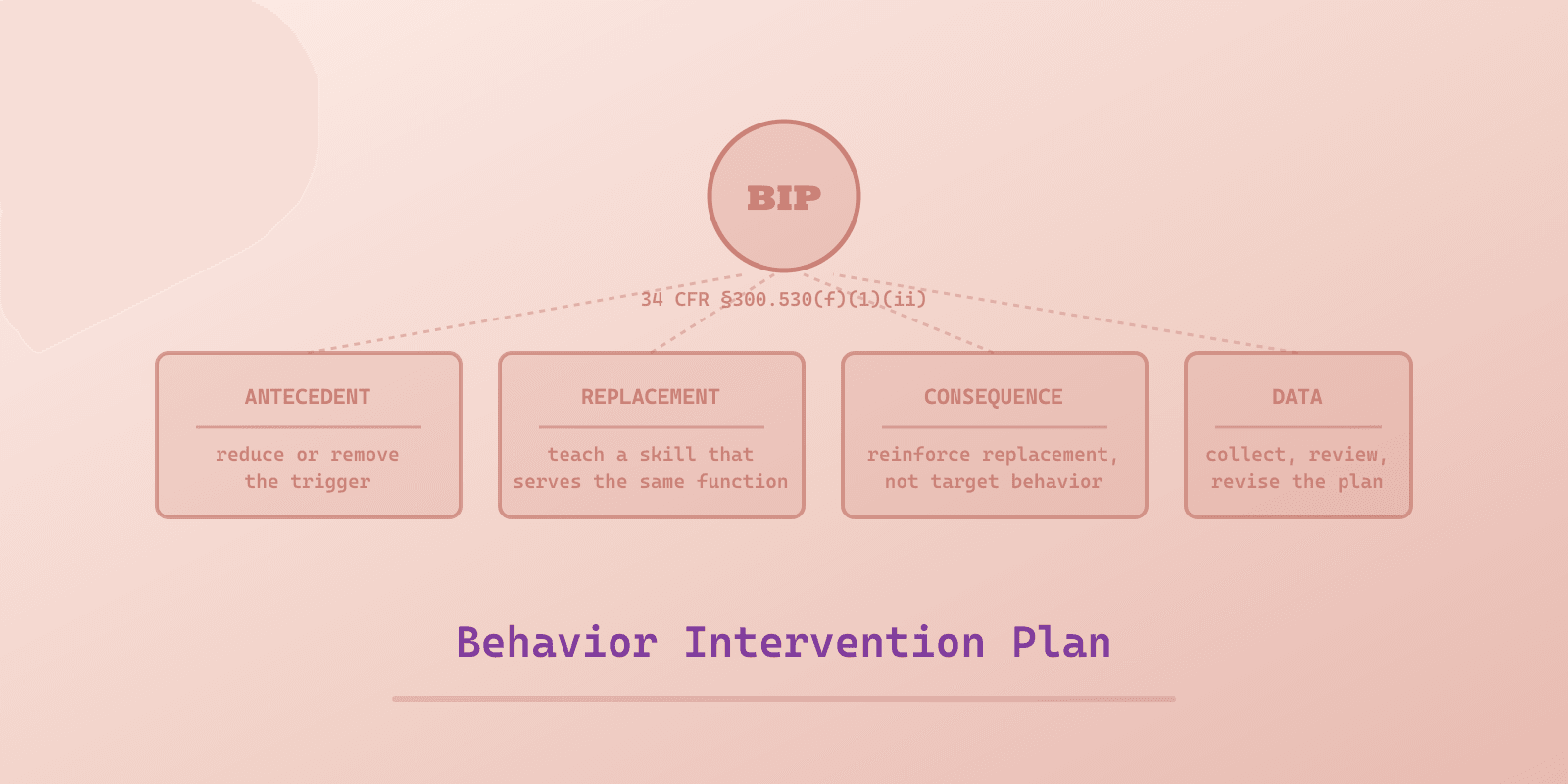
- A real BIP names the function from the FBA, teaches replacement behaviors that serve the same function, defines antecedent and consequence strategies, and includes data collection and review schedule.
- A BIP that is written but not implemented is one of the most common procedural failures. Parents have the right to BIP implementation data and to revise the plan when the data shows it is not working.
A behavior intervention plan, or BIP, is the written document attached to your autistic child's IEP that tells school staff exactly what to do before, during, and after a specific target behavior. It is not a suggestion or a philosophy statement. It is an operational plan, signed by the IEP team, that creates a legally enforceable expectation about how the school responds to your child's behavior.
Take a second grader with autism who screams and throws materials whenever the classroom switches from a preferred activity to a non-preferred task. A real BIP names that behavior with specifics (decibel, duration, what gets thrown), names the function the FBA identified (escape from non-preferred tasks), prescribes the antecedent supports the teacher should use (visual transition warning, first-then board, choice between two non-preferred tasks), prescribes the replacement behavior the team is teaching (hand the teacher a "break please" card), and prescribes what the staff does when the target behavior happens anyway. Without that level of specificity, the BIP is just a wish.
This guide walks through what the law requires, what the components of a strong autism BIP look like, what a sample BIP entry actually reads like, who writes and signs it, how implementation works, and what to do when the data shows the plan is not working. If you are still collecting the behavior data the FBA and BIP will be built from, our free autism meltdown tracker gives you a one-tap log that surfaces antecedent and trigger patterns over 2 to 3 weeks.
When a BIP Is Legally Required
Federal law has two BIP triggers. The first is the consideration mandate at 34 CFR §300.324(a)(2)(i). When the child's behavior impedes the child's learning or that of others, the IEP team must consider the use of positive behavioral interventions and supports, and other strategies, to address the behavior. The regulation does not say "must write a BIP," but the practical consequence of considering positive supports when behavior is recurring is usually a written plan.
The second trigger is the discipline rule at 34 CFR §300.530(f)(1)(ii). When a manifestation determination finds the behavior was a manifestation of disability, the IEP team must implement a behavior intervention plan, or, if a BIP was already in place, must review and modify it as necessary to address the behavior. The Disciplinary meeting prep template walks parents through the questions to bring to that meeting so the BIP review is grounded in the FBA data the team already has, not improvised in the room.
The two rules work together with the functional behavior assessment rule at 34 CFR §300.530(f)(1)(i). FBA first, then BIP grounded in the FBA findings.
Components of a Strong Autism BIP
IDEA does not prescribe BIP contents in the federal regulations. The Office of Special Education Programs (OSEP) and state templates vary. If you want to sketch out a plan for the behavior before the meeting so you walk in with a draft rather than a blank page, that can help you check the team's version against these pieces. Best practice for autism BIPs (drawn from OSEP's PBIS Technical Assistance Center, ABAI standards, and most state guidance) includes:
- Operational definition of the target behavior. Specifics on what the behavior looks like (topography), how often it happens (frequency), how long it lasts (duration), and how intense it is (intensity). "Aggression" is not operational. "Hits peers with closed fist when peer enters within 2 feet during free play" is.
- The function from the FBA. One of escape, attention, access, or sensory or automatic reinforcement, often with a layered description (the child elopes to escape sensory overload and also to access a calmer environment).
- Antecedent strategies. What the team does before the behavior to reduce or eliminate the trigger. Visual schedules, sensory breaks before known triggers, first-then boards, environment modifications, choice within structure.
- Replacement behaviors. What the team is teaching the child to do instead of the target behavior. Critically, the replacement must serve the same function as the target. A child who hits to escape cannot be taught a replacement that earns attention; that does not meet the same need. Replacement behaviors are covered in depth in Spectrum Unlocked's replacement behaviors at school guide. Where the replacement is a peer skill rather than a request, it belongs in the goals section rather than only in the plan, and social emotional IEP goals covers how to write it so it can still be scored.
- Teaching plan for the replacement behavior. How and when the team teaches the replacement, who is responsible for teaching it, and what data shows mastery.
- Consequence strategies. What the team does when the target behavior happens, and how the team reinforces the replacement when it happens. Reinforcement schedules should be specific (every time at first, fading to intermittent as the replacement is mastered). A token board is a common way to make that reinforcement visible to the student and easy to fade on schedule. As the schedule thins, a longer layout like the 10-token reward board stretches the effort the student puts in between rewards. When the plan runs on a daily point system, a check-in check-out point sheet scores each period against the target, and a token tracker sheet records the tokens earned so the reinforcement side of the plan carries its own data trail.
- Data collection plan. What data the team collects, how often, who collects it, and how it is reviewed. Frequency counts, ABC data, scatter plots, and direct measurement of the replacement behavior are the standard formats. If you want to see what these forms look like, the special education data sheets show the ABC, frequency, and duration sheets a classroom team uses to document them. To print a single form for one behavior, a blank ABC data sheet captures the antecedent and consequence around each incident, a scatterplot data sheet maps which times of day the behavior clusters, and a rate data sheet tracks how often it happens per hour of instruction so the team can tell whether the plan is moving the number.
- Review schedule. When the team meets to review the data and adjust the plan. 30-day, 60-day, and quarterly reviews are common starting cadences.
- Crisis plan. When the behavior is unsafe, what the staff does to keep the child and others safe. Restraint and seclusion policies should be referenced where state law applies.
The BIP also has to be communicated to every staff member who interacts with the child. A BIP the classroom teacher knows about but the lunch monitor does not is a BIP that fails the first time the trigger happens in the cafeteria.
A Sample Autism BIP Entry
A made-up example shows the difference between a real BIP and a vague one. Imagine a third grader, Maya, who elopes from the classroom during transitions to non-preferred subjects.
A vague BIP would say: "When Maya elopes, redirect her back to her seat and offer her a sensory break."
A real BIP would say:
- Target behavior: Maya leaves the classroom without permission during transitions between activities. Average 4 elopements per week, average distance 30 to 80 feet from the classroom, average duration 8 minutes before staff returns her.
- Function: Escape from non-preferred academic tasks combined with sensory-seeking (movement and quieter hallway environment).
- Antecedent strategies: Visual schedule reviewed at the start of the day, 5-minute and 1-minute warnings before each transition, first-then board showing the non-preferred task followed by a 5-minute preferred activity, sensory break offered at the start of the non-preferred block.
- Replacement behavior: Maya hands the teacher a "break please" card when she needs a movement break. Break is granted for 3 minutes within the classroom or hallway with adult supervision.
- Teaching plan: Special education teacher prompts Maya to use the card at the start of each non-preferred block for 2 weeks, fading prompts as Maya independently uses the card. Mastery is defined as 3 independent uses per day for 5 consecutive school days.
- Consequence strategies: Card use is reinforced every time with the 3-minute break. If Maya elopes, the paraprofessional follows at a safe distance, does not engage verbally, and returns Maya to the classroom; no preferred activity is offered after elopement. Replacement use is graphed daily.
- Data: Frequency of elopement, frequency of card use, duration of break taken. Reviewed weekly by the case manager and at a formal 30-day review. For a behavior with no clean start and stop, the team can swap the frequency count for an interval recording sheet that marks whether it showed up during each short block of the day.
- Crisis plan: If Maya leaves the building or enters a hazardous area, the staff follows the school safety protocol. Restraint is not part of this BIP under Cal. Ed. Code §49005.2 (if California) or the relevant state statute.
The difference is that the real BIP is testable, repeatable, and gives every staff member a concrete script.
Who Writes and Signs the BIP
The IEP team writes the BIP. A school psychologist or board-certified behavior analyst typically drafts the plan based on the FBA findings, with input from the classroom teacher, paraprofessionals, related-service providers (speech, occupational therapy), and the parents. The BIP is reviewed and adopted at an IEP team meeting. Writing it is only half the job: a plan is delivered minute to minute by whoever is nearest the student, usually a paraprofessional, so it only works if every adult gives the same amount of help in the same order. Working with paraprofessionals covers the prompting rule and the handover that make a plan run the same way on a Tuesday as it does on the day it was written.
Parents are equal team members during BIP development. Your contribution often centers on three things: what works at home (which sometimes generalizes to school), what triggers you see in non-school settings, and what replacement behaviors fit your child's communication system. If your child uses AAC, the replacement targets need to be available on the device or core board.
When the BIP is adopted, it becomes part of the IEP. Subsequent changes to the BIP require prior written notice under 34 CFR §300.503, which is your Prior Written Notice anchor. Significant changes generally require an IEP team meeting and parental consent when they change services or placement.
Implementation Fidelity
A BIP that is written but not implemented is one of the most common procedural failures. Strong implementation has three markers:
- Every staff member who interacts with the child knows the BIP and is trained on the antecedent, replacement teaching, and consequence steps
- Data is collected daily, summarized weekly, and reviewed at a formal cadence
- Crisis steps are practiced before they are needed
"Data is collected daily" only holds if there is a sheet somebody can actually fill in during a busy class. The ABA therapy resources hub collects the FBA and BIP tracking sheet alongside the frequency, duration and interval sheets, all editable before printing, so the recording method can match what the plan actually asks staff to measure. A plan that only runs at school also tends to stall, and ABA parent training handouts covers the materials that let a family run the same strategies at home. If the plan names a measurement the team is not actually set up to take, ABA data collection methods compared covers matching the method to the dimension the goal states.
Many classrooms keep a condensed working copy of the BIP where the adults can actually reach it. A free printable behavior plan template shows what that two-page classroom copy looks like: the prevent, teach, and respond steps on one side and a same-day tally log on the other. It is a fidelity tool, not a substitute for the formal BIP the team adopted.
Parents can request, in writing, copies of the BIP implementation data. Many districts keep the data in a binder in the classroom. If the data is missing or inconsistent, that is a sign the BIP is not being implemented. Request a meeting and put the gap on the record. For an older student who can score their own behavior, a self-monitoring sheet hands part of that tracking to the student and doubles as a replacement skill in its own right. When the team wants the target behavior, the replacement, and the fidelity check on one page, an FBA-BIP tracking sheet keeps the whole plan's data in one place.
If implementation continues to fail, your formal options are a state complaint to your state DOE under 34 CFR §300.151, mediation, or a due process hearing. The IEP Advocacy Letter Builder drafts a letter documenting BIP implementation failures with the relevant citations. And if the school moves to suspend or remove your child despite the plan, a letter challenging that disciplinary action gets your objection on the record.
When the Data Shows the Plan Is Not Working
A good BIP is a hypothesis. The team writes it based on the FBA, implements it, collects data, and revises it when the data shows the original hypothesis was wrong or incomplete. Common patterns when the data is not moving:
- The function was misidentified in the FBA (escape was actually attention, or sensory)
- The replacement behavior does not actually serve the same function
- Reinforcement of the replacement is too thin to compete with reinforcement of the target
- Antecedent strategies are not happening consistently
- Setting events outside the school (sleep, food, family stress) are driving the behavior and need to be brought into the plan
A formal BIP review meeting is the venue for revising. The team examines the data, decides which component to change, and writes a revised BIP. The revision is documented in the IEP and triggers prior written notice.
How BIP Implementation Fits the Larger IEP
A BIP is one component of the IEP, not a separate document. Several pieces of the IEP have to align with it. The present levels of academic and functional performance should describe the behavior pattern in measurable terms. The behavior goals in the IEP should target the replacement behavior the BIP is teaching. The specially designed instruction should include the teaching plan for the replacement skill. The least restrictive environment analysis should make clear that the BIP can be implemented in the proposed setting; if it cannot, the team revisits placement.
The accommodations bank carries a behavior-supports filter the team can pull from when listing antecedent strategies and accommodations in the BIP. The IEP goal bank carries example behavior goals that can be adapted as the team writes goals tied to the replacement behavior, and behavior IEP goals walks through why a percent-reduction target measures the adults rather than the student.
How BIPs Work in Your State
The federal BIP framework applies in all 50 states. State law adds procedural detail on timeline, who is qualified to author the plan, restraint and seclusion limits, and template requirements. The state callout below covers five high-population states.
Outside those five, the federal rule still governs and your state DOE will publish behavior support guidance that mirrors it.
A behavior intervention plan written from a real FBA, with operationally defined target and replacement behaviors, with antecedent and consequence strategies the staff actually use, and with data the team actually reviews, is the difference between behavior that escalates over the school year and behavior that changes. Knowing what a real BIP looks like, and what your rights are when one is not implemented, turns the conversation from "the school keeps suspending my child" into "let us write a plan that actually changes the trajectory."
Need help preparing for YOUR next IEP meeting?
Beacon learns about YOUR child and gives guidance specific to them.
What would Beacon say?
"Help me prep for my IEP meeting"
Beacon pulls your child's goals, challenges, and history, then gives you the exact questions to ask, the red flags to watch for, and what to push back on.

Spectrum Unlocked Editorial Team
Editorial Team
The Spectrum Unlocked editorial team combines lived experience as autism parents with research-backed guidance to create resources families can trust.
Frequently asked questions
- What is a behavior intervention plan?
- A behavior intervention plan, or BIP, is a written plan attached to the IEP that specifies the antecedent strategies, replacement behaviors, consequence strategies, and data collection methods the school will use to address a specific target behavior. It is the action plan that flows from a functional behavior assessment.
- When is a BIP legally required?
- A BIP is required when a manifestation determination finds the behavior was a manifestation of disability (34 CFR §300.530(f)(1)(ii)). IDEA also requires the IEP team to consider positive behavioral interventions and supports when behavior impedes learning (34 CFR §300.324(a)(2)(i)), which generally results in a BIP when a pattern is established.
- What goes into a strong autism BIP?
- An operational definition of the target behavior, the function identified by the FBA, antecedent strategies that reduce the trigger, taught replacement behaviors that serve the same function, consequence strategies that reinforce the replacement and minimize reinforcement of the target, a data collection plan, a review schedule, and a crisis plan if the behavior is unsafe.
- Who writes the BIP and who signs it?
- The IEP team writes the BIP, with input from a school psychologist or BCBA, the classroom teacher, related-service providers, and the parents. The BIP becomes part of the IEP when the team agrees to it. Parental consent is required when adopting the BIP changes the IEP, and prior written notice is required for any changes after that.
- How often should a BIP be reviewed?
- A BIP should be reviewed at least at each annual IEP meeting, and earlier if the data shows the plan is not working. Many districts schedule a formal 30, 60, or 90-day BIP review after implementation begins. Parents can request a review meeting at any time.
- What if the school is not implementing my child's BIP?
- Failure to implement a BIP attached to the IEP is failure to deliver FAPE. Request the BIP implementation data in writing, document the failure with specific dates and incidents, and use the IEP Advocacy Letter Builder to put your concerns on the record. If the failure continues, you can file a state complaint with your state DOE under 34 CFR §300.151.