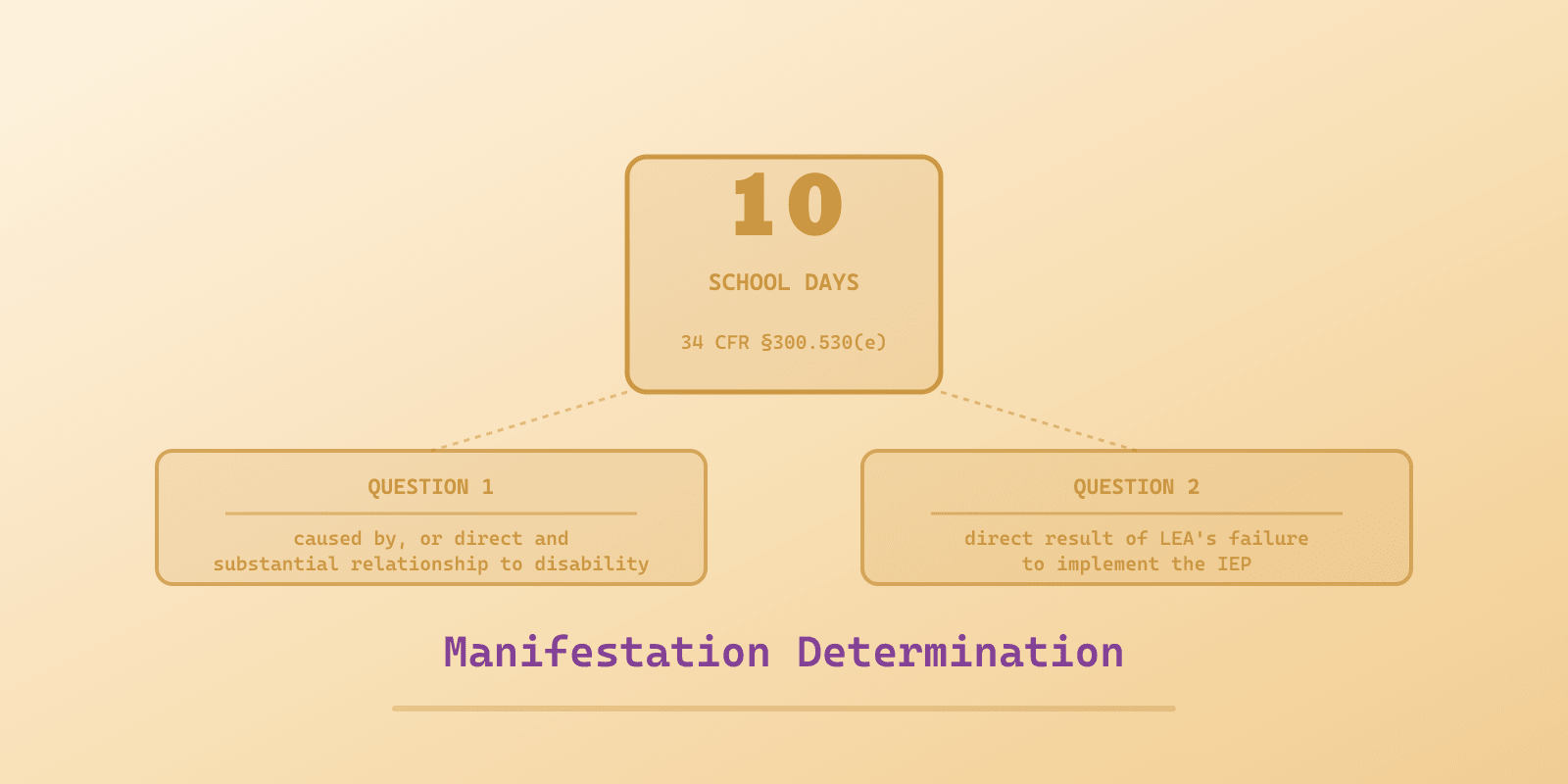
Manifestation Determination for Autism
Manifestation determination is the federal 10-day review that decides whether your autistic child's behavior was caused by their disability before any long suspension or placement change.
Key Takeaways
- When a school proposes to suspend your autistic child for more than 10 school days, federal law requires a manifestation determination review within 10 school days of that decision (34 CFR §300.530(e)).
- The IEP team must decide two questions: was the behavior caused by, or did it have a direct and substantial relationship to, the child's disability, and was the behavior the direct result of the school's failure to implement the IEP.
- If either answer is yes, the school cannot complete the long-term removal. The team must conduct a functional behavior assessment and put a behavior intervention plan in place.
- Parents are equal members of the team. If you disagree with the outcome, you have the right to an expedited due process hearing under IDEA §1415(k).
Manifestation determination is the federal review your child's IEP team must hold within 10 school days when the school proposes to suspend or remove your autistic child for more than 10 school days for the same behavior. The team has to answer two specific questions, and if either answer is yes, the long suspension cannot move forward.
Picture a fifth grader with autism who has a meltdown in the hallway, pushes a teacher, and the principal recommends a 15-day suspension followed by an alternative placement. Because the proposed removal is longer than 10 school days, federal law requires the IEP team to stop and decide whether that behavior was a manifestation of autism before the suspension can stand. If the team finds it was, the suspension above day 10 cannot happen, and the team has to put a behavior plan in place instead.
This guide walks through what the law requires, the two questions the team has to answer, what happens when the answer is yes and when it is no, the three special-circumstance exceptions, and what to do when you disagree with the result.
When Manifestation Determination Is Required
The federal rule lives in 34 CFR §300.530(e). Within 10 school days of any decision to change the placement of a child with a disability because of a violation of a code of student conduct, the LEA, the parent, and relevant members of the IEP team must review all relevant information in the student's file, including the IEP, any teacher observations, and any relevant information provided by the parents.
The trigger is the cumulative length of the removal. A single suspension of more than 10 consecutive school days is a change in placement. A series of shorter suspensions that add up to more than 10 school days in the same school year, where the pattern shows a change in placement (because of the length of each removal, the cumulative amount of time, and the proximity of the removals to one another), is also a change in placement under 34 CFR §300.536. The statute itself, 20 USC §1415(k), sets the same framework.
In plain terms, your child's school cannot quietly stack a series of 3-day and 5-day suspensions and avoid the manifestation review. Once the total crosses 10 school days, the team has to convene.
The 10-School-Day Federal Deadline
The 10-school-day clock starts on the date the school decides to change the placement, not on the date of the incident. The school is required to notify you of that decision and provide you with the procedural safeguards notice on the same day.
The review meeting has to happen within those 10 school days. Weekend days, holidays, and days the school is closed do not count. If your child's school proposes a long suspension on a Monday, and the next two weeks contain a Friday off and a Monday holiday, the meeting still has to be held within the 10 school days that the school is actually in session.
This deadline is not negotiable. Districts that miss it are out of procedural compliance, and missing it is grounds for a state complaint with your state DOE.
The Two Questions the Team Has to Answer
The IEP team's task under 34 CFR §300.530(e)(1) is to answer two questions:
- Was the conduct in question caused by, or did it have a direct and substantial relationship to, the child's disability (34 CFR §300.530(e)(1)(i))?
- Was the conduct in question the direct result of the LEA's failure to implement the IEP (34 CFR §300.530(e)(1)(ii))?
If the answer to either question is yes, the conduct must be determined to be a manifestation of the child's disability under 34 CFR §300.530(e)(2). The team does not need yes answers to both. One is enough.
For autistic children, the first question often comes back yes for behaviors that are classic symptoms of autism (elopement, meltdowns under sensory overload, aggression linked to communication breakdown, self-injurious behavior). If the school has an IEP with specially designed instruction, behavior goals, and accommodations, and the incident happened in a context that the IEP was supposed to address, the second question often comes back yes too.
What the team is supposed to review:
- The current IEP, including any behavior goals and accommodations
- The functional behavior assessment, if one exists
- Any behavior intervention plan in place
- Teacher observations and the discipline incident report
- Relevant information the parents provide (outside evaluations, doctor letters, ABA progress notes)
- Recent evaluations or independent educational evaluations
The team is not supposed to focus narrowly on whether the child knew the rule. The standard is whether the disability was tied to the behavior or whether the school did not deliver the supports the IEP promised.
What Happens When the Behavior Is a Manifestation
When the team finds the behavior was a manifestation, 34 CFR §300.530(f) takes over. The IEP team has to do three things.
First, if a functional behavior assessment was not previously conducted, the team must conduct one and develop a behavior intervention plan. If a BIP was already in place, the team must review the existing plan and modify it as necessary to address the behavior. Functional behavior assessment and BIP development are covered in depth in Spectrum Unlocked's FBA guide and the companion behavior intervention plan walkthrough.
Second, the school must return the child to the placement from which they were removed unless the parent and the LEA agree to a change in placement as part of the modification of the BIP. Stay-put rights kick in.
Third, the long suspension above day 10 does not happen. The school cannot complete the disciplinary removal that triggered the review.
This is the protection IDEA created. A school cannot expel or long-suspend a child for behavior that is part of the disability the IEP exists to address. The relevant rule lives at the intersection of IDEA's discipline procedures and the FAPE guarantee in 20 USC §1415(k). Walking into that review prepared matters, so you can prepare for a disciplinary meeting with the right questions in hand.
What Happens When the Behavior Is Not a Manifestation
If the team finds the behavior was not a manifestation, the school can apply the same discipline it would apply to a non-disabled student under 34 CFR §300.530(c). With one critical floor: even when the behavior is not a manifestation, the child must continue to receive educational services that allow continued progress toward IEP goals during the removal. That requirement lives in 34 CFR §300.530(d).
In practice, this means a long-term suspension or expulsion can proceed, but the school still has to deliver the IEP services in an alternative setting. The team also has to provide, as appropriate, a functional behavior assessment and behavior intervention services and modifications designed to address the behavior so it does not recur (34 CFR §300.530(d)(1)(ii)). The discipline does not erase the IEP.
If you disagree with the not-a-manifestation finding, you have the right to an expedited due process hearing. Hearing rights are covered later in this guide. To put the disagreement on the record in writing before the hearing, the Manifestation Determination disagreement letter template frames the procedural ask with the right federal citations.
The Three Special-Circumstance Exceptions
Federal regulation at 34 CFR §300.530(g) lets school personnel remove a child to an interim alternative educational setting for not more than 45 school days regardless of the manifestation finding, but only in three specific circumstances:
- The child carried a weapon to or possessed a weapon at school, on school premises, or to or at a school function under the jurisdiction of an SEA or LEA
- The child knowingly possessed or used illegal drugs, or sold or solicited the sale of a controlled substance, while at school, on school premises, or at a school function
- The child inflicted serious bodily injury upon another person while at school, on school premises, or at a school function
"Serious bodily injury" is the statutory definition at 18 USC §1365(h)(3): substantial risk of death, extreme physical pain, protracted and obvious disfigurement, or protracted loss or impairment of the function of a bodily member, organ, or mental faculty. This is a high bar. A pushed teacher with a bruise is not serious bodily injury in the federal sense, and many districts apply the term too loosely.
Even in these three cases, the manifestation review still has to happen, the IEP team still has to deliver services that allow continued progress toward IEP goals during the 45-day removal, and the child returns to the previous placement at the end of the 45 days unless a different decision is made through the IEP process.
Your Rights as a Parent
You are a legally equal member of the IEP team during a manifestation determination. The federal rule says the LEA, parent, and relevant members of the IEP team conduct the review, and the parent's input is weighted the same as any other team member's.
Several procedural protections apply at the manifestation determination:
- Written notice of the proposed disciplinary action and the manifestation review date
- A copy of the procedural safeguards notice on the day the disciplinary decision is made
- The right to bring an advocate or attorney to the meeting
- The right to review your child's school records before the meeting
- The right to submit outside evaluations, doctor letters, or other documentation
- Prior written notice of the team's decision under 34 CFR §300.503, which is your Prior Written Notice anchor for any disagreement
If you cannot attend on the proposed date, you have the right to ask for a reschedule within the 10-school-day window. The school cannot proceed without giving you a meaningful opportunity to participate.
If You Disagree With the Outcome
When the team finds the behavior was not a manifestation and you disagree, 20 USC §1415(k)(3) gives you the right to request an expedited due process hearing. Expedited means the hearing must be held within 20 school days of the date the complaint requesting it is filed, and the hearing officer must make a determination within 10 school days after the hearing.
A few practical steps if you decide to challenge the outcome:
- Request the team's written decision in writing, including the data and reasoning the team relied on
- Use the IEP Advocacy Letter Builder to draft a formal disagreement letter to the IEP team and the district special education director
- File a state complaint with your state DOE if the district missed a procedural step (the 10-school-day deadline, the procedural safeguards notice, the parent's right to participate)
- Request an independent educational evaluation if the team relied on outdated or incomplete data
- File for an expedited due process hearing if you intend to contest the manifestation finding itself
Before pursuing due process, consult a special-education attorney or a credentialed parent advocate. The procedural timelines are short, and the stakes (a long removal from the child's educational placement) are high.
Free legal support is available through Parent Training and Information centers in every state (find yours at the Center for Parent Information and Resources) and through state-level disability rights organizations.
If your child's behavior pattern is making suspensions a recurring threat, the longer-term answer is usually a strong behavior intervention plan grounded in a current functional behavior assessment, with clearly defined replacement behaviors. The team can also revisit the least restrictive environment analysis to make sure the placement actually supports the behavioral needs the IEP is supposed to address.
How Manifestation Determination Works in Your State
The federal manifestation determination rule applies in all 50 states. State law and state education agencies add their own procedural detail on top of the federal framework. The state callout below lays out the specific statute or regulation for five high-population states.
Outside those five, the federal rule still governs, and your state DOE will have a discipline policy document that mirrors the federal regulation with whatever local detail applies. The accommodations bank and the IEP goal bank include behavior-related entries the team can pull from when building a BIP after a manifestation finding.
Manifestation determination is one of the most consequential decisions an IEP team makes. Knowing the 10-school-day deadline, the two questions, the three special circumstances, and your procedural rights turns the meeting from something done to your family into something you can shape on the record.
Need help preparing for YOUR next IEP meeting?
Beacon learns about YOUR child and gives guidance specific to them.
What would Beacon say?
"Help me prep for my IEP meeting"
Beacon pulls your child's goals, challenges, and history, then gives you the exact questions to ask, the red flags to watch for, and what to push back on.

Spectrum Unlocked Editorial Team
Editorial Team
The Spectrum Unlocked editorial team combines lived experience as autism parents with research-backed guidance to create resources families can trust.
Frequently asked questions
- What is a manifestation determination meeting?
- A manifestation determination is a meeting the IEP team is required to hold within 10 school days of any decision to suspend or remove your child for more than 10 school days for the same behavior. The team reviews the child's IEP, evaluations, and the incident to decide whether the behavior was a manifestation of the disability (34 CFR §300.530(e)).
- Who attends a manifestation determination?
- The local education agency, the parent, and relevant members of the IEP team chosen by the parent and the school attend the manifestation determination review under 34 CFR §300.530(e)(1). Parents are equal team members. You have the right to bring an advocate or attorney.
- What two questions does the team have to answer?
- Under 34 CFR §300.530(e)(1)(i) and (ii), the team decides whether the conduct in question was caused by, or had a direct and substantial relationship to, the child's disability, and whether the conduct was the direct result of the school's failure to implement the IEP.
- What happens if the behavior is a manifestation of autism?
- If the team finds the behavior was a manifestation, the school must conduct a functional behavior assessment and implement a behavior intervention plan, or review and modify an existing BIP, and return the child to the placement from which they were removed unless the parent and the school agree to a change in placement (34 CFR §300.530(f)).
- Can the school still remove my child to an alternative setting?
- Yes, but only in three specific circumstances under 34 CFR §300.530(g): the child carried a weapon to school, knowingly possessed or used illegal drugs at school, or inflicted serious bodily injury at school. In those cases school personnel may remove the child to an interim alternative educational setting for up to 45 school days, regardless of the manifestation finding.
- What if I disagree with the manifestation determination?
- You have the right to request an expedited due process hearing under IDEA §1415(k)(3). During the hearing, the child remains in the interim alternative educational setting if the school proposed one; otherwise stay-put rights apply. You can also ask the IEP Advocacy Letter Builder to draft a written disagreement letter on the record.