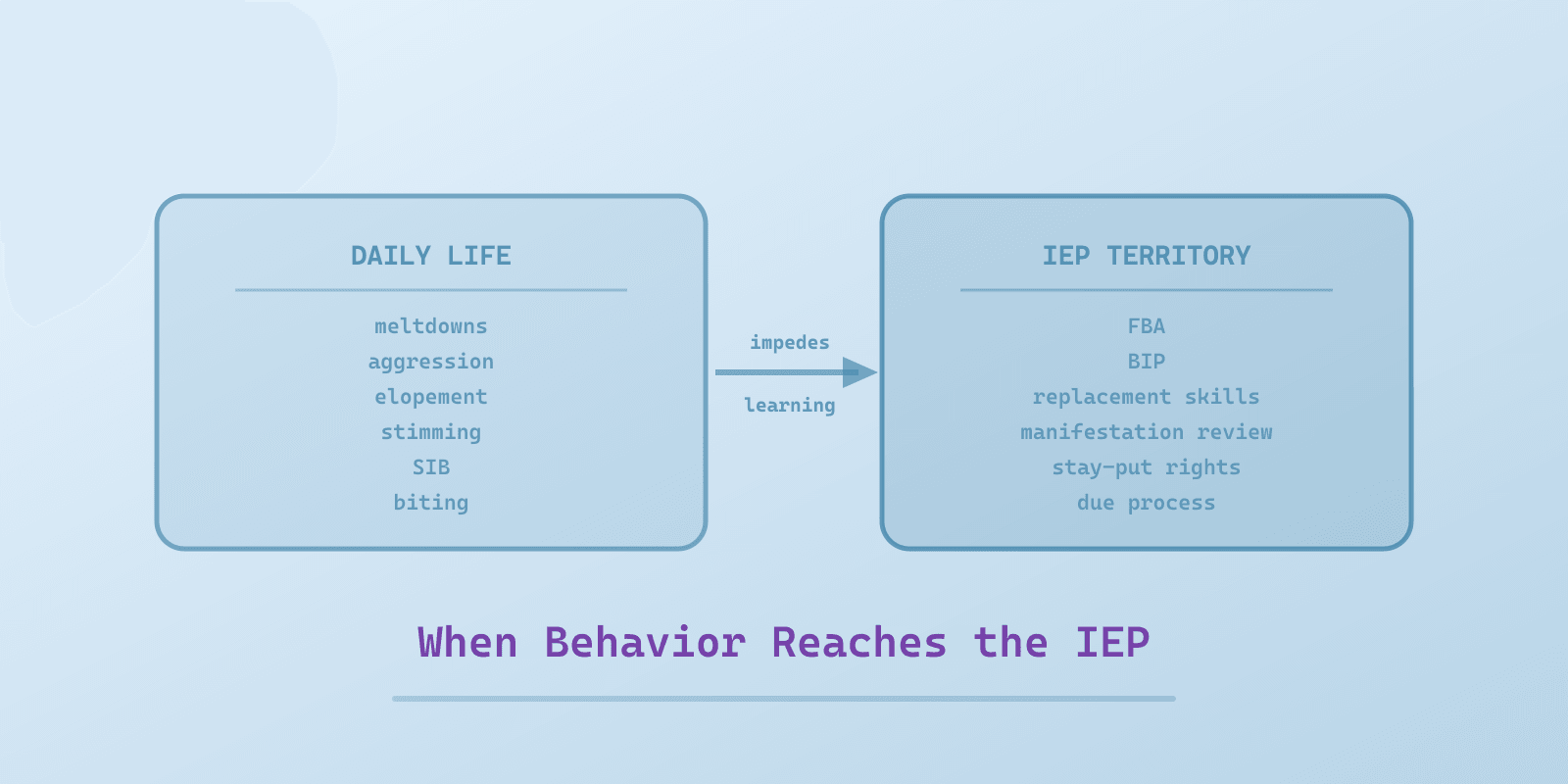
When Autism Behavior Becomes an IEP Issue
Some autism behaviors stay at home; some become school problems. Here is the line where a home behavior pattern turns into something the IEP team has to address, and what you can request when it crosses.
Key Takeaways
- A behavior crosses into IEP territory when it is impeding your child's learning or the learning of others, when it is escalating at school, or when the school is starting to suspend, restrain, or move the placement.
- Once a behavior is impeding learning, federal law requires the IEP team to consider positive behavioral interventions and supports (34 CFR §300.324(a)(2)(i)). That is the bridge from a home pattern to a school plan.
- You can request a functional behavior assessment in writing at any time without waiting for the school to suggest it. The FBA grounds the behavior intervention plan that follows.
- If suspensions are stacking, request a manifestation determination before day 10; this is the federal review that decides whether the behavior was a manifestation of disability.
There is a line where an autism behavior pattern at home turns into something your child's IEP team has to address. Knowing where that line sits, and what to request when your child crosses it, is the difference between waiting for the school to act and putting the issue on the record yourself.
If your autistic child elopes at home, the school may never need to know. If your autistic child elopes at school during transitions, that is now an IEP issue. The legal trigger is whether the behavior is impeding your child's learning or the learning of others, and the practical trigger is usually that the school has started to notice, document, or react to the behavior in a way that affects your child's day.
This guide is the bridge between the daily-life autism behavior posts (aggression, meltdowns, elopement, head-banging, self-injurious behavior, biting, stimming) and the IEP procedure posts on functional behavior assessment, behavior intervention plans, and manifestation determination. It walks through how to recognize when a behavior has crossed, what to request first, and what to escalate to if the school does not respond. If the data side of this work is what stops you (most parents do not arrive at a meeting with a written behavior log), our free autism meltdown tracker is one-tap logging that surfaces the time-of-day and trigger patterns the FBA team will be asking about. If you would rather bring paper, a printable frequency data sheet counts how often the behavior happens each day, and a scatterplot data sheet shades in which periods it clusters so a time-of-day pattern jumps off the page.
The Federal Trigger: When Behavior Is Impeding Learning
The bridge is one regulation. 34 CFR §300.324(a)(2)(i) says that when the IEP team is developing or reviewing an IEP, and the child's behavior impedes the child's learning or that of others, the team must consider the use of positive behavioral interventions and supports and other strategies to address the behavior.
In plain terms, if the behavior is interfering with school, the team has to consider doing something about it. Not consider whether it is a problem. Not consider whether the child should be punished. Consider what supports the IEP can add. That federal mandate is the lever you have when the team is treating the behavior as a discipline issue instead of an IEP issue.
The same lever exists for new IEPs and for revisions to existing IEPs. You do not have to wait for the annual meeting to raise it. A pattern that emerges in October can be addressed in October.
Five Common Patterns Where Behavior Crosses Into IEP Territory
Pattern recognition matters because every school district reacts to behavior differently, but the patterns that trigger IEP action are similar across districts.
Pattern 1: A daily-life behavior starts showing up at school. Your child has stimmed at home for years and now stims so intensely in class that the teacher reports it. Your child has eloped from your house and now leaves the classroom. The behavior itself is not new; what is new is the school context. The IEP team has to consider whether the behavior is impeding learning in the new setting and whether supports can reduce it.
Pattern 2: A school behavior is escalating in frequency or intensity. The teacher reports started as "Maya seemed distracted" and have shifted to "Maya threw materials twice this week." Escalation patterns mean the behavior plan, if any, is not working, or there is no plan at all. Once you see an upward trend in incident reports, the behavior has crossed. To show that trend with numbers rather than adjectives, a rate data sheet converts raw counts into how often the behavior happens per hour so week-to-week comparisons hold up, and a rating-scale sheet captures intensity on a fixed scale when the change you notice is severity rather than count.
Pattern 3: The school is starting to suspend. Even one suspension for a disability-linked behavior is a signal. Suspensions for behaviors that are part of autism (meltdowns, sensory-driven elopement, communication-driven aggression) are the classic case for manifestation determination. Track the days. Once the cumulative suspensions for the same behavior cross 10 school days in a school year, the school has triggered a change in placement. At that point you can request a manifestation determination in writing so the review happens before any further removal.
Pattern 4: The school is talking about restraint or seclusion. Any incident where the school physically restrained your child or placed them in a seclusion room is a serious signal. State law varies on what is permitted, but in every state, restraint or seclusion of an autistic child without a functional behavior assessment and behavior intervention plan is grounds for an immediate IEP team meeting and, often, a state complaint.
Pattern 5: The school is proposing a more restrictive placement. When the IEP team starts suggesting a special class, a separate school, or homebound instruction primarily because of behavior, you are at the placement-change moment. The least restrictive environment rule says the team has to document why less restrictive options will not work, and supplementary aids and behavioral supports are supposed to be considered before a more restrictive placement is approved.
What to Request First
Once you see the pattern, the first request is usually a functional behavior assessment. The FBA grounds everything that follows. Without it, any behavior plan the school writes is a guess.
Request the FBA in writing. Put it on the record by asking the team for a meeting in writing so there is a dated paper trail of the request. The request can be short:
Date [Case manager], [Special education director], [Principal]
Re: Functional Behavior Assessment request, [Child's name], [Grade], [School]
I am writing to request a functional behavior assessment for [Child]. Specific behaviors of concern: [behavior 1, behavior 2]. Recent incidents: [dates and contexts]. The behavior is impeding [Child's] learning under 34 CFR §300.324(a)(2)(i). Please respond with prior written notice within a reasonable time.
[Parent signature]
The school's response options under 34 CFR §300.503 are to agree and seek consent, or to deny in writing with reasons. If they deny, you can request an independent educational evaluation that includes an FBA.
The Behavior & Discipline letter template is a ready-to-send version of this request with the federal citations pre-filled. The IEP Advocacy Letter Builder is the full AI version when you need a custom draft.
What to Bring to the Table
Parent observation is one of the strongest data sources the IEP team has, and it is often the source the school relies on least. Bring the patterns you see at home and in the community to the meeting:
- Times of day when the behavior is most likely (early morning, post-school, late evening)
- Triggers you can identify (transitions, sensory overload, hunger, lack of sleep, social demands, unstructured time)
- Setting events from outside school (a poor night's sleep, a missed meal, a stressful weekend)
- What works at home to defuse or redirect the behavior
- What replacement behaviors your child already uses (asking for a break, going to a quiet space, using AAC)
This information is the input the school's behavior team often does not have. A teacher seeing the behavior at 1:45pm may not know that the child slept poorly and missed breakfast, and that pattern is the strongest predictor of the 2pm meltdown. If the school is unsure how quickly the behavior follows a demand, a latency data sheet times the gap between the instruction and the response, which often tells the team whether the trigger is the task itself or the transition into it.
For each Daily Life behavior, our guides cover the home-side strategies that often translate to school. Autism aggression, aggression triggers, biting, elopement, elopement prevention, head-banging, meltdown vs tantrum, self-injurious behavior, stimming, and public meltdowns each include patterns the IEP team can use as input.
Escalation: When the School Does Not Respond
If the school does not respond to the FBA request, or denies it without reasons, the escalation steps are familiar:
- Request an IEP team meeting to discuss behavior. The team is required to hold one when the parent requests it.
- File a state complaint with your state DOE under 34 CFR §300.151. State complaints trigger a formal investigation of whether the district followed federal procedure. They are free and do not require an attorney.
- Request mediation, which is voluntary, free, and often faster than a hearing.
- File for a due process hearing under 34 CFR §300.507 if the dispute centers on a denial of FAPE.
A special-education attorney or a credentialed parent advocate can be invaluable at the escalation stage. Free legal help is available through Parent Training and Information centers in every state (find yours at the Center for Parent Information and Resources).
After the FBA: BIP, Replacement Behaviors, and Tracking
The FBA produces a written report identifying the function of the behavior. The next step is the behavior intervention plan, which translates the FBA findings into specific staff actions. A real BIP names the antecedent strategies, the replacement behaviors at school the team is teaching, the consequence strategies, the data collection plan, and the review schedule. If the plan runs on a daily point card, a check-in check-out point sheet scores each period against the target and a token tracker sheet logs what the student earned, while an FBA-BIP tracking sheet keeps the function, the replacement, and the fidelity check on a single page the team can pull at each review.
Once the BIP is implemented, the team should be reviewing data on a known cadence (30-day, 60-day, quarterly) and revising the plan when data shows it is not working. Parents have the right to BIP implementation data and to request a review meeting at any time.
If the behavior keeps escalating to suspensions, the manifestation determination review is the federal protection that decides whether the long suspension can stand. The team has to convene the manifestation review within 10 school days of any decision to remove your child for more than 10 school days for the same behavior.
What Crossing the Line Actually Looks Like
The single clearest way to know your child's behavior has crossed into IEP territory: the school has started to act on it. They are reporting incidents, holding informal conversations, issuing warnings, sending the child to the office, sending the child home, or proposing a placement change. Each of those steps is the school treating the behavior as a school issue. Federal law treats that same behavior as an IEP issue, and the team has tools (FBA, BIP, replacement teaching, antecedent supports) to address it.
If you are unsure where the line is for your child, the safest move is to write the FBA request letter anyway. The school's response will tell you whether the team sees the behavior as a school issue. If they agree to the FBA, you have momentum. If they deny, you have a written record and the right to an independent evaluation. Either way, you have put the issue on the record, and the IEP team is now obligated to engage with it.
The accommodations bank carries a behavior-supports filter the team can pull from when listing antecedent strategies in the BIP, and the IEP goal bank carries example behavior goals you can use as a starting point during the meeting.
Crossing the line from a home behavior to an IEP issue is not a setback. It is the point at which the school's resources become available to address what your family has been managing alone. Knowing the patterns to watch for, the federal triggers, and the requests that put the issue on the record turns the conversation from "the school is not helping" into "the IEP team is now responsible for this, and here is the data we are starting with."
Need help preparing for YOUR next IEP meeting?
Beacon learns about YOUR child and gives guidance specific to them.
What would Beacon say?
"Help me prep for my IEP meeting"
Beacon pulls your child's goals, challenges, and history, then gives you the exact questions to ask, the red flags to watch for, and what to push back on.

Spectrum Unlocked Editorial Team
Editorial Team
The Spectrum Unlocked editorial team combines lived experience as autism parents with research-backed guidance to create resources families can trust.
Frequently asked questions
- When does a behavior at home become a school problem the IEP has to address?
- When the behavior shows up at school and impedes your child's learning or the learning of others, the IEP team has a federal obligation to consider positive behavioral interventions and supports under 34 CFR §300.324(a)(2)(i). Behaviors that stay home and do not affect school performance generally do not trigger the IEP.
- Should I tell the school about home behaviors my child does not do at school?
- Yes, if those behaviors are part of a pattern that might emerge at school or are setting events for behaviors the school does see. Sharing the pattern at home gives the IEP team a fuller picture for the FBA and BIP. It also helps the team understand what a real baseline looks like.
- How do I escalate when the school is not taking the behavior seriously?
- Put it in writing. Request a functional behavior assessment in a written letter, request an IEP team meeting to discuss the behavior, and document specific incidents with dates and contexts. The IEP Advocacy Letter Builder can format the request with the relevant federal citations.
- Does a 504 plan cover behavior the same way an IEP does?
- A 504 plan provides accommodations but does not carry the IDEA-specific behavior protections like manifestation determination or the FBA / BIP framework. If behavior is significant, an IEP under IDEA is generally the stronger framework. Our IEP vs 504 plan comparison covers the practical differences.
- What if my child is being suspended repeatedly?
- Track the days. If suspensions for the same behavior cross 10 school days in a school year, the school has triggered a change in placement and must hold a manifestation determination. Even before day 10, you can request an FBA and a BIP without waiting for the discipline to escalate further.