Standard annual IEP review
When to use: Use when you are walking into your child's regular yearly IEP review. The team will look back at progress on current goals, propose new goals and services, and finalize the IEP for the upcoming year.
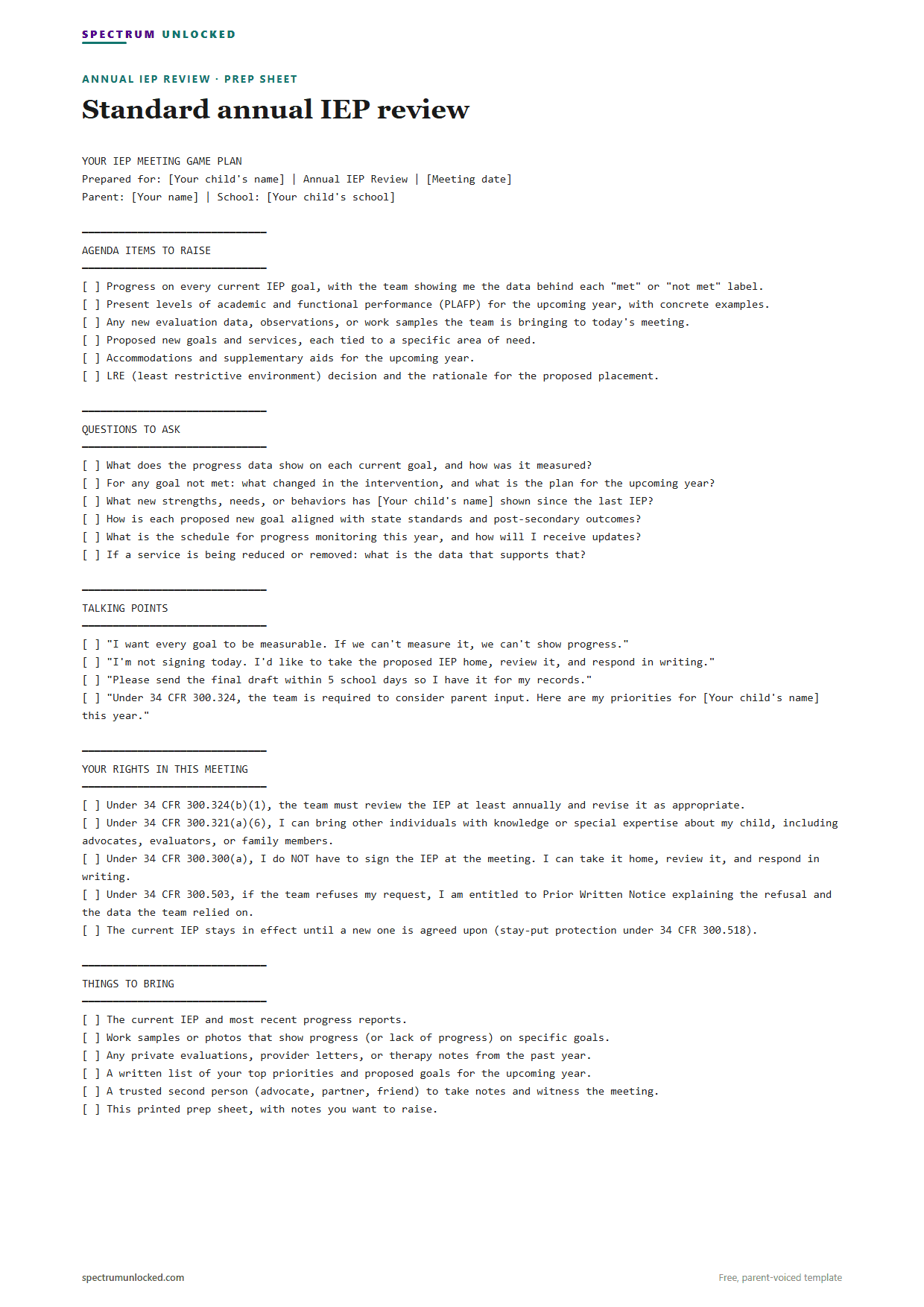
YOUR IEP MEETING GAME PLAN
Prepared for: [Your child's name] | Annual IEP Review | [Meeting date]
Parent: [Your name] | School: [Your child's school]
AGENDA ITEMS TO RAISE
- Progress on every current IEP goal, with the team showing me the data behind each "met" or "not met" label.
- Present levels of academic and functional performance (PLAFP) for the upcoming year, with concrete examples.
- Any new evaluation data, observations, or work samples the team is bringing to today's meeting.
- Proposed new goals and services, each tied to a specific area of need.
- Accommodations and supplementary aids for the upcoming year.
- LRE (least restrictive environment) decision and the rationale for the proposed placement.
QUESTIONS TO ASK
- What does the progress data show on each current goal, and how was it measured?
- For any goal not met: what changed in the intervention, and what is the plan for the upcoming year?
- What new strengths, needs, or behaviors has [Your child's name] shown since the last IEP?
- How is each proposed new goal aligned with state standards and post-secondary outcomes?
- What is the schedule for progress monitoring this year, and how will I receive updates?
- If a service is being reduced or removed: what is the data that supports that?
TALKING POINTS
- "I want every goal to be measurable. If we can't measure it, we can't show progress."
- "I'm not signing today. I'd like to take the proposed IEP home, review it, and respond in writing."
- "Please send the final draft within 5 school days so I have it for my records."
- "Under 34 CFR 300.324, the team is required to consider parent input. Here are my priorities for [Your child's name] this year."
YOUR RIGHTS IN THIS MEETING
- Under 34 CFR 300.324(b)(1), the team must review the IEP at least annually and revise it as appropriate.
- Under 34 CFR 300.321(a)(6), I can bring other individuals with knowledge or special expertise about my child, including advocates, evaluators, or family members.
- Under 34 CFR 300.300(a), I do NOT have to sign the IEP at the meeting. I can take it home, review it, and respond in writing.
- Under 34 CFR 300.503, if the team refuses my request, I am entitled to Prior Written Notice explaining the refusal and the data the team relied on.
- The current IEP stays in effect until a new one is agreed upon (stay-put protection under 34 CFR 300.518).
THINGS TO BRING
- The current IEP and most recent progress reports.
- Work samples or photos that show progress (or lack of progress) on specific goals.
- Any private evaluations, provider letters, or therapy notes from the past year.
- A written list of your top priorities and proposed goals for the upcoming year.
- A trusted second person (advocate, partner, friend) to take notes and witness the meeting.
- This printed prep sheet, with notes you want to raise.
Customize this prep sheet for your situation
Tell us what's different about your meeting and the prep sheet will rewrite to match. A few sentences is plenty:
- What is the school proposing or refusing?
- What is your top concern walking in?
- What outcome do you want to leave with?
20 more characters to enable Customize0 / 2000