Early transition planning (age 14)
When to use: Use when your child is 14 or about to turn 14 and you are pushing for transition planning to start before the federal age-16 floor. Many states and adult-outcome data support starting earlier.
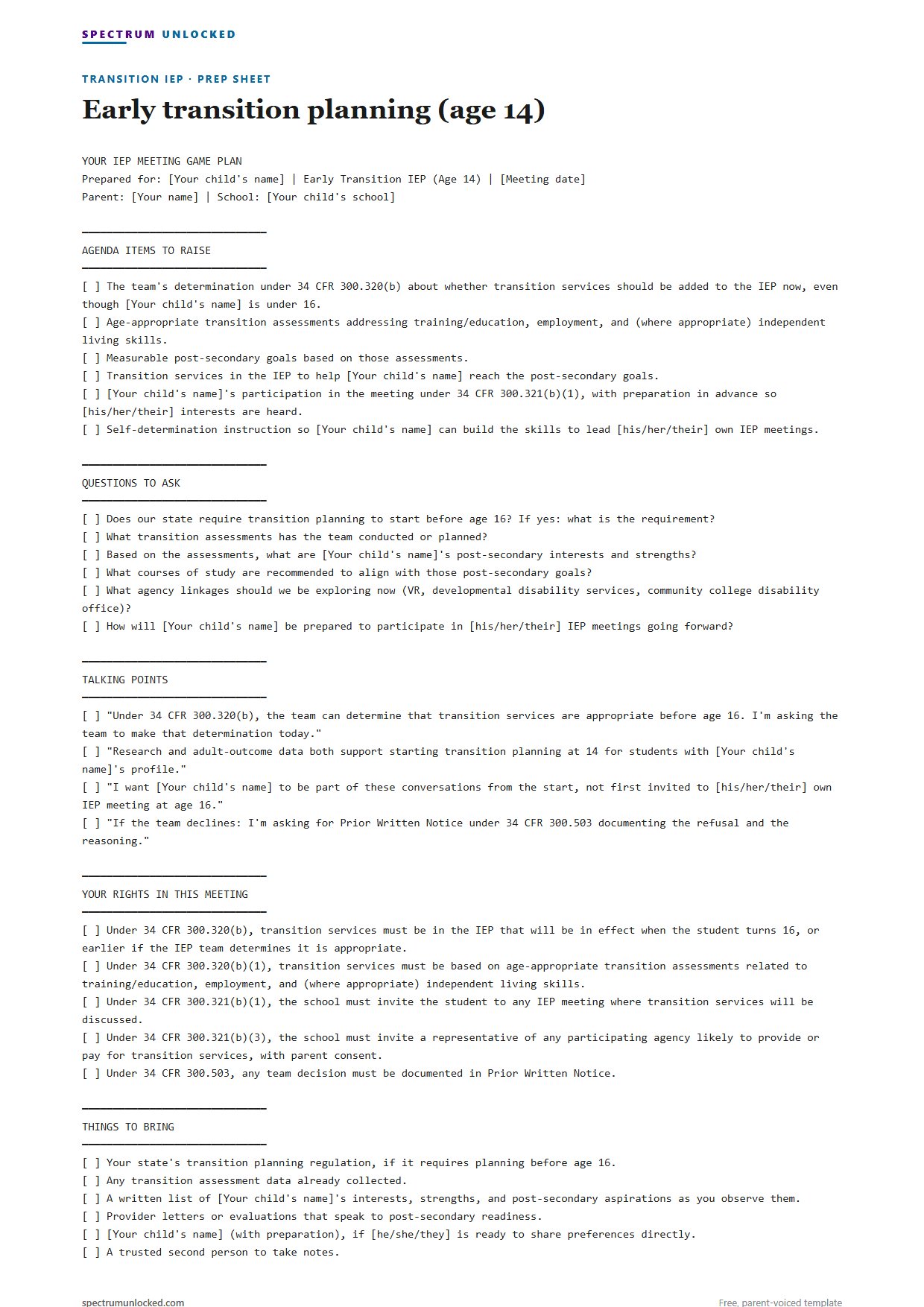
YOUR IEP MEETING GAME PLAN
Prepared for: [Your child's name] | Early Transition IEP (Age 14) | [Meeting date]
Parent: [Your name] | School: [Your child's school]
AGENDA ITEMS TO RAISE
- The team's determination under 34 CFR 300.320(b) about whether transition services should be added to the IEP now, even though [Your child's name] is under 16.
- Age-appropriate transition assessments addressing training/education, employment, and (where appropriate) independent living skills.
- Measurable post-secondary goals based on those assessments.
- Transition services in the IEP to help [Your child's name] reach the post-secondary goals.
- [Your child's name]'s participation in the meeting under 34 CFR 300.321(b)(1), with preparation in advance so [his/her/their] interests are heard.
- Self-determination instruction so [Your child's name] can build the skills to lead [his/her/their] own IEP meetings.
QUESTIONS TO ASK
- Does our state require transition planning to start before age 16? If yes: what is the requirement?
- What transition assessments has the team conducted or planned?
- Based on the assessments, what are [Your child's name]'s post-secondary interests and strengths?
- What courses of study are recommended to align with those post-secondary goals?
- What agency linkages should we be exploring now (VR, developmental disability services, community college disability office)?
- How will [Your child's name] be prepared to participate in [his/her/their] IEP meetings going forward?
TALKING POINTS
- "Under 34 CFR 300.320(b), the team can determine that transition services are appropriate before age 16. I'm asking the team to make that determination today."
- "Research and adult-outcome data both support starting transition planning at 14 for students with [Your child's name]'s profile."
- "I want [Your child's name] to be part of these conversations from the start, not first invited to [his/her/their] own IEP meeting at age 16."
- "If the team declines: I'm asking for Prior Written Notice under 34 CFR 300.503 documenting the refusal and the reasoning."
YOUR RIGHTS IN THIS MEETING
- Under 34 CFR 300.320(b), transition services must be in the IEP that will be in effect when the student turns 16, or earlier if the IEP team determines it is appropriate.
- Under 34 CFR 300.320(b)(1), transition services must be based on age-appropriate transition assessments related to training/education, employment, and (where appropriate) independent living skills.
- Under 34 CFR 300.321(b)(1), the school must invite the student to any IEP meeting where transition services will be discussed.
- Under 34 CFR 300.321(b)(3), the school must invite a representative of any participating agency likely to provide or pay for transition services, with parent consent.
- Under 34 CFR 300.503, any team decision must be documented in Prior Written Notice.
THINGS TO BRING
- Your state's transition planning regulation, if it requires planning before age 16.
- Any transition assessment data already collected.
- A written list of [Your child's name]'s interests, strengths, and post-secondary aspirations as you observe them.
- Provider letters or evaluations that speak to post-secondary readiness.
- [Your child's name] (with preparation), if [he/she/they] is ready to share preferences directly.
- A trusted second person to take notes.
Customize this prep sheet for your situation
Tell us what's different about your meeting and the prep sheet will rewrite to match. A few sentences is plenty:
- What is the school proposing or refusing?
- What is your top concern walking in?
- What outcome do you want to leave with?
20 more characters to enable Customize0 / 2000