Facilitated IEP meeting
When to use: Use when you are walking into a facilitated IEP meeting with a neutral state-trained facilitator because parent and school have not reached agreement and want a structured approach before escalating.
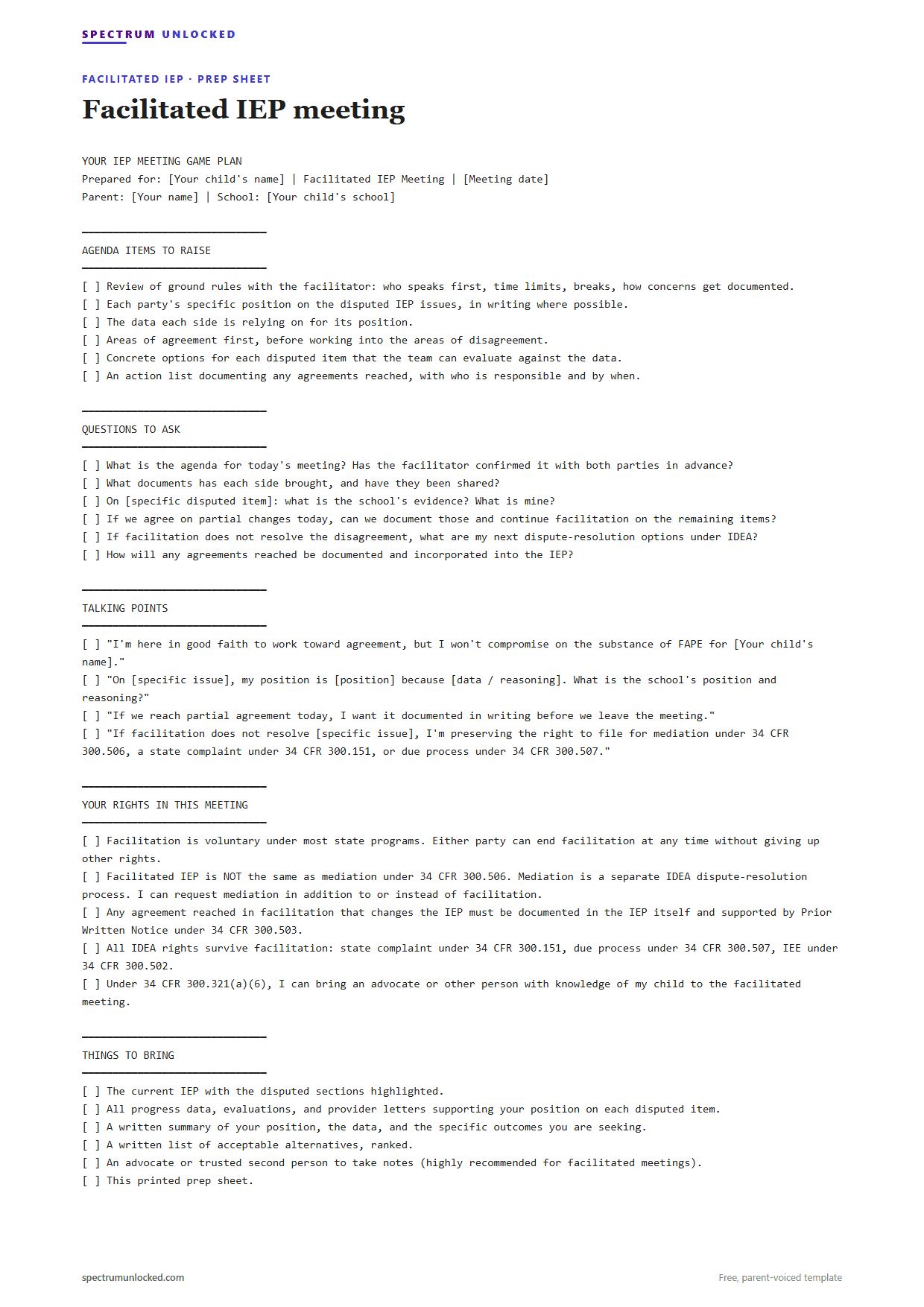
YOUR IEP MEETING GAME PLAN
Prepared for: [Your child's name] | Facilitated IEP Meeting | [Meeting date]
Parent: [Your name] | School: [Your child's school]
AGENDA ITEMS TO RAISE
- Review of ground rules with the facilitator: who speaks first, time limits, breaks, how concerns get documented.
- Each party's specific position on the disputed IEP issues, in writing where possible.
- The data each side is relying on for its position.
- Areas of agreement first, before working into the areas of disagreement.
- Concrete options for each disputed item that the team can evaluate against the data.
- An action list documenting any agreements reached, with who is responsible and by when.
QUESTIONS TO ASK
- What is the agenda for today's meeting? Has the facilitator confirmed it with both parties in advance?
- What documents has each side brought, and have they been shared?
- On [specific disputed item]: what is the school's evidence? What is mine?
- If we agree on partial changes today, can we document those and continue facilitation on the remaining items?
- If facilitation does not resolve the disagreement, what are my next dispute-resolution options under IDEA?
- How will any agreements reached be documented and incorporated into the IEP?
TALKING POINTS
- "I'm here in good faith to work toward agreement, but I won't compromise on the substance of FAPE for [Your child's name]."
- "On [specific issue], my position is [position] because [data / reasoning]. What is the school's position and reasoning?"
- "If we reach partial agreement today, I want it documented in writing before we leave the meeting."
- "If facilitation does not resolve [specific issue], I'm preserving the right to file for mediation under 34 CFR 300.506, a state complaint under 34 CFR 300.151, or due process under 34 CFR 300.507."
YOUR RIGHTS IN THIS MEETING
- Facilitation is voluntary under most state programs. Either party can end facilitation at any time without giving up other rights.
- Facilitated IEP is NOT the same as mediation under 34 CFR 300.506. Mediation is a separate IDEA dispute-resolution process. I can request mediation in addition to or instead of facilitation.
- Any agreement reached in facilitation that changes the IEP must be documented in the IEP itself and supported by Prior Written Notice under 34 CFR 300.503.
- All IDEA rights survive facilitation: state complaint under 34 CFR 300.151, due process under 34 CFR 300.507, IEE under 34 CFR 300.502.
- Under 34 CFR 300.321(a)(6), I can bring an advocate or other person with knowledge of my child to the facilitated meeting.
THINGS TO BRING
- The current IEP with the disputed sections highlighted.
- All progress data, evaluations, and provider letters supporting your position on each disputed item.
- A written summary of your position, the data, and the specific outcomes you are seeking.
- A written list of acceptable alternatives, ranked.
- An advocate or trusted second person to take notes (highly recommended for facilitated meetings).
- This printed prep sheet.
Customize this prep sheet for your situation
Tell us what's different about your meeting and the prep sheet will rewrite to match. A few sentences is plenty:
- What is the school proposing or refusing?
- What is your top concern walking in?
- What outcome do you want to leave with?
20 more characters to enable Customize0 / 2000