ABA vs Speech vs OT: Which Therapy Should Come First?
You can't start everything at once. How to sequence ABA, speech therapy, and OT for your autistic child based on their biggest barrier, their age, and what you can actually access right now.
Key Takeaways
- There is no universally correct first therapy. Sequence by your child's biggest daily-life barrier: communication barrier means speech-led, sensory and daily-living barriers mean OT-led, and safety behaviors or broad skill-building needs mean ABA-led, with the others layered in as capacity allows.
- Chronologically, free services come first regardless of which therapy leads. Early intervention (under 3) and school district services (3 and older) have no fee and shorter timelines than most private waitlists, and starting them costs you nothing while you wait.
- Get on every waitlist the same week. Choosing which therapy comes first does not mean applying sequentially; private waitlists run months long, so apply everywhere and decide what leads when offers actually arrive.
- Not every autistic child needs every therapy, and some families reasonably skip ABA entirely. The right mix depends on your child's profile and your family's values, not on what the nearest provider happens to sell.
- Re-sequence as your child changes. The therapy that leads at 3 is often not the one that should lead at 6; barriers shift, and the plan should follow the child.
Every newly diagnosed family hits the same wall: the evaluator says "ABA, speech therapy, and OT," hands you a packet, and leaves you to figure out what order any of that happens in. You can't start everything at once. Waitlists, money, and your child's stamina all say no.
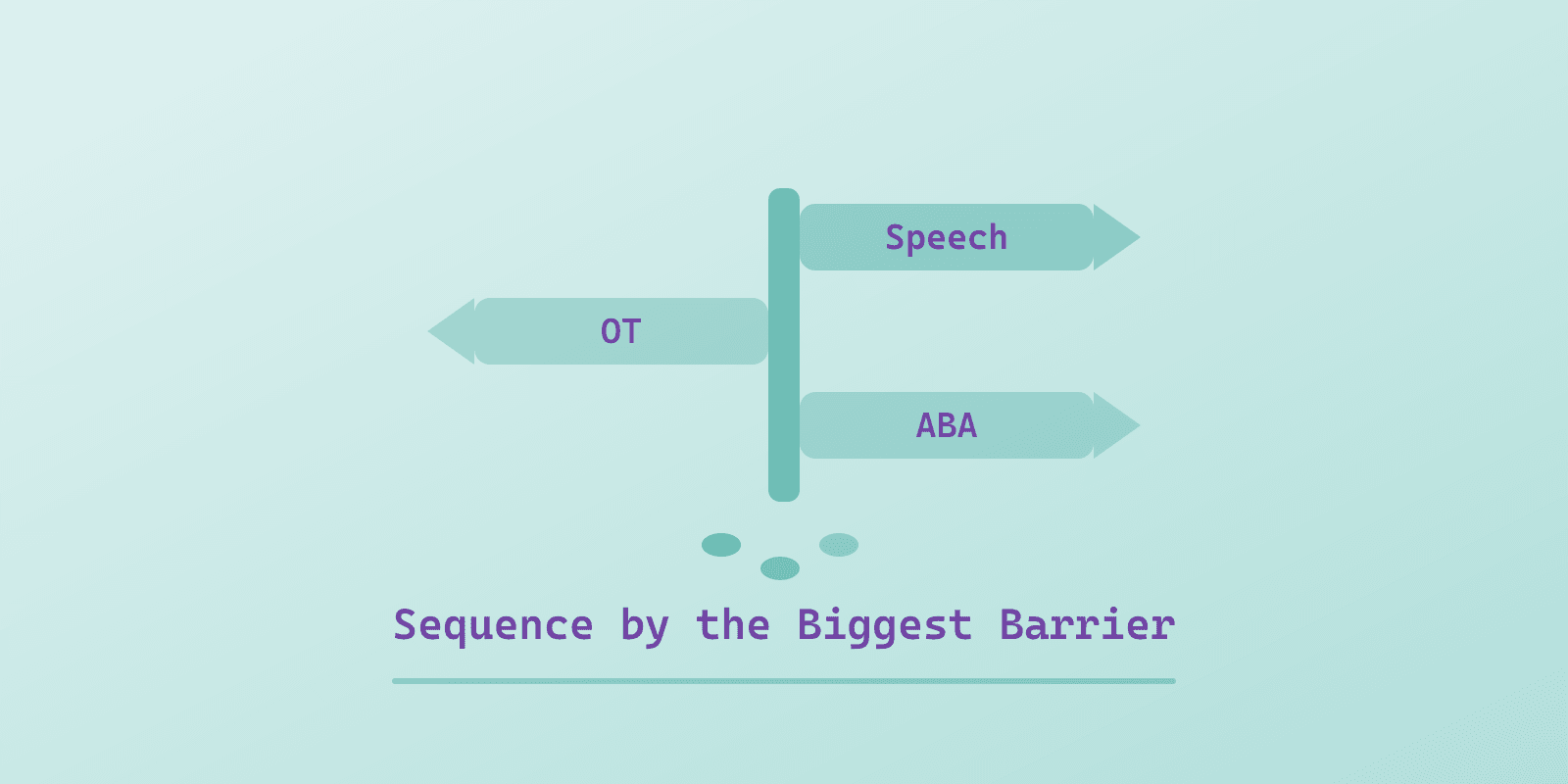
The honest answer to "which comes first": there is no universal first. You sequence by your child's biggest daily-life barrier, and you let the free services start while the private waitlists run. We don't sell therapy, so this guide has no horse in the race. Here's the framework:
| Your child's biggest barrier right now | What leads | What that looks like |
|---|---|---|
| No reliable way to communicate wants and needs | Speech therapy (with AAC on the table) | SLP evaluation that considers devices, signs, and pictures alongside speech |
| Sensory overload, motor skills, feeding, daily living (dressing, sleep, toileting mechanics) | Occupational therapy | Sensory profile work, regulation strategies, daily-living skill building |
| Safety behaviors (elopement, self-injury, aggression) or broad skill gaps across settings | ABA, from a neurodiversity-affirming provider | Functional assessment first, then targeted skill-building hours |
| You're not sure what the barrier is | Free evaluations first | Early intervention (under 3) or school district evaluation (3+), both free, both produce a written picture |
Whichever row fits, the chronological order is usually the same:
- Request the free evaluations this week. Early intervention if your child is under 3, a written school district evaluation request if they're 3 or older. No fee, legally mandated timelines, and services can start while everything else is pending.
- Get on every private waitlist at the same time. Months-long waits mean you apply broadly now and decide what leads when offers arrive. Spectrum Unlocked's waitlist survival guide covers what to do in the gap.
- Anchor the schedule with the lead therapy, layer the rest. One therapy carries the priority goal; the others run at maintenance intensity until the lead barrier moves.
Why "Which Is Best" Is the Wrong Question
ABA, speech, and OT aren't competing answers to the same problem. They target different problems: speech-language therapy targets communication (spoken or AAC), OT targets sensory regulation, motor skills, and daily living, and ABA targets behavior and skill acquisition. Asking which is best is like asking whether glasses are better than a hearing aid. The real question is which of your child's barriers is doing the most daily damage, and the therapy types guide covers what each discipline actually does, what it costs, and the red flags that apply to any provider.
What makes this confusing for parents is that the marketing volume is wildly uneven. ABA providers dominate autism services advertising because insurance mandates made it a funded industry, so "your child needs 30 hours of ABA" is often the first and loudest recommendation a family hears, sometimes before anyone has asked what the child's actual barriers are. Sometimes that recommendation is right. The point of a sequencing framework is that it gets decided by your child's profile, not by whoever called you back first.
The Sequencing Framework, Expanded
Communication barrier leads: speech-led plan. If your child can't reliably make wants and needs known, that barrier feeds everything else. A child who can't ask for a break doesn't get breaks; a child who can't refuse gets pushed past tolerance, and the resulting behavior then gets labeled the problem. A speech-led plan starts with an SLP evaluation where AAC is explicitly on the table from day one, not held back as a last resort. If you're still untangling whether the speech picture is a delay or part of autism, the autism vs speech delay guide walks the differentiators. If your child talks but people outside the family struggle to understand them, the chart of phonological processes shows which sound patterns are still typical at their age.
Sensory and daily-living barriers lead: OT-led plan. If meltdowns track sensory overload, if clothing and food and sound are daily wars, or if motor skills block independence (dressing, utensils, toileting mechanics), OT leads. Mapping your child's sensory profile first makes every other therapy hour more productive, because a dysregulated child can't learn much in any discipline. And an OT-led plan doesn't have to idle while you wait for the referral: the free occupational therapy activities hub collects OT-informed fine motor practice, visual routines, and goal-tracking sheets a family can start using the same day.
Safety and broad skill gaps lead: ABA-led plan. Elopement, self-injury, aggression, or skill gaps wide enough to block daily functioning are where a behavioral approach earns its place, starting with a functional assessment of what the behavior is communicating. Quality varies enormously between providers; insist on one that targets skills your child benefits from and treats assent seriously. Quality also shows up in the data a program keeps. A good one does not just bill hours, it measures whether skills are actually moving: breaking a multi-step routine onto a task-analysis data sheet, scoring discrete targets on a trial-by-trial data sheet, and recording how much help each try still needs on a prompt-level data sheet. It should also confirm that a mastered skill holds up outside the therapy room with a generalization probe sheet, and score problem behavior with time-sampling on an interval recording sheet rather than a gut feeling. To see the formats before you ask a provider how they track progress, the free data sheet maker builds each one to print, and the data sheet template gallery shows all of them side by side.
Age matters at the margins. Under 3, early intervention blurs the lines anyway: EI providers deliver a blended developmental approach, which is part of why starting EI beats agonizing over the perfect private sequence. School-age, the school district itself becomes a service provider through the IEP (speech and OT can be written in as related services), which changes the math on what you buy privately.
The Free-First Rule
Whatever leads clinically, free services lead chronologically, because they cost nothing to start and the waitlists are usually shorter than private ones:
- Under 3: your state's early intervention program evaluates for free and provides services regardless of diagnosis status. The early intervention guide covers the process, and if EI says no, appeal it.
- 3 and older: the school district must evaluate on written request, and an IEP can deliver speech and OT during the school day at no cost. If you want to see what a school session actually looks like from the inside, this speech therapy lesson plan template is a finished articulation session, timed step by step, with the trial record the SLP scores as they go. Many children in speech therapy are working on a pattern rather than one sound, like stopping ("tun" for "sun") or velar fronting ("tup" for "cup"); each page has free picture pairs, and the stopping worksheets and fronting worksheets send every pair home. The home half of that same work is a word list on the fridge: the free S words for speech therapy page has lists by position with a printable practice sheet for each. S and Z share a tongue position, so a child working on one is often working on both, and the Z sound pack runs S and Z word pairs through to sentences. If what you hear is a lisp rather than a missing sound, read how to fix a lisp before buying anything: some lisps fade and some need an SLP straight away.
- Any age: state Medicaid waivers and autism insurance mandates change what "we can't afford it" actually means; check your state's benefits before ruling anything out.
While you wait on any of these, the printable side costs nothing either. The ABA therapy resources hub collects the data sheets, token boards and visual supports an ABA team would use, and the speech therapy worksheets and occupational therapy activities hubs do the same for the other two lanes. Whichever therapy leads, ask the provider what they send home after a parent training session: ABA parent training handouts covers what that should look like, and why a verbal explanation alone rarely survives the week.
Overload Is a Real Failure Mode
The most common sequencing mistake isn't picking the wrong first therapy; it's stacking everything at once on a small child. A 4 year old doing 25 ABA hours plus weekly speech plus weekly OT plus preschool is working a longer week than most adults, and the signs it's too much (sleep falling apart, meltdowns climbing, stable skills regressing) get misread as "needs more therapy." Build up gradually, hold one variable at a time steady, and treat "fewer hours, better tolerated" as the clinical win it is.
And whatever the mix, require coordination. Providers who never talk produce a child practicing one skill three contradictory ways. A shared priority list across providers (even one you write yourself and email to everyone) is the cheapest therapy upgrade available.
The Bottom Line
Pick the lead therapy by the biggest daily barrier: communication means speech-led, sensory and daily living mean OT-led, safety and broad skill gaps mean ABA-led. Start the free evaluations this week regardless, join every waitlist at once, layer therapies gradually, and re-sequence as your child changes. The plan should follow the child. For what each therapy actually involves session to session, see the full therapy types guide; for surviving the months before anything starts, the waitlist guide is the companion piece.
Which therapy first? That depends entirely on your child.
Beacon learns about YOUR child and gives guidance specific to them.
What Would Beacon Say?
"Which therapy should we start first?"
Beacon weighs your child's age, biggest challenges, and your insurance reality, then tells you what to prioritize instead of starting everything at once.

Spectrum Unlocked Editorial Team
Editorial Team
The Spectrum Unlocked editorial team combines lived experience as autism parents with research-backed guidance to create resources families can trust.
Frequently Asked Questions
- Should we start ABA or speech therapy first?
- Lead with the bigger daily barrier. If your child has no reliable way to communicate wants and needs (spoken, signed, or AAC), communication is almost always the priority, because frustration from being unable to communicate drives many of the behaviors other therapies then have to address. If safety behaviors like elopement or self-injury are the dominant daily problem, a behavioral approach typically leads. In practice many families run both in parallel at different intensities; the question is which one anchors the schedule, not which one exists.
- Can my child do ABA, speech, and OT at the same time?
- Yes, and a 2-to-3-therapy combination is the most common setup. The practical limits are scheduling, cost, and your child's tolerance: a young child in 25 hours of ABA plus weekly speech and OT sessions is working a longer week than many adults. Watch for overload (sleep changes, more meltdowns, regression in skills that were stable) and remember that cutting hours is a legitimate clinical decision, not a failure. Providers should coordinate goals with each other, and you can require that they do.
- Which therapy should come first for a nonverbal 3 year old?
- Communication access first, in whatever form works. For a 3 year old without reliable spoken language, that usually means a speech-language pathologist evaluation that explicitly considers AAC alongside speech, because giving the child some way to communicate now (device, signs, pictures) reduces frustration across every other setting. School district services begin at age 3 and can provide speech therapy for free through an IEP. Whether ABA also belongs in the picture depends on what else is on the list: safety issues and broad skill gaps push it up, and its absence of communication progress alone does not.
- Does my autistic child need ABA at all?
- Not necessarily. ABA is the most heavily marketed autism therapy and the one insurers cover most readily, but need depends on your child's profile. Families commonly prioritize it when safety behaviors, severe skill gaps, or toileting and daily-living targets dominate. Families reasonably skip or limit it when their child's main needs are communication or sensory regulation, or when the local provider quality is poor. If you do use ABA, modern neurodiversity-affirming practice focuses on skills the child benefits from, not on making the child look less autistic; our therapy types guide covers the red flags to watch for in any provider.
- What should we do first if everything has a waitlist?
- Three moves in the same week: request an early intervention evaluation (under 3) or a written school district evaluation (3 and older), both free and legally mandated; get on every private waitlist for the therapies on your list, since you can decline an offer that arrives at the wrong time; and start the parent-side work that has no waitlist, like visual supports at home and learning your child's sensory profile. Waitlists are a sequencing reality, not a sequencing strategy; the order you apply in should not be the order you would ideally start in.
- What if we can only afford one therapy?
- First, make sure that's actually the constraint: early intervention and school services are free, state autism insurance mandates cover ABA in most states, and Medicaid waivers in many states cover therapies regardless of parent income. If one private therapy is genuinely the limit, buy the one targeting your child's biggest daily barrier, and ask that provider for a home program so practice continues between sessions. A weekly session plus consistent home carryover routinely beats two uncoordinated therapies.