What Is an IEP? The Plain-English Guide for Parents of Autistic Children
An IEP is the legally binding plan that spells out the special education services your autistic child receives under IDEA. Here are the 8 required components, who qualifies, the timeline, and your rights as an IEP parent.
Key Takeaways
- An IEP (Individualized Education Program) is a legally binding written plan, required by IDEA, that spells out the special education services, goals, and accommodations your autistic child needs to make meaningful progress in school (20 USC §1414(d); 34 CFR §300.320).
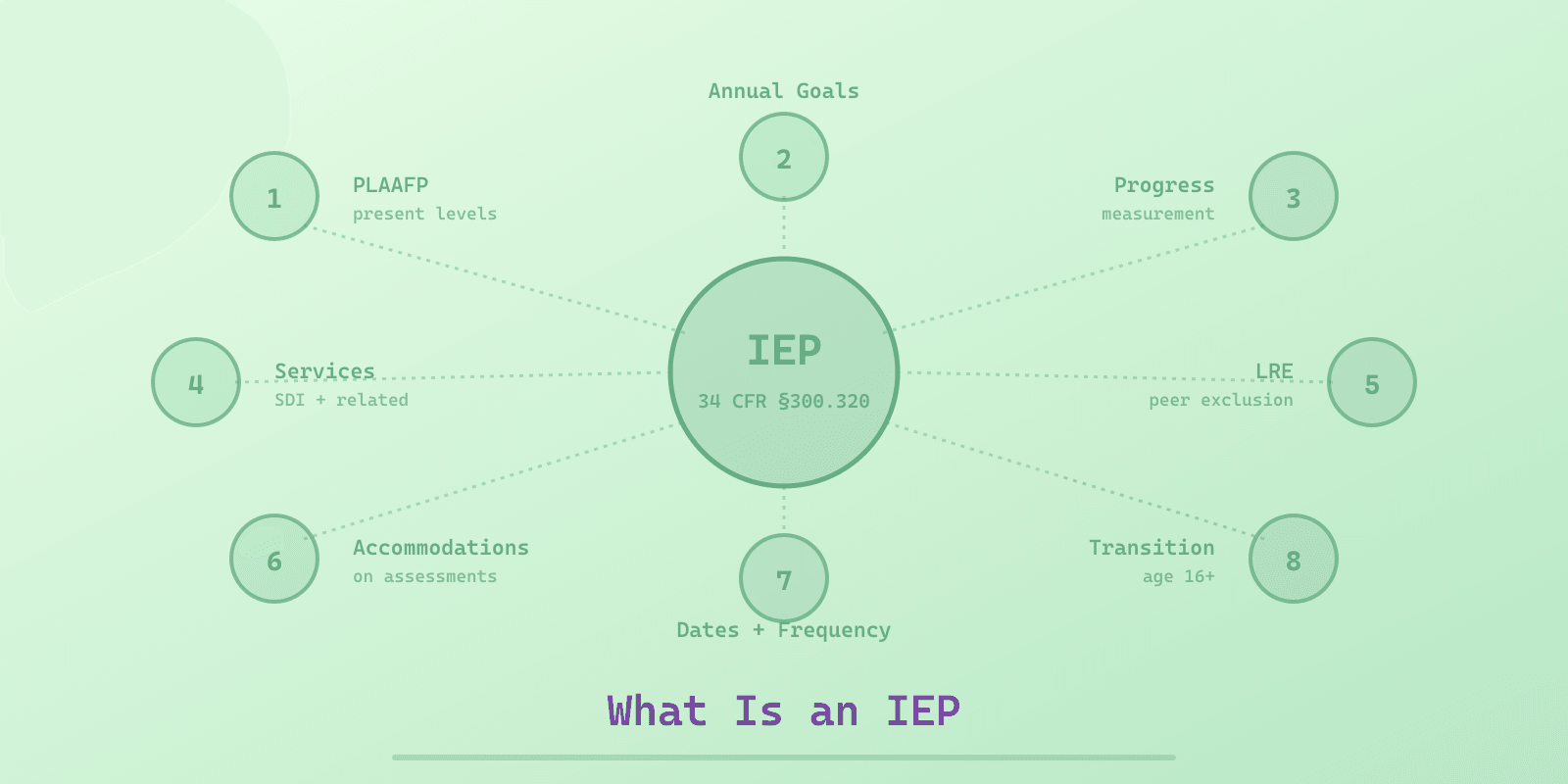
- Federal regulation requires 8 components in every IEP: PLAAFP, measurable annual goals, progress measurement, special education and related services, the extent of non-participation with non-disabled peers, accommodations on state and district assessments, projected dates and frequency, and transition services beginning at age 16 (34 CFR §300.320(a)).
- An IEP differs from a 504 plan: an IEP provides specially designed instruction plus related services plus accommodations under IDEA; a 504 plan provides accommodations only under the civil-rights framework of Section 504 of the Rehabilitation Act.
- Your rights as an IEP parent include prior written notice before any change (34 CFR §300.503), the right to an Independent Educational Evaluation at public expense if you disagree with the school's evaluation, and the right to procedural safeguards under 34 CFR §300.500 et seq.
An IEP, or Individualized Education Program, is a legally binding written plan that spells out the special education services, goals, and accommodations your autistic child needs to make meaningful progress in school. It is required under the Individuals with Disabilities Education Act (IDEA) for every eligible child with a disability, and it is the foundation for everything the school does for your child during the school day.
The statutory anchor for the IEP lives at 20 USC §1414(d), and the federal regulation that lists every required component of an IEP is at 34 CFR §300.320. The regulation that governs when the IEP must be in effect is at 34 CFR §300.323; the regulation governing how the IEP is developed, reviewed, and revised is at 34 CFR §300.324.
This guide walks through the 8 components federal regulation requires in every IEP, who qualifies, how the IEP differs from a 504 plan, the timeline from initial referral through annual review, and your rights as an IEP parent. It is the entry point for the broader IEP authority cluster on Spectrum Unlocked; every other post in the cluster builds on the framework introduced here.
The 8 Required Components of an IEP
Federal regulation at 34 CFR §300.320(a) requires every IEP to include 8 specific components. A document that omits any one of them is not a compliant IEP under IDEA. Parents reading their child's draft IEP can use this list as a checklist; if any item is missing, that is a documentable procedural gap. If the wording in any component reads like a wall of acronyms, you can paste it in and turn the jargon into plain English before you check it against this list.
- Statement of present levels of academic achievement and functional performance (PLAAFP). The data section of the IEP that describes where the child is right now in both academics (reading, math, writing) and functional areas (communication, social skills, behavior, sensory regulation, self-care, motor skills). Every goal and service that follows is supposed to be justified by this data. Required by 34 CFR §300.320(a)(1). Teachers writing this section for a full caseload often start from a present levels (PLAAFP) toolkit of paragraph frameworks and baseline banks rather than a blank page. Parents drafting a parent-side version can print a present levels starter sheet that walks each domain in turn.
- Statement of measurable annual goals. Specific, measurable goals designed to meet the child's needs that result from the disability and to enable the child to be involved in and make progress in the general education curriculum. For autistic learners, this typically includes academic goals plus functional goals (social-pragmatic communication, executive function, self-advocacy, self-regulation, AAC use). Required by 34 CFR §300.320(a)(2).
- Description of how progress will be measured. The IEP must explain how the school will measure progress toward the annual goals and when progress reports will be issued (typically quarterly, aligned with general-education report cards). Required by 34 CFR §300.320(a)(3). Behind that description sits the teacher's own paperwork: an IEP progress monitoring sheet captures the running data on each goal through the term, and an IEP progress report sheet turns that data into the quarterly update you receive.
- Statement of special education and related services. The specially designed instruction, related services (speech therapy, occupational therapy, physical therapy, counseling, behavioral support, transportation, assistive technology), and supplementary aids and services the child needs to advance toward the annual goals, be involved in the general education curriculum, and be educated and participate with non-disabled children. Required by 34 CFR §300.320(a)(4).
- Explanation of the extent of non-participation with non-disabled peers. The IEP must explain the extent, if any, to which the child will not participate with non-disabled children in the regular classroom and in extracurricular and other non-academic activities. This is the least restrictive environment (LRE) documentation surface. Required by 34 CFR §300.320(a)(5).
- Statement of accommodations for state and district assessments. Any individual appropriate accommodations the child needs to measure academic achievement and functional performance on state and district assessments. If the IEP team determines the child cannot participate in a particular state or district assessment, the IEP must explain why and how the child will be assessed instead. Required by 34 CFR §300.320(a)(6).
- Projected dates for beginning services and frequency, location, and duration. The IEP must specify the projected date for the beginning of services and modifications, and the anticipated frequency, location, and duration of those services and modifications. This is the service-grid surface where parents check whether the IEP's commitments match the actual school day. Required by 34 CFR §300.320(a)(7).
- Transition services (beginning at age 16). Beginning not later than the first IEP to be in effect when the child turns 16 (and updated annually thereafter), the IEP must include appropriate measurable postsecondary goals based on age-appropriate transition assessments and the transition services (including courses of study) needed to assist the child in reaching those goals. Required by 34 CFR §300.320(b).
Together these 8 components define what an IEP is under federal law. The federal regulation at 34 CFR §300.323 governs when the IEP must be in effect (at the beginning of each school year for each child with a disability within the agency's jurisdiction), and the regulation at 34 CFR §300.324 governs how the IEP is developed (the team must consider the strengths of the child, the concerns of the parents for enhancing the education of the child, the results of the initial or most recent evaluation, and the academic, developmental, and functional needs of the child).
Who Qualifies for an IEP
A child qualifies for an IEP when two conditions are both met under 34 CFR §300.8. First, the child has one of 13 specified disabilities. The 13 categories named in the federal regulation include autism, specific learning disability, speech or language impairment, emotional disturbance, intellectual disability, other health impairment (which covers ADHD), orthopedic impairment, hearing impairment, deafness, visual impairment, deaf-blindness, multiple disabilities, and traumatic brain injury. Second, by reason of that disability, the child needs special education and related services; that is, the disability adversely affects educational performance such that the child needs specially designed instruction.
For autistic children, the eligibility determination follows a comprehensive evaluation conducted by the school district at no cost to the family under 34 CFR §300.301. The evaluation must use a variety of assessment tools and strategies, must assess the child in all areas related to the suspected disability, and must produce data the IEP team uses to determine eligibility and to inform the PLAAFP section of the resulting IEP. The federal 60-day evaluation procedure, parent-request workflow, and what the team must assess are covered in depth in the special education evaluation process for autism guide. The full walkthrough of the 13 federal disability categories and where autism fits sits in the IDEA disability categories explained post. The eligibility meeting itself, with what to bring and what the team is supposed to address, is in IEP eligibility criteria for autism.
The eligibility threshold for an IEP under IDEA is meaningfully higher than the threshold for a 504 plan under Section 504. A child whose autism affects how they learn but does not require specially designed instruction may not be IDEA-eligible; that same child may still be 504-eligible if the autism substantially limits a major life activity (learning, communicating, concentrating, interacting with others, caring for oneself). For the full side-by-side comparison, see the IEP vs 504 Plan walkthrough and the 504 Accommodations for Autism guide.
IEP vs 504: A Brief Framing
The simplest way to hold the IEP and the 504 plan apart is this: an IEP is a special-education plan that provides specially designed instruction plus related services plus accommodations, while a 504 plan is a civil-rights plan that provides accommodations only.
An IEP is grounded in IDEA (20 USC §1400 et seq.) and provides federal procedural safeguards (prior written notice, independent educational evaluation, stay-put rights, due process hearings). A 504 plan is grounded in Section 504 of the Rehabilitation Act (29 USC §794) and provides civil-rights protections against discrimination. The procedural safeguards under IDEA are stronger and more specific; the eligibility threshold for a 504 is lower.
For the deep walkthrough of when each plan is the right fit for an autistic child, the differences in services, procedural protections, and legal enforceability, see the IEP vs 504 Plan walkthrough. For the autism-specific 504 accommodations and sample plan wording, see the 504 Accommodations for Autism guide. If a 504 turns out to be the better fit, you can send a 504 plan request to start that process in writing.
The IEP Timeline: From Initial Referral Through Annual Review
The IEP framework runs on a defined timeline anchored by 34 CFR §300.301, 34 CFR §300.306, and 34 CFR §300.323.
Initial referral to evaluation. The process begins when the parent (or the school, with parent consent) submits a written request for evaluation. The school must respond by either initiating the evaluation or, if it declines, issuing a Prior Written Notice (PWN) under 34 CFR §300.503 explaining the refusal and the basis. Federal regulation requires the school to obtain parent consent before conducting an initial evaluation under 34 CFR §300.300.
Initial evaluation. Once consent is given, the school must complete the initial evaluation within 60 calendar days under 34 CFR §300.301(c)(1), though state law may shorten the window (Texas uses 45 school days; many other states match the federal 60 calendar days). The evaluation must be comprehensive, assess the child in all areas related to the suspected disability, and produce data sufficient to determine eligibility.
Eligibility determination. After the evaluation is complete, a group of qualified professionals plus the parent reviews the data and determines whether the child meets the IDEA eligibility criteria under 34 CFR §300.306. If the child is found eligible, the IEP team must develop the initial IEP within 30 calendar days of the eligibility determination under 34 CFR §300.323(c).
Initial IEP meeting. The IEP team meets, drafts the IEP using the data from the evaluation, and the parent reviews and consents to the initial provision of special education services under 34 CFR §300.300(b). Once parent consent is given, the IEP is in effect, and services begin.
Annual review. The IEP must be reviewed at least annually under 34 CFR §300.324(b). At the annual review, the IEP team reviews progress on each goal, updates the PLAAFP section, revises goals as needed, and adjusts services and accommodations. A parent may request a review more frequently if data supports a change, and you can ask for an IEP meeting in writing to put that request on the record. The IEP meeting checklist walks the prep, the meeting itself, and the 48-hour follow-up for any of these annual or amendment meetings.
Reevaluation. The school must conduct a comprehensive reevaluation at least every 3 years under 34 CFR §300.303(b)(2), unless the parent and the school agree a reevaluation is not necessary. The reevaluation refreshes the eligibility data and ensures the IEP continues to reflect the child's current profile.
The full wall-clock timeline from initial written request to IEP in effect typically runs 60 to 90 calendar days. Disputes (a refusal to evaluate, a disagreement with the eligibility determination, a disagreement with the proposed services) extend the timeline through the procedural safeguards framework. Parents preparing for the initial IEP meeting often use the Initial IEP Meeting prep template (or the printable IEP Meeting Prep checklist) to gather the data and questions they need. Many also bring a one-page introduction so the team meets the child before the paperwork: the free Meet My Child one-pager is built for exactly that first meeting.
Your Rights as an IEP Parent
Federal IDEA procedural safeguards under 34 CFR §300.500 and the regulations that follow give parents specific rights at every stage of the IEP process. The most load-bearing rights for parents of autistic children are summarized below.
The right to be a legally equal IEP team member. Under 34 CFR §300.321, the parents are members of the IEP team with the same standing as the school's representatives. Parent input on the PLAAFP data, goals, and services is supposed to be considered on the same footing as input from teachers and specialists.
The right to prior written notice (PWN). Under 34 CFR §300.503, the school must provide PWN before proposing or refusing to initiate or change the identification, evaluation, educational placement, or provision of FAPE. The PWN must explain the proposed or refused action, the basis, the data, the alternatives considered, and the procedural safeguards available to the parent. For the deep walkthrough of how to read and respond to a PWN, see the Prior Written Notice (PWN) explainer.
The right to consent before initial evaluation and initial placement. Under 34 CFR §300.300, the school must obtain informed parental consent before conducting an initial evaluation and before providing initial special education services. Consent is voluntary and may be revoked.
The right to an Independent Educational Evaluation (IEE). Under 34 CFR §300.502, if the parent disagrees with the school's evaluation, the parent has the right to an IEE at public expense; the school must either fund the IEE or file for a due process hearing to defend its evaluation.
The right to FAPE. Under 20 USC §1412(a)(1) and 34 CFR §300.101, every eligible child with a disability has the right to a Free Appropriate Public Education. The substantive standard set by the Supreme Court in Endrew F. v. Douglas Cnty. Sch. Dist., 137 S. Ct. 988 (2017) is that the IEP must be reasonably calculated to enable the child to make progress appropriate in light of the child's circumstances. For the deep walkthrough, see the FAPE under IDEA explainer.
The right to LRE. Under 34 CFR §300.114, the child must be educated with non-disabled peers to the maximum extent appropriate; a more restrictive placement is allowed only when even strong supplementary aids cannot make the regular classroom work. For the deep walkthrough, see the Least Restrictive Environment (LRE) guide.
The right to dispute resolution. Under 34 CFR §300.151 through 34 CFR §300.518, parents have access to state complaint, mediation, and due process hearing procedures when disputes arise. Talk to a special-education attorney before pursuing formal dispute resolution; the procedural rules and short timelines make consultation a sensible first step. These procedures were unaffected by the June 2026 federal reorganization; the 2026 education changes explainer explains why your child's rights did not change.
When the school proposes or refuses an action that raises a concern, the parent's response is documented analysis: gather the data, name the concern in writing, cite the regulation, and ask the IEP team to reconvene. The IEP Advocacy Letter Builder drafts this written request with the relevant citations inline, and Spectrum Unlocked's school email templates cover the everyday written record: evaluation requests, meeting follow-ups, and incident documentation.
How the IEP Surfaces Connect to the Broader Cluster
The IEP is the central document, but the framework around it has several adjacent surfaces every parent learns to navigate. The 9 sibling guides in the Spectrum Unlocked IEP authority cluster walk through each surface in detail; each one builds on the framework introduced here.
The Least Restrictive Environment (LRE) guide covers placement decisions and the federal preference for the regular classroom. The IEP vs 504 Plan walkthrough holds the two frameworks apart and helps parents pick the right one for their child. The PLAAFP (Present Levels) explainer walks through the data section that anchors every goal and service. The 504 Accommodations for Autism guide covers the civil-rights framework and sample 504 plan wording. The Prior Written Notice (PWN) explainer walks through the procedural document the school must issue before changing the IEP. The Accommodations vs Modifications walkthrough draws the line between changes to how the child accesses the curriculum and changes to what the child is expected to learn. The Extended School Year (ESY) guide covers regression-risk eligibility for summer services. The FAPE under IDEA explainer walks through the legal anchor for every IEP, related service, and accommodation. And the Specially Designed Instruction (SDI) explainer covers the federally defined core of special education.
Two filterable tool surfaces pair with the cluster. The IEP Goal Bank provides over 100 SMART-formatted IEP goals across 6 focus areas with per-goal handoff to the IEP Goal Builder. The Accommodations Bank provides 157 fully-loaded accommodation cards across 4 settings with sample IEP and 504 plan wording and per-card handoff to the IEP Advocacy Letter Builder. Two AI-assisted builders pair with the cluster: the IEP Goal Builder drafts a parent-side measurable goal from a focus area and a skill description, and the IEP Advocacy Letter Builder drafts a written request that names the data, cites the regulation, and asks the team to act.
A Quick Recap for Parents
Before any IEP meeting where the document is on the table, keep these 6 anchors in mind:
- The IEP is a legally binding written plan required by IDEA at 20 USC §1414(d) and 34 CFR §300.320; it includes 8 required components and is the foundation for every special-education service your autistic child receives during the school day.
- The 8 components are PLAAFP, measurable annual goals, progress measurement, special education and related services, the extent of non-participation with non-disabled peers, accommodations on state and district assessments, projected dates and frequency, and transition services beginning at age 16 (34 CFR §300.320(a)).
- Eligibility under 34 CFR §300.8 requires both a qualifying disability and an adverse educational impact such that the child needs specially designed instruction; the comprehensive evaluation at no cost to the family is the gateway under 34 CFR §300.301.
- The IEP differs from a 504 plan in scope (specialized instruction plus related services plus accommodations on the IEP; accommodations only on the 504), in framework (IDEA vs Section 504), and in procedural protections (IDEA's safeguards are stronger and more specific).
- The IEP timeline runs from initial written request through 60-day evaluation, eligibility determination, 30-day IEP development, and annual review (34 CFR §300.323 and 34 CFR §300.324); reevaluation is required at least every 3 years under 34 CFR §300.303.
- Parent rights under 34 CFR §300.500 include legally equal IEP team membership, prior written notice before any change, consent before initial evaluation and placement, the right to an Independent Educational Evaluation at public expense, the right to FAPE under Endrew F., the right to LRE, and access to state complaint, mediation, and due process hearing procedures.
For more on navigating the IEP process, see the Least Restrictive Environment (LRE) guide, the IEP vs 504 Plan walkthrough, the PLAAFP (Present Levels) explainer, the 504 Accommodations for Autism guide, the Prior Written Notice (PWN) explainer, the Accommodations vs Modifications walkthrough, the Extended School Year (ESY) guide, the FAPE under IDEA explainer, and the Specially Designed Instruction (SDI) explainer; browse the filterable IEP Goal Bank and Accommodations Bank; or use the IEP Advocacy Letter Builder to draft a written request when the IEP your child needs is not the IEP your school is offering.
Need help preparing for YOUR next IEP meeting?
Beacon learns about YOUR child and gives guidance specific to them.
What would Beacon say?
"Help me prep for my IEP meeting"
Beacon pulls your child's goals, challenges, and history, then gives you the exact questions to ask, the red flags to watch for, and what to push back on.

Spectrum Unlocked Editorial Team
Editorial Team
The Spectrum Unlocked editorial team combines lived experience as autism parents with research-backed guidance to create resources families can trust.
Frequently asked questions
- What does IEP stand for?
- IEP stands for Individualized Education Program. It is a legally binding written plan required by the Individuals with Disabilities Education Act (IDEA) for every eligible child with a disability. The statutory definition lives at 20 USC §1414(d), and the federal regulation that lists the required components is at 34 CFR §300.320. The IEP is the document the school, the parents, and the child's IEP team use to define the special education services, related services, accommodations, and goals the child needs to make progress in school.
- What are the 8 required components of an IEP?
- Federal regulation at 34 CFR §300.320(a) requires every IEP to include: (1) a statement of the child's present levels of academic achievement and functional performance (PLAAFP); (2) a statement of measurable annual goals; (3) a description of how progress toward those goals will be measured and reported; (4) a statement of the special education and related services and supplementary aids and services to be provided; (5) an explanation of the extent to which the child will not participate with non-disabled children in the regular classroom; (6) a statement of any individual accommodations needed for state and district assessments; (7) the projected date for the beginning of services and the anticipated frequency, location, and duration; and (8) beginning not later than the first IEP to be in effect when the child turns 16, appropriate measurable postsecondary goals and transition services.
- Who qualifies for an IEP?
- A child qualifies for an IEP when two conditions are met under 34 CFR §300.8. First, the child has one of 13 specified disabilities, which include autism, specific learning disability, speech or language impairment, emotional disturbance, intellectual disability, other health impairment, and several others. Second, the disability adversely affects educational performance such that the child needs specially designed instruction. For autistic children, the eligibility evaluation must be comprehensive and is conducted at no cost to the family under 34 CFR §300.301.
- What is the difference between an IEP and a 504 plan?
- An IEP is a special-education plan under IDEA that provides specially designed instruction plus related services (speech therapy, occupational therapy, behavioral support) plus accommodations, with measurable annual goals and progress monitoring. A 504 plan is a civil-rights plan under Section 504 of the Rehabilitation Act (29 USC §794) that provides accommodations only, with no specialized instruction and no related services. The eligibility threshold for a 504 is lower (the disability substantially limits a major life activity), but the legal protections and the services available are narrower.
- How long does it take to get an IEP?
- The federal timeline runs in two phases. First, after the parent submits a written request for evaluation, the school district must complete the initial evaluation within 60 calendar days under 34 CFR §300.301(c)(1), though some states define a shorter timeline (California uses 60 calendar days from consent; Texas uses 45 school days). Second, if the child is found eligible, the IEP must be developed and in effect within 30 calendar days of the eligibility determination under 34 CFR §300.323. The total wall-clock from initial request to IEP in effect typically runs 60 to 90 calendar days, longer if the family disputes the evaluation or eligibility determination.
- Who is on the IEP team?
- Under 34 CFR §300.321, the IEP team includes: the parents, at least one regular education teacher of the child (if the child is or may be participating in regular education), at least one special education teacher, a representative of the school district who is qualified to provide or supervise specially designed instruction and is knowledgeable about the general education curriculum and the availability of resources, an individual who can interpret the instructional implications of evaluation results, other individuals who have knowledge or special expertise regarding the child (invited by the parent or the agency), and the child where appropriate. The parent is a legally equal team member; parent input carries the same weight as any other team member.
- What are my rights as an IEP parent?
- Federal IDEA procedural safeguards under 34 CFR §300.500 et seq. give parents specific rights. You have the right to be a legally equal IEP team member. You have the right to prior written notice before the school proposes or refuses to initiate or change the identification, evaluation, placement, or provision of FAPE (34 CFR §300.503). You have the right to an Independent Educational Evaluation (IEE) at public expense if you disagree with the school's evaluation (34 CFR §300.502). You have the right to consent before initial evaluation and initial placement (34 CFR §300.300). You have the right to inspect and review your child's educational records. You have the right to file a state complaint, request mediation, or file for a due process hearing if a dispute arises (34 CFR §300.151 to 300.518).