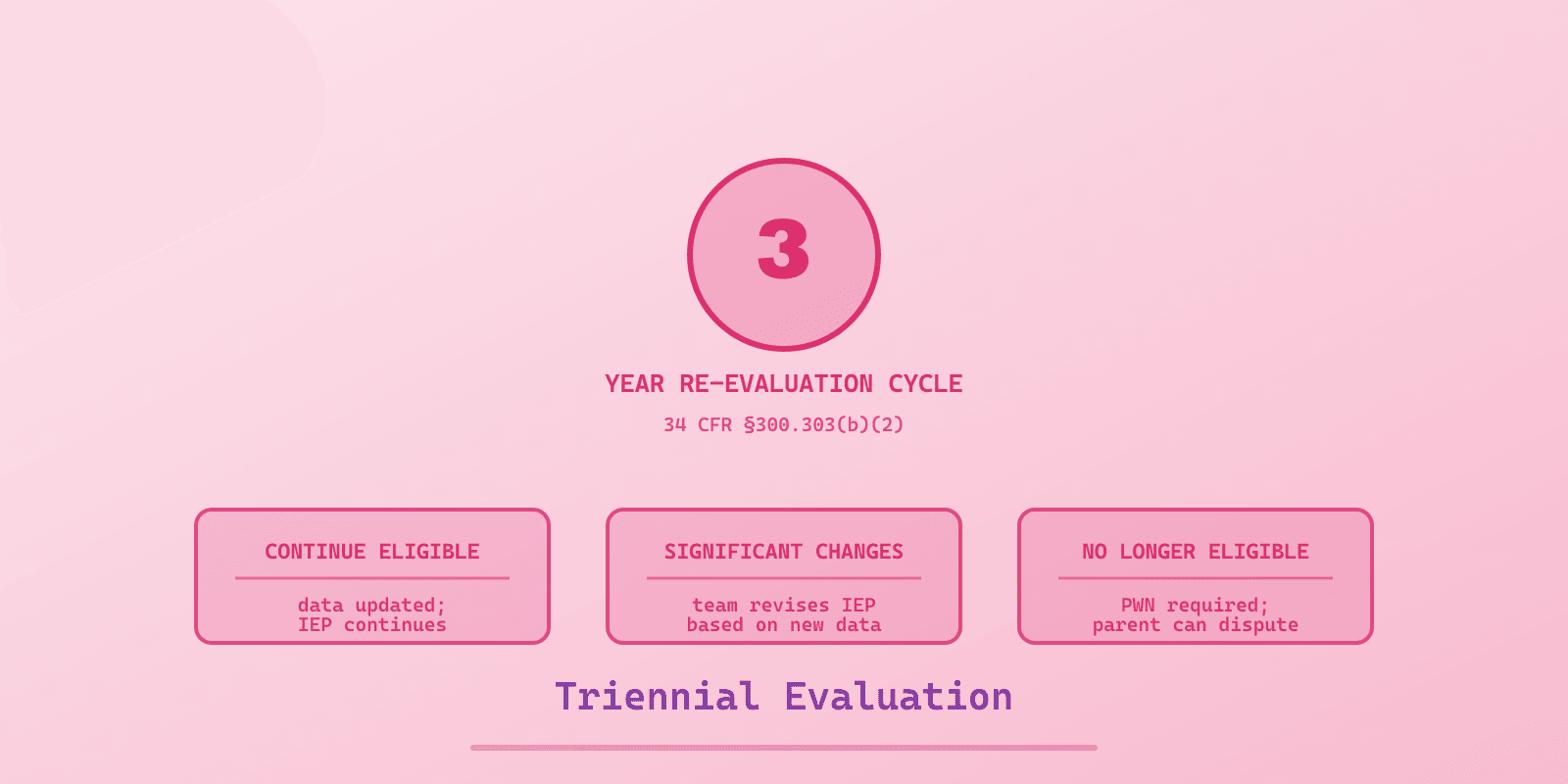
Triennial Evaluation in Special Education
Federal law requires a re-evaluation at least every 3 years to confirm continuing IEP eligibility. Here is what changes at the triennial, when the team can waive it, and your rights.
Key Takeaways
- Federal law requires the IEP team to conduct a re-evaluation at least every 3 years under 34 CFR §300.303(b)(2), unless the parent and the agency agree it is not necessary.
- The triennial re-evaluation re-confirms continuing eligibility, identifies any new needs, and updates the data the IEP relies on; parental consent is required for new tests.
- Either the parent OR the school can request a re-evaluation earlier than the 3-year mark if conditions warrant under 34 CFR §300.303(a).
- If the team agrees a full re-evaluation is not needed, they must still review existing data and decide whether new assessments are warranted (34 CFR §300.305(d)).
A triennial evaluation is the re-evaluation IDEA requires at least every 3 years to confirm your child's continuing eligibility for an IEP. Federal law lives at 34 CFR §300.303, and the rule has two parts: the team must consider whether re-evaluation is needed at the 3-year mark, and either the parent or the school can trigger an earlier re-evaluation when conditions warrant.
Take a fourth grader who was found eligible under Autism three years ago, and whose IEP has been working reasonably well. The triennial is the procedural moment to re-confirm the eligibility category still fits, check whether any new domains of need have emerged, and update the data the IEP is grounded in. The team is not required to repeat every test from the original evaluation; the focus is on what new information would change the IEP.
This guide walks through what the triennial requires, what the team can and cannot waive, who decides, parental consent, and what to do if the triennial outcome changes your child's IEP.
What the Triennial Requires
Under 34 CFR §300.303(b)(2), a re-evaluation must occur at least once every 3 years, unless the parent and the public agency agree that a re-evaluation is unnecessary. The rule has three operative parts:
- The team must consider re-evaluation at the 3-year mark
- Re-evaluation can be waived if both parent and agency agree
- The team can also re-evaluate more often if the parent or teacher requests it or if the agency determines need
Under 34 CFR §300.305(a), the re-evaluation must include a review of:
- Evaluations and information provided by the parents
- Current classroom-based local or state assessments
- Classroom-based observations
- Observations by teachers and related-service providers
Based on that review, the team decides what additional data, if any, are needed. The team can determine that no additional data are needed if existing information is sufficient under 34 CFR §300.305(d). In that case, the team notifies parents in writing of the determination and the reasons.
If new tests are needed, parental consent is required under 34 CFR §300.300(c) before testing can begin.
When Re-Evaluation Is Earlier Than 3 Years
Under 34 CFR §300.303(a)(1), the school must conduct a re-evaluation when it determines educational or related-service needs warrant it, OR when the parent or teacher requests one. The federal frequency cap is once a year under 34 CFR §300.303(b)(1), unless parent and agency agree to more.
Common triggers for an early re-evaluation:
- Significant change in academic performance (sudden decline or unexpected gains)
- New behavioral pattern emerging (aggression, elopement, self-injurious behavior) that the current behavior intervention plan does not address
- New medical diagnosis or condition that affects educational performance
- Major life transition (puberty, school change, family change) that introduces new needs
- The child's IEP is plainly not working and the team needs new data to understand why
- Considering a more or less restrictive placement primarily because of behavior, which under 34 CFR §300.530(f) often triggers an FBA
To request an early re-evaluation, parents write to the case manager and special education director under the same letter format as an initial evaluation request. Reference 34 CFR §300.303(a)(1) and describe the specific changes triggering the request. Use the IEP Advocacy Letter Builder for a formatted version.
When the Triennial Can Be Waived
The triennial can be waived under 34 CFR §300.303(b)(2) only when both parent and agency agree it is unnecessary. The waiver is rare in practice for two reasons. First, the school district has a procedural interest in re-confirming eligibility on the federal cycle to protect against later complaints. Second, parents often want updated data even if the IEP is working, because the data anchors the annual review and the next 3 years of services.
If a waiver is offered, the team must still complete the review-of-existing-data step under 34 CFR §300.305. The waiver applies to new testing, not to the procedural review.
A waiver is documented in writing. The school cannot quietly skip the triennial without parent agreement and a written record of the waiver decision.
What the Triennial Covers for Autism
For an autistic child, a complete triennial typically considers updates in:
- Cognitive functioning (if there is reason to believe scores may have shifted)
- Academic achievement
- Speech-language including pragmatics and social communication
- Sensory profile (sensory needs can shift significantly with age)
- Social-emotional and behavior (especially if behavior plan effectiveness is being reviewed)
- Adaptive behavior (Vineland or ABAS update on age-appropriate skills)
- Autism-specific diagnostic measure if the team needs to re-confirm eligibility under the category
- Functional behavior assessment if behavior is a current concern
- Transition assessment (mandatory starting age 16 under 34 CFR §300.320(b), though many states start earlier)
The team is allowed to use existing data (e.g., a recent private speech-language evaluation) instead of re-administering the same tests. Bring outside reports to the triennial planning meeting so they can be incorporated.
Triennial Outcome Scenarios
Three main outcomes are possible.
Continued eligibility, IEP roughly the same. The triennial confirms the child still meets eligibility under the same category, the existing IEP framework is working, and only minor adjustments are needed at the next annual review. The team documents the decision in writing under 34 CFR §300.306 and proceeds to the annual review.
Continued eligibility, significant IEP changes. New data shows additional or different needs. The team can convene an IEP meeting to update goals, services, placement, or supports based on the new data. Major changes require parent consent and prior written notice.
Eligibility termination. The team finds the child no longer meets eligibility criteria. Under 34 CFR §300.305(e)(1), the team must conduct a full evaluation before determining the child no longer needs special education, except when termination is due to graduation with a regular diploma or exceeding the age of eligibility. Prior written notice under 34 CFR §300.503 is required.
If you disagree with an eligibility termination, your rights are the same as at initial eligibility: request an independent educational evaluation, file a state complaint under 34 CFR §300.151, request mediation, or file for a due process hearing under 34 CFR §300.507.
What to Bring to the Triennial Planning Meeting
The triennial usually starts with a planning meeting to decide what data the team will collect. Bring:
- Your concerns ranked by priority (what you most want the triennial to address)
- Any outside evaluations from the last 3 years (medical, speech, OT, behavioral)
- A list of changes you have seen at home or in the community since the last evaluation
- Recent IEPs and progress reports
- Specific questions about whether the current category still fits
The Re-Evaluation meeting prep template walks through the triennial-specific questions; the full IEP Meeting Prep tool generates a custom packet if your situation needs more.
If the school proposes to skip a domain you think is relevant, push back in writing. Triennials that skip domains produce IEPs that miss the same domains for the next 3 years.
Triennial and the Larger IEP Cycle
The triennial is one of three procedural moments where eligibility data gets re-examined:
- Initial evaluation (covered in special education evaluation process)
- Triennial re-evaluation (this guide)
- Earlier re-evaluation when conditions warrant (covered above)
The triennial feeds the PLAAFP data the team uses for the next 3 years of IEPs. Goals, specially designed instruction, accommodations vs modifications, and least restrictive environment analysis all rest on the triennial findings.
Tools that pair with the triennial step:
- IEP Advocacy Letter Builder for written re-evaluation requests
- IEP Meeting Prep for the triennial planning meeting
- Accommodations Bank for refreshed accommodation candidates
- IEP Goal Bank for updated goal examples
The triennial re-evaluation is a structured procedural moment where parents have full rights of input, consent, and disagreement. Knowing the 3-year clock, the waiver option, the review-of-existing-data step, parental consent for new tests, and your rights when you disagree turns the triennial from a routine paperwork moment into an active touchpoint where the IEP gets re-grounded in current data.
Need help preparing for YOUR next IEP meeting?
Beacon learns about YOUR child and gives guidance specific to them.
What would Beacon say?
"Help me prep for my IEP meeting"
Beacon pulls your child's goals, challenges, and history, then gives you the exact questions to ask, the red flags to watch for, and what to push back on.

Spectrum Unlocked Editorial Team
Editorial Team
The Spectrum Unlocked editorial team combines lived experience as autism parents with research-backed guidance to create resources families can trust.
Frequently asked questions
- What is a triennial evaluation?
- A triennial evaluation is a re-evaluation the IEP team conducts at least every 3 years under 34 CFR §300.303(b)(2). It re-confirms whether the child continues to be eligible for special education, identifies any new needs, and updates the data the IEP relies on. The team is not required to repeat every test; the focus is on what new information is needed.
- Is the triennial evaluation mandatory?
- Federal law requires the team to consider re-evaluation at least every 3 years, but if the parent and the agency agree that a full re-evaluation is not necessary, the re-evaluation can be waived under 34 CFR §300.303(b)(2). However, the team must still review existing data and decide whether new assessments are needed.
- Can I request a re-evaluation before the 3-year mark?
- Yes. Under 34 CFR §300.303(a)(1), the public agency must conduct a re-evaluation when it determines that educational or related-services needs warrant a re-evaluation OR when the parent or teacher requests one. Frequency is limited to once a year unless the parent and agency agree otherwise.
- Do I have to give consent for a triennial evaluation?
- Yes, when new tests will be conducted. Under 34 CFR §300.300(c), parental consent is required for re-evaluation, with limited exceptions. If the team decides no new tests are needed (existing data is sufficient), formal consent for new assessments is not required, but the team must still notify parents in writing of the determination.
- What happens if my child is no longer eligible after the triennial?
- If the triennial concludes the child no longer meets eligibility criteria, the team must provide prior written notice of the change under 34 CFR §300.503 with the reasons and the data the decision relied on. Parents can request an IEE, file a state complaint, request mediation, or file for a due process hearing if they disagree.
- Does the triennial re-evaluation reset the IEP?
- No. The triennial is a re-evaluation, not an automatic IEP rewrite. The IEP team typically uses the triennial findings at the next annual IEP review to update goals, services, and placement based on new data. The annual review and the triennial can be scheduled together to streamline the process.