Letter Recognition Before Letter Writing: Activities That Do the Real Work
Recognition comes before writing, and matching comes before naming. The sequence that builds alphabet knowledge, the confusable-letter problem, and activities that test recognition instead of accidentally testing something else.
Key Takeaways
- Recognition comes before writing, and inside recognition, matching comes before naming: a child can match b to b long before they can answer what letter is this, and both are real progress.
- The alphabet song is not letter recognition. A child can sing all twenty-six and recognize four; the song teaches sequence and names, not symbols.
- Confusable pairs (b/d, p/q, m/w, n/u) deserve separate, spaced practice rather than side-by-side drilling, which cements the confusion instead of resolving it.
- The best recognition activities make the letter the key to something the child wants to finish, which is why color-by-letter works: finding every b is the game, not the test.
- Uppercase and lowercase are effectively different symbol sets to a beginner. Teach the form the child sees most, then bridge with matching pairs rather than assuming transfer.
Every reading skill a child will ever build stands on a quiet one: looking at a squiggle and knowing which squiggle it is. Letter recognition gets less attention than phonics and less shelf space than handwriting, and it comes before both.
It also gets tested more than it gets taught. Most alphabet activities in circulation ask the child to prove they know a letter. The useful ones make the letter do something.
Recognition has layers
A child is not simply able or unable to recognize a letter. The skill stacks:
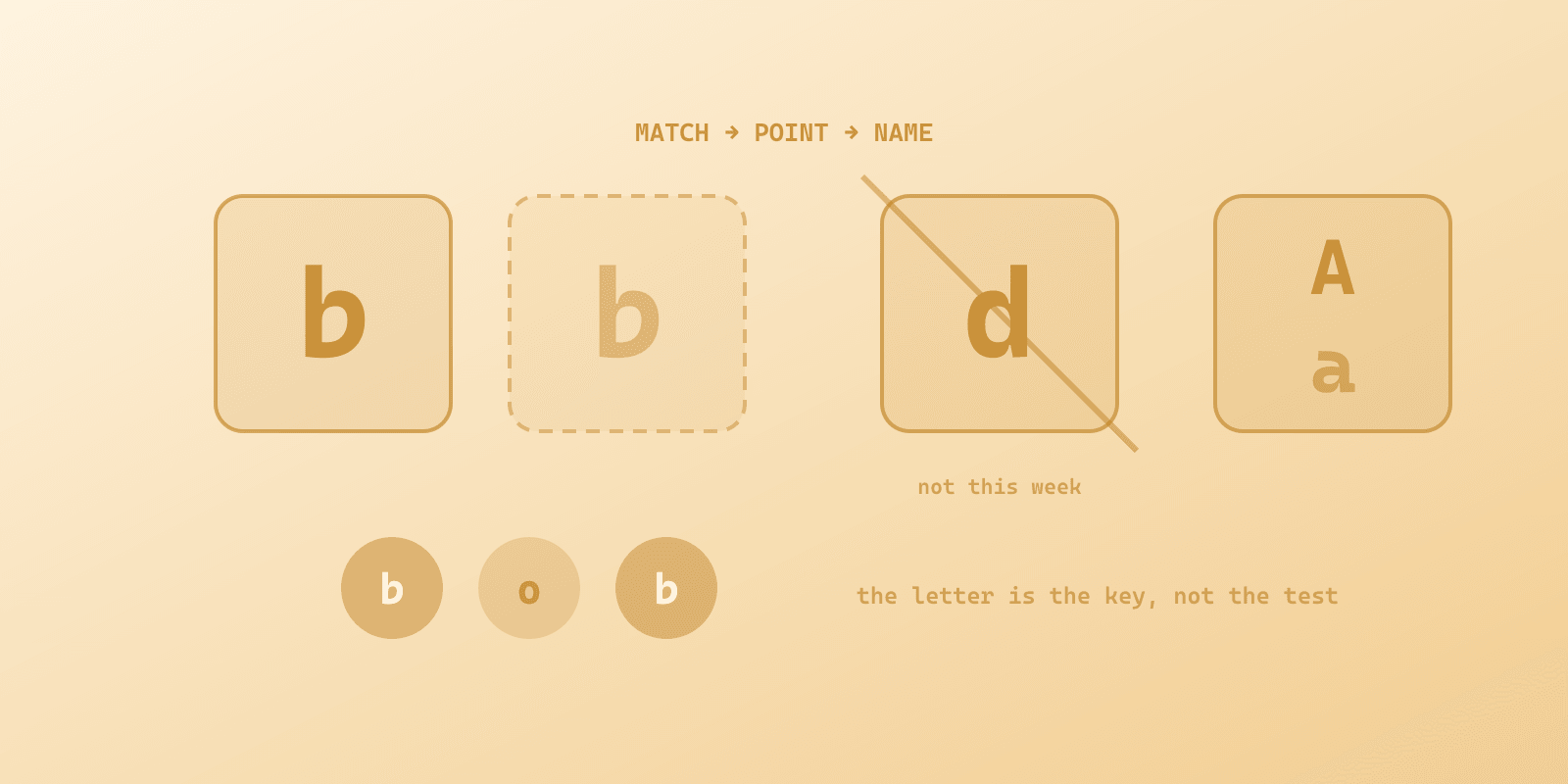
- Match identical letters. Put the b card on the b square. No name needed; pure visual discrimination.
- Match across cases. Put A with a. This is a taught link, not an obvious one.
- Point to the letter named. "Touch the m." Receptive knowledge; the name goes in, the eyes search.
- Name the letter shown. The layer every checklist tests, and the last to arrive.
A child who fails layer four may be solid at layer two, and the work that helps them lives at layer three, not in more flashcards at layer four. When progress stalls, drop a layer and check where the floor actually is.
The alphabet song sits outside this stack entirely. It teaches the names and their order, which matters, but a child can sing all twenty-six while recognizing four. Singing is not seeing.
The confusables are a separate curriculum
Letters are the first objects in a child's world where a mirror image is a different thing. Before print, orientation never mattered: a cup is a cup from either side. So b/d, p/q, m/w and n/u confusion is not a red flag in a preschooler; it is the expected cost of a brand-new rule.
The counterintuitive part is the fix. Showing b and d together to teach the difference cements the pair as one blurry item. What works is separation: bring b to full automaticity on its own, with its own anchor phrase, and introduce d weeks later. Confusable pairs deserve spaced, one-at-a-time treatment, and any activity that mixes the whole alphabet should lean on the distinct letters early.
Activities where the letter is the key
The strongest recognition practice makes the letter the key to something the child wants to complete, so the recognition act is voluntary and repeated.
- Color-by-letter pages are the cleanest version of this: the picture only comes out right if every b gets found and colored the b color. One page produces dozens of real recognition acts, and errors self-reveal, because a wrong letter puts a wrong color where the picture shows it cannot go. Our Color by Code pack builds this mechanic across letters, numbers and shapes at three difficulty levels, and the same pages ride the free color-by-letter worksheets generator.
- Letter hunts in real print put recognition where it will actually be used: find every e on the cereal box, on the stop sign, on the store receipt. In autumn a seasonal picture list does the same job at the table: on a page of fall words or Halloween words, every picture sits under the letter it starts with, so the child hunts for the a beside the acorn rather than reciting the alphabet.
- Name-first practice leans on the one word a child is already motivated by; the letters of their own name are the natural first curriculum, and it connects directly to name tracing practice once forming the letters begins.
- Matching decks and clip cards live at layers one and two and are the right home for confusable-pair work, one letter at a time.
What all of these share is that the adult can watch recognition happen instead of quizzing for it.
Recognition and writing feed each other, in that order
Tracing a letter does build recognition of it, and recognizing a letter makes tracing it meaningful. But the dependency runs one way at the start: a child cannot meaningfully write a symbol they cannot pick out of a lineup. When a child is stuck on letter tracing, the cause is often a recognition gap wearing a handwriting costume, and a week at the matching layer moves the pencil further than another week of dots.
There is a layer below the letter, and it is worth checking before assuming the problem is letters at all. Letters are built from a small set of strokes and closed forms, so a child who cannot yet copy a circle or a square from a model has no reliable way to produce a b or an E either. Shape tracing worksheets are the cheapest way to find out where that sits, because the same page shows you whether the hand can close a curve and turn a corner without any letter knowledge being in the way. The pre-writing skills sequence sets out the full order.
What to do on Monday
Pick four distinct letters, one of them from the child's name. Check each at all four layers, thirty seconds per letter. Whatever layer wobbles first is the week's work, and a color-by-letter page with those letters is the least fight you will get about doing it.
Need help preparing for YOUR next IEP meeting?
Beacon learns about YOUR child and gives guidance specific to them.
What would Beacon say?
"Help me prep for my IEP meeting"
If you asked Beacon "Help me prep for my IEP meeting" it would pull your child's goals, challenges, and history, and give you the exact questions to ask, red flags to watch for, and what to push back on.

Spectrum Unlocked Editorial Team
Editorial Team
The Spectrum Unlocked editorial team combines lived experience as autism parents with research-backed guidance to create resources families can trust.
Frequently asked questions
- What order should children learn to recognize letters?
- Start with the letters of the child's own name, because motivation does half the work, then high-frequency and visually distinct letters like o, s, x and t, and hold the confusable pairs apart from each other. There is no single research-mandated order, but two principles hold: personally meaningful letters first, and never introduce b and d, or p and q, in the same week. The alphabet-song order is the weakest choice, because it front-loads letters by sequence rather than by distinctiveness or meaning.
- Is matching letters the same as recognizing them?
- Matching is the first layer of recognizing. A child who can place b on b is discriminating the shape from the other shapes, which is genuine recognition work even though they cannot yet name it. The usual layers run: match identical letters, match uppercase to lowercase, point to the letter you name (receptive), and name the letter shown (expressive). Naming is the layer most checklists test, but a child failing at naming may be secure at pointing, and knowing which layer is shaky tells you what to practice.
- Why does my child confuse b and d?
- Because until print, orientation never mattered. A cup is a cup facing either way, and a chair is a chair from both sides; letters are the first objects in a child's life where mirror images are different things. Reversal confusion is developmentally normal well into age 7. It resolves faster when the pair is separated: teach b to fluency in its own sessions with an anchor like b has its belly after the line, and only bring d in once b is automatic. Drilling the two side by side to teach the difference is the intuitive move and the slow one.
- Are letter recognition worksheets effective?
- They are effective when the worksheet makes the letter functional, and busywork when it does not. Circle every b on a page of letters is a test wearing a worksheet costume. Color-by-letter pages work differently: the letters are the key to finishing a picture the child wants to finish, so the child performs dozens of genuine recognition acts voluntarily, and self-corrects because a wrong letter puts a wrong color where the picture shows it does not belong. The same mechanic carries recognition of numbers and shapes.
- Should I teach uppercase or lowercase letters first?
- Teach what the child encounters most, and treat the other case as a linked second set rather than free transfer. Lowercase dominates the print children will actually read, which argues for lowercase-first in reading contexts; names and environmental print push capitals early anyway. In practice most children learn a mixed diet, and the important work is the bridge: matching uppercase to lowercase explicitly, pair by pair, because to a beginner A and a share a name and nothing else.
- How long does it take a child to learn all their letters?
- Typically months, not weeks, and unevenly: a burst of easy distinct letters, then a long tail of confusables. A rough benchmark is that many children recognize most letters by the end of the year they turn 5, but the range around that is wide and includes plenty of typically developing children. For autistic learners and children with language delays the sequence is the same with more repetitions per letter, and the functional activities matter more, because drill tolerance is usually lower. Track by letters secure at each layer rather than by weeks elapsed.