First-Then Board Complete Guide for Autism: Examples, Templates, How to Use
Complete guide to first-then boards (also called first-then templates) for autistic kids. What they are, when to use them, 10 example pairs by age, common pitfalls, and free printable templates.
Key Takeaways
- A first-then board is the simplest visual schedule format: one non-preferred task on the left, one preferred reward on the right. Most autistic kids understand the contract within the first week.
- Use a first-then board before a longer visual schedule. The format teaches contingency learning, which is the foundation skill every more complex schedule depends on.
- The reward (the 'then') must be something your child actually wants and you can deliver immediately. Generic rewards (stickers, praise) fail to motivate most autistic kids in this format.
- 10 example pairs by age in this guide cover toddler, preschool, elementary, and tween. Free printable template at the link.
- Common failure mode: parents add steps to the 'then' (brush teeth, then put on pajamas, then story). This breaks the contract and your child stops trusting the board. The 'then' must be exactly what you promised.
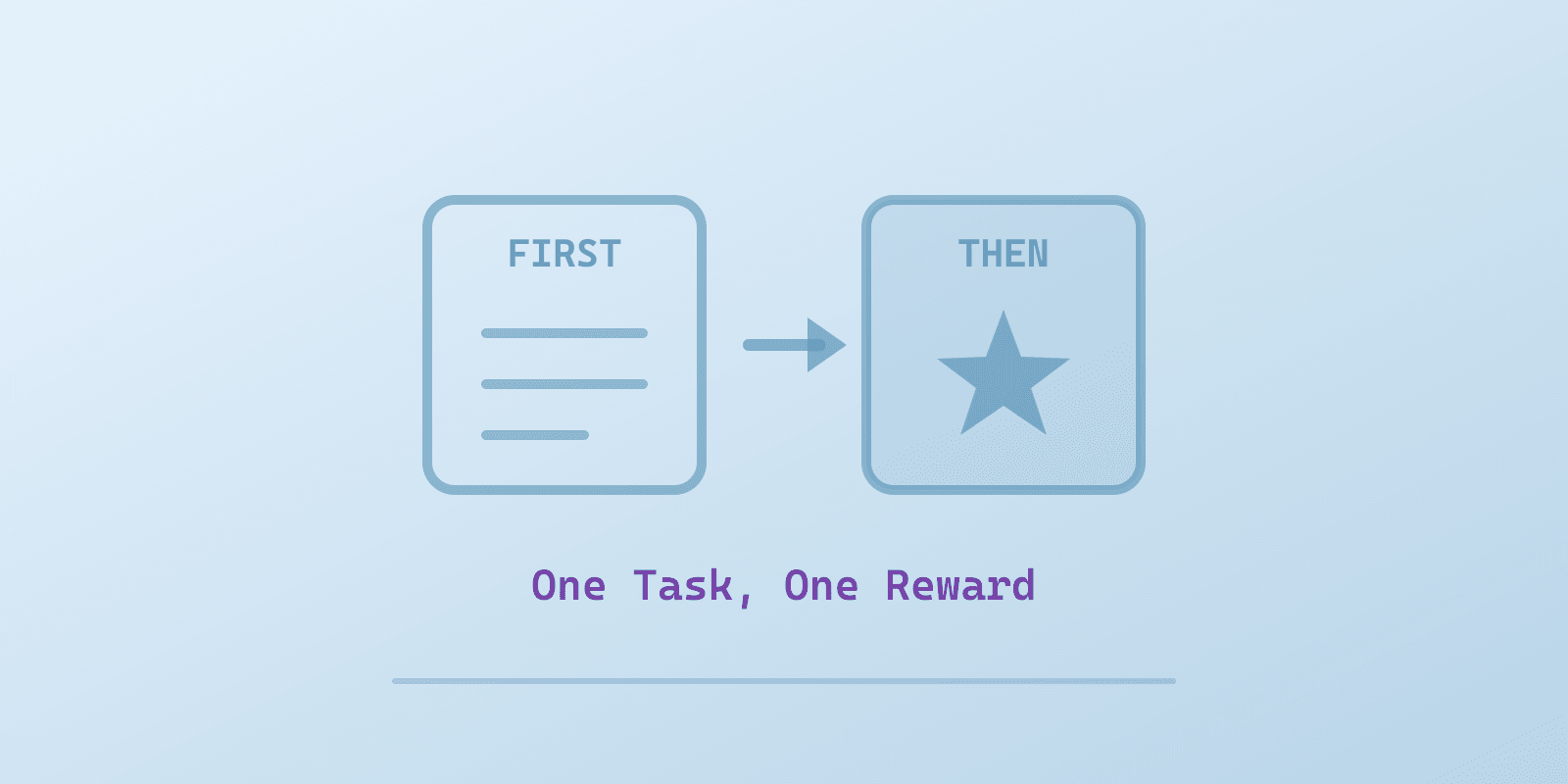
A first-then board is the simplest visual schedule format you can use with an autistic child, and for most kids learning to follow visual supports, it is the right place to start. Two cards. One task on the left. One reward on the right. The format teaches the single most important skill underneath every more complex visual schedule: contingency learning, the understanding that completing one specific thing earns one specific reward.
A first-then board (also called a first-then template or first-then strip) is a two-card visual schedule that shows one non-preferred task on the left labeled "First" and one preferred reward on the right labeled "Then", used to teach autistic kids that completing the task earns the reward. The format comes from Applied Behavior Analysis (ABA) and was popularized through the Picture Exchange Communication System (PECS) in the early 1990s. Today it is one of the most common visual supports recommended by occupational therapists, special educators, and ABA providers because it works fast and it works for almost every kid on the spectrum.
This guide covers what first-then boards are, why they work, when to use them instead of longer schedules, 10 example pairs by age, how to phase them out when your child is ready, the most common pitfalls (and how to avoid them), and where to get free printable templates you can customize tonight.
Want to skip straight to the template? Open the free First-Then Board Maker in our browser editor. Customize the cards with your own images and labels, then print or save as PDF. No email required.
Why First-Then Boards Work for Autistic Kids
The first-then format works because it removes ambiguity. A neurotypical kid hears "brush your teeth and then we'll see about a story" and interprets the "we'll see" as a strong yes. An autistic kid hears the same words and either does not register the contingency at all, or registers it as a vague promise that could mean anything. The same gap shows up with everyday instructions, which is why a social story about following directions walks a child through stopping, listening, and asking for a repeat when a direction does not land. The first-then board makes the contingency concrete: a picture, a label, a left-to-right reading direction, and an unambiguous reward.
Three things happen when a kid uses a first-then board consistently:
- They learn the contingency. "If I do this, then I get that" becomes a stable expectation. After a few weeks, your child starts looking for the board before asking for preferred activities. They start regulating their own behavior to the board's contract.
- They reduce protest behavior. Tasks that used to trigger meltdowns happen with less drama because the path through the task and out of it is visible. The reward is not a maybe; it is the next thing on the schedule.
- They build the foundation for longer schedules. Once a kid can follow a two-card schedule, three-card and four-card schedules become teachable. Most kids who handle first-then for two to four weeks can move to longer formats. Kids who plateau at first-then forever still get real value from the format. When your child is ready for those longer sequences, a daily-routine card set gives you the next set of steps to lay out. For a child in kindergarten to second grade who is practicing the order words themselves, Christmas sequencing cards turn holiday routines such as wrapping a present into short picture sequences, each with a shorter, gentler version for a child who is coming straight from two cards. For a classroom-wide set of these supports, the educator resources page gathers the free makers alongside the printable packs, and the self-contained classroom setup guide fits first-then boards into the room's wider behavior systems.
The format also works because it puts the rules in the environment instead of in the parent's voice. When the board is the source of the contract, your child negotiates with the board, not with you. That is a much more sustainable parenting position than being the source of every contingency.
When to Use a First-Then Board Instead of a Longer Schedule
Use a first-then board when:
- Your child is new to visual schedules and you want to start with the smallest possible commitment.
- Your child gets overwhelmed by longer sequences and melts down when shown a 6-step morning routine board.
- You are introducing a specific non-preferred task (a new chore, a new therapy demand, a new clothing transition) and want to anchor it to a known reward.
- It is the first week of a new routine and you want to ease your child into the visual-schedule format before bumping up complexity.
- Your child is old enough to want a sense of control but young enough to need the visual anchor (typically ages 2 to 7).
Use a longer visual schedule instead when:
- Your child needs to walk through a sequence with multiple steps (morning routine, bedtime routine, school day) where there is no single non-preferred task to motivate.
- Your child has graduated past the first-then format and consistently completes single-task contingencies without prompting.
- You need to show the structure of a whole day, not the contingency of a single moment.
Many families use both. A longer morning routine schedule for the wake-up-through-school-bag sequence, and a first-then board for specific sticking points like brushing teeth or putting on socks. When you're ready to build the longer version, Spectrum Unlocked's complete visual schedule guide walks the format choice, the step count, and the troubleshooting end to end.
10 Example First-Then Pairs by Age
The first-then board format is age-agnostic. What changes is the specific pair you put on it. For example, a fish-feeding routine board can frame "first feed the fish, then screen time." Here are ten pairs that work well, grouped by age band.
Toddler (ages 2 to 4)
- First: brush teeth. Then: bath toys. Use bathtub time as the "then" if your toddler loves splashing. Brush teeth before the bath so the reward is immediate and embodied. If bedtime is where brushing stalls instead, the brush teeth, then story board swaps the bath reward for a calming bedtime story.
- First: get dressed. Then: breakfast. Pairs the morning's most-resisted task with the morning's most-anticipated one. Breakfast is the reward; getting dressed is the gate. The get dressed, then breakfast board prints this pair ready to use.
- First: clean up toys. Then: story. Bedtime story is one of the most motivating "thens" for toddlers. Use it as the reward for cleaning up the play area before bed. For the play-reward version, the clean up, then play board prints ready to use, and the single play card prints a full sheet for every board in the house.
Preschool (ages 4 to 6)
- First: speech therapy session. Then: iPad. For kids who tolerate speech therapy but do not love it, a contingent iPad session immediately after is often enough motivation.
- First: shoes on. Then: outside time. Pairs a small motor demand with the big outdoor reward. Works especially well in spring and summer. To stretch that outdoor reward across several steps, the 6-token outside-time board earns going outside once six tokens are filled.
- First: vegetables. Then: dessert. Classic for a reason. Use a visible board (not a parent-spoken contract) so the deal is in the environment, not in negotiation. For the same food payoff on a token layout, the 4-token snack board earns a snack across four steps.
Elementary (ages 6 to 10)
- First: homework. Then: video game time. The most common useful pair at this age. Be precise about how much homework (15 minutes? two pages?) and how much game time (30 minutes? one episode?). The homework, then screen time board sets up this pair so you can fill in your own limits.
- First: piano practice. Then: friend playdate. For kids in extracurriculars, pair the daily demand with the weekly social reward.
- First: shower. Then: phone. For older elementary kids transitioning into the tween phase, screen access is the highest-value contingent reward you have. Use it deliberately.
Tween (ages 10 to 13)
- First: room cleaned. Then: weekend outing. As kids age into more independence, the first-then format can scale up to longer-arc contingencies. A weekend trip to the trampoline park earns a weekly clean-room demand. The board still works; the time horizon stretches. When the reward is that far off, a 10-token reward board breaks the wait into ten visible steps so the outing still feels close.
For any of these pairs, the actual visual board has the task icon on the left, the reward icon on the right, and clear labels underneath. The free First-Then Board Maker ships with a homework-then-play default but lets you swap in any pair from the list above (or your own).
How to Phase Out the First-Then Board
Most kids do not need the board forever. Phase it out when your child consistently completes the task without prompting for seven to ten consecutive days. Three fade approaches:
Fade approach 1: remove the visual, keep the verbal. Take the board off the wall but still announce the contingency verbally: "first homework, then play." This keeps the contract structure without the physical card. Most kids transition cleanly to verbal-only within two to four weeks.
Fade approach 2: shift to a written checklist. Replace the picture board with a simple written checklist. Same structure, different visual. Good for kids who are reading age and want a more grown-up cue.
Fade approach 3: shift to a chore chart or routine schedule. Move the task into a longer visual schedule and drop the explicit contingency. Once "homework" is just one step in the after-school routine, the reward is no longer a contingent thing your kid earns; it is the next step on the schedule. If your child still needs the reward held out but can wait a little longer for it, a token board stretches a single first-then into several steps before the payoff.
Some kids never fully phase out. That is fine. The board is a complete tool, not training wheels for something else. If your child likes the visual structure and uses it productively, leave it.
Common Pitfalls (and How to Avoid Them)
Pitfall 1: stacking the "then." Parents often try to sneak extra tasks into the contract: "brush teeth, then put on pajamas, then bathroom, then story." This breaks the contract. Your child sees that "then" no longer means what was promised, and they stop trusting the board. Fix: one task, one reward. If you need a longer sequence, use a longer schedule, not a stretched first-then.
Pitfall 2: weak rewards. Generic rewards (stickers, praise, "good job") do not motivate most autistic kids in this format. The reward has to be something your child actually wants and is willing to work for. Fix: pick a reward that is genuinely motivating for THIS kid. iPad time, a specific snack, a favorite toy, a sensory activity they love. Not what you think should motivate them.
Pitfall 3: delayed delivery. The reward has to come immediately after the task is complete. If you say "yes you did your homework, you can play after dinner," the contingency is broken because dinner is between the task and the reward. Fix: pick a "then" you can deliver right now, even if it is only a small window of the preferred activity.
Pitfall 4: renegotiating mid-task. Your child completes the task and asks for something different than what is on the board. Holding the line is part of how the board works. Fix: point at the board. Deliver exactly what was promised. If your child wants something different, that becomes the "then" for the next round.
Pitfall 5: using the board only in crisis. Some parents pull the board out only when their kid is melting down. By then, the format does not work because the child cannot process visual supports during dysregulation. Fix: introduce the board during a calm moment with a low-stakes pair. Practice the format when it is easy so it works when it matters.
Materials You Need
You do not need anything fancy. A first-then board can be:
- A printable PDF like the free First-Then Board templates, printed and laminated or slipped into a clear page protector.
- A piece of cardstock with two velcro spots for the task and reward picture cards (PECS-style).
- A small whiteboard divided into two boxes, drawn with dry-erase markers each day.
- An app like Choiceworks or Visual Schedule Planner that lets you build digital first-then boards on a tablet.
For most families, the printable PDF is the right starting point because it is free, customizable, and survives bathroom splashes if laminated. Move to velcro or app-based versions if your child wants to physically move the cards or check off completed steps. If you would rather build it on a phone or tablet and keep it with you, you can make a visual daily plan that holds the first-then pair alongside the rest of the day. And if the "first" task has a duration rather than a clear endpoint (ten minutes of reading, not one worksheet), pair the board with a visual timer so your child can see how much of the "first" is left.
Free Printable First-Then Boards
The fastest first-then board printable is the free First-Then Board Maker: open it, drop in the "first" task and the "then" reward, and print. For a dedicated set, browse the First-Then Board template gallery, which includes ready-to-print boards like the three-step potty routine board, or build your own from scratch in the First-Then Board Maker. If you would rather grab a ready-made set, the Educators resources page has free first-and-then boards you can print flat and start using today. When you want the full classroom kit, the First-Then Board Pack collects two-step first-and-then boards for autism in US Letter and A4 with a setup guide, sized to laminate and reuse. There is a free sample to print before you commit to a layout. First-then boards get used heavily in ABA sessions, so if you also need the recording side, the ABA therapy resources hub collects the free data sheets and the other visual supports on one page. And since the "then" side is so often a snack, the velcro snack choices book makes choosing it a language moment too: the child seats the picture of the snack into an "I want" sentence before they get it.
Related Resources from Spectrum Unlocked
- First-Then Board Maker (dedicated tool)
- First-Then Board template gallery
- Free Visual Schedule Templates gallery
- Visual Schedule Creator (build your own from scratch)
- Visual morning routine guide
- Pet care visual schedules
- Autism homeschooling guide
A first-then board takes about five minutes to set up and a week or two to internalize. For most autistic kids and their families, it is the highest-leverage visual support you can introduce, and it is the foundation every longer schedule is built on. Print the template, pick a pair from the list above, and try it for a week. If it works, you have your foundation. If it does not, swap the pair and try again. The format is the same; what you put on it is what makes it useful.
Behavior is communication. The question is what it's telling you.
Beacon learns about YOUR child and gives guidance specific to them.
What would Beacon say?
"Help me understand what's driving this behavior"
Beacon helps you map the trigger and the function, then plan a response that meets the same need, tailored to your specific child instead of a generic chart.
Spectrum Unlocked Editorial Team
Editorial Team
The Spectrum Unlocked editorial team combines lived experience as autism parents with research-backed guidance to create resources families can trust.
Frequently asked questions
- What is a first-then board?
- A first-then board is a visual schedule with exactly two cards: a non-preferred task on the left labeled 'First' and a preferred activity on the right labeled 'Then'. The format teaches the child that completing the first task earns the second activity. It is the simplest possible visual schedule and the foundation pattern that every longer schedule is built on. Also called a first-then template, first-then strip, or premack board.
- When should I use a first-then board instead of a longer schedule?
- Use a first-then board when your child is new to visual schedules, when they get overwhelmed by longer sequences, when you are introducing a specific non-preferred task, or for the first week of any new routine. Most autistic kids ages 2 to 7 do best with first-then for the first month before graduating to three-step or longer schedules. Older kids who melt down at longer schedules also benefit from going back to the first-then format.
- Is a first-then board the same as bribery?
- No. Bribery is offering a reward in the middle of a tantrum to make the behavior stop. A first-then board is a pre-arranged contract: this task earns this reward, set up before the task starts. The structure teaches your child that completing non-preferred tasks earns something they want, which is the foundation of executive function and contingency learning, not manipulation. Used consistently, first-then boards reduce the number of meltdowns over time because your child trusts the contract.
- What if my child refuses the first task even with a first-then board?
- Two possibilities. Either the first task is too hard right now (shorten it: one tooth instead of all teeth, two minutes of homework instead of twenty), or the 'then' is not motivating enough (find a bigger reward). Try shortening the task first. If that does not work, swap the reward for something more motivating. If both fail, the first-then format may not be the right tool for this task today. Try again tomorrow with a different pairing or a different time of day.
- How do I phase out the first-then board?
- Most kids do not need the board forever. Once your child completes the task without the visual prompt for seven to ten consecutive days, you can fade the board. Two ways to fade: remove the board from the wall but keep verbal reference ('first homework, then play'), or move from physical board to a checklist with just words. Some kids never fully fade because they like the visual structure, which is fine. The board is a complete tool, not a half-built one.
- Can I use a first-then board with multiple kids?
- Yes, with one board per kid. Each child needs their own first-then pair because their motivators and sticking points differ. Trying to share one board across siblings teaches them to negotiate around the contract rather than respect it. Print and post one board per kid in their own space.
- What is the difference between a first-then board and a visual schedule?
- A visual schedule shows a sequence of activities in chronological order. A first-then board shows a contingency between two specific activities: do this, then earn this. Both are visual supports, but they serve different purposes. Use a first-then board when you need to motivate a specific task. Use a longer visual schedule when you need to walk through a routine with multiple steps. Many families use both for different parts of the day.