Best Adaptive Strollers for Big Kids With Special Needs
Five adaptive strollers for children who have outgrown a regular one, with each maker's weight limit, the seat size to measure for and how insurance can help.
Key Takeaways
- Everyday strollers are usually rated for 40 to 65 lb, so a child who still needs to ride on long outings soon outgrows them. Adaptive strollers carry 75 to 250 lb depending on the model and seat size.
- Choose by the maker's weight limit and by seat width. Measure across your child's hips while they sit, then pick a seat a little wider.
- For a child who bolts, a 5-point harness matters more than any other feature. A lap belt alone is easy for many children to open.
- Higher-support models such as Convaid, Zippie and Special Tomato are usually ordered through a medical equipment supplier, and a doctor's prescription can make insurance or Medicaid pay part or all of the cost.
- Only ride in a stroller on a school bus or in a van if the maker rates that exact model for transit and it is secured with tie-downs.
Somewhere around age four or five, a regular stroller stops working. Your child is too long for the seat, too heavy for the frame and, on paper, old enough to walk. Many autistic children still need a seat on wheels long after that. Some run toward a road or slip away in a crowd, some run out of energy halfway through an outing, and for others a familiar seat with a harness is what makes a busy place bearable.
An adaptive stroller is the next step up. It looks like an oversized stroller, carries a bigger child safely and folds for the car. Below are five that Amazon sells, with each maker's own weight and height limits, followed by what to measure, how insurance can help and how to ride safely.
Where These Strollers Came From
We started with the adaptive strollers families and therapists mention most, then kept the ones Amazon could actually deliver: on November 10, 2026 we opened each product page with a delivery address near Atlanta and checked that it could be bought there. Every weight and height limit comes from the maker's listing or brochure, and where the number depends on seat size we give the range. Two strong brands, Convaid and Zippie, are not sold on Amazon, so they appear in the insurance section instead of as picks.
The Strollers at a Glance
| Stroller | Best for | Weight limit (maker) | Seat |
|---|---|---|---|
| Coche XL | Lowest price, light umbrella fold | 110 lb, up to 48 in tall | 15 in wide |
| Maclaren Major Elite | A light, long-standing design | 110 lb (50 kg), up to 48 in tall | One size |
| Strive by Circle Specialty | Growing children, seat depth that adjusts | 75 to 250 lb by seat size | 12, 14, 16 or 18 in |
| Smilez | Canopy, basket and anti-tippers included | Up to 250 lb | 12, 14, 16 or 18 in |
| Sylvan Urban Rider | Teens and young adults who stay seated | 250 lb | 17 in |
The Strollers
Coche XL
The lowest-priced pick and the simplest. Coche lists the XL for children up to 110 lb and 48 inches tall, with a seat 15 inches wide and 10 inches deep. It has an aluminum frame, a 5-point adjustable harness, a footplate with three positions, front wheels that swivel all the way round and solid tires that cannot go flat. It folds like an umbrella stroller, into a long, narrow shape. The shallow seat suits a slim child better than a tall one, so check the depth against your child's thigh length.

Coche XL Special Needs Stroller for Older Children
Maclaren Major Elite
Maclaren has made the Major for older children for decades, and the Elite keeps its slim umbrella fold. Maclaren rates it for children up to 110 lb (50 kg) and about 48 inches tall, and the frame itself weighs 16.5 lb, one of the lightest frames here. It has a 5-point harness, separate brakes on each rear wheel and a rigid footrest with three heights that comes off before you fold it. The upholstery wipes clean, a real help after spilled snacks or car sickness.

Maclaren Major Elite Special Needs Stroller
Strive by Circle Specialty
The Strive is closer to what a medical supplier would bring you. You choose the seat width on the Amazon page, and Circle Specialty's brochure gives each size its own weight limit: 75 lb for the 12-inch seat, 100 lb for 14, 170 lb for 16 and 250 lb for 18. The seat depth adjusts, the footrests move up and down and a 5-point harness comes standard. Extras such as a head support, tray, anti-tippers and transit tie-downs are sold as add-ons. For a child who shoots up every year, choosing one size above today's fit can add years of use.

Strive Adaptive Stroller by Circle Specialty
Smilez Adaptive Stroller
Like the Strive, the Smilez is ordered by seat width, 12 to 18 inches, in blue or pink. The listing gives a top weight limit of 250 lb without saying which seat size carries it, so confirm the limit for your size with the seller before you order. It comes with more in the box than the others here: a full canopy, a storage basket and anti-tippers. The seat reclines between 80 and 95 degrees, the footrests swing out of the way for climbing in and out, and the rear wheels are 10 inches across.
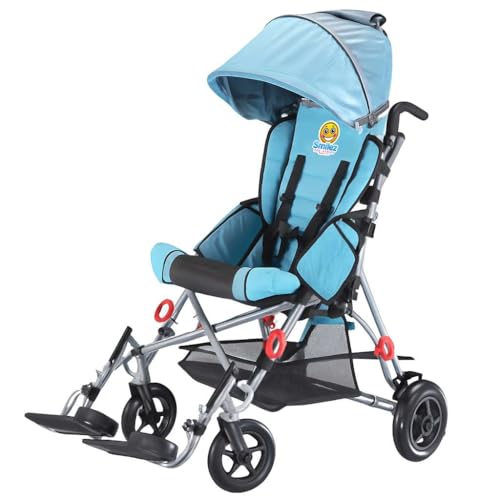
Smilez Adaptive Special Needs Stroller for Big Kids
Sylvan Urban Rider
Built for teenagers and young adults, the Urban Rider has a 17-inch shaped seat and a 250 lb capacity on an alloy steel frame, with a breathable mesh seat that washes and brakes on the rear wheels. Sylvan lists it as a portable folding wheelchair as much as a stroller. Be aware that it comes with a lap belt, not a harness, so it suits an older child who stays seated once settled. For a child who unbuckles or tries to climb out, choose one of the harnessed models above.
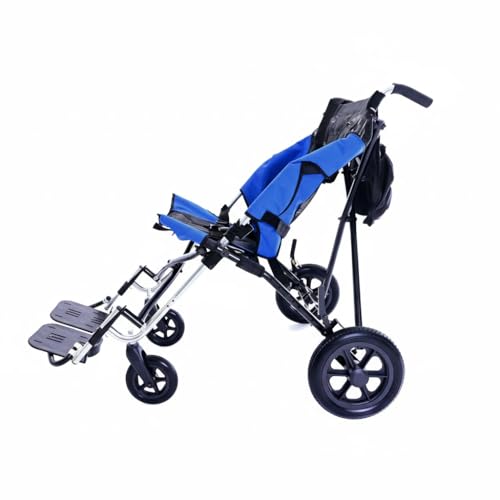
Sylvan Urban Rider Adaptive Stroller for Teens and Young Adults
Matching a Stroller to Your Child's Size and Needs
- Start with the weight limit. Use the maker's number, not a review, and leave room for a year or two of growth.
- Measure your child sitting down. Hip width sets the seat width; add an inch or so. The distance from the back of the knee to the back of the bottom tells you whether a seat is deep enough.
- Check the harness height. The shoulder straps should start at or just above your child's shoulders. A harness that sits too low pulls them forward.
- Think about the car. Lift a folded weight you can manage every day. Umbrella folds such as the Coche XL and Maclaren take up less room than the heavier positioning frames.
- Match the restraint to your child. A child who bolts or unbuckles needs a 5-point harness. Our guide to harnesses and wrist links covers the walking part of the same outing.
- Plan for the bus separately. A stroller only belongs in a school bus or van if its maker rates that model for transit and it is tied down properly.
Getting One Through Insurance or a Medical Supplier
Higher-support strollers such as the Convaid Cruiser, the Zippie Voyage and the Special Tomato range are usually ordered through a durable medical equipment supplier rather than a store. They offer more head and trunk support and more ways to fit the seat, and they can cost well over the prices above.
Insurance or Medicaid will often pay for them when a doctor writes a prescription plus a medical necessity letter setting out why your child needs one, such as safety risks from running off, low stamina or poor sitting balance. A physical or occupational therapist can measure your child and help the supplier choose a model. Expect the paperwork to take weeks, so start well before the regular stroller gives out. Families use the same kind of letter for safety beds, and that guide shows what to put in it.
Riding Safely
- Buckle every time, even for a short stretch. The ride that skips the harness is the one when your child spots something across the street.
- Set the brakes before loading and keep them on until your child is buckled.
- Keep heavy bags off the handles. A loaded handle can tip a stroller backward when the child climbs out. Use the basket instead.
- Use anti-tippers on hills and curbs if your model has them.
For a child who runs off, a stroller covers only part of the day. Our elopement prevention guide and our look at GPS trackers for autistic kids cover the rest.
Adaptive strollers vary a great deal from child to child. Before buying, ask your child's physical or occupational therapist to check the fit, and read the maker's manual for weight limits and safe use.
Products Mentioned in This Article
Coche XL Special Needs Stroller for Older Children
Maclaren Major Elite Special Needs Stroller
Strive Adaptive Stroller by Circle Specialty
Smilez Adaptive Special Needs Stroller for Big Kids
Sylvan Urban Rider Adaptive Stroller for Teens and Young Adults
Prices and availability are accurate as of the date/time shown and are subject to change. Any price and availability information displayed on Amazon at the time of purchase will apply to the purchase of this product.
Routines, feeding, sleep, toileting. The stuff that fills every hour of every day.
Beacon learns about YOUR child and gives guidance specific to them.
What Would Beacon Say?
"How do I handle this with my specific child?"
If you asked Beacon "How do I get my child to eat more than 3 foods?" it would consider their sensory preferences and age, then give you a specific food chaining strategy to start this week.

Spectrum Unlocked Editorial Team
Editorial Team
The Spectrum Unlocked editorial team combines lived experience as autism parents with research-backed guidance to create resources families can trust.
Frequently Asked Questions
- What is an adaptive stroller?
- A stroller built for a child or adult who is too big for a regular stroller but still needs to be pushed, whether for safety, stamina or physical support. It has a larger seat, a higher weight limit and usually a harness and adjustable footrest.
- Does my autistic child need an adaptive stroller?
- Not every child does. Families tend to look for one when a child bolts across parking lots or into crowds, tires quickly on long outings, or needs a familiar, contained seat to stay calm at busy places such as airports, zoos or hospitals.
- What size adaptive stroller should I buy?
- Measure your child seated: hip width, the length from the back of the knee to the back of the bottom, and shoulder height. Choose a seat slightly wider than the hips and check the harness reaches the shoulders, then confirm the weight limit leaves room to grow.
- Will insurance pay for an adaptive stroller?
- Often, when a doctor writes a prescription and a letter explaining why your child needs one. Insurers and Medicaid usually cover models ordered through a medical equipment supplier rather than stores, so ask the supplier or your child's therapist to start the paperwork.
- How much does an adaptive stroller cost?
- The models on Amazon in this guide ran from about $400 to $800 on November 10, 2026. Supplier models with more positioning support can cost more, which is why many families go through insurance.
- Can an adaptive stroller be used on a school bus?
- Only if its maker rates that model for transit and it is fastened with a proper tie-down system. Otherwise the child should move into a vehicle seat for the ride. Ask the maker or the transport team before using one on a bus.