Best Chewables and Oral-Sensory Tools for Autistic Kids (Beyond the Chew Necklace)
The oral-sensory tools that give an autistic chewer a safe outlet: a discreet wrist chew, a pencil topper for school, a firm oral-motor chew, a back-molar Y-chew, a vibrating Z-Vibe, and a textured bar, plus how to match firmness and stay safe.
Key Takeaways
- Chewing is communication and a sensory need, not a bad habit to break. The jaw pressure of chewing delivers proprioceptive input that is calming and organizing, and kids also chew to manage anxiety, meet an oral-motor need, or self-regulate when overwhelmed. The goal is never to stop the chewing but to give it a safe outlet, which is exactly what these tools do.
- Firmness has to match your chewer, and this is where safety lives. A light chewer needs a soft or standard chew; an aggressive chewer who destroys things needs a very firm, tough one. The critical rule: a chew your child can bite through is a choking hazard, so size up the firmness for a strong chewer and inspect every tool regularly, replacing it the moment it shows real wear.
- Match the form to where your child chews. If they chew shirt collars and sleeves, a discreet chew bracelet or necklace redirects it; if they chew pencils and destroy erasers at school, a chewable pencil topper meets them at the desk. Buying for the specific context beats buying a generic chew and hoping it lands.
- Chewing tools split into passive and active. Passive chews (bracelets, toppers, chew tools) give a child something safe to bite whenever they need it. An active tool like a vibrating Z-Vibe adds gentle stimulation and oral awareness and is used in speech and feeding therapy, a different job from simple chewing, so pick based on whether your child needs an outlet or oral-motor work.
- Some chewing points to something worth a professional's eye. Intense, constant chewing, chewing tied to distress, feeding difficulties, or chewing and swallowing non-food items (pica) are all reasons to loop in an occupational therapist or speech-language pathologist. A chew tool meets the need safely today while an OT or SLP helps you understand and address the why.
If your child chews through shirt collars, destroys pencils, or always seems to have something in their mouth, they are not misbehaving. Chewing delivers calming pressure through the jaw, and autistic kids reach for it to self-regulate, manage anxiety, and meet a real oral-sensory need. Stopping the chewing is the wrong goal. A safe outlet is the right one, so your child gets the input they need without wrecking clothes or gnawing on something that is not safe to bite.
A chew necklace is the usual first stop, and it deserves its own guide. This list goes wider, to the rest of the oral-sensory toolkit: a wrist chew for the sleeve chewer, a pencil topper for the desk, firm chews for front teeth and back molars, a vibrating tool for oral-motor work, and a textured bar. One rule runs through all of it, matching firmness to your chewer for safety, which we cover plainly. And if the chewing zeroes in on the toothbrush itself, a chew-safe sensory toothbrush meets that need at the bathroom sink.
Read Your Chewer First
- Treat chewing as a need, not a habit. The goal is a safe outlet, not stopping it. Redirect the chewing rather than fighting it.
- Match firmness to your chewer. Soft or standard for a light chewer, tough and firm for an aggressive one. A chew your child can bite through is a choking hazard, so size up for a strong chewer and replace any worn tool.
- Buy for where they chew. Collars and sleeves point to a bracelet or necklace; pencils and erasers point to a topper; grinding with molars points to a Y-chew.
- Know passive from active. A chew gives a safe thing to bite; a vibrating tool does oral-motor work. Pick for the goal, and get therapist input for intense or feeding-related chewing.
What Made a Chew Earn a Spot
Nothing here was bitten in a lab, and no chew gets a score out of ten. The shortlist came from the way occupational and speech therapists use oral input, then each tool was checked on four things a parent can verify from the packaging: whether the maker sells it in more than one toughness grade, whether the material is non-toxic, which teeth the shape reaches, and whether it fits the place your child chews.
- One chewing pattern per pick. Wrist chewer, desk chewer, front teeth, back molars, oral-motor work, texture seeker.
- Toughness you can step up. A tool that comes in firmer grades for a child who bites through the first one.
- A real replacement for the sleeve. Something a child will reach for instead of clothes or pencils.
- Built for the bite it targets. A molar chew has to survive a molar grinder.
- Clear limits. A safe outlet, with a pointer to an OT or SLP for intense or feeding-related chewing.
The Best Chew Toys and Chewies for Oral Sensory Issues
Best discreet wearable: Sensory Chew Bracelet
For the child who chews sleeves, hoods, and collars, worn where no one has to notice. A stretchy coil chew bracelet sits on the wrist like an ordinary bracelet and is always right there when your child needs to bite, redirecting the chewing off their clothes and onto something safe. It is more discreet than a necklace for some kids and keeps the outlet within reach at school, in the car, or out in public without a fuss. For a low-key, always-available chew that does not announce itself, the bracelet is a great everyday default, especially paired with a chew necklace for variety.

Sensory Chew Bracelet (Stretchy Coil)
Best for school: Chewable Pencil Toppers
For the desk chewer who mangles pencils and erasers. A chewable pencil topper slips onto the end of a pencil and gives a child something safe and satisfying to bite during schoolwork, which meets the chewing right where it happens and is far less conspicuous than a necklace for an older student. It solves the destroyed-pencil, chewed-cap problem while giving your child the oral input that helps them focus, and a multipack means spares for the ones that inevitably get lost. For chewing that flares up during seat work and homework, this is the pick that fits the classroom.
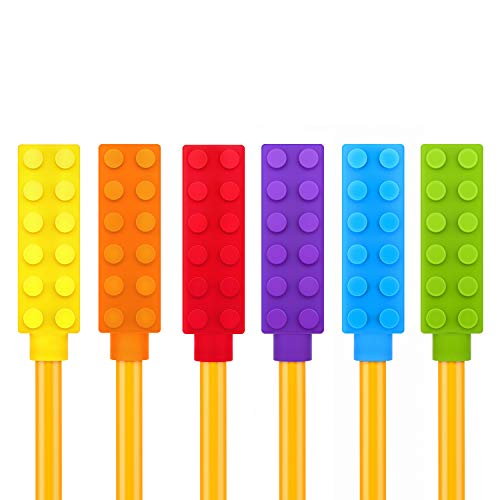
SOLACE Chewable Pencil Toppers (6-Pack)
Best firm oral-motor chew: ARK Grabber
For a child who needs a real, sturdy chew tool to work their jaw. The ARK Grabber is a P-shaped, medical-grade chew designed for front-teeth chewing and oral-motor input, and it comes in escalating toughness levels so you can match it to how hard your child chews. It is a therapy-grade staple for a reason: durable, safe, and shaped to give firm, satisfying resistance where a soft chew would not. For a child whose chewing is about needing to bite down hard on something substantial, the Grabber is the dependable workhorse, and moving up a toughness level is the answer if they power through the standard one.

ARK Grabber Oral-Motor Chew
Best for a back-molar chewer: ARK Y-Chew
For the heavy chewer who grinds with their molars, not their front teeth. Most chews are built for the front of the mouth, which leaves a molar-grinder unsatisfied, and the Y-Chew solves that with a branched shape that reaches back so a child can chew exactly where they need to. It comes in firm versions made to survive a strong chewer, and it is the answer for the kid who jams things toward the back of their mouth or grinds rather than nibbles. If a front-teeth chew keeps failing your child, it is probably the wrong shape, not the wrong idea, and this is the fix.

ARK Y-Chew (Back-Molar Chew)
Best active oral tool: ARK Z-Vibe
For oral-motor work and strong oral input, not just passive chewing. The Z-Vibe is a vibrating oral tool that adds gentle stimulation to the mouth, building oral awareness and sensory input, and it is widely used by speech and feeding therapists for oral-motor development as well as by kids who seek intense oral input. This is a different job from a simple chew: it actively stimulates rather than just giving something to bite, which can help a child build tolerance and awareness. Choose it when the goal is oral-motor work or strong active input, and use it alongside your child's therapist's guidance where you can.

ARK Z-Vibe Vibrating Oral Tool
Best textured chew: Chewy Stixx Textured Bar
For the chewer who wants a different feel and easy reach. A textured chew bar is a long, double-ended tool with a bumpy surface that provides varied tactile input to the mouth along with something firm to bite, and the length makes it easy to guide toward wherever a child chews. The texture suits a kid who finds smooth chews boring or wants more sensation, and the double ends give options in one tool. It rounds out a chew collection with a different shape and feel from the others here, which matters, since many chewers want variety and will use different tools on different days.

Chewy Stixx Textured Oral Chew Bar
Redirect the Chewing and Biting, Safely
Your child chews because it helps them, so give them a safe, satisfying place to do it, matched to how they chew and where, and the clothes and pencils get a reprieve while your child keeps the regulation they need. Firmness and wear are where you cannot cut corners: match the toughness to your chewer, inspect the tools often, and replace anything that starts to break down, because a chew bitten to pieces is a choking hazard.
Chewing is one thread in your child's sensory and self-regulation world. If the chewing is one of several stims, our guide to stimming frames why it happens and when to simply let it be, and if the oral-seeking shows up hardest at mealtimes, the sensory feeding tools guide covers the table. The chew necklace guide is the companion first stop to this one. And if you are not sure how much oral input your child is seeking, the sensory profile quiz maps it across all eight senses. Requesting the chewy instead of grabbing a sleeve is teachable too: the printable sensory breaks book has the child seat the picture of their chewy into an "I need" sentence. Meet the need safely, match the tool to the chewer, and loop in a therapist when the pattern runs deep.
Products mentioned in this article
Sensory Chew Bracelet (Stretchy Coil)
SOLACE Chewable Pencil Toppers (6-Pack)
ARK Grabber Oral-Motor Chew
ARK Y-Chew (Back-Molar Chew)
ARK Z-Vibe Vibrating Oral Tool
Chewy Stixx Textured Oral Chew Bar
Prices and availability are accurate as of the date/time shown and are subject to change. Any price and availability information displayed on Amazon at the time of purchase will apply to the purchase of this product.
Sensory overwhelm shows up differently in every child.
Beacon learns about YOUR child and gives guidance specific to them.
What would Beacon say?
"What sensory strategies actually work for my child?"
Beacon factors in your child's specific sensitivities (sound, light, texture, movement) and current regulation, then builds a sensory plan you can start tonight.
Spectrum Unlocked Editorial Team
Editorial Team
The Spectrum Unlocked editorial team combines lived experience as autism parents with research-backed guidance to create resources families can trust.
Frequently asked questions
- Why does my autistic child chew on everything?
- Because chewing does something for them, and it is almost always a need rather than misbehavior. The main driver is proprioceptive input through the jaw, which is calming and organizing, the same reason many people chew gum or pen caps when concentrating or stressed. Kids also chew to manage anxiety and big feelings, to meet an oral-motor need, and sometimes simply because they are teething or hungry. Occasionally intense chewing or swallowing of non-food items points to pica or a medical issue worth raising with a doctor. A chew tool gives your child a safe, acceptable outlet for the input they are already seeking, while you work out the why with an OT or speech-language pathologist. Our guide to chew necklaces covers that first-line option in depth.
- How do I choose the right firmness or toughness of chew?
- Match it to how hard your child chews, because this is the main safety decision. A light or mild chewer does well with a soft or standard-firmness tool, which feels pleasant and is easy on the jaw. A strong or aggressive chewer, the kind who shreds shirts and destroys pencils, needs a firm, tough chew, and brands like ARK sell the same tool in escalating toughness levels for exactly this reason. The rule that matters most: never give a chew your child can bite pieces off of, because that is a choking hazard. If your child gets through a chew quickly, move up to a firmer version, inspect every tool often, and retire any chew that shows cracks, tears, or bite-through.
- Necklace, bracelet, or pencil topper, which chew should I get?
- Buy for where your child chews. If they chew shirt collars, hoods, and sleeves, a chew necklace or a discreet chew bracelet sits right where the chewing happens and redirects it to something safe. If the chewing shows up at school on pencils, erasers, and pen caps, a chewable pencil topper meets them at the desk and is far less conspicuous than a necklace for an older kid. If they need a dedicated chew tool to hold and bite, a chew tool or textured bar is the pick. Many families own two: a wearable one for out and about, and a chew tool or topper for focused chewing at home or school.
- What is a ChewNoodle, and is it what my child needs?
- A ChewNoodle is a clip-on chew: a length of non-toxic silicone on a clip that fastens to a shirt, a bag or a belt, so the tool stays with your child instead of going missing by second period. It does the same job as the chew bracelet at the top of this list, which is keeping a safe, discreet chew within reach of a child who otherwise goes for collars and sleeves, so the choice between them comes down to what your child will actually wear. A clip sits on clothing and is quick to grab but can be pulled off and dropped; a bracelet stays put on the wrist and is harder to lose. Whichever shape you pick, the safety rule does not change: match the firmness to how hard your child chews, never leave them with a chew they can bite pieces off, and retire any tool that shows cracks or bite-through.
- What is a vibrating chew tool like the Z-Vibe for?
- A Z-Vibe is an active oral-motor tool rather than a passive chew, and it does a different job. It provides gentle vibration to the mouth, which increases oral awareness and sensory input, and it is widely used by speech-language pathologists and occupational therapists for speech, feeding, and oral-motor therapy, as well as for kids who seek strong oral input. Where a bracelet or chew tool simply gives a child something safe to bite, the Z-Vibe actively stimulates and works the oral area, which can help a child who needs to build oral awareness or tolerate more input. Choose it when the goal is oral-motor work or intense stimulation, and ideally use it with guidance from your child's therapist.
- My child chews with their back molars or grinds. What helps?
- That is a heavy chewer, and most chew tools are shaped for the front teeth, which is why they do not satisfy a child who needs to grind with their molars. A Y-shaped chew is designed for exactly this: the branched shape reaches back to the molars so a child can chew where they need to, and it comes in firm versions built to survive a strong chewer. If your child jams things toward the back of their mouth or grinds rather than nibbles, a front-teeth chew will keep failing them; a back-molar chew meets the need. As always, match the toughness to their strength and replace it when it wears.
- When should I involve a speech therapist or occupational therapist?
- When the chewing is intense, constant, tied to distress, or paired with other concerns. Persistent aggressive chewing that a tool does not satisfy, chewing that spikes with anxiety or overwhelm, feeding and eating difficulties alongside the chewing, or chewing and swallowing non-food items (pica) are all reasons to bring in an occupational therapist or speech-language pathologist. They can assess the oral-motor and sensory drivers, rule out or address medical factors, and build a plan that fits your child. A chew tool is the right immediate step, it meets the need safely today, but for an ongoing, intense pattern it works best alongside professional input rather than instead of it.