Best Slant Boards for Kids' Handwriting
Slant boards that tilt the page up for easier handwriting, from a budget dry-erase board to a classroom set, plus the free binder version and how to set one up.
Key Takeaways
- A slant board raises the far edge of the page so a child writes on a tilted surface instead of a flat desk. Occupational therapists use them to bring the wrist into a firmer writing position and lift the work closer to eye level.
- The benefits come mostly from therapist experience rather than controlled studies, so treat a board as something to try for a few weeks and keep if handwriting or stamina improves.
- Children who tire quickly, slump over the desk, or hold the pencil with a wrist that bends forward tend to notice the biggest change.
- You can test the idea for free with a 3-inch ring binder turned sideways before buying a board.
- Pair the board with short writing sessions and a good pencil grip; the board changes the angle, but it does not replace practice.
Watch a child write at a flat table for ten minutes and you often see the same slide: the head drops closer to the page, the shoulders round, the wrist bends forward and the letters start to wander. A slant board will not fix handwriting by itself, but it changes the surface the child is fighting against, and in many cases that surface is what was wearing the child out.
This roundup covers what the tilt actually changes, which children tend to get the most out of it, five boards worth buying, and a free version you can set up tonight. Each price below was confirmed on November 10, 2026.
What the Tilt Changes
A slant board raises the far edge of the page, most often to around 20 degrees. Occupational therapists point to three effects:
- Wrist position. On an angle, the wrist tends to settle slightly back rather than curling forward, which gives the fingers more control of the pencil.
- Posture. The work comes up toward the child, so they lean over it less.
- Eye level. The page sits closer to where the eyes already are, which some children find easier for copying and for keeping their place when reading.
An honest note: most of what is written about slant boards comes from therapists' experience and from the companies that sell them, not from controlled studies. That does not mean they do not work. It means the best evidence for your child is a few weeks of trying one and comparing.
Which Children Notice a Difference
Children who tend to get the most from a board:
- A child with low muscle tone who tires quickly at a desk
- A child whose wrist bends forward or whose grip collapses as they write
- A child who slumps until their face is close to the paper
- A child who copies from a board or book and loses their place
- An autistic child who finds a flat desk uncomfortable and stops writing early because of it
If your child's handwriting difficulty is mainly about forming letters, spacing or planning what to write, a board may help less, and an occupational therapy evaluation is worth asking about. Our guide to motor skills IEP goals shows how handwriting support can be written into a school plan.
What Earned a Place Here
Each board below does something the others do not. We looked for a firm surface that does not flex under a pencil, a clip or magnets to stop the page moving, an angle close to what therapists recommend, and a price that makes sense for a tool your child may outgrow. All five could be ordered from Amazon on November 10, 2026, the day this list was last reviewed.
Best Overall: INNER-ACTIVE Sloped Writing Board
A plain, sturdy board built for handwriting rather than as a general desk accessory. It has a clip at the top to hold the page and a smooth surface that does not give under the pencil. If you are buying one board for home and want it to just work, start here.

INNER-ACTIVE Slant Board for Writing, Sloped Surface for Handwriting and Posture
Best With a Whiteboard: Visual Edge
The Visual Edge board doubles as a magnetic whiteboard. That matters for a child who resists paper: practicing letters with a dry-erase marker on the same angle can feel lower stakes, and magnets hold a worksheet or a visual schedule in place. It sits at 22 degrees and is the priciest of the five, so it suits a family that will use it every day.
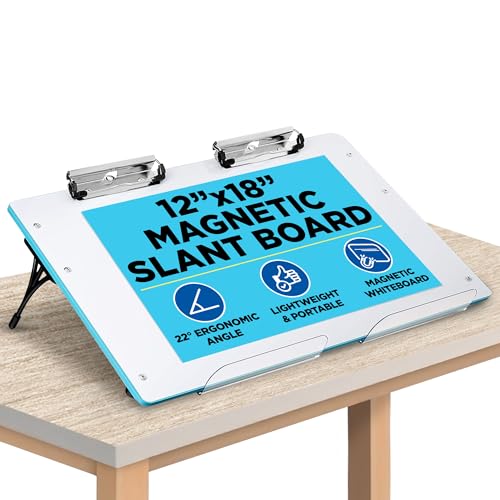
Visual Edge Slant Board for Writing, Magnetic Whiteboard, 22 Degree Angle
Best on a Budget: Junior Learning
A lighter magnetic dry-erase slant board at a lower price. It is a sensible first board while you find out whether the angle suits your child, and the dry-erase surface means it earns its keep even on days without worksheets.

Junior Learning Slant Board, Magnetic Dry Erase Board for Handwriting
Best for Changing the Angle: AnYoben Bamboo Board
This bamboo board folds and sets to six angles, which helps if one fixed slope feels too steep or too shallow for your child. It is newer and has far fewer reviews than the boards above, so treat it as the pick for a family that specifically wants adjustability. It also suits an older child or teen who uses it for reading as well as writing.

AnYoben Adjustable Bamboo Slant Board for Writing, 6 Angles
Best for a Classroom: hand2mind Set of Six
A set of six colorful boards for a classroom, therapy room or a family with several children. Teachers can hand one to any child who needs it without singling anyone out, which matters to a student who does not want to look different from classmates.

hand2mind Rainbow Writing Slant Boards, Set of 6
The Free Version: a Binder on Its Side
Before buying anything, try a 3-inch ring binder. Lay it on the table with the spine away from your child so the cover slopes toward them, then clip the paper to the cover or hold it with painter's tape. It is not as stable as a real board, but a week with it will tell you whether the angle helps your child at all.
Setting It Up So It Gets Used
- Chair and table first. Feet flat on the floor or a box, and the table at about elbow height. A board cannot make up for a chair that is too low.
- Start with drawing. A first session of coloring or tracing on the board is easier to accept than a page of handwriting.
- Keep sessions short. Five to ten minutes of writing on the board, then a break, works better than a long session that ends in frustration.
- Clip the page. Paper that slides is one more thing to fight. Every board above has a clip or magnets for this reason.
- Pair it with a grip if needed. If your child's fingers still struggle on the angle, our pencil grips roundup covers grips matched to different grasp patterns.
- Give the lines some help. On a tilted surface, raised-line or highlighted handwriting paper shows a child exactly where each letter should stop.
For a child who wriggles while they write, a wobble cushion on the chair can work alongside the board, giving the body some movement while the hands get a steadier surface.
Products Mentioned in This Article
INNER-ACTIVE Slant Board for Writing, Sloped Surface for Handwriting and Posture
Visual Edge Slant Board for Writing, Magnetic Whiteboard, 22 Degree Angle
Junior Learning Slant Board, Magnetic Dry Erase Board for Handwriting
AnYoben Adjustable Bamboo Slant Board for Writing, 6 Angles
hand2mind Rainbow Writing Slant Boards, Set of 6
Prices and availability are accurate as of the date/time shown and are subject to change. Any price and availability information displayed on Amazon at the time of purchase will apply to the purchase of this product.
Need help preparing for YOUR next IEP meeting?
Beacon learns about YOUR child and gives guidance specific to them.
What Would Beacon Say?
"Help me prep for my IEP meeting"
If you asked Beacon "Help me prep for my IEP meeting" it would pull your child's goals, challenges, and history, and give you the exact questions to ask, red flags to watch for, and what to push back on.

Spectrum Unlocked Editorial Team
Editorial Team
The Spectrum Unlocked editorial team combines lived experience as autism parents with research-backed guidance to create resources families can trust.
Frequently Asked Questions
- What is a slant board used for?
- It tilts the writing surface up at the far edge, usually by about 20 degrees, so a child writes, draws or reads on an angle. Occupational therapists use one to support wrist position, posture and visual attention during desk work.
- Do slant boards really help handwriting?
- Many occupational therapists see improvements in posture, stamina and pencil control when a child uses one, but most of that evidence is practical experience rather than research trials. The fair test is your own child: try one for a few weeks and compare their writing and how long they can keep going.
- What angle should a slant board be?
- Around 20 degrees is the common starting point, and some therapists suggest at least 22 for posture. A board with several angles lets you adjust if your child's wrist still bends or the paper slides.
- Can I make a slant board at home?
- Yes. A 3-inch ring binder laid on its side with the spine away from your child makes a quick slant board. Clip the paper to the cover or use a strip of painter's tape to keep it from sliding.
- Are slant boards good for autistic children?
- They can help an autistic child who has low muscle tone, tires quickly when writing, or finds a flat desk uncomfortable. A board with a clip also keeps the page still, which helps a child who is distracted by paper that shifts.
- Is a slant board the same as a writing slope?
- Yes. Writing slope, slanted writing board and slant board all describe the same tool: a firm angled surface that sits on a desk or table.