Best Pencil Grips for Autistic Kids: A Better Grasp, Less Fatigue
Does your autistic or neurodivergent child fist the pencil or press until their hand aches? Which grip fixes which grasp problem, plus picks sized for young kids, older kids, and left-handed writers.
Key Takeaways
- A pencil grip guides the fingers into a tripod grasp, the thumb and two fingers hold that makes writing controlled and comfortable. For an autistic child who wraps the whole fist around the pencil or crosses the fingers over, a shaped grip physically blocks the awkward hold and puts the hand where it needs to be, so the correction happens without a running reminder to fix it.
- The right grip eases hand fatigue for a child who presses very hard or tires after a few lines. A cushioned or structured grip spreads the pressure and takes some of the work off small, tired muscles, which is why a kid who used to give up after one sentence can sometimes finish the page.
- A textured grip doubles as a quiet fidget. The squish or bumps give busy fingers something to feel while the hand still does its job, which suits a sensory-seeking child who writes better with a bit of tactile input in the fingers.
- Grip choice is individual, and an occupational therapist is the person who can match the grip to the child. What corrects one kid's grasp does nothing for another, so plan to trial a few. A grip supports a motor or sensory difficulty without curing it.
- A grip is a training aid, not a permanent crutch. As a child's control improves, you can step down from a highly structured grip to a lighter one and eventually to none, and an OT can guide that fading so the gains stick.
If writing is a fight in your house, a pencil grip is a small, cheap thing worth trying early. A lot of autistic kids do not hold a pencil the way handwriting instruction assumes. They wrap the whole fist around it, cross the fingers over the top, or grab it so tight that the hand aches after a couple of lines. A shaped grip slides onto the pencil and guides the fingers into a tripod grasp, the thumb-and-two-fingers hold that makes writing controlled and far less tiring, so the correction happens in the hand instead of in a constant reminder to hold it right.
Grips solve three different problems, and kids differ in which one they have. Some need the fingers physically blocked out of a bad hold. Some need the pressure cushioned because they bear down hard or tire fast. Some just want a bit of texture to keep busy fingers settled on the pencil. A caveat first: grip choice is individual, and an occupational therapist is the person who can match a grip to a child's hand. A grip supports a fine-motor or sensory difficulty without curing it. The six grips below each answer one of those three problems.
How Your Child Holds the Pencil Now
- Watch how your child holds the pencil first. A fist-grip or finger-crossover needs a structured, winged grip that blocks the wrong hold. A child who just tires or presses hard may do better with a soft cushioned grip.
- Plan to trial more than one. Grip fit is individual, and what corrects one child's grasp does nothing for another. A variety kit or a big multipack lets you test without buying five separate things.
- Check the hand. A left-handed child needs a grip designed for the left hand, not a righty grip turned around, or it pushes the fingers into an awkward spot.
- Treat it as a training aid you will phase out. The goal is a better grasp that eventually holds up on its own. As control improves, step down to a lighter grip.
- Check the grip is the real problem. A child who cannot yet copy a cross or a square from a model is not being held back by the pencil, and no grip will supply the missing stroke. The pre-writing skills sequence shows which shape comes next and how to test where a child really is.
Grasp Support Came First, Then Fit and Price
These grips were compared on paper and against OT practice rather than in a lab, and none carries a star rating. The comparison weighed how each grip shapes the fingers (wings, a claw, finger pockets or plain cushioning), whether it suits a left hand, how low-profile it looks for an older child, what it is made of and how many come in a pack. Occupational-therapy guidance on grasp development and sensory input, plus Spectrum Unlocked's own work with kids who struggle with handwriting, filled in the rest. Every pick was checked as a real, currently available listing before it went on the list. Five criteria:
- Real grasp support. A grip that guides the fingers into a tripod hold or blocks the fist-grip, rather than just padding the barrel.
- A match to the problem. Options for the fist-gripper, the heavy presser, the sensory seeker, the lefty, and the older kid who refuses anything obvious.
- A way to trial and fade. Kits and multipacks so you can test support levels and step down as a child's control grows.
- A fit for the real hand. Sizes and shapes that suit a young child, an older kid, or a left-handed writer.
- Value that survives a backpack. Durable material and a sensible price, since these get lost, chewed, and handed around.
A note on the brands before the list. Four of the six picks are made by The Pencil Grip, on purpose. The Pencil Grip is the long-standing, OT-standard maker whose grips therapists reach for, so a grasp-training list that skipped them would be leaving out the tools that do the most work.
Pencil Grips That Help Autistic and Neurodivergent Kids Hold a Pencil
Best Overall for Training a Tripod Grasp: The Pencil Grip Crossover Grip
The one to start with for a child who fists the pencil or crosses the fingers over the top. This Crossover grip from The Pencil Grip has raised "wings" that physically sit in the way of the wrong hold, so the fingers cannot fold into a fist or cross over and instead land in the tripod position the wings leave open. It is ambidextrous, so it works for a righty or a lefty, and it comes as a six-pack, which is exactly what you want when grips vanish into backpacks and desks. If you are buying one grip to fix an awkward grasp, this is the kind that does the correcting for you.

The Pencil Grip Crossover Grip (6-Pack)
Best Variety Kit to Trial and Fade: The Pencil Grip 3-Step Training Kit
For the family that does not yet know which level of support their child needs, or wants to step down over time. This 3-Step Training Kit from The Pencil Grip pairs three grips at three levels: the Crossover that blocks the fist-grip, a Pinch grip with less structure, and a Standard grip for the lightest touch. That lets you trial support levels at home instead of guessing, and it makes the eventual fade straightforward, because as your child's control improves you already have the next lighter grip in hand. For a first purchase when you are still figuring out what helps, the kit answers more questions than any single grip.

The Pencil Grip 3-Step Training Kit
Best Textured Grip for a Heavy Presser or Sensory Seeker: Special Supplies Squishy Pencil Grips
For the child who bears down hard, tires fast, or wants something to feel while they write. This Special Supplies set is a soft, squishy cushion grip, and the give in the material spreads out the pressure from a white-knuckle hold so the strain does not go straight into small, tired hand muscles. The same squish gives busy fingers a quiet tactile fidget on the pencil, which suits a sensory-seeking kid who focuses better with a bit of input in the hand. It comes as a hundred-pack in assorted colors, so there is one for every pencil at home and school, and losing a few costs nothing. For hand fatigue and sensory needs, start here.
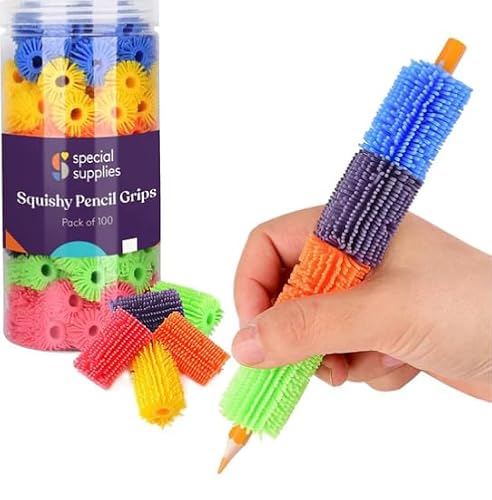
Special Supplies 100 Squishy Pencil Grips
Best for Left-Handed Kids: Firesara Left-Handed Butterfly Grips
For the lefty whose hand a standard grip seems to fight. These Firesara grips are mirror-designed for the left hand, with finger pockets shaped for the way a left-handed child holds and angles the pencil, rather than a right-handed grip reused and hoped for. That distinction matters, because a righty grip on a left hand can push the fingers into a worse position than no grip at all. The butterfly shape gives clear pockets for the thumb and fingers to settle into. If your child is left-handed and grips have not seemed to help, it may be that the grip was built for the wrong hand, and this is the one to try before giving up.

Firesara Left-Handed Butterfly Pencil Grips (4-Pack)
Best Subtle Grip for an Older Kid or Teen: The Pencil Grip Pinch Grip
For the older child or teenager who still needs correction but will not be caught dead with a chunky "babyish" grip. This Pinch grip from The Pencil Grip is lower-profile and less obvious than a big winged grip, so it guides the thumb and fingers toward a proper hold without announcing itself across a middle-school classroom. It comes as a six-pack, and it slots in well as a step down for a kid who has outgrown a heavier training grip but still writes better with a nudge. For the self-conscious older writer, discreet is what gets the grip used instead of stuffed in a locker.

The Pencil Grip Pinch Grip (6-Pack)
Best Maximum-Structure Grip for a Strong Presser: The Pencil Grip CLAW
For the child who grips like a vice or whose fingers slide out of a softer grip. The CLAW from The Pencil Grip is a three-pronged design that locks the thumb and two fingers into set positions, so it gives the most structure of any grip here and holds the hand in place even for a strong, heavy-handed writer. Where a cushioned grip suggests a position, the CLAW enforces one, which suits a white-knuckler who needs the fingers held rather than merely guided. It is the most directive option on the list, so reach for it when lighter grips have not been enough to keep the hand where it should be.

The Pencil Grip Writing CLAW
Where the Grip Sits on the Pencil
A pencil grip only helps if it sits in the right spot and matches the problem in the hand, so a couple of checks decide most of it. First, placement: the grip goes low on the pencil, near the sharpened end, where the fingers naturally fall, not up by the eraser. Slide it down until your child's fingertips rest on the shaped part rather than reaching past it. Second, the match: a fist-gripper needs the structure of a winged or clawed grip, while a child who only tires or presses hard often does better with a soft cushioned one, so watch the hand before you commit to a type.
From there, expect some trial and error, and do not read a grip that does not click as failure. Grip fit is individual, and it is normal to try two or three before one takes. Introduce the grip as a normal part of the pencil rather than a correction, let your child get used to the feel, and if your child works with an occupational therapist, bring the grips to a session, because matching a grip to a hand is exactly what an OT is trained to do. As control improves, step down to a lighter grip so the gains hold up on their own.
Where a Pencil Grip Fits
A grip is one support inside a bigger picture, and it works best alongside the other tools that meet a busy or sensory-seeking child where they are. A grip keeps the fingers on task while writing, but the strength behind that grip has to come from somewhere, which is where therapy putty earns its place, since squeezing and pinching it builds the very hand muscles a pencil grip relies on. The same child often needs an outlet for restless hands the rest of the day too, which is where a set of sensory and fidget toys comes in, and the broader best toys for autistic kids guide covers the play that builds hand strength and coordination in the background. Handwriting leans on more than the grip alone, so the fine-motor and sensory pieces around it matter.
The practice side is covered on this site too. The free special education worksheets gallery has ready-made tracing worksheets at every support level, so a new grip has a page to work on the day it arrives.
If you are not yet sure whether your child's writing struggle is mostly motor or mostly sensory, the sensory profile quiz is a good place to start sorting it out. Match the grip to the hand, lean on an occupational therapist where you have one, and a small rubber shape can turn a page of writing from a battle into something your child can finish.
Products mentioned in this article
The Pencil Grip Crossover Grip (6-Pack)
The Pencil Grip 3-Step Training Kit
Special Supplies 100 Squishy Pencil Grips
Firesara Left-Handed Butterfly Pencil Grips (4-Pack)
The Pencil Grip Pinch Grip (6-Pack)
The Pencil Grip Writing CLAW
Prices and availability are accurate as of the date/time shown and are subject to change. Any price and availability information displayed on Amazon at the time of purchase will apply to the purchase of this product.
Which therapy first? That depends entirely on your child.
Beacon learns about YOUR child and gives guidance specific to them.
What would Beacon say?
"Which therapy should we start first?"
Beacon weighs your child's age, biggest challenges, and your insurance reality, then tells you what to prioritize instead of starting everything at once.

Spectrum Unlocked Editorial Team
Editorial Team
The Spectrum Unlocked editorial team combines lived experience as autism parents with research-backed guidance to create resources families can trust.
Frequently asked questions
- Do pencil grips actually help autistic kids?
- For many kids, yes, though not as a magic fix. A lot of autistic children hold a pencil in a fist or with the fingers crossed over, which makes writing tiring and hard to control, and some press so hard that their hand aches after a few lines. A shaped grip guides the fingers into a tripod hold and cushions the pressure, so the hand does less work and the writing gets steadier. It supports a fine-motor or sensory difficulty rather than curing it, and it works best paired with practice and, where a child has one, an occupational therapist's guidance.
- How do I choose the right pencil grip for my child?
- Plan to trial a few, because grip fit varies from child to child and what corrects one child's grasp does nothing for another. Start by watching how your child holds the pencil: a fist-grip or finger-crossover usually needs a structured, winged grip that blocks the wrong hold, while a child who just tires or presses hard may do better with a soft cushioned grip. A variety kit lets you test different levels of support at home. If your child works with an occupational therapist, ask them, matching the grip to the hand is exactly the kind of thing an OT does.
- Are textured or squishy grips better for a sensory seeker or a heavy presser?
- They often help both. A squishy, textured grip gives the fingers something to feel, which a sensory-seeking child tends to like and which can keep busy fingers occupied on the pencil instead of wandering. The same cushioning spreads out the pressure from a child who bears down hard, so the grip absorbs some of the force that would otherwise go straight into small hand muscles. If your child either craves tactile input or writes with a white-knuckle grip, a soft textured grip is worth trying first.
- Are there pencil grips made for left-handed kids?
- Yes, and they matter more than people expect. A left-handed child holds and angles the pencil differently, so a grip designed for a right hand can push the fingers into an awkward position rather than a helpful one. A true left-handed grip mirrors the finger pockets for the left hand instead of reusing a righty mold. If your child is a lefty and a standard grip seems to fight them, switch to one made for the correct hand before deciding grips do not work.
- At what age can a child start using a pencil grip?
- Roughly from the preschool and early-elementary years, once a child is holding crayons and pencils and starting to write, which is often around three or four and up. Younger children usually do best with a chunky, structured grip that makes the correct hold obvious, while older kids can use lower-profile grips. There is no hard cutoff at the top end either, plenty of older kids, teens, and adults use grips to write more comfortably. Follow your child's hand, not just the birthday.
- Will a pencil grip fix my child's handwriting on its own?
- No. A grip puts the fingers in a better position and takes some strain off the hand, but handwriting also depends on hand strength, motor planning, and practice, none of which a piece of rubber supplies by itself. Think of a grip as one support inside a bigger plan. Pair it with regular writing practice, our free name tracing worksheets are one way to get a page in front of them, and, where a child has motor or sensory challenges, an occupational therapist who can build strength and technique alongside the grip.
- How do I fade the grip once my child's control improves?
- Step down gradually rather than pulling it away all at once. As a child's grasp gets steadier, you can move from a highly structured grip that locks the fingers in place to a lighter one that only nudges them, and eventually to writing without a grip at all. A variety kit makes this staged fade easier because you already have the lighter options on hand. If your child sees an occupational therapist, let them guide the timing, so the correct grasp holds up once the support comes off.