Best Weighted Blankets for Autistic Kids (and How to Use Them Safely)
The weighted blankets that actually help autistic kids self-regulate, with the 10-percent rule and the safety guidance an occupational therapist would give you first.
Key Takeaways
- Deep pressure helps a lot of autistic kids feel calmer and more organized, and a weighted blanket is the most common way to give it at home. But it is a tool for winding down and regulating, and the research on sleep specifically is mixed, so do not count on it as a sleep aid.
- Get the weight right: the common guideline is about 10 percent of your child's body weight, and it is safer to start a pound or two under that than over. Heavier is not better.
- Safety comes before the product. A weighted blanket is only appropriate once a child can independently push it off and reposition themselves, which is generally not before about age 3 and never for a baby or toddler. If your child cannot remove it on their own, it is not safe for them.
- A lap pad or a weighted stuffed animal is often the better starting point than a full blanket: lighter, easier for a child to control, and usable at school or the dinner table where a blanket is not.
- Match the tool to the moment. Blanket for bedtime wind-down, lap pad for sitting and focus, weighted plush for portable comfort and a gentle first try.
Deep pressure, the calm, grounding feeling of a firm hug or a heavy blanket, helps a lot of autistic kids feel more settled and organized in their own bodies. A weighted blanket is the most common way parents bring that feeling home, and for the right child it can turn a frantic bedtime into a calmer one. It is also the anchor of the calm-down zone in a home sensory room.
But weighted products are one of the few sensory tools with a real safety line, so this guide does two things. It tells you which weighted blankets work for autistic kids at each body weight, and it gives you the safety guidance an occupational therapist would give you before you buy anything. That second part comes first, because it changes which product is even right for your child.
The Safety Rules That Come First
Before any product, three rules. These three decide whether a weighted blanket is appropriate for your child at all.
- Your child must be able to take it off themselves. This rule sums up the safety question. A weighted blanket is only appropriate once a child can independently push it off and move out from under it. If your child cannot do that on their own, a weighted blanket is a suffocation and entrapment risk, not a calming tool. This is also why weighted blankets are never for babies or toddlers, and why most guidance starts around age 3.
- Get the weight right, and round down. The common guideline is about 10 percent of your child's body weight. For a 50-pound child, that is roughly a 5-pound blanket. If you are between sizes, pick the lighter one. Extra weight adds no extra calm.
- Ask your OT or pediatrician first. Especially if your child has any breathing, circulation, or seizure condition. An occupational therapist can match the weight and type to your specific child, and deep pressure is squarely in their wheelhouse. Never cover the face or head, and watch for overheating.
On what to expect: many families find deep pressure calming, and it is a well-established OT strategy, but the formal research on weighted blankets improving sleep is mixed. Treat a weighted blanket as a wind-down and regulation tool that may help, paired with a calm bedtime routine, rather than a guaranteed sleep fix. If sleep is the core struggle, our piece on the sensory and sleep connection in autism goes deeper.
Autism Blankets, Sensory Blankets and Weighted Blankets Are the Same Thing
You will see this product sold as an autism blanket, a children's weighted blanket, a sensory blanket, a sensory weighted blanket, a weighted blanket for ASD, or simply as weighted items for autism, and some listings aim themselves at sensory processing disorder instead. The label is marketing. What is inside is the same thing every time: an evenly filled blanket, usually with glass beads, that applies steady deep pressure. What does differ from listing to listing is the weight, the size, the fill and the cover, which is exactly where the picks below differ from each other. So buy on your child's weight and on the fabric they will tolerate, and treat an autism weighted blanket and an autistic weighted blanket and a plain kids weighted blanket as what they are, which is one product with three price tags.
Weight Charts and Covers, Compared
No blanket here went through a sensory lab, and none has a score. Every blanket was checked against its listed weight and dimensions, its fill and cover, what OTs and parents report, and the safety rules above. Four points decided the list:
- A weight near 10 percent. Every pick comes in a child-appropriate weight, so you can land near 10 percent of body weight without going over.
- Easy to push off. A blanket a child can shove away and climb out from under on their own ranked higher, and each pick names the body weight it suits.
- Blankets for bedtime only. Seat work and portable comfort belong to lap pads and weighted plush, so this list sticks to blankets for winding down at night.
- Covers that breathe and wash. Cooling microfiber, cotton, bamboo rayon and zip-off minky all appear, because kids overheat and spill.
Children's Weighted Blankets for Autism, Matched to Your Child's Weight
Every pick below is a blanket. If what you want is something your child can use at a desk, in the car, or at the dinner table, that is a lap pad rather than a blanket, and the weighted lap pad roundup covers those. If you want the gentlest possible first try for a younger child, that is a weighted stuffed animal, which is lighter again and fully under the child's control.
Best overall weighted blanket: yescool 5 lb Cooling Weighted Blanket
For a child around 50 pounds, this is the sensible default bedtime blanket. The 5-pound weight hits the 10-percent guideline for a roughly 50-pound kid, the breathable cooling microfiber cover helps with overheating, and the even glass-bead fill gives consistent deep pressure rather than bunching. It is the one to reach for when you want a real wind-down blanket and your child can manage it safely.

yescool Kids Weighted Blanket (5 lb, Cooling)
Best cotton blanket for fabric-sensitive kids: MAXTID 5 lb Cotton Weighted Blanket
Every other pick here is synthetic, and for some autistic kids that alone rules a blanket out: microfiber and minky feel slick or clingy in a way that ends the experiment before the weight gets a chance. This one is cotton on one face and minky on the other, so a child can choose the side that suits them, and the same blanket works in a house where one texture is tolerated and the other is not. It matches the 5-pound size above at 36 by 48 inches, and the maker aims it at roughly ages 3 to 8. Machine washable on a cold gentle cycle.

MAXTID Kids Weighted Blanket (5 lb, Cotton)
Best for a school-age child: yescool 7 lb Cooling Weighted Blanket
The same idea in a larger size and weight, suited to a child around 70 pounds where the 5-pound version would be too light to register. Use this as your reminder to size by your child's actual weight, not their age: weigh them, take 10 percent, and round down. A 7-pound blanket is right for a roughly 70-pound child, not automatically for an older one.

yescool Kids Weighted Blanket (7 lb, Cooling)
Best washable cover: Harkla Kids Weighted Blanket
When real life means spills, washability is what decides whether a blanket stays in use or ends up in a cupboard. This one comes from Harkla, a sensory brand many parents already know, and its glass-bead inner layer sits inside a removable minky duvet cover that unzips and goes in the machine. The shell is rayon made from bamboo, which breathes better than a plain fleece cover for a child who overheats, and the dotted minky face gives a tactile surface some kids seek out on its own. Harkla sizes this 7-pound version for a 40 to 70 pound child, so check the weight rather than the age.

Harkla Kids Weighted Blanket (7 lb, Washable Cover)
Best for a preteen or a twin bed: hazli 10 lb Weighted Blanket
At 48 by 72 inches, this is the pick that covers a twin mattress, which starts to matter once a child is big enough that a throw-sized blanket slides off them in the night. Ten pounds suits a child of about 100 pounds on the same 10-percent guideline, so it is the top of the range here rather than a general upgrade. The fill is glass beads held in stitched pockets instead of open channels, so the weight stays spread out rather than pooling at one end, and the minky cover unzips for washing.
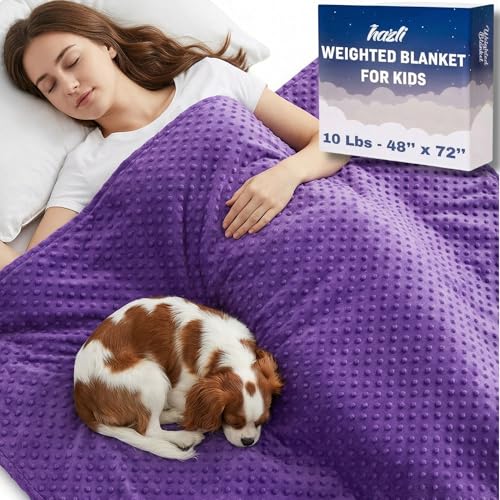
hazli Kids Weighted Blanket (10 lb, 48 x 72 in)
Body Weight First, Bed Size Second
Do not buy by age. Weigh your child, take about 10 percent, and round down. A blanket that is right by weight but wrong by size can still slide off the bed or bunch, so check the dimensions against your child's bed or body too. Let your child help choose the cover or the animal; a product they feel some ownership of is one they will use. And reassess as they grow, because the right weight changes with the child.
Is a Sensory Blanket Even Right for Your Child?
Deep pressure helps many autistic kids, but not all, and forcing it backfires. Introduce any weighted product when your child is calm, not mid-meltdown, and let them opt in. If your child consistently pushes it away, treat that as useful information, because some kids regulate better with other input entirely. Our guides to sensory-friendly activities and building a sensory diet cover the wider menu of calming input, and an occupational therapist can help you read which kind your child seeks. And if the need is deep pressure on the move (transitions, seat work, errands) rather than at rest, that's the weighted vest conversation, which comes with its own wear-time protocol and a more cautious evidence caveat.
The blanket supplies the pressure, while the sensory plan and your OT tell you whether and how it fits. And when your child needs that same calming pressure away from the bed, on a lap in the car or a backpack at school, a weighted stuffed animal is the portable version they will carry. If the blanket runs too hot or gets kicked off, a compression sheet delivers the same all-night hug without loose weight; our guide to compression and deep-pressure products covers that alternative and the rest of the deep-pressure toolkit. And for a child who seeks that pressure through movement rather than lying still, a body sock gives them a stretchy sack to push against.
Products Mentioned in This Article
yescool Kids Weighted Blanket (5 lb, Cooling)
MAXTID Kids Weighted Blanket (5 lb, Cotton)
yescool Kids Weighted Blanket (7 lb, Cooling)
Harkla Kids Weighted Blanket (7 lb, Washable Cover)
hazli Kids Weighted Blanket (10 lb, 48 x 72 in)
Prices and availability are accurate as of the date/time shown and are subject to change. Any price and availability information displayed on Amazon at the time of purchase will apply to the purchase of this product.
Sensory overwhelm shows up differently in every child.
Beacon learns about YOUR child and gives guidance specific to them.
What Would Beacon Say?
"What sensory strategies actually work for my child?"
Beacon factors in your child's specific sensitivities (sound, light, texture, movement) and current regulation, then builds a sensory plan you can start tonight.
Spectrum Unlocked Editorial Team
Editorial Team
The Spectrum Unlocked editorial team combines lived experience as autism parents with research-backed guidance to create resources families can trust.
Frequently Asked Questions
- How heavy should a weighted blanket be for a child?
- The widely used guideline is about 10 percent of the child's body weight. For a 50-pound child that is roughly a 5-pound blanket. It is safer to round down than up, so if your child is between sizes, choose the lighter one and see how they respond. Heavier does not mean more effective, and a blanket that is too heavy for your child to move on their own is a safety problem. An occupational therapist can help you fine-tune the weight for your specific child.
- Are weighted blankets safe for autistic kids?
- They can be, with the right size and supervision, but safety comes first. The core rule is that a weighted blanket is only appropriate once a child can independently push it off and move out from under it. A blanket your child cannot remove on their own poses a suffocation and entrapment risk. They are not safe for babies or toddlers. Use the roughly 10-percent weight guideline, never let the blanket cover the face or head, and check with your pediatrician or occupational therapist before starting, especially if your child has any breathing, circulation, or seizure condition.
- What age can a child use a weighted blanket?
- Most pediatric and occupational-therapy guidance puts it at around age 3 and up, and only once the child can independently remove the blanket, with no use for children under 2 under any circumstances. Age stands in for the real test, which is whether your child can reposition and free themselves. A cautious developmental fit and your OT's input matter more than a birthday.
- Do weighted blankets actually help with autism?
- Many autistic kids and their families report that the deep pressure feels calming and organizing, and deep-touch pressure is a well-established occupational-therapy strategy. That said, the formal research, especially on improving sleep, is mixed rather than conclusive. So a reasonable expectation is that a weighted blanket may help your child wind down and feel regulated, while not being a guaranteed fix for sleep on its own. Pair it with a calm, predictable bedtime routine.
- Weighted blanket, lap pad, or weighted stuffed animal, which should I get first?
- For many families a lap pad or a weighted stuffed animal is the smarter first purchase. They are lighter, a child can easily lift them off, and they work in places a blanket cannot, like a classroom, the car, or the dinner table. A full weighted blanket is best for bedtime wind-down once you know your child likes deep pressure and can manage the blanket safely. Starting small lets you test whether deep pressure helps before investing in a blanket.
- Can my child sleep with a weighted blanket all night?
- Only if your child can independently move it off themselves and an OT or pediatrician has signed off. Even then, some families use a weighted blanket only for the wind-down period before sleep rather than all night, and remove it once the child is settled. Watch for overheating and never tuck or secure the blanket so that your child cannot get out from under it.