ABA Parent Training Handouts a BCBA Can Actually Use
Parent training is billable, but the materials rarely exist. Free printable handouts for ABA caregiver training sessions, matched to the goal you are teaching, plus what makes a handout survive contact with a real family.
Key Takeaways
- Parent training fails on materials more often than on content. A caregiver who leaves with a verbal explanation and no artifact has nothing to work from on Tuesday night, which is why the handout is not an afterthought to the session but most of what survives it.
- Match the handout to the training target, not to the diagnosis. A parent working on transitions needs a first-then board; a parent working on requesting needs picture cards. Handing over a general autism packet is how a training goal quietly becomes a reading assignment.
- One page beats a packet. Caregiver training competes with everything else in a family's week, and a single sheet that lives on the fridge outperforms a twenty-page binder that lives in a drawer.
- The handout should be editable before it prints. A generic sheet asks the family to translate the example into their own child; a sheet carrying the child's actual routine, targets, and reinforcers asks them only to follow it.
- Write the parent training goal so the data can be taken. If the goal says the caregiver will implement the procedure with 80 percent fidelity across three consecutive sessions, something has to record fidelity, and that something is a treatment integrity sheet, not memory.
Parent training sits in almost every authorization, gets its own goals, and is billed as its own service. What it usually does not have is materials. Most BCBAs end up building caregiver handouts the night before, in a word processor, from scratch, for the fourth time this month.
The gap is not knowledge. It is that clinical training covers what to teach a caregiver and says almost nothing about what to hand them at the end. So the session ends with a good explanation and no artifact, and the procedure that made sense in the living room on Thursday is gone by Tuesday.
Here is the shape that works, matched by what you are actually teaching:
- Transitions and routine compliance: a first-then board and a picture schedule of that family's real evening
- Requesting and functional communication training: picture cards or a core vocabulary board, built from the child's own motivators
- Behavior reduction goals: a one-page ABC or frequency sheet a caregiver can fill in without a measurement lesson
- Daily living and self-care: a task analysis written in the steps that household actually uses
- Reinforcement systems: a token board with the exchange rule written on the board itself
- Your own documentation: a treatment integrity sheet, so caregiver fidelity is recorded rather than remembered
Every one of those is free to make and print on Spectrum Unlocked, and the whole set sits together on the ABA therapy resources hub.
Match the handout to the training goal, not to the diagnosis
The most common materials mistake is handing a family a general autism packet. It feels generous and it is close to useless, because it asks the caregiver to work out which four pages apply to the goal you just wrote.
| Parent training target | What the caregiver needs in hand | Where to build it |
|---|---|---|
| Following the evening routine without escalation | Picture schedule of that family's actual sequence | Visual Schedule Creator |
| Getting through a non-preferred task | First-then board with a real reinforcer on it | First-Then Board Maker |
| Requesting instead of grabbing or screaming | Picture cards or a core board, and a story that rehearses asking quietly | PECS Card Maker, AAC Core Board Maker, quiet voice social story |
| Offering choices to reduce demand escalation | Choice board with the options the family owns | Choice Board Maker |
| Delivering reinforcement on a schedule | Token board with the exchange rule printed on it | Token Board Maker |
| Recording what happens before a behavior | One-page ABC sheet | ABC Data Sheet |
| Teaching a self-care routine step by step | Task analysis sheet in the family's own steps | Task Analysis Sheet |
| Preparing the child for something new | A short social story in the child's own words | Social Story Maker |
The column that matters is the middle one. A first-then board with a stock picture of broccoli and a cartoon television is a worksheet. A first-then board showing the actual bathtub and the actual iPad is a tool the family will use, and the difference is about ninety seconds of editing before you print.
One page, not a packet
Caregiver training competes with work, siblings, appointments, and exhaustion. A single sheet that goes on the fridge gets run; a bound packet gets filed with the evaluation reports.
That constraint is worth taking seriously when you plan the session, because it forces a decision you should be making anyway: what is the one procedure this caregiver is leaving with? Families given six new procedures reliably run none of them. Families given one, with an artifact, often run it.
If the goal genuinely needs more than a page, split it across sessions rather than across pages.
Run the rehearsal, not just the explanation
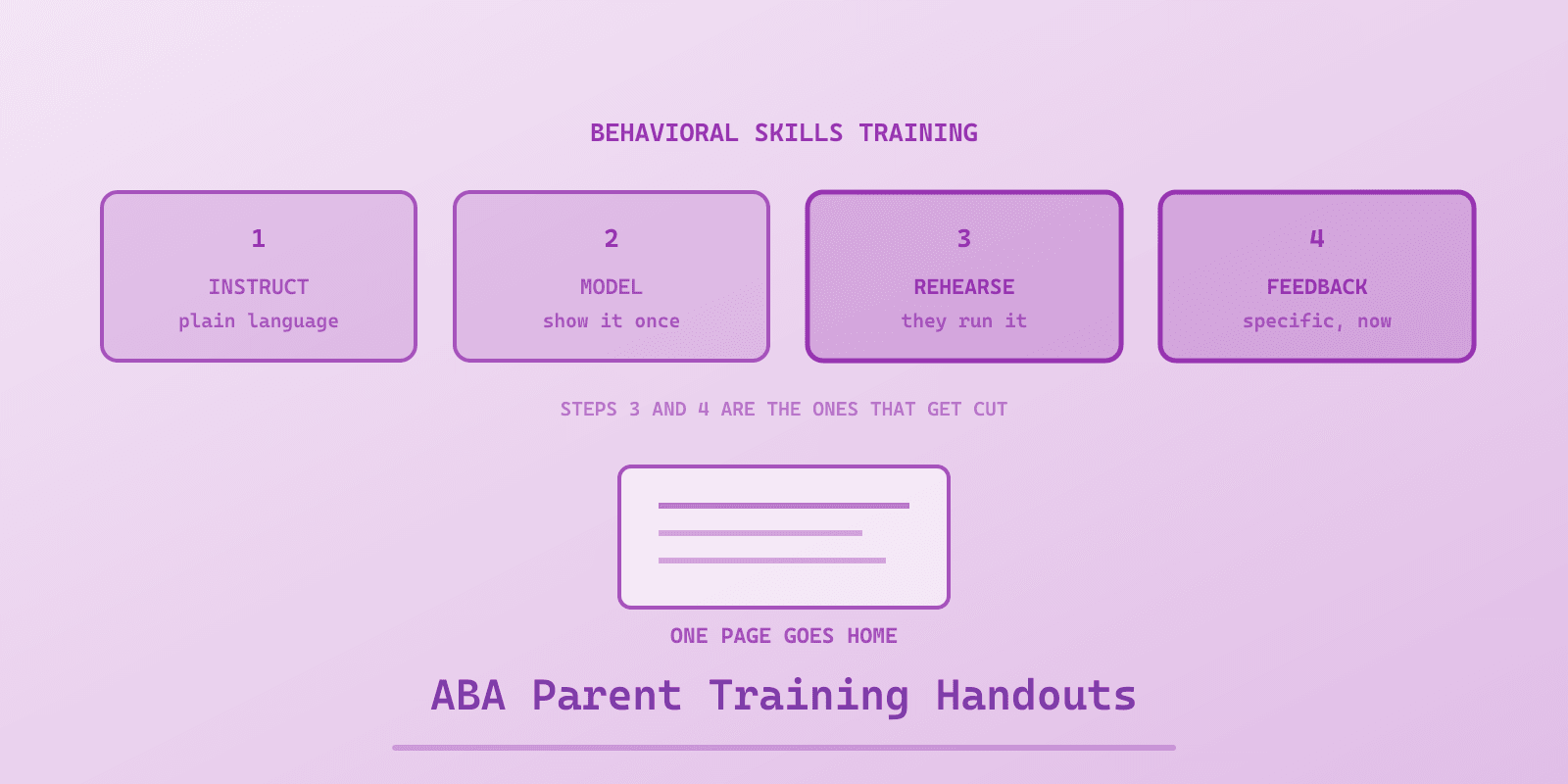
Behavioral skills training is four steps, and under time pressure the last two are the ones that get cut:
- Instruction. Explain the procedure and why it is being used, in plain language, without the technical vocabulary.
- Modeling. Show it, with the child if that is appropriate, or in role play if it is not.
- Rehearsal. The caregiver runs it while you are still in the room. This is the step that turns understanding into a skill.
- Feedback. Specific and immediate, naming what they did rather than what they should have done next time.
Skipping rehearsal is what produces the familiar pattern where a caregiver nods through the whole session and then reports the next week that it did not work. They were not resistant. They had never actually done it once.
The handout supports step 3 and step 4 more than it supports step 1. Its job is to be on the table during the rehearsal, and on the fridge afterward.
Write the goal so the data can be taken
A parent training goal describes the caregiver's behavior. That sounds obvious and it is routinely written the other way.
Compare:
- Not measurable: the parent will understand reinforcement strategies
- Measurable: the caregiver will deliver reinforcement within five seconds of the target response, with at least 80 percent procedural fidelity, across three consecutive observed sessions
The second version tells you what to teach, what to watch, and what to write down. It also tells you that something has to record fidelity, which is where a treatment integrity sheet earns its place. Fidelity recalled at the end of a session is not fidelity data, and a payer reviewing caregiver training units is entitled to ask what the 80 percent was measured against.
For the goal itself, the IEP Goal Builder writes measurable objectives in this shape, and the goal-page and progress-monitoring templates on the ABA therapy resources hub carry the recording side.
What a caregiver should never be handed
Two things belong to the clinician and not to the family:
Function. Deciding why a behavior is happening is assessment work. A caregiver can record what happened before and after; they should not be asked to conclude that the behavior is maintained by escape and then design around that conclusion.
Restrictive procedures. Anything that restricts should be reviewed on a schedule by the team that wrote it, and should not be taught as a home strategy in a training session.
The distinction is worth naming out loud in the session, because families frequently assume that anything explained to them is theirs to modify. Telling a caregiver which parts are theirs to adjust, and which parts should not move without a conversation, prevents a lot of drift between visits.
Documenting it so the units survive review
Caregiver training is authorized separately, so it is reviewed separately. A note that reads discussed reinforcement with mother does not describe a service. A defensible note names the caregiver goal being addressed, what was modeled, that the caregiver rehearsed it, the fidelity observed, and what was left with the family.
That last clause is the one most often missing, and it is the easiest to fix: if the handout is generated with the child's name and targets on it, the note can say exactly what went home.
Whether parent training hours are covered, and how many, depends on the payer and the state. Coverage rules for autism services vary widely, and Spectrum Unlocked's state-by-state autism benefits comparison covers what each state mandates before you assume a family's plan includes caregiver units.
Where to start
If you are building a caregiver training library rather than a single session, the order that pays off fastest is:
- A first-then board and a visual schedule, because transitions appear in most families' first goal
- An ABC sheet, because it is the recording task most caregivers are asked for first
- A task analysis, because self-care goals are where families feel progress soonest
- A treatment integrity sheet for your own fidelity data
All four are free to build and print, with no account, from the ABA therapy resources hub. If you want the reasoning behind which data sheet fits which measurement question, ABA data collection methods compared sets frequency, duration, latency and interval recording side by side, and the ABC data sheet guide covers the antecedent-behavior-consequence format specifically. For self-care goals, task analysis in ABA covers writing the step list in the family's own sequence rather than handing them a generic one.
Parent training is the part of an ABA program most likely to keep working after the authorization ends, because it is the only part that lives with the family. The materials should be built to survive that.
The data is the easy part. The write-up is what takes the evening.
Beacon remembers your caseload and your setting, so you are not re-explaining them every time.
What would Beacon say?
"Help me set up data collection for this goal"
Beacon takes the goal you are already running, suggests the measurement that actually fits it, and drafts the note that has to follow.

Spectrum Unlocked Editorial Team
Editorial Team
The Spectrum Unlocked editorial team combines lived experience as autism parents with research-backed guidance to create resources families can trust.
Frequently asked questions
- What handouts should a BCBA use for ABA parent training?
- Match the handout to the training target rather than to the diagnosis. For transitions and routine compliance, a first-then board and a visual schedule. For requesting and functional communication training, picture cards or a core vocabulary board. For behavior reduction goals, a simple ABC or frequency sheet the caregiver can complete without training in measurement. For daily living targets, a task analysis broken into the steps that family actually uses. The common requirement is that the caregiver can use it the same evening without a second explanation.
- Is ABA parent training billable?
- Caregiver training is a distinct billable service under most payers, commonly billed separately from direct therapy, and many authorizations include a specific number of caregiver training units. Because it is authorized separately, it is also reviewed separately, which is why the documentation matters as much as the session: a payer reading the note wants a stated caregiver goal, evidence the caregiver practiced, and a measure of how well they performed. Requirements vary by payer and state, so verify against the specific authorization rather than a general rule.
- How do you write a parent training goal in ABA?
- Write it about the caregiver's behavior, not the child's. A usable goal names who does what, under which conditions, to what standard: the caregiver will implement the three-step prompting sequence during the evening routine with at least 80 percent procedural fidelity across three consecutive observed sessions. That phrasing tells you what to teach, what to observe, and what to record. A goal phrased as the parent will understand reinforcement cannot be measured and cannot be defended in a review.
- Why does parent training so often fail?
- Usually because the session was an explanation rather than a rehearsal. Behavioral skills training works because the caregiver watches the procedure, tries it while the clinician is still in the room, and gets feedback before leaving. Skipping the rehearsal turns training into a lecture, and the caregiver then attempts an unfamiliar procedure alone, during the hardest part of the day, with no artifact to check against. The second common cause is volume: a family given six new procedures reliably runs none of them.
- What is BST in ABA parent training?
- Behavioral skills training, a four-part teaching sequence: instruction, modeling, rehearsal, and feedback. Applied to a caregiver, that means explaining the procedure, demonstrating it with the child or in role play, having the caregiver run it while you watch, and giving specific feedback on what they did. The rehearsal and feedback steps are the ones most often dropped under time pressure, and they are the two that make the difference between a caregiver who can describe a procedure and one who can run it.
- Can parents use these materials without a BCBA?
- The printables are free for anyone, and a parent can absolutely use a visual schedule or a first-then board on their own. What a parent should not do alone is design a behavior reduction program from them. Assessing why a behavior is happening, and writing a plan around that function, is clinical work that belongs to a qualified professional. These materials support a program and a family's routines; they do not substitute for assessment, supervision, or a treatment plan.