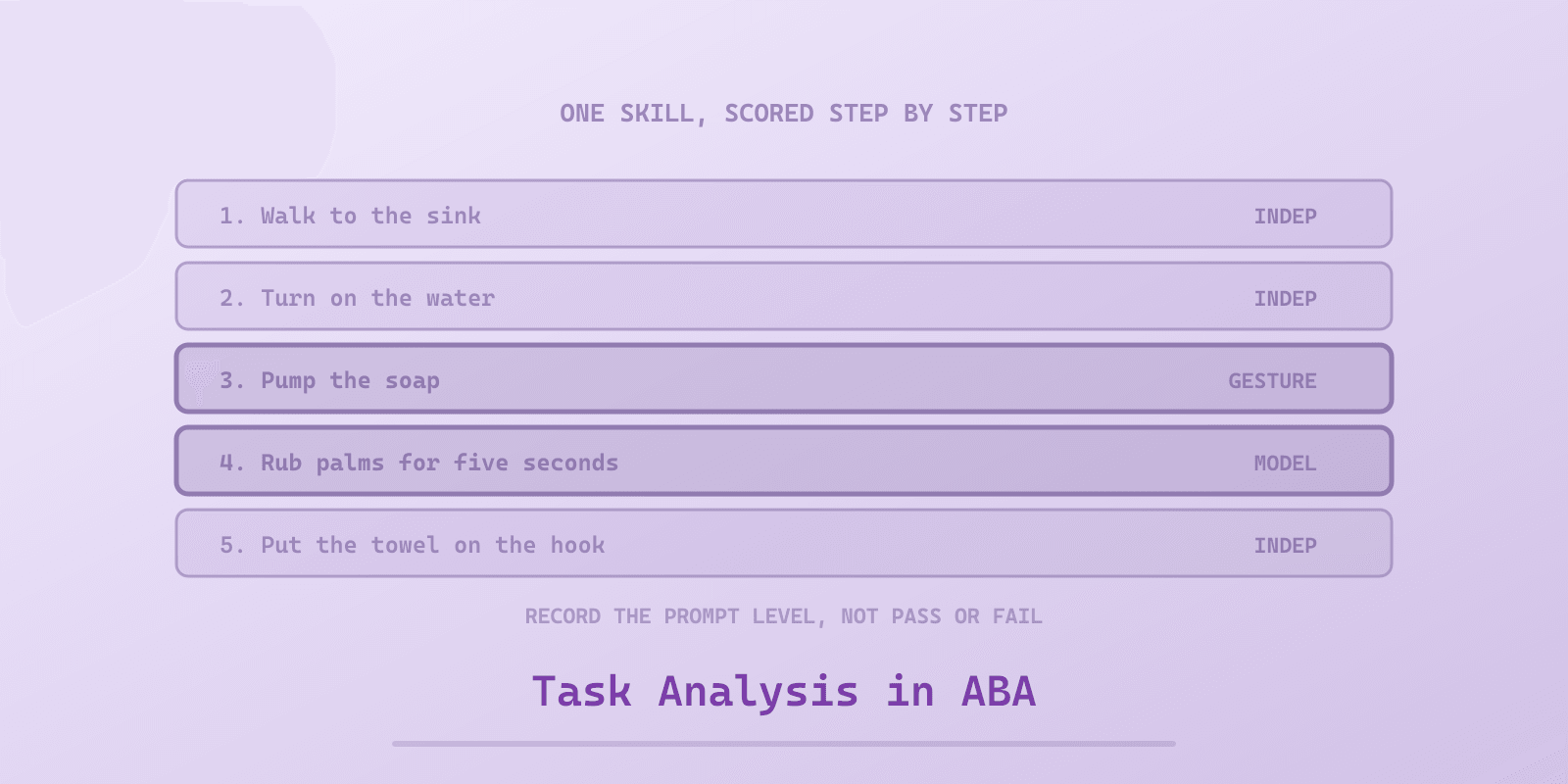
Task Analysis in ABA: Breaking a Skill Into Teachable Steps
How to break a skill into steps a learner can actually be taught, how many steps is the right number, forward and backward chaining explained, and a free printable task analysis sheet you can build for your own routine.
Key Takeaways
- A task analysis is a list of the steps one specific learner needs, in the order their household or classroom actually does them. Copying a generic step list is the most common reason a task analysis stops working in week two.
- The right number of steps is decided by the learner, not by the skill. Split any step where the learner reliably stalls, and merge steps they already chain together without help.
- Write each step as an observable action a second person could score the same way. If two staff would disagree about whether a step was completed, the step is written wrong, not scored wrong.
- Backward chaining teaches the last step first so the learner finishes the routine every single time, which is why it usually suits skills where the natural reinforcer sits at the end.
- Baseline the whole chain before teaching it. Watching the learner attempt every step once tells you where the actual gaps are, and it routinely shows that two or three steps are the problem rather than the whole routine.
A task analysis is a skill cut into steps small enough to teach and score one at a time. Handwashing becomes eight steps. Packing a school bag becomes six. The learner stops being someone who "can't do the morning routine" and becomes someone who does eleven of thirteen steps independently and needs help with two.
That reframe is most of the value. The other part is that it tells you exactly where to teach.
The build order is short:
- Do the routine yourself and write down what you actually did, in that setting, in that order
- Baseline it: ask the learner to do the whole chain once, prompting only to keep it moving, and score every step
- Split the steps they stall on, merge the ones they already run together
- Pick a chaining method: forward, backward, or total task
- Score prompt level per step, not pass or fail
- Stop changing the step list once teaching begins, or the data cannot be compared
You can build and print the sheet for any routine from the free Task Analysis Data Sheet, with your own steps on it rather than a stock list.
Write the steps for this learner, in this house
The most common failure is a downloaded step list. Generic task analyses read plausibly and then fall apart, because the sequence in the document is not the sequence in the room.
A real handwashing chain depends on whether the tap is a lever or two separate handles, whether the soap is a pump or a bar, and whether the towel is on a hook the learner can reach. Get any of those wrong and the learner fails a step that does not exist in their bathroom. The same goes for the pictures: the hand washing visual schedule is a starting sequence from the sink to drying off, and any picture in it can be swapped for a photo of the learner's own tap, soap and towel.
So write the list by doing the routine in the actual setting. It takes four minutes and it is the difference between a sheet that works and a sheet that gets abandoned.
Make every step observable
Each step should be an action a second person could score the same way without asking you what you meant.
| Written poorly | Written well | Why |
|---|---|---|
| Get ready to wash hands | Walk to the sink | Observable, single action |
| Wash properly | Rub palms together for five seconds | Scorable, has a stated standard |
| Clean up | Put the towel on the hook | One action, clear endpoint |
| Turn on water and wet hands | Turn on the water / Put hands under the water | Two actions need two steps |
The bundled-step problem in the last row is the sneaky one. When a step contains two actions, a learner can do one and not the other, and whoever is scoring has to guess. Two staff guessing differently is how a program produces data that says nothing.
A quick test: hand the list to someone who has never met the learner and ask if they could score a session from it without asking you a single question.
How many steps is right
There is no correct length, and two task analyses of the same skill can honestly differ. The number of steps is a property of the learner.
- Split any step where the learner reliably stalls. If "put on the shirt" fails every time, it is probably three steps: gather the hem, head through the neck hole, one arm then the other.
- Merge steps the learner already performs as one motion. Listing them separately adds scoring work and shows no useful detail.
This is also why the baseline matters. Watching the learner attempt the whole chain once, before any teaching, usually reveals that the routine is not the problem: two or three specific steps are, and the rest are already there.
Choosing a chaining method
Forward chaining teaches step one to mastery while prompting the rest, then step two, and onward. It suits routines where the early steps are the hard ones, and it gives a clear teaching focus each session.
Backward chaining teaches the last step first, prompting everything before it, then works backward. Its advantage is that the learner completes the routine on every attempt from day one and contacts whatever naturally reinforces it at the end, which matters for chains that end in something the learner wants.
Total task presentation runs every step every time with prompting as needed. It suits learners who can already do part of the chain and need practice across the whole sequence rather than isolated drilling.
None of the three is better in general. Backward chaining is often the right first choice for self-care routines whose payoff sits at the end, and total task is often right when a baseline shows the learner already has most of the steps.
Record prompt level, not pass or fail
Scoring each step as done or not done throws away most of the information. A learner who needed hand-over-hand help on step four last month and now needs only a gesture has made real progress, and a yes or no column shows none of it.
Record the level of help instead: independent, verbal, gestural, model, partial physical, full physical. That is what makes a plateau readable, because a chain stuck at 60 percent independent looks flat until you notice the prompts behind those steps have moved two levels.
The Prompt Level Data Sheet records the fading side directly if prompt level is the dimension the goal names. Which measurement fits which goal is covered in ABA data collection methods compared.
Stop editing the list once teaching starts
Task analyses get quietly revised. A step gets reworded, two get merged, someone adds one that was always assumed. Each edit is reasonable and the cumulative effect is that this month's 70 percent cannot be compared with last month's 55 percent, because the denominator changed.
Get the list right during baseline, then freeze it. If it genuinely has to change, mark the date and treat the following sessions as a new baseline rather than a continuation.
Where the printable sheets live
Task analysis sits alongside the other measurement systems on the ABA therapy resources hub, all free to build and print with no account. If the routine also needs a visual for the learner rather than a scoring sheet for the adult, the Visual Schedule Creator turns the same step list into pictures, and the Routine Builder adds timing and transition warnings. For a home routine that has already been broken into steps, the Home Organization Task Boxes print five four-step routines, sheets, plants, the bathroom counter, as cut-apart cards a learner sequences onto a numbered mat, which is total task presentation in a box. A seasonal outdoor chore breaks down the same way: Fall Yard and Porch Chores prints raking leaves and porch cleanup as six-step chains, each with a look-and-decide step for the judgment call and a self-check strip, and its free raking sample is one full routine as it prints. Holiday routines break down the same way for younger learners: Christmas Sequencing Cards print each routine, from decorating the tree to making a card, as picture cards with a short sentence that a child cuts apart and orders on a strip, with a shorter, gentler version of each. In November the same breakdown fits Thanksgiving sequencing activities, where setting the table runs tablecloth, plates, napkins and then dinner, and each step leaves something the next card needs. The same frozen-list principle runs through three daily routine packs. The Morning Routine, Alarm to Door is a nine-step chain with a data sheet that scores every step across five dated columns, and its free morning routine checklist is the chain as it prints. Bedroom and Personal Space Routines keeps its bed-making chain at six steps and puts the fold on an extension card outside the numbered list, so adding it later does not change the denominator; the free make your bed sample is the chain and its three-point check. Pet Care Routines runs feeding and walking as chains that end on handwashing, a last step many learners already have, which lets a backward chain finish independently from the first session, and the free dog feeding sample is one full routine. All three chains, with the hygiene, cleaning and laundry and weather dressing packs written the same way, one action to a step, are the six packs in the Daily Living Routines Bundle.
If a family is running the routine at home between sessions, the step list should go with them: ABA parent training handouts covers what makes a handout a caregiver can actually follow.
The data is the easy part. The write-up is what takes the evening.
Beacon remembers your caseload and your setting, so you are not re-explaining them every time.
What would Beacon say?
"Help me set up data collection for this goal"
Beacon takes the goal you are already running, suggests the measurement that actually fits it, and drafts the note that has to follow.

Spectrum Unlocked Editorial Team
Editorial Team
The Spectrum Unlocked editorial team combines lived experience as autism parents with research-backed guidance to create resources families can trust.
Frequently asked questions
- What is a task analysis in ABA?
- A task analysis is a complex skill broken into a sequence of smaller, observable steps that can be taught and scored one at a time. Handwashing, getting dressed, making a sandwich, and packing a bag are all routinely taught this way. The point is not documentation for its own sake: splitting the skill lets you see exactly which step the learner cannot do, teach that step specifically, and record progress on the parts rather than waiting for the whole routine to succeed.
- How many steps should a task analysis have?
- As many as that learner needs, which is why two task analyses for the same skill can legitimately look different. A learner who struggles with a particular part needs that part split further, and a learner who already performs three actions as one fluid movement does not need them listed separately. A useful check is to run the chain once and watch: any step where the learner consistently stalls should be split, and any run of steps they complete without a pause can usually be merged.
- What is the difference between forward and backward chaining?
- Forward chaining teaches step one to mastery while the remaining steps are prompted, then adds step two, and so on. Backward chaining teaches the final step first, with the earlier steps prompted, then works backward. Total task presentation teaches every step in each attempt with prompting as needed. Backward chaining has a practical advantage for routines whose reinforcer sits at the end, because the learner completes the routine and contacts that natural reinforcer on every single trial from the first day.
- How do you write task analysis steps correctly?
- Write each step as something observable that a second person could score identically. Turn on the water is scorable; get ready to wash is not. Avoid steps that bundle two actions, because a learner can complete half of one and there is no honest way to score it. A good test is to hand the list to a colleague who has never seen the learner and ask whether they could score today's session from it without asking you a question.
- How do you take data on a task analysis?
- Score each step in each attempt, usually as independent, prompted at some level, or not completed. Recording the prompt level rather than a simple yes or no is what shows movement, because a learner going from full physical help to a gesture on step four has made real progress that a pass or fail column erases. Percentage of steps completed independently is the usual summary, and it becomes meaningful once the step list has stopped changing.
- What skills work well with task analysis?
- Any routine with a stable sequence: handwashing, toothbrushing, dressing, toileting, making a simple snack, packing a school bag, doing laundry, or a classroom arrival routine. It suits skills where the order matters and the learner needs the same sequence every time. It fits less well for open-ended or socially variable skills like conversation, where there is no fixed correct order and a rigid step list would teach a script rather than a skill.